
Length
InferredAbout 1.3 m; museum reference
The museum does not specify a fossil individual, age or reconstruction method. This is not a measured adult or species range. [D2]
TWO WAYS TO PICTURE THE PAST
Compare the evidence with the familiar movie image. The illustrations are not to a shared scale.
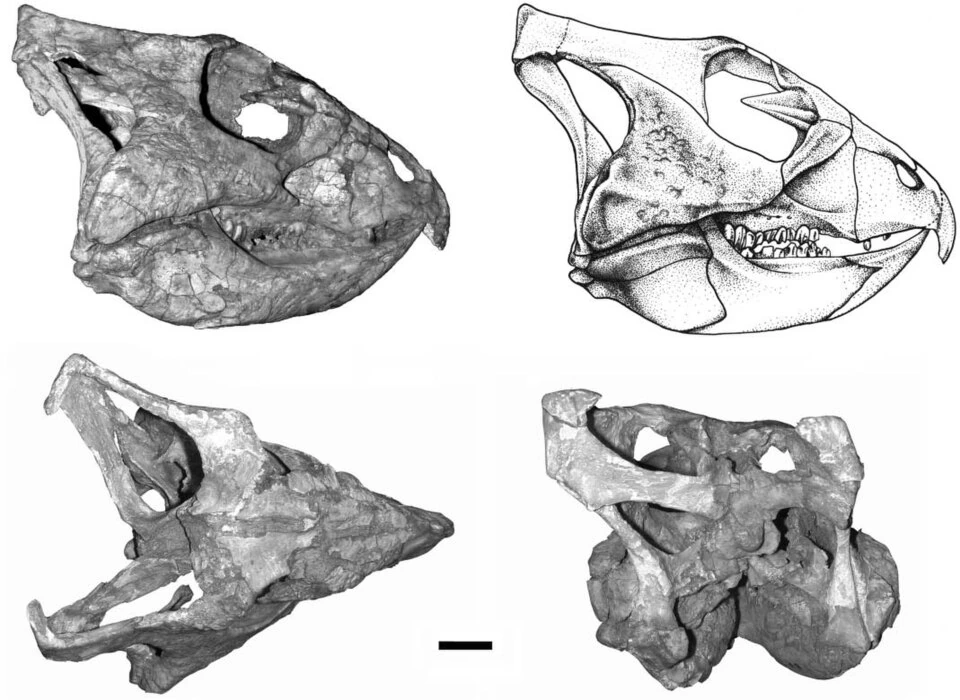
Published views of the A. oshimai holotype, IVPP V11114. Outlines include reconstruction; missing frill details remain uncertain. Fossil coloration does not establish living colors or soft tissues. [1]
Archaeoceratops.jpg · Hai-Lu You and Peter Dodson. CC BY 2.0. Proportionally resized Commons preview and converted to WebP; no anatomy edits.
The photograph or figure shows the credited fossil material; displayed mounts and labels can include interpretation.
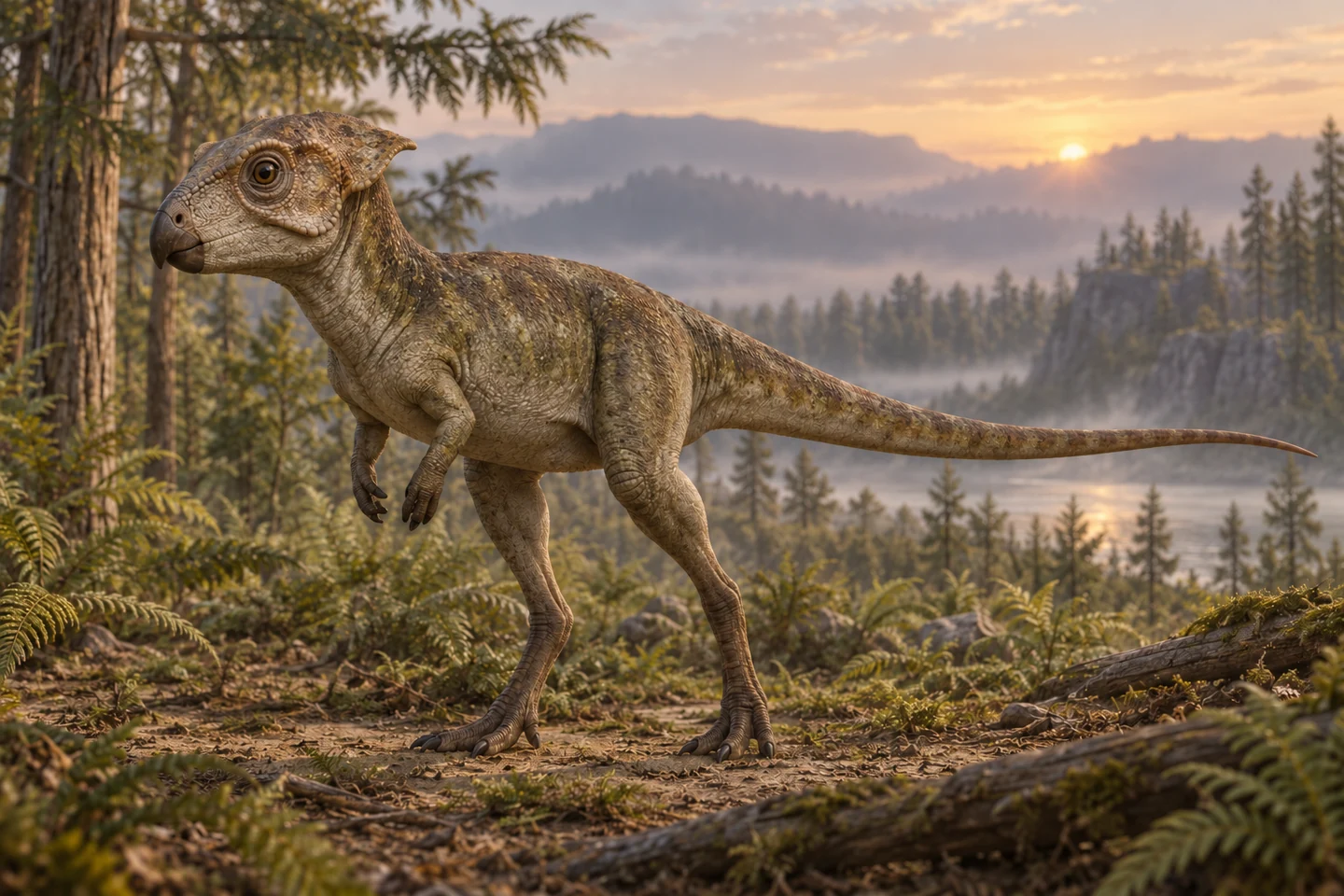
Original cinematic interpretation of Archaeoceratops oshimai. Colors, soft tissues, scenery and missing anatomy are reconstructed artistic choices; this is not a directly observed individual or behavior. The body and living soft tissues are reconstructed; no large horn cores or ceratopsid-style frill are implied. The incipient frill is shown as a restrained backward extension; its complete living outline is reconstructed. Lighting, coloration and scenery are artistic choices. This image does not document a fossil locality or behavior.
Original artwork · artistic interpretation.
Scientific view: source-informed reconstruction, credited paleoart or specimen-based imagery. Movie-style view: Original artistic interpretation. Reconstructions involve uncertainty.
MEET THE ANIMAL
Archaeoceratops was a small plant-eating dinosaur from Early Cretaceous China. It belonged to the early relatives of the familiar large horned dinosaurs, rather than being a miniature version of their final body plan. A museum reference of about 1.3 metres introduces its scale without identifying a measured adult maximum. Small size alone does not settle maturity. [D2]
Comparative work treats Archaeoceratops as generally moving on its hind legs. That is a reconstructed posture from anatomy, not a directly observed walking sequence or a measured speed. It highlights a useful difference within the wider ceratopsian group: the heavy, four-legged outline of later members should not simply be copied backward onto every earlier relative. [D5]
Its genus includes more than one species from the Mazongshan region. Geological work distinguishes Archaeoceratops oshimai from Archaeoceratops yujingziensis and keeps their settings separate. Correlating the rock layers still involves uncertainty. A species name and a fossil locality are therefore part of the evidence, not interchangeable labels. Combining their measurements or deposits would create a profile more uniform than the actual discoveries justify. [D3]
PREHISTORIC ANIMAL DOSSIER
The animal, the evidence, and the questions still open.
Its large eye sockets and short frill preserve an early combination of ceratopsian features; much of its skeleton remains incomplete. [D1]
Profile scope: Primarily A. oshimai, represented by holotype IVPP V11114 and the smaller, incomplete paratype V11115. [D1]
Source supported identifies a description documented by the cited source. Inferred marks a reconstruction or functional estimate. Debated marks competing interpretations. Not established means the sources reviewed for this dossier do not support a firm conclusion; it does not mean a behavior never occurred.
A size reference is an estimate, not a population range. Nesting evidence does not by itself establish courtship, mate choice, or lifelong pairing.
About 1.3 m; museum reference
The museum does not specify a fossil individual, age or reconstruction method. This is not a measured adult or species range. [D2]
About 9 kg; holotype-scaled model
Paul models IVPP V11114 using reconstructed volume and estimated limb scaling. Incomplete skeleton; maturity unconfirmed. [D6]
Plant eater
The museum classifies it as herbivorous. The beak and cheek teeth indicate food processing, but no reviewed evidence establishes its preferred plants. [D2]
River-associated continental deposits
A. oshimai comes from Gongpoquan red beds in Gansu. The 2019 working correlation places them in the early Albian Zhonggou Formation; exact correlations remain uncertain. Depositional setting does not define its preferred microhabitat. [D3]
Probably mainly bipedal
Comparative studies treat Archaeoceratops as a generally bipedal early neoceratopsian; exact stance, speed and gait are reconstructed. [D5]
Hornless skull with a small frill
The type lacks nasal and orbital horns. Premaxillary teeth accompany its beak; eroded parietals leave the complete frill outline uncertain. [D1]
Not established here
The 2003 description interprets sutural closure as approaching adult size. This does not establish reproductive maturity, eggs, nests or parental care. [D1]
Not established here
Reviewed cranial studies do not establish mate choice, display rituals or sex-specific ornamentation. A frill alone cannot identify mating behavior. [D4]
Not established here
The described type and paratype do not provide evidence sufficient to reconstruct herd structure, group size or family associations. [D1]
Sources and inspection notes for the claims in this profile.
THE STORY IN THE FOSSILS
Archaeoceratops combines a cropping beak with a much smaller frill than those of later large horned dinosaurs. Its remains reveal character combinations within early ceratopsian evolution, rather than a confirmed direct ancestor. [1]
The genus includes A. yujingziensis from another Mazongshan setting. Keeping that species separate matters: its size and geological context cannot simply be assigned to A. oshimai. [3]
The dossier identifies the scope of each reference estimate. A mount, an individual fossil and a species-wide adult range are different measurements. Comparison metrics remain unavailable where adult scope has not been established. Unknown does not mean zero.
Sources support the stated claims and scopes. Refer to the evidence notes for uncertainty.
KEEP EXPLORING
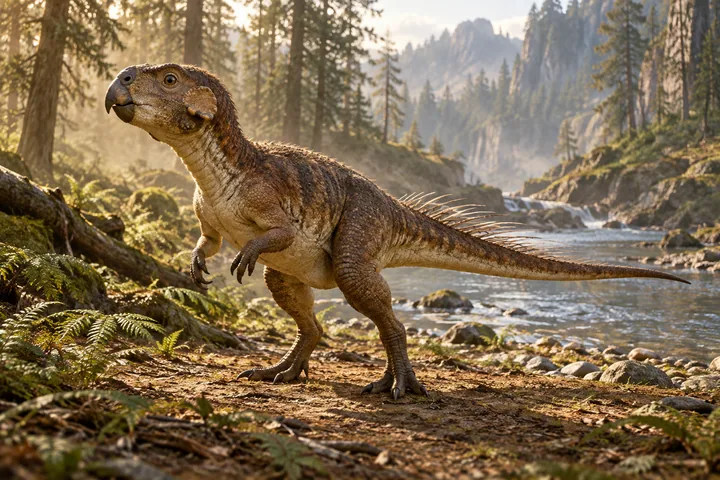
Psittacosaurus
Psittacosaurus was an early ceratopsian widespread in Early Cretaceous Asia. One exceptionally preserved specimen reveals scaly skin, tail bristles and a camouflage pattern.
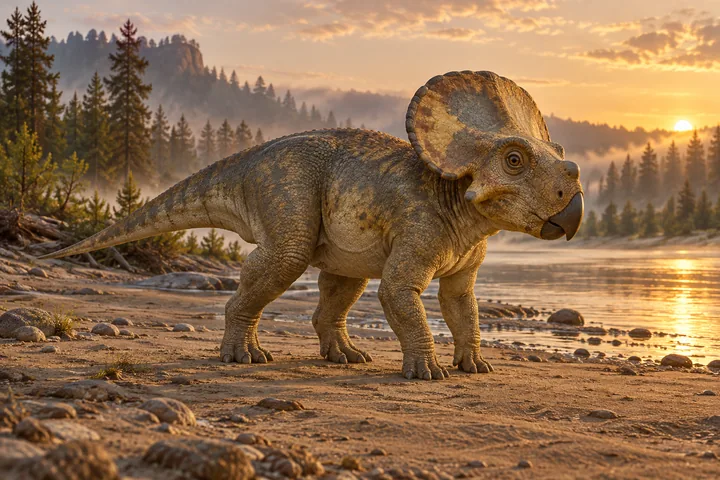
Protoceratops
Protoceratops was a small ceratopsian from Late Cretaceous Asia. A large head and neck frill distinguished it, and one fossil records an encounter with Velociraptor.
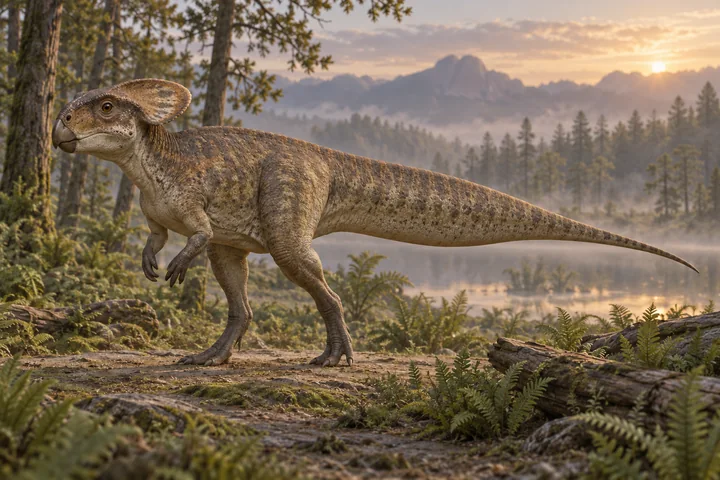
Yamaceratops dorngobiensis
Yamaceratops was a small beaked ceratopsian whose cheek and jaw anatomy records a distinctive early neoceratopsian combination.