Body length
InferredAbout 2 m; genus museum reference
NHM provides this rounded genus reference without specifying which species or individual it represents. [D1]
EXHIBIT 37
Psittacosaurus
A parrotlike beak, cheek projections and bristles on the tail.
TWO WAYS TO PICTURE THE PAST
Compare the evidence with the familiar movie image. The illustrations are not to a shared scale.

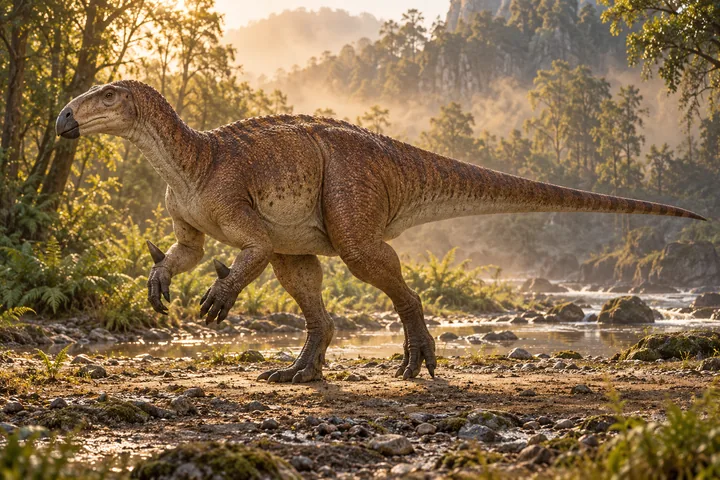
The artist identifies this reconstruction as Psittacosaurus sp. (based on SMF R 4970). This view illustrates one form within the genus, rather than every species or individual. Fossil-informed anatomy: Small ceratopsian with parrotlike beak, cheek projections and short forelimbs; use scaly skin and localized tail bristles based on the exceptional specimen. Specimen is identified only to genus; do not relabel as a named species. Source revision adds patagia and cloacal pigmentation; unpreserved contours remain reconstructed. [1] [2]
Psittacosaurus TD.png — TotalDino. CC BY 4.0. Remote source artwork displayed without additional cropping; Wikimedia supplies any display-size derivative.
Scientific picture served by Wikimedia · internet connection required.
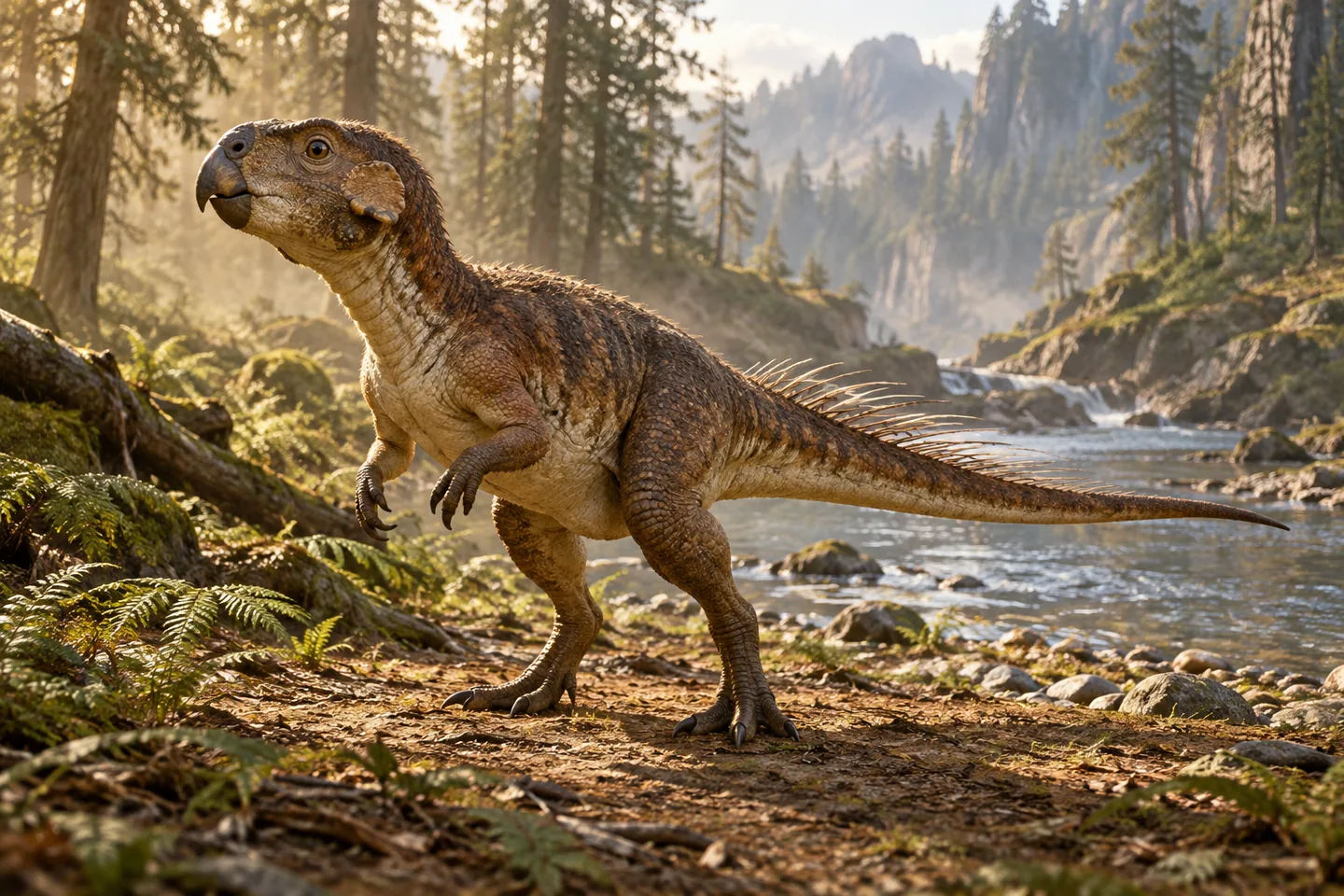
Cinematic Psittacosaurus with parrotlike beak, cheek projections, scaly body, localized long tail bristles and pale underside; compact alert stance in dappled woodland. Dramatic lighting, surface detail and scenery are artistic choices. This is an original cinema-inspired picture, rather than a frame from a film or a documented fossil locality.
Original artwork · artistic interpretation.
Scientific view: credited paleoart interpreting fossil evidence, served online by Wikimedia. Movie-style view: Original artistic interpretation. Colors, soft tissues and settings involve reconstruction.
MEET THE ANIMAL
Psittacosaurus lived in the Early Cretaceous, and Chinese fossils include remarkable groups of young animals. Researchers examined a cluster with juveniles of different ages and interpreted it as evidence that they associated together. Grouping might have helped with protection or feeding, but a mixed-age cluster does not by itself show adults caring for young at a nest. [D2]
Another exceptionally preserved Chinese specimen at the Senckenberg museum has long bristle-like structures on its tail. Laser-based imaging helped researchers show that these were part of the animal's skin covering. They occurred in bundles and covered only part of the tail. This unusual covering provides a glimpse of an animal's surface that most dinosaur skeletons cannot preserve. [S1]
The same museum account describes a darker upper surface and lighter underside in the preserved specimen. Researchers tested a model under different lighting and interpreted the pattern as camouflage suited to shaded woodland. That is evidence about one fossil and a proposed habitat, rather than proof that every Psittacosaurus species shared an identical pattern. Its bristles' exact role also remains an interpretation. [S1]
PREHISTORIC ANIMAL DOSSIER
The animal, the evidence, and the questions still open.
Psittacosaurus was an early ceratopsian with a parrot-like beak. Exceptionally preserved fossils document pigmentation and juvenile associations, but neither feature establishes a genus-wide parenting or mating system.
Profile scope: Genus: Psittacosaurus; juvenile groups and the color-preserved specimen are not assumed to cover all species.
Source supported identifies a description documented by the cited source. Inferred marks a reconstruction or functional estimate. Debated marks competing interpretations. Not established means the sources reviewed for this dossier do not support a firm conclusion; it does not mean a behavior never occurred.
A size reference is an estimate, not a population range. Nesting evidence does not by itself establish courtship, mate choice, or lifelong pairing.
About 2 m; genus museum reference
NHM provides this rounded genus reference without specifying which species or individual it represents. [D1]
About 50 kg; genus museum estimate
The museum supplies a rounded estimate without a species, specimen, growth stage or method. It is not a mass range for every Psittacosaurus species. [D1]
Herbivore; plant material
NHM identifies a beak and plant-based diet. A specific food selection is not established here. [D1]
Woodland inferred for one color-preserved specimen
A pigmentation-based model supports a relatively shaded environment for the studied specimen. That finding should not be generalized to all species and localities. [D3]
Two- or four-legged movement
NHM summarizes the genus as moving on two or four legs. It does not specify the age, species or frequency for each mode. [D1]
Parrot-like beak; preserved color pattern
NHM documents the beak. A separate well-preserved specimen allows a reconstruction of dark upper surfaces and a lighter underside. [D1] [D3]
Not established here
A famous supposed adult with 34 juveniles was identified as a composite, and the larger individual was below breeding age. Reliable juvenile clusters establish association, not a proven parental nest. [D2]
Not established here
The reviewed sources do not establish a mating ritual, pair bond or breeding season for this taxon.
Mixed-age juvenile grouping inferred
One studied cluster contains five approximately two-year-olds and one approximately three-year-old, consistent with association in life. Protection, shared foraging and nest helping are proposed explanations, not established motives. [D2]
Sources and inspection notes for the claims in this profile.
THE STORY IN THE FOSSILS
Psittacosaurus takes its name from its parrotlike beak. It was an early relative of later horned dinosaurs, with projections at the sides of the head. The Natural History Museum records fossils across China, Mongolia and Russia, and describes this genus as a plant eater. [1] [2]
A well-preserved Chinese specimen retains scales, dark pigment patterns and long tail bristles. Researchers reconstructed a darker upper surface above a lighter underside, then tested models under different lighting. The pattern appeared best suited to diffuse forest light, offering a hypothesis about the animal’s habitat. [2]
We have not established a comparable adult total-length estimate for this taxon in this draft. Specimen measurements in the text describe those individuals. The cited dates are approximately 120–100 million years ago. Approximate museum catalogue reference interval for the genus, not an exact duration for every species. Unknown does not mean zero.
Sources and evidence notes for this exhibit.
KEEP EXPLORING
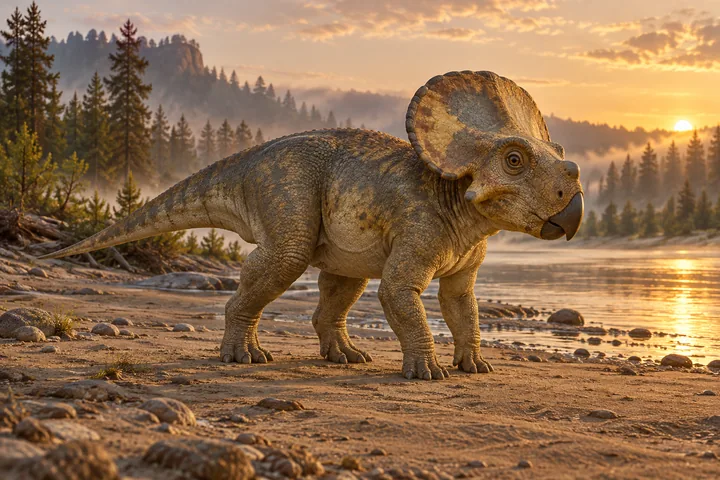
Protoceratops
A beaked herbivore preserved in a struggle with Velociraptor.
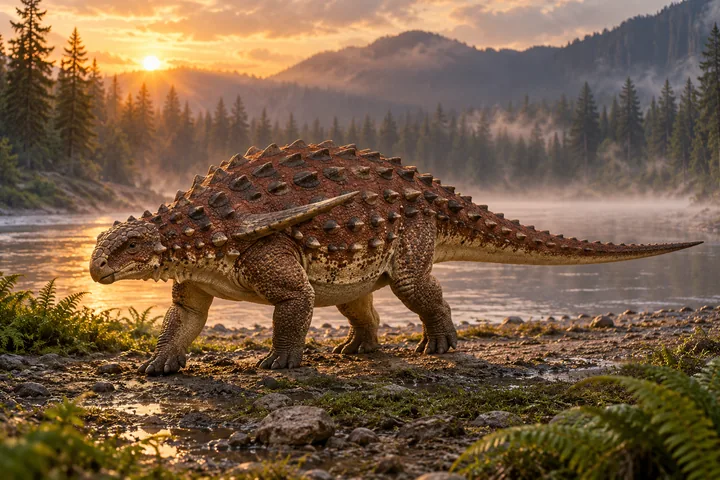
Borealopelta markmitchelli
Preserved skin, armour and a fern-rich last meal.