
Body length
InferredAbout 1.8 m; museum reference
NHM supplies a rounded genus estimate without identifying one specimen or a full species-size distribution. [D1]
EXHIBIT 36
Protoceratops
A beaked herbivore preserved in a struggle with Velociraptor.
TWO WAYS TO PICTURE THE PAST
Compare the evidence with the familiar movie image. The illustrations are not to a shared scale.

The artist identifies this reconstruction as Protoceratops andrewsi. This view illustrates one form within the genus, rather than every species or individual. Fossil-informed anatomy: Low quadrupedal ceratopsian with large beaked head and broad neck frill; modest facial ornamentation, no prominent Triceratops-like brow horns. Colours and soft-tissue contours are artistic interpretation. No accuracy warning appears on the read source page. [1] [2]
Protoceratops andrewsi Restoration.png — PaleoNeolitic. CC BY 4.0. Remote source artwork displayed without additional cropping; Wikimedia supplies any display-size derivative.
Scientific picture served by Wikimedia · internet connection required.
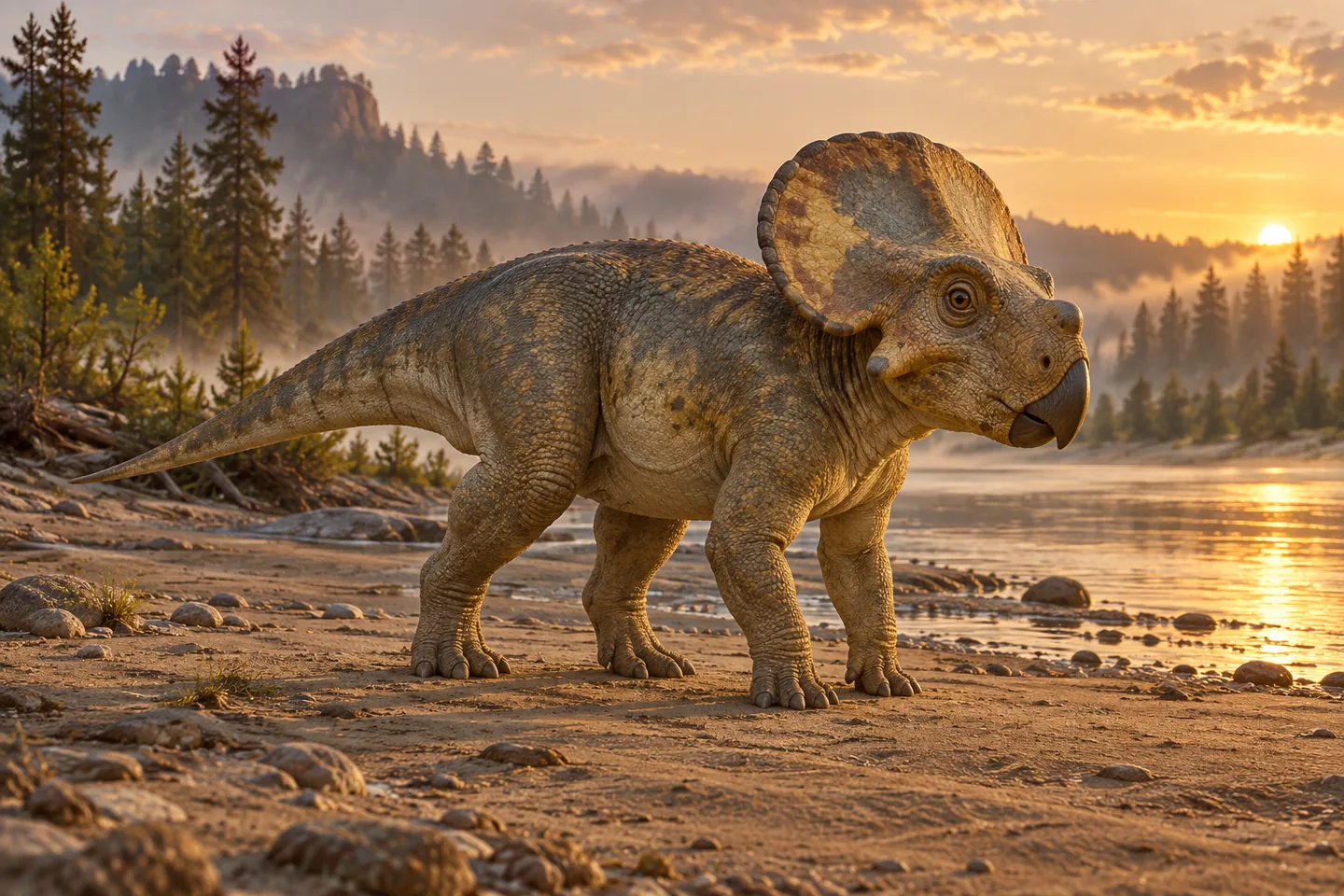
Cinematic Protoceratops, compact quadruped with large beaked head and broad thin frill, subdued facial ornamentation; sturdy silhouette on a sandy Gobi slope. Dramatic lighting, surface detail and scenery are artistic choices. This is an original cinema-inspired picture, rather than a frame from a film or a documented fossil locality.
Original artwork · artistic interpretation.
Scientific view: credited paleoart interpreting fossil evidence, served online by Wikimedia. Movie-style view: Original artistic interpretation. Colors, soft tissues and settings involve reconstruction.
MEET THE ANIMAL
Protoceratops was a heavily built, four-legged dinosaur with a parrot-like beak and a bony frill behind its skull. It lived in Mongolia during the Cretaceous. Its jaws were suited to processing plants. A tiny specimen found at Ukhaa Tolgod in 1997 provides a very different view from an adult skull: its neck frill was still small and undeveloped. [S1]
Young fossils help scientists discover how the animal changed as it grew. The American Museum of Natural History explains that neck vertebrae near the skull became joined with age, adding support for the heavier head. Comparing young and older animals is therefore essential. An adult's impressive frill should not simply be copied onto a hatchling reconstruction. [S1]
A study of skull shape in Protoceratops andrewsi supported a possible social or sexual signaling role for the frill. In plain language, its shape may have helped animals communicate with one another. The study did not find male and female skull forms. A proposed signaling function is therefore different from evidence for a particular courtship display or a reliable way to identify a fossil's sex. [D3]
PREHISTORIC ANIMAL DOSSIER
The animal, the evidence, and the questions still open.
Protoceratops was a small beaked ceratopsian with a developing neck frill. Multiple age-specific fossil associations in one P. andrewsi population support a tendency to gather, while studies of skull growth suggest a signaling role for its frill.
Profile scope: Genus: Protoceratops; grouping and frill studies concern P. andrewsi, with locality limits.
Source supported identifies a description documented by the cited source. Inferred marks a reconstruction or functional estimate. Debated marks competing interpretations. Not established means the sources reviewed for this dossier do not support a firm conclusion; it does not mean a behavior never occurred.
A size reference is an estimate, not a population range. Nesting evidence does not by itself establish courtship, mate choice, or lifelong pairing.
About 1.8 m; museum reference
NHM supplies a rounded genus estimate without identifying one specimen or a full species-size distribution. [D1]
About 400 kg; museum estimate
The museum figure has no stated specimen, life stage or estimation method. It should not be treated as a measured live weight. [D1]
Herbivore; plant material
NHM describes a beak and teeth suited to processing vegetation. Particular plant species are not established here. [D1]
Sandy dune and interdune settings in Mongolia
The grouping study documents aeolian sandstone at Tugrikin Shire. This refers to that P. andrewsi population and does not define the entire genus's habitat. [D2]
Walked on four legs
NHM identifies quadrupedal locomotion. Aquatic swimming or burrowing behavior is not established by this fact. [D1]
Beak, plant-processing teeth and neck frill
The museum documents feeding anatomy; the research tracks major changes in frill shape and size through growth. [D1] [D3]
Possible juvenile nest; parenting unresolved
An earlier 15-juvenile association has been interpreted as a nest, but the grouping study also allows an independent juvenile group. Association alone does not prove adult care. [D2]
Frill signaling supported as a hypothesis
Skull growth and variation fit socio-sexual signaling or mutual mate choice in P. andrewsi. The study did not detect sexual shape dimorphism or establish a specific display ritual. [D3]
Age-restricted grouping in one studied population
Fossil groups support gregariousness across growth stages at Tugrikin Shire. The authors explicitly avoid inferring dominance hierarchies or universal grouping in all populations. [D2]
Sources and inspection notes for the claims in this profile.
THE STORY IN THE FOSSILS
Protoceratops walked on four legs and cropped plants with a beak at the front of its jaws. Teeth behind the beak processed its food. Its unusually large head included a thin bony frill extending across the neck, a characteristic feature of ceratopsian anatomy. [1] [2]
The famous fighting fossil preserves Protoceratops together with an attacking Velociraptor. Other specimens document growth from infants to adults. Paleontologists have proposed that the broad frill made the animal appear larger during competition for mates, linking its striking silhouette with a possible signaling role. [1] [2]
We have not established a comparable adult total-length estimate for this taxon in this draft. Specimen measurements in the text describe those individuals. The cited dates are approximately 74–70 million years ago. The NHM catalogue gives approximately 74–70 Ma; the cited older AMNH display gives 85–80 Ma. The catalogue interval is used as the genus reference. Unknown does not mean zero.
Sources and evidence notes for this exhibit.
KEEP EXPLORING
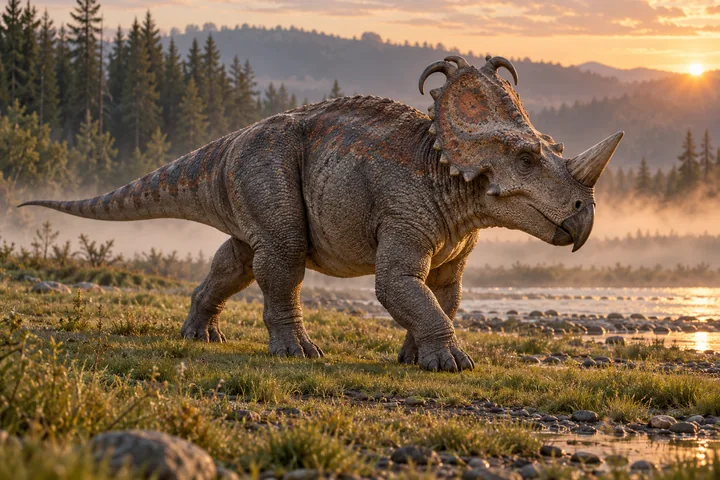
Centrosaurus
A single nose horn — and a fossil that preserves bone cancer.
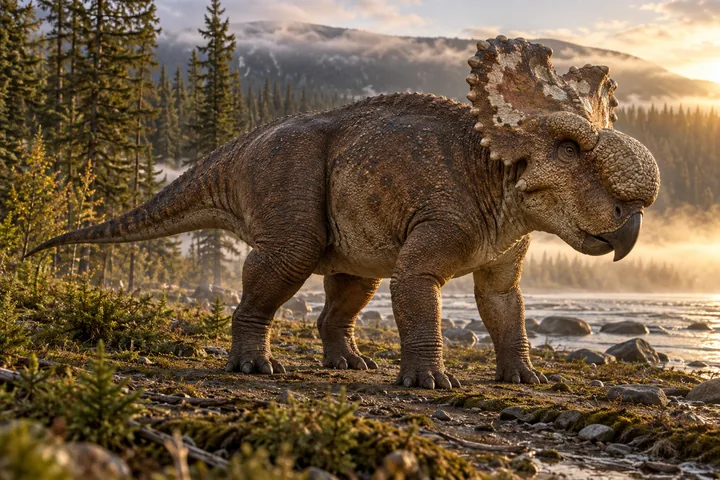
Pachyrhinosaurus
A broad bony nasal boss took the place of a nose horn.
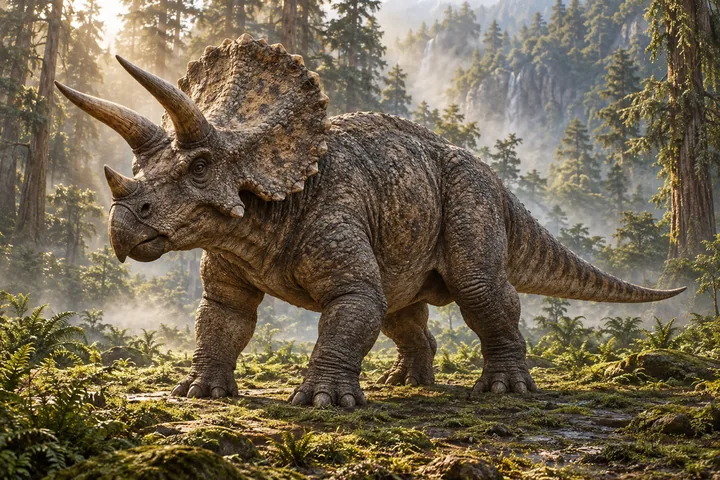
Triceratops horridus
Three horns, a broad frill, and a plant-eater beneath the formidable silhouette.