
Length
InferredAbout 6 m (museum reference)
A rounded museum reference, not a measured population range; the page does not specify the specimen, method or growth stage. [D1]
EXHIBIT 39
Centrosaurus
A single nose horn — and a fossil that preserves bone cancer.
TWO WAYS TO PICTURE THE PAST
Compare the evidence with the familiar movie image. The illustrations are not to a shared scale.

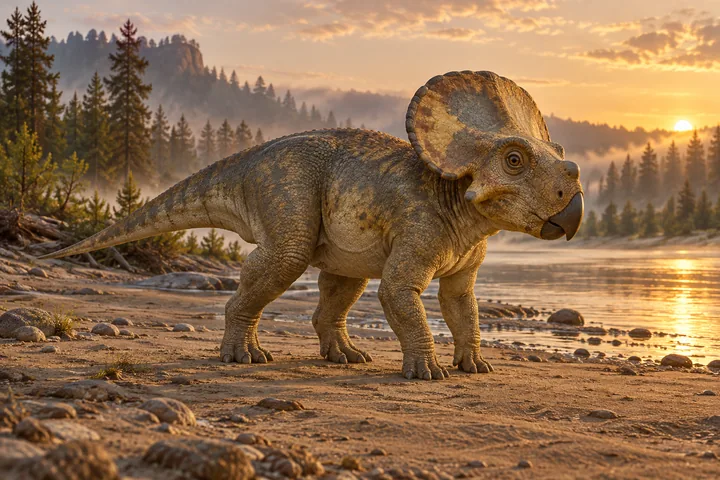
The artist identifies this reconstruction as Centrosaurus. Fossil-informed anatomy: Robust quadrupedal ceratopsid with beak, one nasal horn and ornamented neck frill; subdued brow projections rather than long paired brow horns. File identifies the genus only. Colour and soft-tissue detail are artistic reconstruction; no source-page accuracy warning was found. [1] [2]
Centrosaurus.png — Fred Wierum. CC BY-SA 4.0. Remote source artwork displayed without additional cropping; Wikimedia supplies any display-size derivative.
Scientific picture served by Wikimedia · internet connection required.
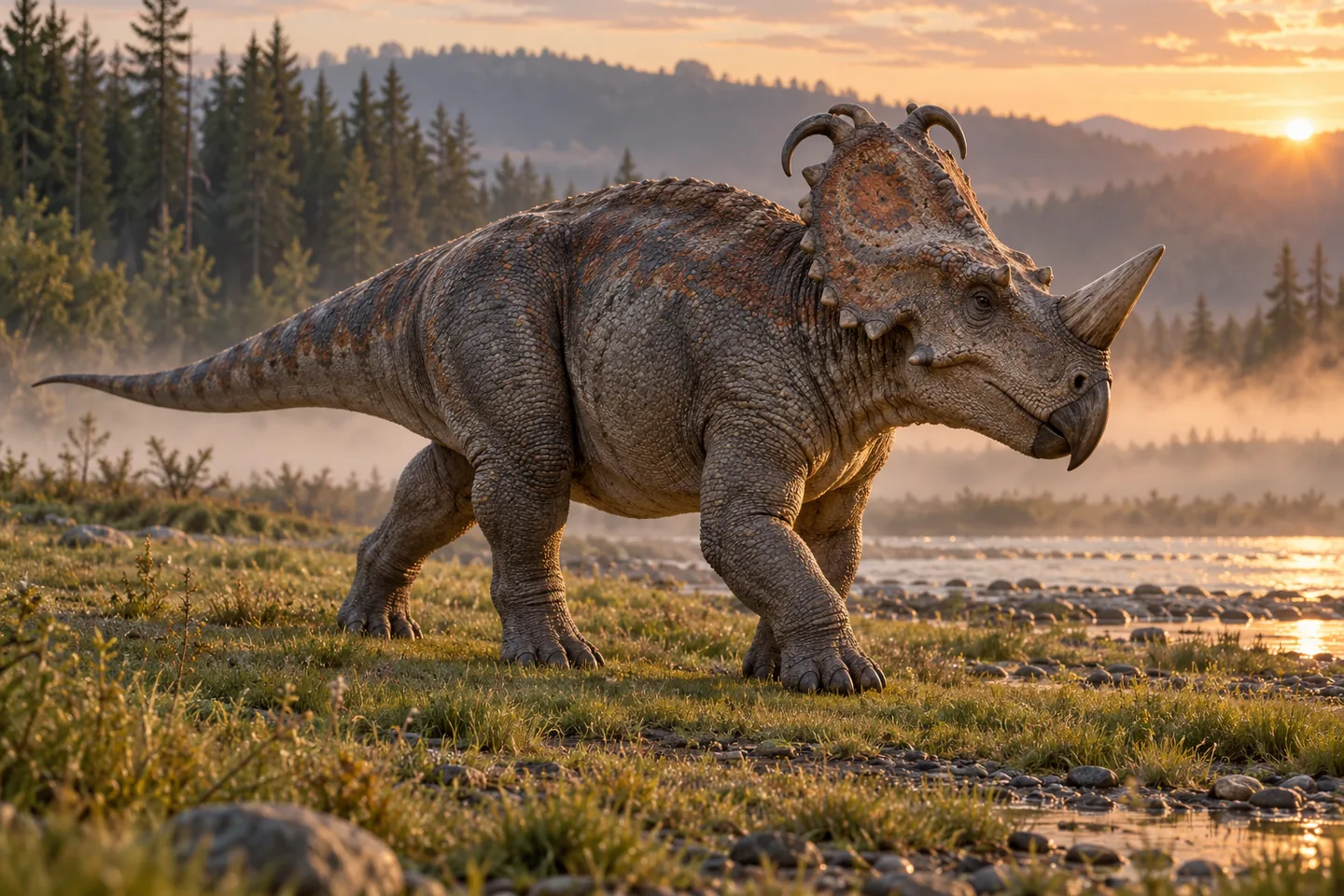
Cinematic Centrosaurus, heavy quadrupedal herbivore with one prominent nasal horn, beak and compact ornamented frill; steady full-body stance on a coastal plain. Dramatic lighting, surface detail and scenery are artistic choices. This is an original cinema-inspired picture, rather than a frame from a film or a documented fossil locality.
Original artwork · artistic interpretation.
Scientific view: credited paleoart interpreting fossil evidence, served online by Wikimedia. Movie-style view: Original artistic interpretation. Colors, soft tissues and settings involve reconstruction.
MEET THE ANIMAL
Centrosaurus apertus was a plant-eating horned dinosaur living in Alberta around 76 million years ago. One fossil from Dinosaur Provincial Park tells a surprisingly personal part of its story. The end of a lower-leg bone was badly misshapen. At first, that damage was interpreted as a healing fracture, but later researchers recognized that it needed a much closer examination. [S1]
The team combined paleontology with medical techniques. They used high-resolution scans to look inside the bone, then examined thin slices under a microscope. Comparisons with an unaffected Centrosaurus bone and a human bone with a known cancer helped support a diagnosis of osteosarcoma, an aggressive bone cancer. The diagnosis concerned this particular adult animal, rather than every member of its species. [S1]
Its fossil came from a large concentration of Centrosaurus bones. Researchers interpreted the deposit as animals dying together in a flood, with herd life potentially helping the ill individual survive before that event. This remains an interpretation of the bonebed. The specimen shows that understanding a dinosaur includes its health and life history, alongside the familiar horns and skeleton. [S1]
PREHISTORIC ANIMAL DOSSIER
The animal, the evidence, and the questions still open.
Centrosaurus combined a large nasal horn with a shorter decorated frill. A fibula assigned to C. apertus preserves an aggressive bone cancer diagnosed by comparison with normal dinosaur and human bones.
Profile scope: Genus: Centrosaurus; cancer and herd discussion concerns C. apertus.
Source supported identifies a description documented by the cited source. Inferred marks a reconstruction or functional estimate. Debated marks competing interpretations. Not established means the sources reviewed for this dossier do not support a firm conclusion; it does not mean a behavior never occurred.
A size reference is an estimate, not a population range. Nesting evidence does not by itself establish courtship, mate choice, or lifelong pairing.
About 6 m (museum reference)
A rounded museum reference, not a measured population range; the page does not specify the specimen, method or growth stage. [D1]
About 1,000 kg (museum reference)
A rounded museum reference, not a measured population range; the page does not specify the specimen, method or growth stage. [D1]
Plant eater with a cropping beak
The museum identifies herbivory and tough vegetation. Exact plant preferences are not demonstrated by this directory. [D1]
Late Cretaceous Canadian fossil localities
The directory places fossils in Canada about 76–74 million years ago. It does not establish a preferred habitat within that region. [D1]
Four-legged walking
The skeletal reconstruction described by the museum is quadrupedal; no speed estimate is established here. [D1]
Nasal horn and spined neck frill
One prominent horn rose above the snout, with projections along the frill margin. [D1]
Not established here
The reviewed sources do not establish nest structure, incubation or parental care for Centrosaurus.
Not established here
The reviewed sources do not establish a courtship sequence or mating system for Centrosaurus.
Herd living proposed
ROM researchers suggest a protective herd could explain prolonged survival of a cancer-afflicted C. apertus. That scenario does not demonstrate nursing or routine care for sick individuals. [D2]
Sources and inspection notes for the claims in this profile.
THE STORY IN THE FOSSILS
Centrosaurus walked on four legs and fed on plants using a beak. One horn rose from the snout, while smaller projections ornamented its neck frill. Its classification among centrosaurines connects it with other ceratopsids whose most conspicuous head ornament lay over the nose. [1]
Researchers examining a malformed Centrosaurus fibula diagnosed an aggressive bone cancer called osteosarcoma. Comparison with a normal dinosaur fibula and a human case supported the diagnosis. The advanced disease provided an unusual glimpse of an individual dinosaur’s medical history, extending knowledge beyond its outward anatomy. [2]
We have not established a comparable adult total-length estimate for this taxon in this draft. Specimen measurements in the text describe those individuals. The cited dates are approximately 76–74 million years ago. Approximate museum catalogue reference interval for the genus, not an exact duration for every species. Unknown does not mean zero.
Sources and evidence notes for this exhibit.
KEEP EXPLORING
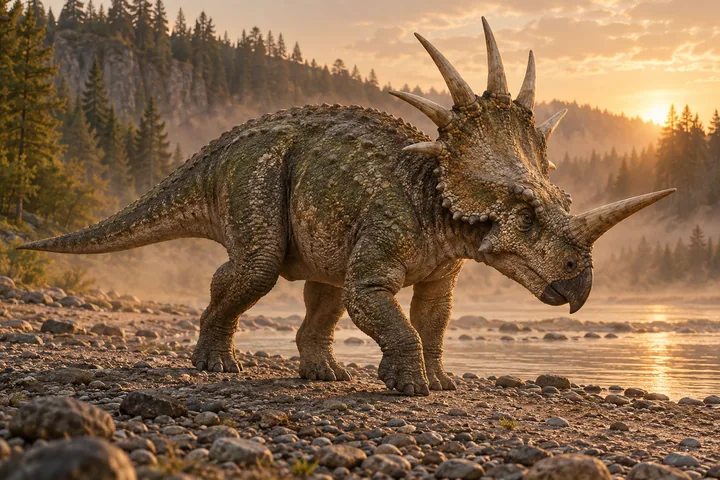
Styracosaurus
A long nose horn framed by a spectacular spiked frill.
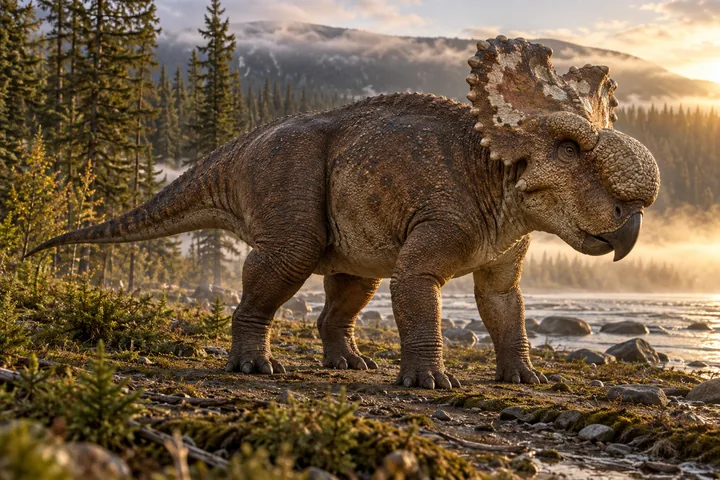
Pachyrhinosaurus
A broad bony nasal boss took the place of a nose horn.
Protoceratops
A beaked herbivore preserved in a struggle with Velociraptor.