
Body length
InferredAbout 2.0 m; broad museum reference
The museum provides no specific individual, life stage or calculation. The named type is immature; this reference does not establish a fully grown maximum or a population range. [D4] [D1]
TWO WAYS TO PICTURE THE PAST
Compare the evidence with the familiar movie image. The illustrations are not to a shared scale.
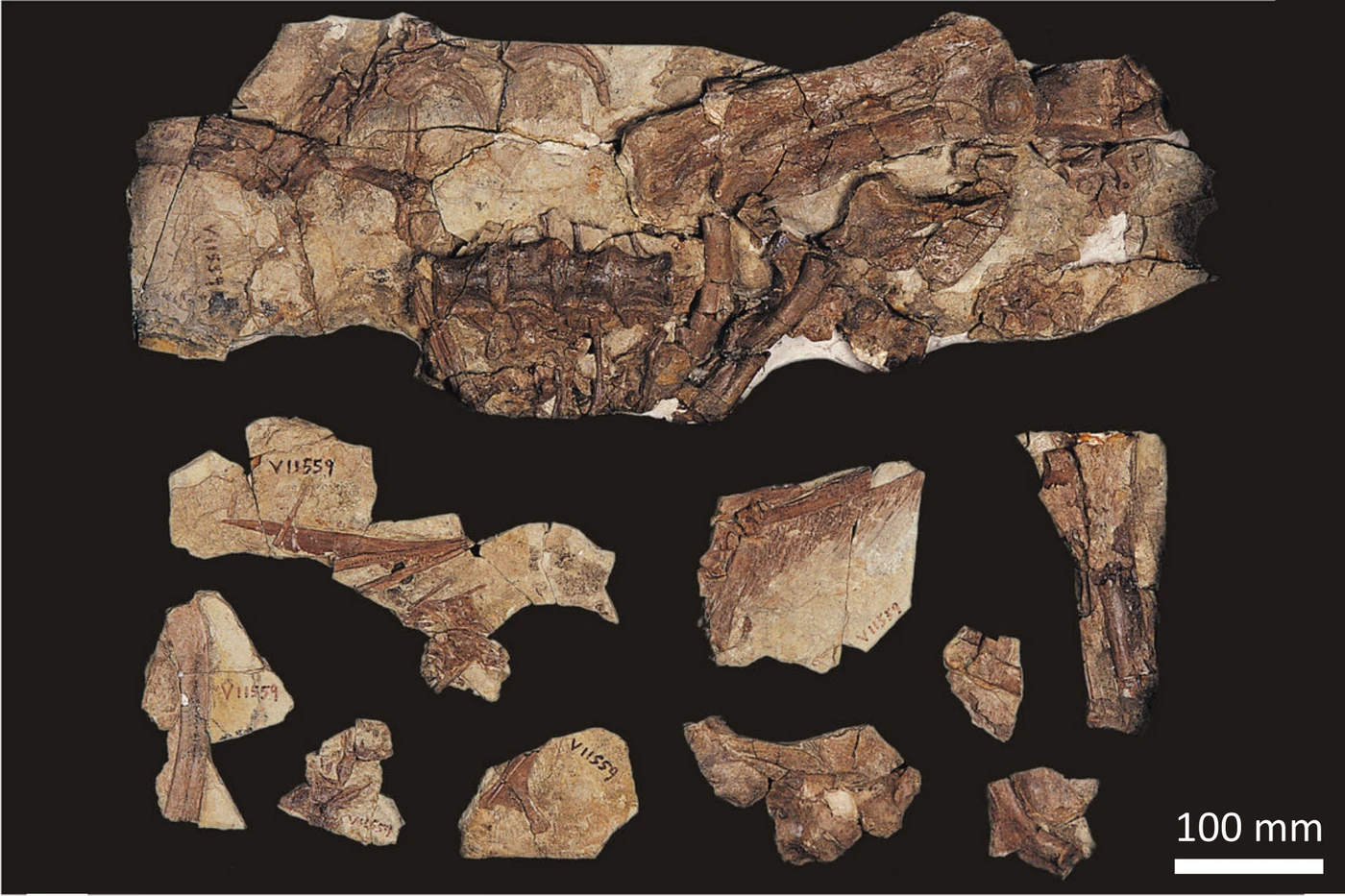
Published photograph of holotype IVPP V11559, with its slab and additional pieces arranged separately. The 2021 osteological study identifies this animal as immature. The plate is not a complete articulated skeleton or a fully grown body-size reference. [2]
Beipiaosaurus inexpectus holotype IVPP V11559 · Maria E. McNamara, Fucheng Zhang, Stuart L. Kearns, Patrick J. Orr, André Toulouse, Tara Foley, David W. E. Hone, Chris S. Rogers, Michael J. Benton, Diane Johnson, Xing Xu & Zhonghe Zhou. CC BY 4.0. Converted to WebP and resized proportionally within verified native dimensions; no anatomical edits. Existing Commons crops or figure revisions are retained under the inspected file license.
The photograph or figure shows the credited fossil material; displayed mounts and labels can include interpretation.
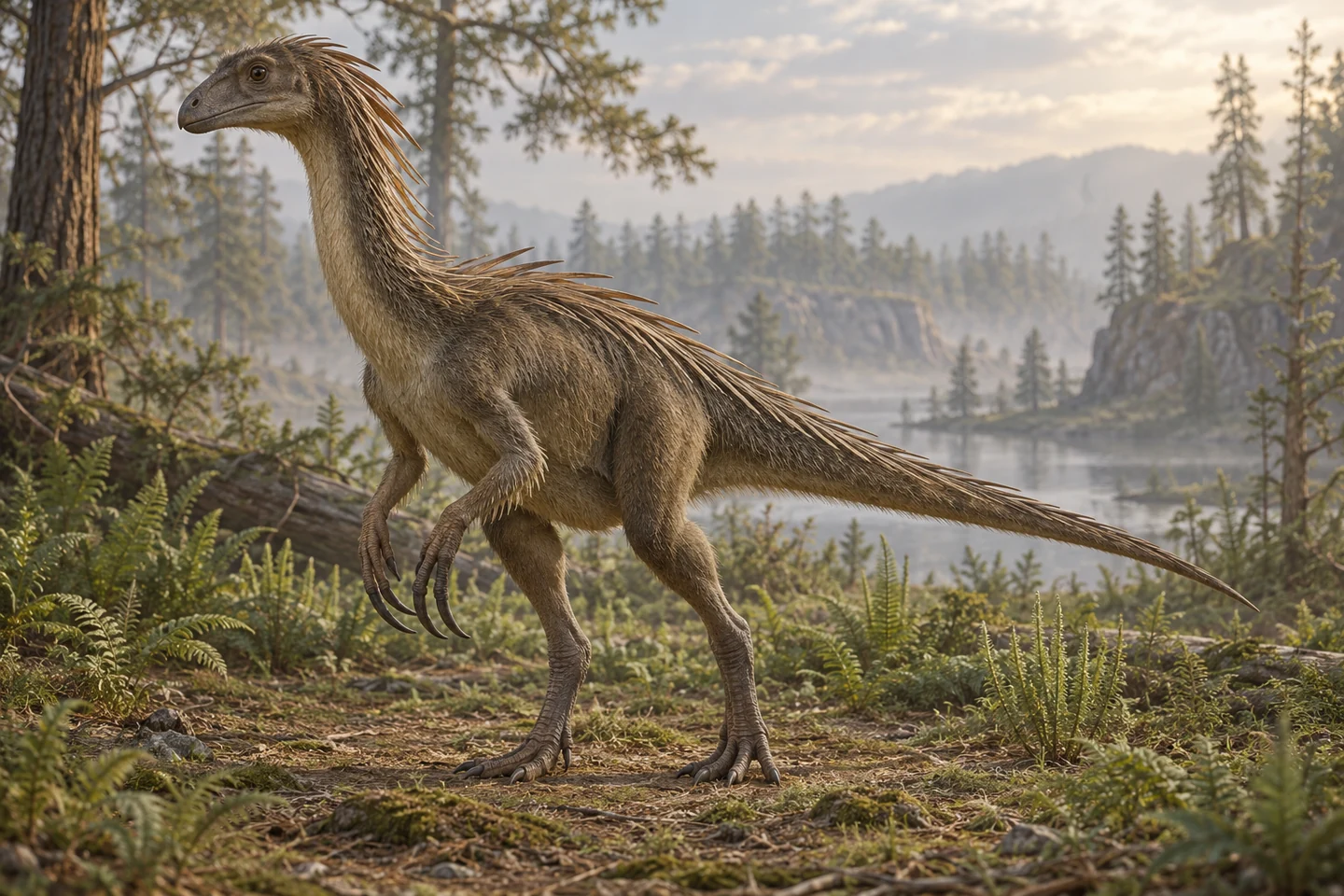
Original cinematic interpretation of Beipiaosaurus. Published fossils preserve filamentous coverings including longer broad unbranched structures. This illustration combines those findings; exact distribution, colors and body fullness are reconstructed rather than an adult maximum. Lighting, colors and scenery are artistic choices; this image does not document directly observed behavior. Lighting, coloration and scenery are artistic choices. This image does not document a fossil locality or behavior.
Original artwork · artistic interpretation.
Scientific view: source-informed reconstruction, credited paleoart or specimen-based imagery. Movie-style view: Original artistic interpretation. Reconstructions involve uncertainty.
MEET THE ANIMAL
Beipiaosaurus was a therizinosaur relative discovered in China. Its fossils helped demonstrate that unusual members of this dinosaur family carried feather-like body coverings. Preserved structures around the skeleton provide evidence that a simple scaly outline would miss. This is an example of how exceptional fossil preservation can reveal more than an animal's bones. [D3]
The Natural History Museum describes it as an omnivore, meaning an animal that may eat both plants and animal food. That is a dietary interpretation, rather than a preserved list of meals. Its two-metre museum length is a useful reference for imagining its scale, but the directory does not identify the measured individual or its stage of growth. [D4]
Its covering was especially varied: short filaments occurred alongside much longer, broader, unbranched feathers. Researchers proposed that some of the conspicuous feathers helped with visual display. That possibility does not tell us their colors, identify a male or female, or reveal a courtship routine. Some of the detailed covering evidence comes from a referred specimen identified at genus level, so it should not all be assigned to one named species without qualification. [D2]
PREHISTORIC ANIMAL DOSSIER
The animal, the evidence, and the questions still open.
The preserved coverings differ in structure. Their distribution offers evidence about feather evolution, while proposed display functions remain interpretations and their colors are not established here. [D2]
Profile scope: Genus profile centered on immature B. inexpectus IVPP V11559. Referred STM 31-1 is Beipiaosaurus sp.; its anterior integument is not automatically species-level evidence. [D1]
Source supported identifies a description documented by the cited source. Inferred marks a reconstruction or functional estimate. Debated marks competing interpretations. Not established means the sources reviewed for this dossier do not support a firm conclusion; it does not mean a behavior never occurred.
A size reference is an estimate, not a population range. Nesting evidence does not by itself establish courtship, mate choice, or lifelong pairing.
About 2.0 m; broad museum reference
The museum provides no specific individual, life stage or calculation. The named type is immature; this reference does not establish a fully grown maximum or a population range. [D4] [D1]
About 40 kg; immature-type restoration
Paul’s appendix assigns IVPP V11559 a 40 kg model mass. This individual model is not a measured weight or mature species maximum; maturity is assessed in the osteological paper. [D5] [D1]
Omnivory proposed; exact foods uncertain
The museum interprets omnivory. No inspected stomach contents identify a particular meal or quantify the balance between plant and animal foods. [D4]
Aptian Yixian Formation, Liaoning
The holotype comes from Sihetun in northeastern China. The 2021 osteological account assigns the Yixian material to the Aptian; this fossil setting does not establish exclusive habitat use. [D1]
Bipedal; three principal weight-bearing toes
The reduced first metatarsal differs from derived four-toed therizinosaur feet. Preserved proportions support a two-legged reconstruction, without establishing walking speed. [D1]
Short filaments and broad unbranched feathers
The 2009 study documents two coverings. Long EBFFs occur in referred STM 31-1 and additionally prepared type-tail material; branching, color and every restored body region must not be invented. [D2]
Not established here
Focused searches did not establish securely assigned eggs, embryos, nests, clutch size, incubation or parental care. Broader theropod evidence cannot identify this genus’s reproductive habits.
Visual display proposed for long feathers
The 2009 authors favor display for elongated broad filaments. This does not identify sex-specific ornamentation, observed mate choice or a demonstrated mating ritual. [D2]
Not established here
More than one specimen documents the genus, but separate finds do not establish a living flock, family group or synchronized social behavior. [D1]
Sources and inspection notes for the claims in this profile.
THE STORY IN THE FOSSILS
The initial description helped establish therizinosaurs as feather-bearing theropods. Its publisher abstract supports that broad evolutionary connection, while later work supplies the detailed anatomy and maturity assessment. [3]
The dossier identifies the scope of each reference estimate. A mount, an individual fossil and a species-wide adult range are different measurements. Comparison metrics remain unavailable where adult scope has not been established. Unknown does not mean zero.
Sources support the stated claims and scopes. Refer to the evidence notes for uncertainty.
KEEP EXPLORING
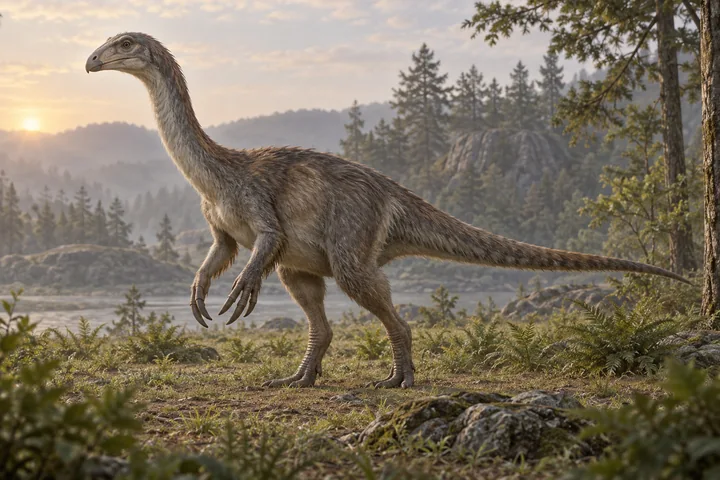
Alxasaurus elesitaiensis
Alxasaurus linked therizinosaurs with other theropods through its skeleton. A preserved jaw and specialized wrist give separate clues to feeding and movement.
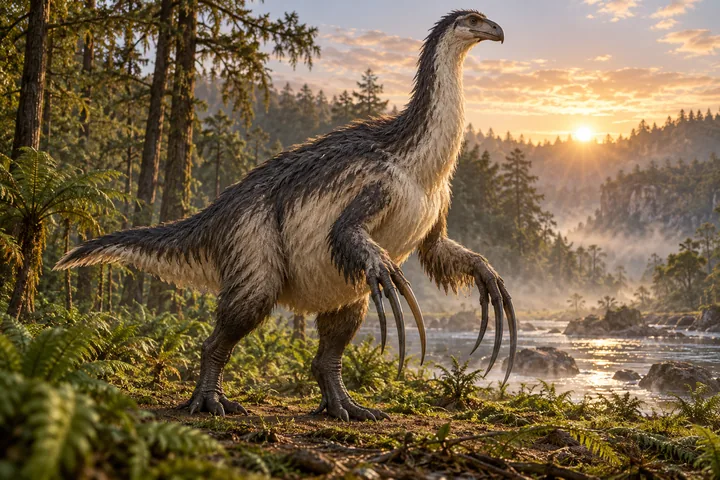
Therizinosaurus
Therizinosaurus lived in Late Cretaceous Mongolia. Its long hand claws are well known, while much of its body must be reconstructed from relatives.
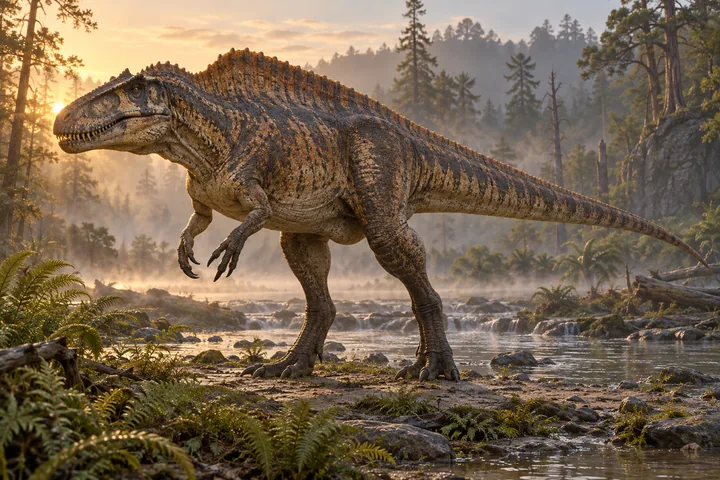
Acrocanthosaurus
This Early Cretaceous carnivore is known from North American fossils. Its high vertebral spines give it a distinctive raised back profile.