
Size reference
Not establishedNot established here
The original full size description was inaccessible; the inspected abstract does not give a body-length value. [D1]
EXHIBIT 284
Ceratomyrmex
Prehistoric insect
Ceratomyrmex was a horned Cretaceous ant; one amber fossil preserves prey between its jaws and head projection. [3]
TWO WAYS TO PICTURE THE PAST
Compare the evidence with the familiar movie image. The illustrations are not to a shared scale.
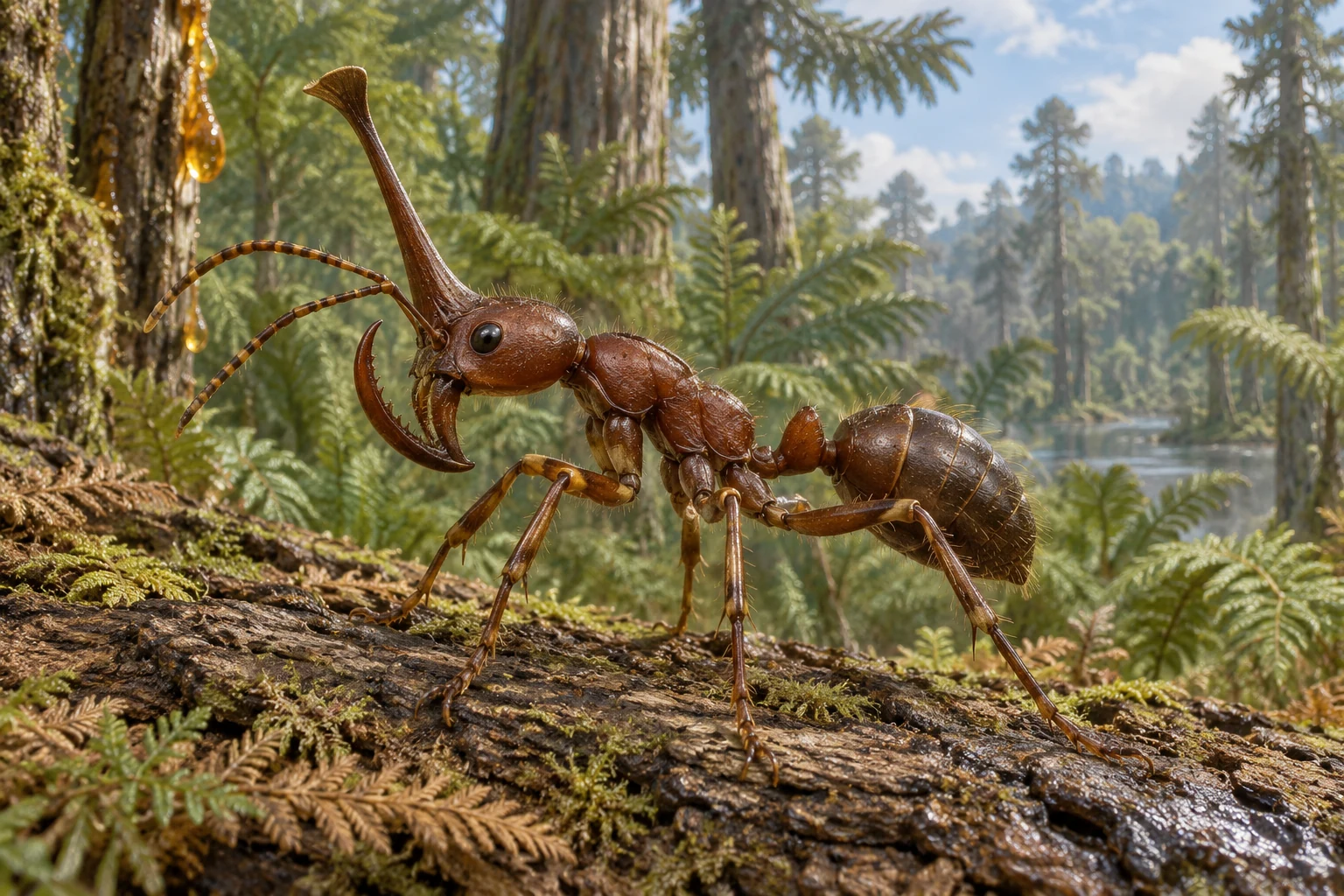
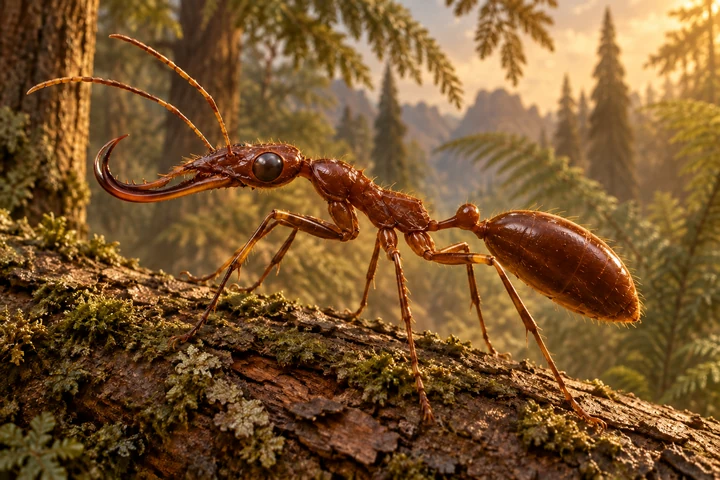
Source-informed reconstruction of Ceratomyrmex. The head projection and upward-closing mandibles inform this reconstruction. Life colors and the local scenery are artistic choices.
Original DinoGrove artwork. Extreme Morphogenesis and Ecological Specialization among Cretaceous Basal Ants. New Fossil Discovery Shows How Ancient 'Hell Ants' Hunted with Killer Headgear.
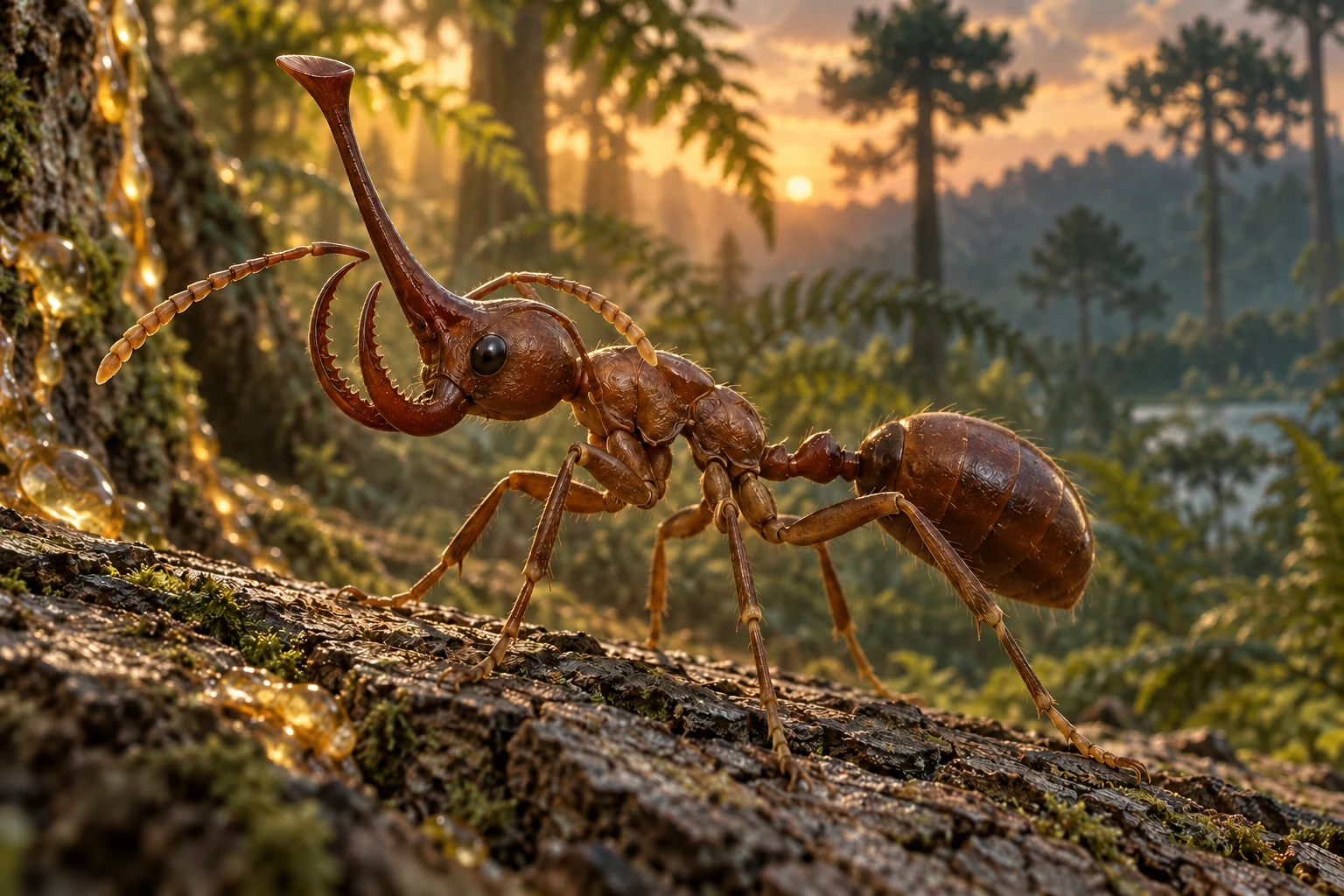
Cinematic interpretation of Ceratomyrmex. The head projection and upward-closing mandibles inform this reconstruction. Life colors and the local scenery are artistic choices.
Original DinoGrove artwork. Extreme Morphogenesis and Ecological Specialization among Cretaceous Basal Ants. New Fossil Discovery Shows How Ancient 'Hell Ants' Hunted with Killer Headgear.
Scientific view: source-informed reconstruction, credited paleoart or specimen-based imagery. Movie-style view: Original artistic interpretation. Reconstructions involve uncertainty.
MEET THE ANIMAL
Ceratomyrmex was an ant with headgear unlike that of ants alive today. A projection rose above its face, opposite two curved jaws. The original study proposed that these parts formed a trap for other insects. Such a specialist might hunt by itself, even if it belonged to a colony. A hunting interpretation does not supply facts about its nest, eggs or courtship. [D1]
A later fossil supplied stronger evidence: an individual was preserved holding a young Caputoraptor, a cockroach relative. The animal was pinned between the ant’s jaws and head projection. That position helped researchers explain how the jaws worked. Living ants generally close their jaws sideways; this extinct ant’s jaws could operate in a different plane. The fossil records a moment of prey capture, rather than every step in feeding. [D3]
The Nanjing institute’s account documents C. ellenbergeri as a worker ant from Myanmar amber, around 99 million years old. Its head anatomy reveals an early experiment in specialized hunting. The available evidence is strongest for worker form. Restored colors and a complete woodland scene remain interpretations, and this genus should not be confused with other horned-ant genera. [D4]
PREHISTORIC ANIMAL DOSSIER
The animal, the evidence, and the questions still open.
A captured cockroach relative provides direct support for the horn-and-jaw prey trap. [D2]
Profile scope: Genus — Ceratomyrmex; C. ellenbergeri workers anchor reconstruction, including prey-capture specimen NIGP 163569. [D4] [D2]
Source supported identifies a description documented by the cited source. Inferred marks a reconstruction or functional estimate. Debated marks competing interpretations. Not established means the sources reviewed for this dossier do not support a firm conclusion; it does not mean a behavior never occurred.
A size reference is an estimate, not a population range. Nesting evidence does not by itself establish courtship, mate choice, or lifelong pairing.
Not established here
The original full size description was inaccessible; the inspected abstract does not give a body-length value. [D1]
Not established here
No mass estimate is supplied by the inspected original abstract. [D1]
Arthropod predation supported
Amber preserves C. ellenbergeri holding a Caputoraptor nymph between mandibles and horn. [D2]
Terrestrial Cretaceous resin forest
Myanmar amber preserves the encounter; an exact nest site is not established. [D3]
Walking inferred
Worker legs support terrestrial movement; the prey fossil does not measure speed. [D3]
Horn above scythe-like mandibles
The head projection and vertically opposed jaws formed a specialized prey trap. [D1]
Not established here
The examined worker evidence does not supply attributable eggs or brood care. [D1]
Not established here
The predation study does not preserve mating or mate selection. [D3]
Solitary hunting proposed
Specialist hunting is inferred; this does not mean absence of colonies or establish colony organization. [D1]
Sources and inspection notes for the claims in this profile.
THE STORY IN THE FOSSILS
The preserved prey position supports a jaw motion unlike the sideways closure of living ants. It does not show the entire hunt. [3]
The dossier identifies the scope of each reference estimate. A mount, an individual fossil and a species-wide adult range are different measurements. Comparison metrics remain unavailable where adult scope has not been established. Unknown does not mean zero.
Sources support the stated claims and scopes. Refer to the evidence notes for uncertainty.
KEEP EXPLORING
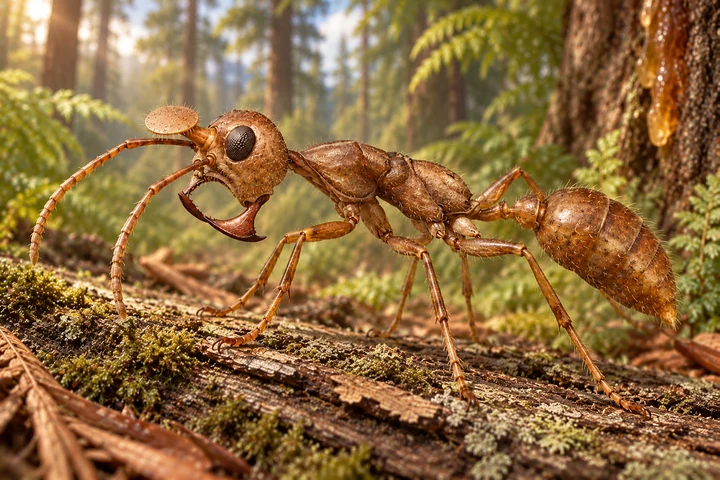
Linguamyrmex
Prehistoric insect
Linguamyrmex was a Cretaceous ant with curved jaws and a reinforced paddle-shaped facial projection.
Haidomyrmex
Prehistoric insect
Haidomyrmex was a Cretaceous hell ant with upcurved jaws; its diet and arboreal habits are anatomical inferences.
Tyrannosaurus rex
Tyrannosaurus rex was a large meat-eating dinosaur from the final part of the Cretaceous in western North America. Fossil teeth, bite marks and skeletons reveal a powerful animal whose behaviour still invites questions.