
Size reference
Not establishedNot established here
BuPH-01 has a 1.77 mm mesosomal reference length; its incomplete gaster prevents treating that as total body length. [D1]
EXHIBIT 285
Linguamyrmex
Prehistoric insect
Linguamyrmex was a Cretaceous ant with curved jaws and a reinforced paddle-shaped facial projection. [1]
TWO WAYS TO PICTURE THE PAST
Compare the evidence with the familiar movie image. The illustrations are not to a shared scale.
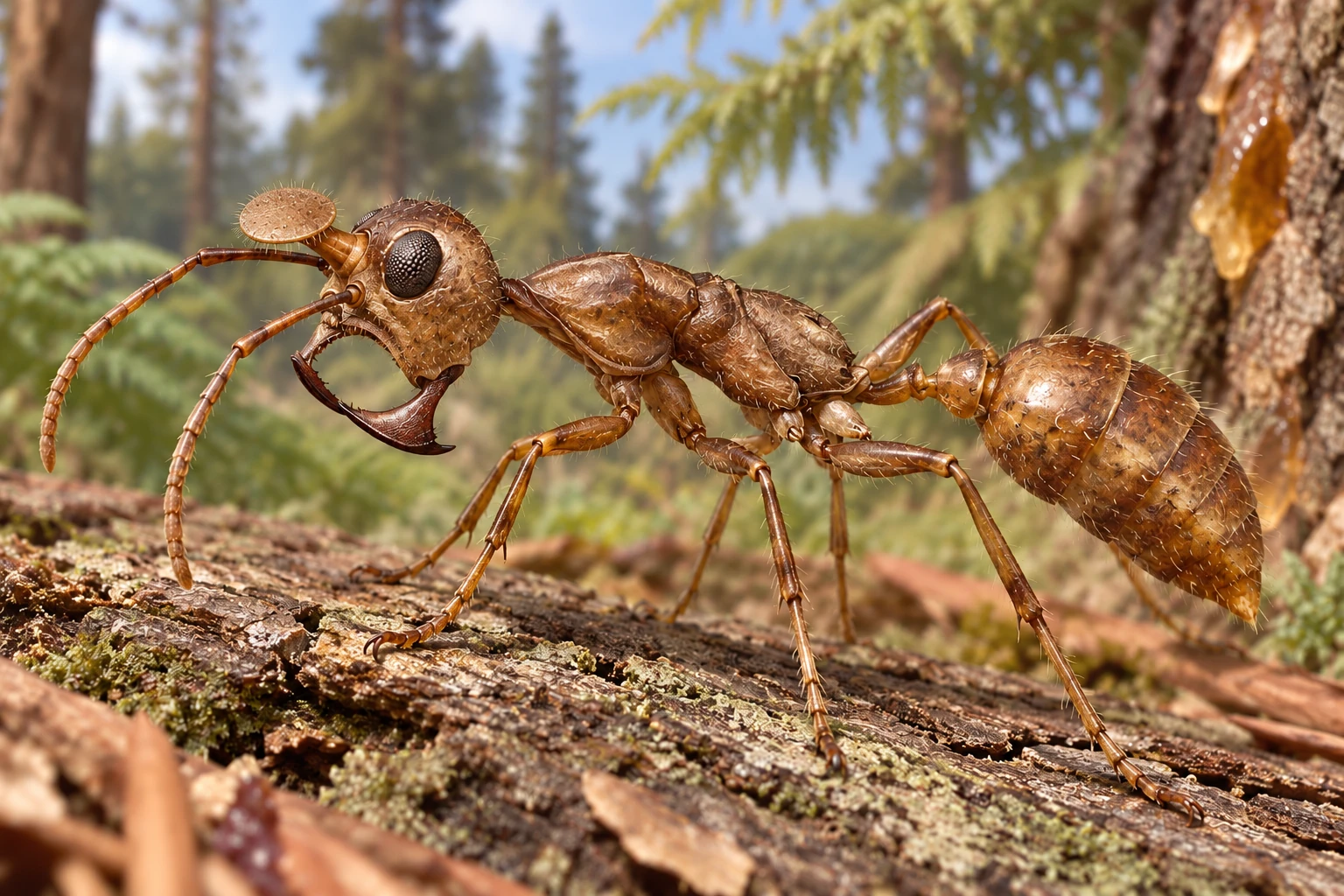
An illustrative reconstruction. Compare its anatomy with the evidence and limitations in the dossier. [1]
Source-informed reconstruction. Appearance evidence [1]. Original illustration; missing anatomy, coloration and scenery include interpretation.
Fossils constrain this life reconstruction. Missing anatomy, coloration and the environmental scene include interpretation; the dossier explains the evidence limits.
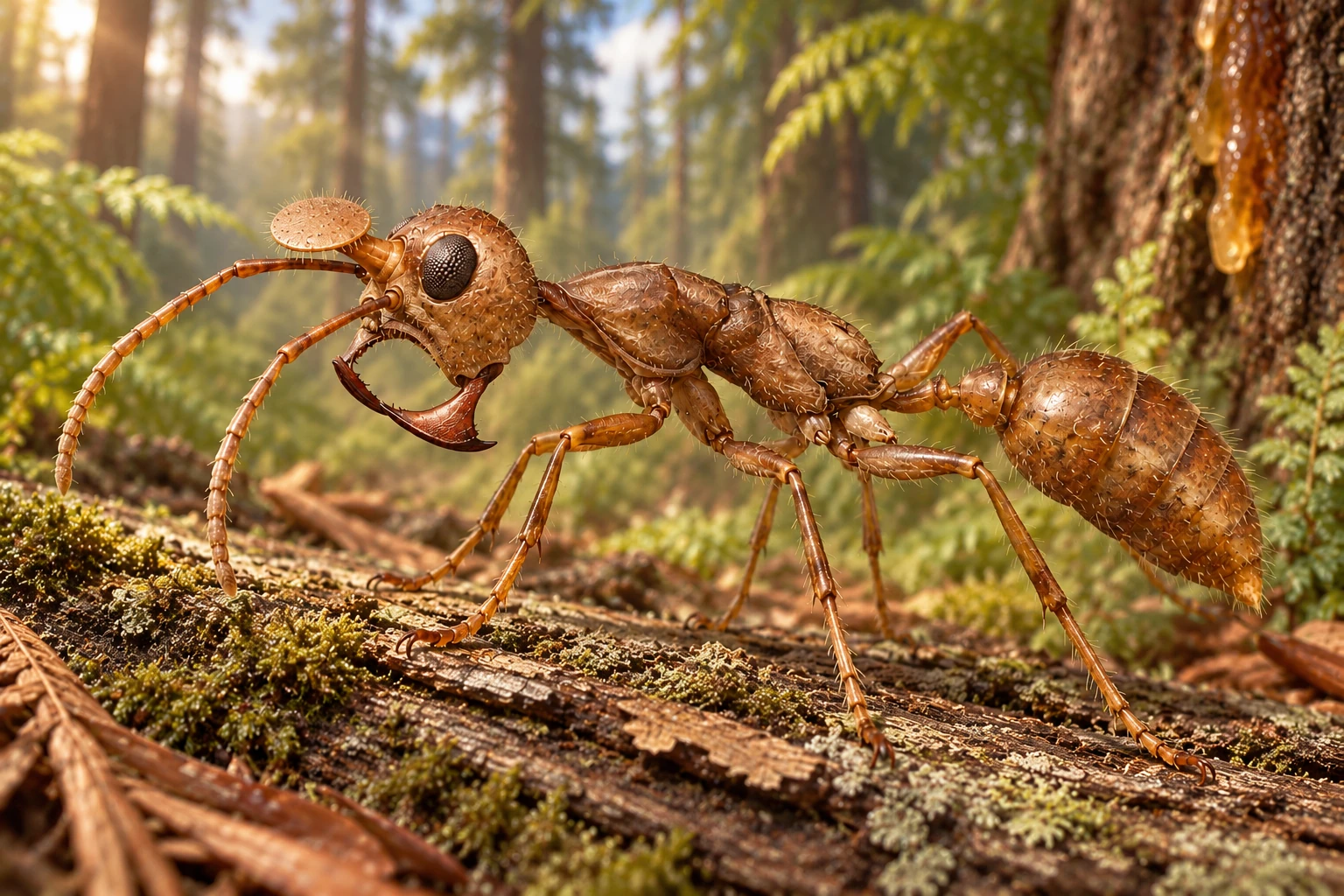
An illustrative reconstruction. Compare its anatomy with the evidence and limitations in the dossier. Lighting, coloration and scenery are artistic choices. This image does not document a fossil locality or behavior.
Original artwork · artistic interpretation.
Scientific view: source-informed reconstruction, credited paleoart or specimen-based imagery. Movie-style view: Original artistic interpretation. Reconstructions involve uncertainty.
MEET THE ANIMAL
Linguamyrmex was a small ant preserved in Cretaceous amber from Myanmar. Its curved jaws worked beneath a paddle-shaped projection on its face. The type specimen of L. vladi has incomplete antennae and an incomplete rear abdomen. Researchers measured individual structures rather than reporting a reliable total body length. The reconstruction therefore keeps its distinctive head while restoring missing parts cautiously. [D1]
A later description added L. brevicornis, a related species with a shorter horn. Workers and a winged reproductive female helped reveal differences within the genus. Their measurements and caste features belong to that species and cannot simply be transferred to L. vladi. Comparing specimens makes the genus clearer without turning every fossil into the same ant. [D2]
The NJIT reconstruction project explains why these fossils attract scientists and artists. The paddle may have been strengthened and used with the jaws to pin or puncture prey. Eating liquid from prey is a proposed explanation, rather than a complete meal preserved in action. Its living colors, courtship and detailed colony life remain uncertain. Game babies and their friendly gestures are imaginative appearances, not recovered fossil behavior. [D3]
PREHISTORIC ANIMAL DOSSIER
The animal, the evidence, and the questions still open.
Imaging suggests reinforced cuticle; metal composition and liquid feeding remain hypotheses. [D1]
Profile scope: Genus — Linguamyrmex; L. vladi holotype AMNH BuPH-01 anchors the reconstruction. Other 2017 specimens are not assigned to that species. [D1]
Source supported identifies a description documented by the cited source. Inferred marks a reconstruction or functional estimate. Debated marks competing interpretations. Not established means the sources reviewed for this dossier do not support a firm conclusion; it does not mean a behavior never occurred.
A size reference is an estimate, not a population range. Nesting evidence does not by itself establish courtship, mate choice, or lifelong pairing.
Not established here
BuPH-01 has a 1.77 mm mesosomal reference length; its incomplete gaster prevents treating that as total body length. [D1]
Not established here
The original description supplies no mass. [D1]
Specialized predation inferred
Jaws and paddle suggest pinning prey; liquid-feeding and metal reinforcement are qualified interpretations. [D1]
Cretaceous resin woodland inferred
The studied fossils come from Kachin amber; exact nest substrate is unestablished. [D3]
Walking inferred
Worker feet and legs support movement, without a measured speed or flight claim. [D1]
Paddle-like projection and curved jaws
The stalk supports a setose pad; X-ray attenuation cannot establish elemental composition. [D1]
Related species has winged females
L. brevicornis workers and gynes do not establish L. vladi reproductive morphology. [D2]
Not established here
The institutional reconstruction account supplies no courtship observations. [D3]
Not established here
This reconstruction account does not establish colony size or cooperative hunting. [D3]
Sources and inspection notes for the claims in this profile.
THE STORY IN THE FOSSILS
The NJIT team used fossil observations to develop reconstructions. Restored parts, living colors and feeding scenes still require interpretation. [3]
The dossier identifies the scope of each reference estimate. A mount, an individual fossil and a species-wide adult range are different measurements. Comparison metrics remain unavailable where adult scope has not been established. Unknown does not mean zero.
Sources support the stated claims and scopes. Refer to the evidence notes for uncertainty.
KEEP EXPLORING
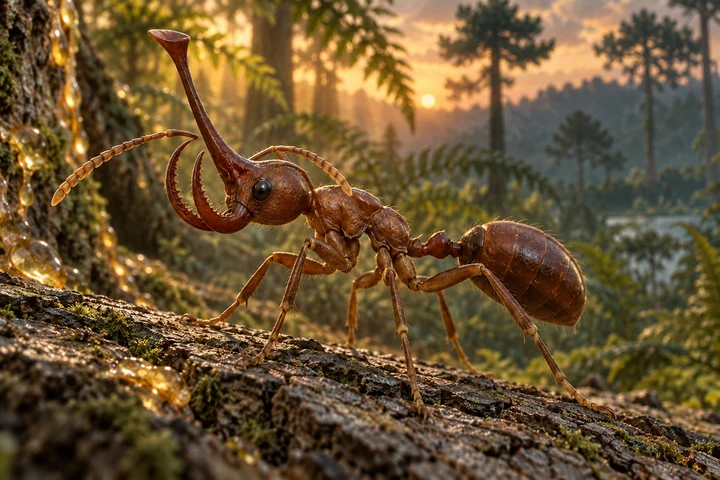
Ceratomyrmex
Prehistoric insect
Ceratomyrmex was a horned Cretaceous ant; one amber fossil preserves prey between its jaws and head projection.
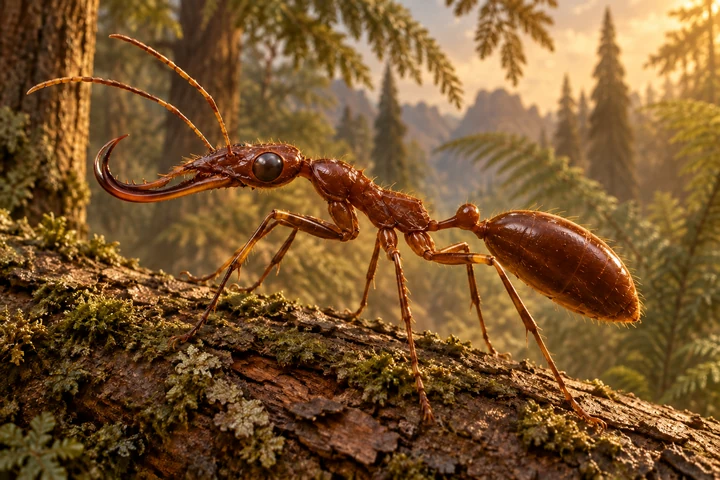
Haidomyrmex
Prehistoric insect
Haidomyrmex was a Cretaceous hell ant with upcurved jaws; its diet and arboreal habits are anatomical inferences.
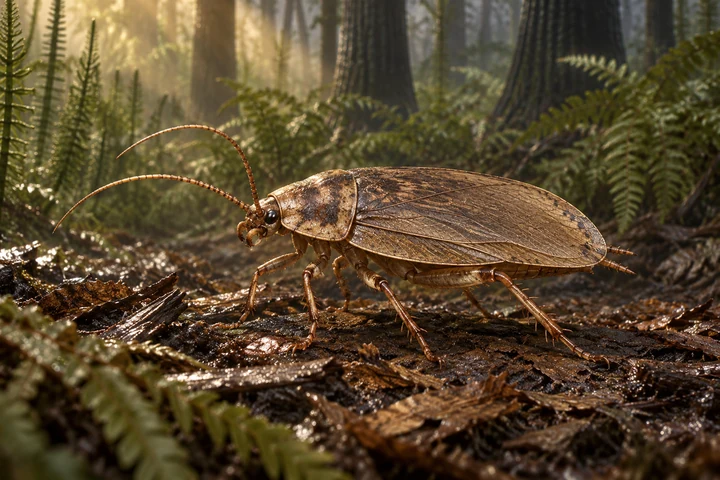
Archimylacris
Prehistoric insect
Archimylacris was a cockroach-like insect; scanning revealed climbing pads and slender running legs.