
Size reference
Source supported8.0 mm fossil body reference
H. scimitarus AMNH Bu-FB80 dealate adult female; H. zigrasi’s3.5 mm worker-form specimen is separate, not a full genus range. [D1]
EXHIBIT 226
Haidomyrmex
Prehistoric insect
Haidomyrmex was a Cretaceous hell ant with upcurved jaws; its diet and arboreal habits are anatomical inferences. [1]
TWO WAYS TO PICTURE THE PAST
Compare the evidence with the familiar movie image. The illustrations are not to a shared scale.
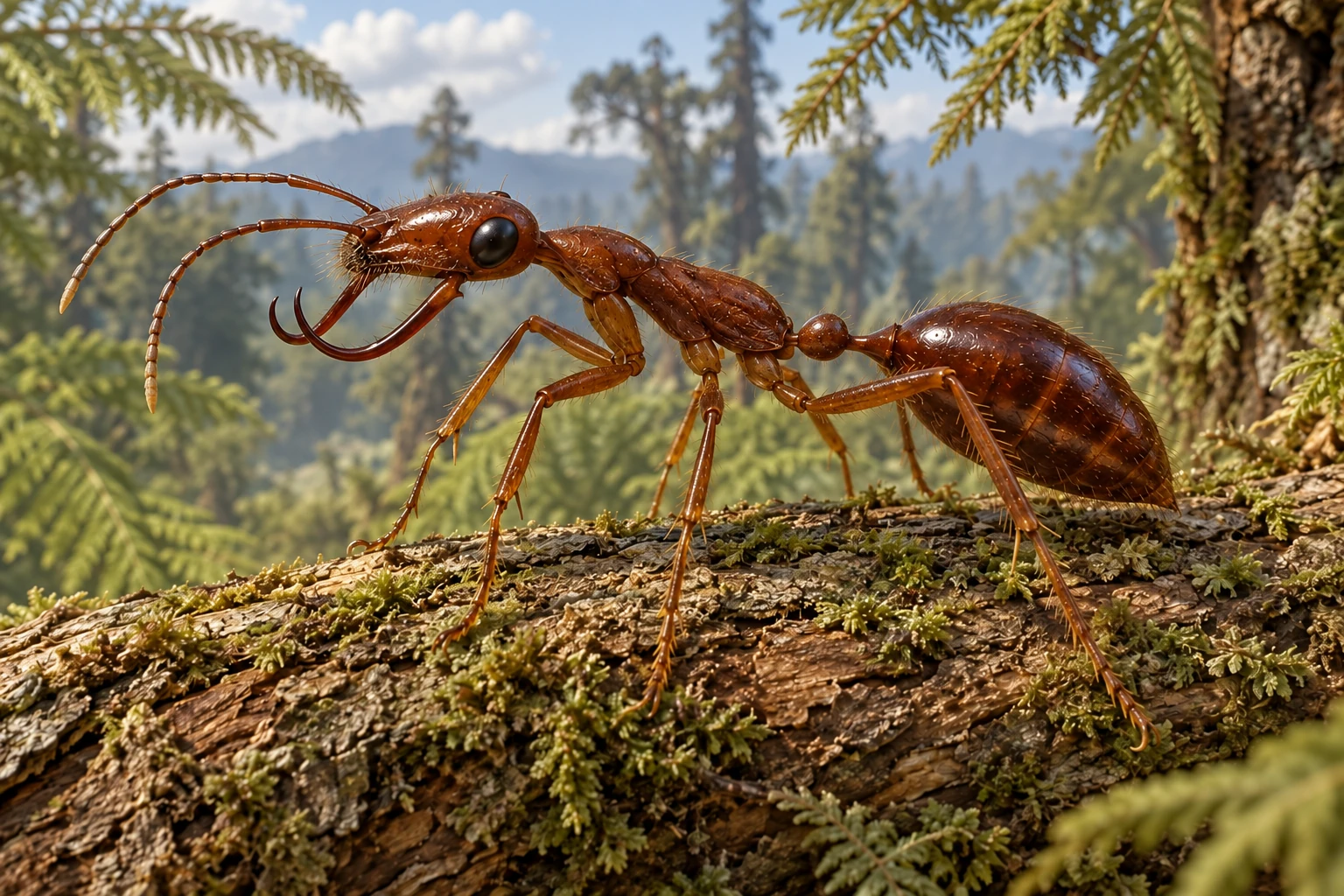
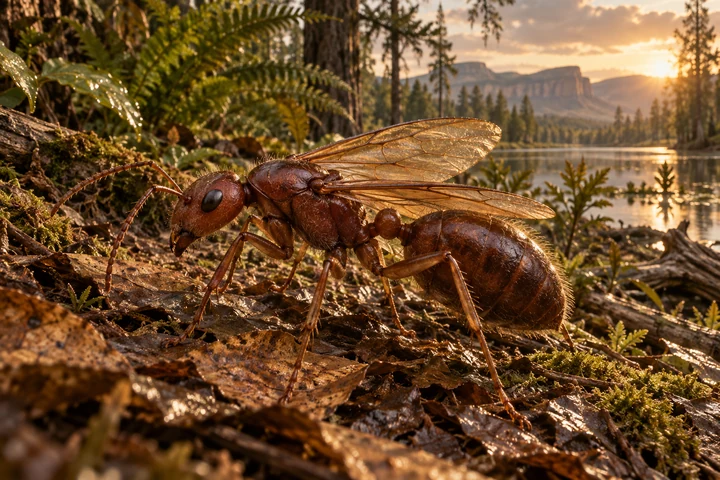
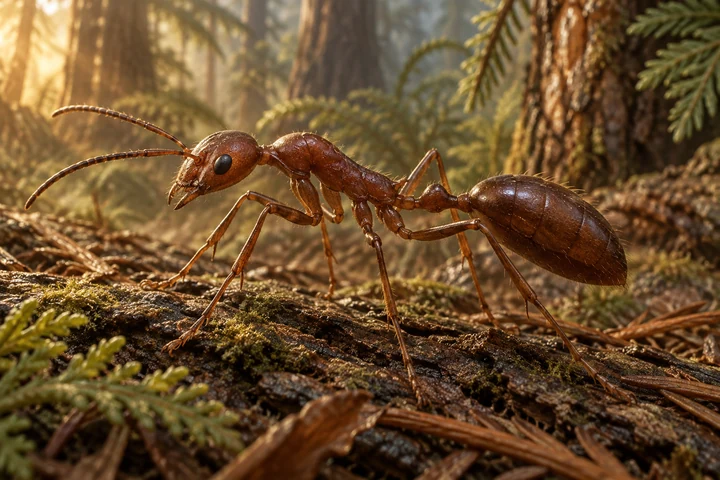
An illustrative reconstruction. Compare its anatomy with the evidence and limitations in the dossier. [2]
Source-informed reconstruction. Appearance evidence [2]. Original illustration; missing anatomy, coloration and scenery include interpretation.
Fossils constrain this life reconstruction. Missing anatomy, coloration and the environmental scene include interpretation; the dossier explains the evidence limits.
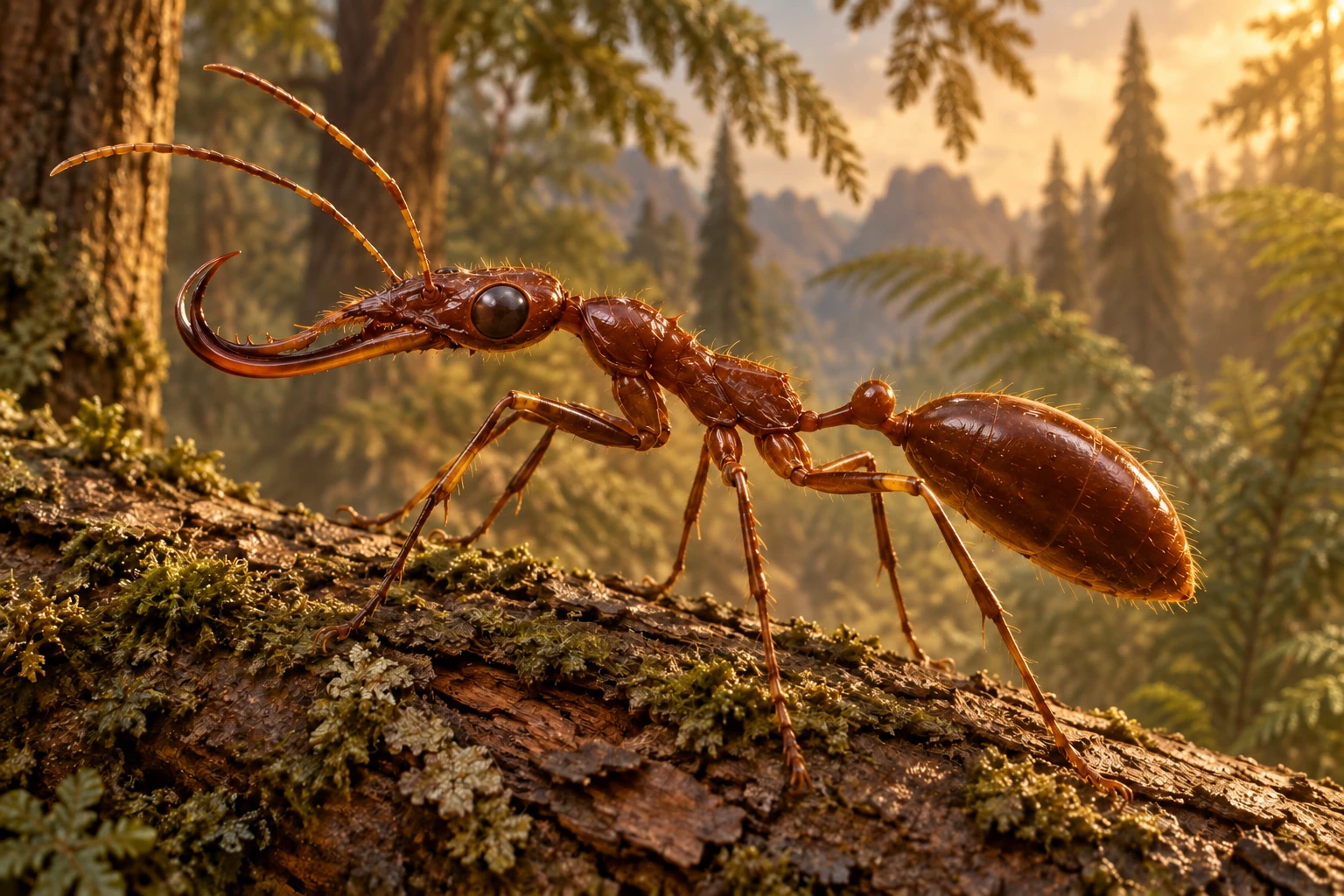
An illustrative reconstruction. Compare its anatomy with the evidence and limitations in the dossier. Lighting, coloration and scenery are artistic choices. This image does not document a fossil locality or behavior.
Original artwork · artistic interpretation.
Scientific view: source-informed reconstruction, credited paleoart or specimen-based imagery. Movie-style view: Original artistic interpretation. Reconstructions involve uncertainty.
MEET THE ANIMAL
Haidomyrmex was an extinct ant from Cretaceous amber in Myanmar. It belongs to the group often called hell ants because of their unusual heads and jaws. The gallery focuses on Haidomyrmex scimitarus, represented by a female fossil8 millimeters long. She had lost or damaged her wings and is described as dealate. That specimen is not a measured male or the size of every Haidomyrmex. [D1]
Its long jaws curve upward toward a short bristly pad on the face. Other hell-ant genera can have tall horns, but those should not be added to this ant. The jaw apparatus suggests specialized predation, although a familiar-looking hunting scene would go beyond the evidence. Finding prey with a different hell-ant genus does not prove what Haidomyrmex ate. [D2]
Later researchers described both a winged and a wingless queen-form female of Haidomyrmex cerberus and compared them with workers. That helps explain differences between ant castes and supports a social organization hypothesis. The specimens do not preserve the ants cooperating in a colony or laying eggs. A caste identification can therefore tell us something about reproduction without revealing the whole life cycle. [D3]
PREHISTORIC ANIMAL DOSSIER
The animal, the evidence, and the questions still open.
Other hell-ant genera have different facial structures; their preserved prey cannot be assigned to Haidomyrmex. [D2]
Profile scope: Genus — Haidomyrmex; gallery anchored to H. scimitarus dealate adult female AMNH Bu-FB80, Kachin amber, Myanmar. [D1]
Source supported identifies a description documented by the cited source. Inferred marks a reconstruction or functional estimate. Debated marks competing interpretations. Not established means the sources reviewed for this dossier do not support a firm conclusion; it does not mean a behavior never occurred.
A size reference is an estimate, not a population range. Nesting evidence does not by itself establish courtship, mate choice, or lifelong pairing.
8.0 mm fossil body reference
H. scimitarus AMNH Bu-FB80 dealate adult female; H. zigrasi’s3.5 mm worker-form specimen is separate, not a full genus range. [D1]
Not established here
The inspected specimen description provides no defensible body-mass estimate. [D1]
Specialized predation inferred
Jaw form suggests prey capture; broader feeding and exact jaw mechanics remain debated, with no identified Haidomyrmex meal. [D4]
Woody forest surfaces inferred
Long legs and antennae suggest arboreal activity; Kachin amber supplies preservation context, not a known nest. [D1]
Legged adult; wings vary
The focal H. scimitarus female is dealate; H. cerberus includes an alate female, so flightlessness is not genus-wide. [D3]
Upcurved jaws; low facial pad
Haidomyrmex has one petiole and lacks the tall paddle-like horn of other hell-ant genera. [D2]
Queen-form females documented
H. cerberus alate and dealate females support caste interpretation; eggs and actual egg-laying remain unestablished here. [D3]
Not established here
Queen/worker morphology does not record a male–female courtship or mating sequence. [D5]
Caste organization inferred
Queen-form and worker-form fossils support division of labor; nest structure, colony size and direct cooperation remain unknown. [D3]
Sources and inspection notes for the claims in this profile.
THE STORY IN THE FOSSILS
The description of H. davidbowiei expanded the genus beyond the three species in the 2012 paper. Its authors also reconsidered feeding interpretations, illustrating why unfamiliar jaws deserve qualified explanations. [4]
The dossier identifies the scope of each reference estimate. A mount, an individual fossil and a species-wide adult range are different measurements. Comparison metrics remain unavailable where adult scope has not been established. Unknown does not mean zero.
Sources support the stated claims and scopes. Refer to the evidence notes for uncertainty.
KEEP EXPLORING
Wathondara
Prehistoric insect
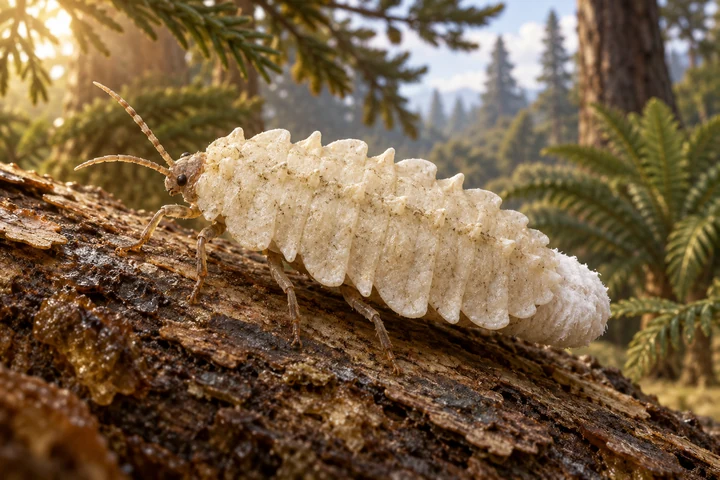
Wathondara was a Cretaceous scale insect whose amber fossil preserves a female, wax egg sac and young.
Titanomyrma
Prehistoric insect
Titanomyrma was an Eocene ant genus with strikingly large winged queens and unresolved ecological details.
Gerontoformica
Prehistoric insect
Gerontoformica was a stem ant preserved in Cretaceous amber, with fossil evidence informing early cooperation.