
Body length
InferredAbout 2.1 m; museum reference
NHM gives a rounded genus figure with no specified specimen or life stage. It is not a maximum size claim. [D1]
EXHIBIT 29
Citipati
A dinosaur preserved with its arms spread over a nest.
TWO WAYS TO PICTURE THE PAST
Compare the evidence with the familiar movie image. The illustrations are not to a shared scale.

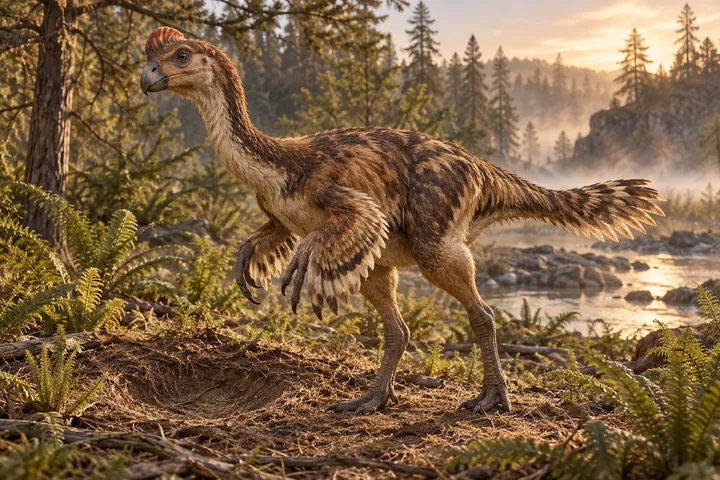
The artist identifies this reconstruction as Citipati osmolskae. This view illustrates one form within the genus, rather than every species or individual. Fossil-informed anatomy: Bipedal oviraptorid with short deep beaked skull, cranial crest and long arms; feathered forelimbs are reconstructed from related evidence. Feathers and coloration are interpretive; species reconstruction represents the genus. [1] [2] [3]
Citipati osmolskae Restoration.png — PaleoNeolitic. CC BY 4.0. Remote source artwork displayed without additional cropping; Wikimedia supplies any display-size derivative.
Scientific picture served by Wikimedia · internet connection required.
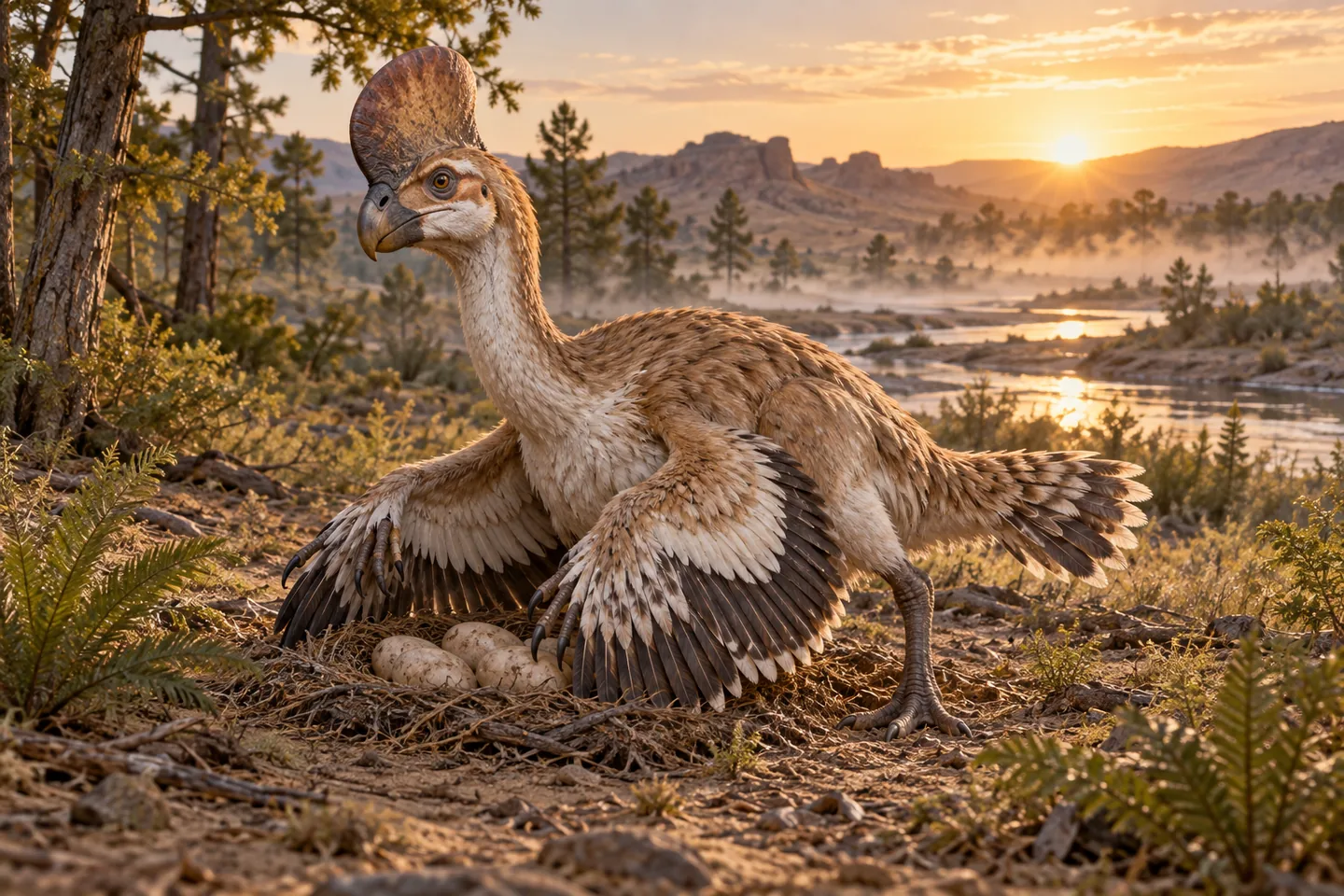
Cinematic Citipati in a birdlike brooding pose, beaked crested head, plausible feathered arms spread over eggs; full body visible in warm Gobi light. Dramatic lighting, surface detail and scenery are artistic choices. This is an original cinema-inspired picture, rather than a frame from a film or a documented fossil locality.
Original artwork · artistic interpretation.
Scientific view: credited paleoart interpreting fossil evidence, served online by Wikimedia. Movie-style view: Original artistic interpretation. Colors, soft tissues and settings involve reconstruction.
MEET THE ANIMAL
Citipati was a two-legged dinosaur from Late Cretaceous Mongolia with a beak rather than teeth. The Natural History Museum lists an omnivorous diet, meaning that both plant and animal foods are proposed. That broad interpretation is useful for imagining its place in an ecosystem, but it is not a list of meals directly recovered from every Citipati fossil. [D1]
One specimen nicknamed Big Mama gives unusually strong evidence about nesting. Its skeleton was preserved curled over a nest of eggs, a position interpreted as brooding. Brooding means sitting over eggs to help incubate or protect them. The roughly 75-million-year-old Mongolian fossil was announced in 1995 and later identified as Citipati when that genus was named in 2001. [S1]
This is much more informative than finding scattered eggs alone: the adult's position connects an animal with a particular nest. Even so, a single frozen moment cannot reveal its whole breeding season. The fossil supports care at the egg stage, while leaving questions about later chick care, courtship and division of parental duties unanswered in this account. [S1]
PREHISTORIC ANIMAL DOSSIER
The animal, the evidence, and the questions still open.
Citipati is an oviraptorid best known for fossils positioned over egg clutches in a bird-like brooding posture. Its well-preserved skull also documents extensive internal air spaces, while its precise diet and mating system remain less certain.
Profile scope: Genus: Citipati; brooding and skull evidence concerns C. osmolskae.
Source supported identifies a description documented by the cited source. Inferred marks a reconstruction or functional estimate. Debated marks competing interpretations. Not established means the sources reviewed for this dossier do not support a firm conclusion; it does not mean a behavior never occurred.
A size reference is an estimate, not a population range. Nesting evidence does not by itself establish courtship, mate choice, or lifelong pairing.
About 2.1 m; museum reference
NHM gives a rounded genus figure with no specified specimen or life stage. It is not a maximum size claim. [D1]
Not established here
The reviewed sources do not establish a numerical body-mass estimate for this record.
Possible omnivore; exact foods unresolved
NHM lists omnivory, but the reviewed material does not establish a menu through gut contents. Beak form alone does not reveal every food consumed. [D1]
Djadokhta Formation, Ukhaa Tolgod, Mongolia
DigiMorph identifies the formation and locality for the C. osmolskae holotype. This is fossil context rather than a demonstrated habitat preference. [D3]
Bipedal theropod; gait unreviewed
Museum skeletal reconstructions show a two-legged theropod. The inspected sources do not establish a running speed or complete gait model. [D2]
Beaked skull with extensive pneumatic recesses
CT work on the holotype documents numerous skull recesses interpreted as air spaces. The skull differs from the true Oviraptor holotype. [D3]
Egg laying; bird-like brooding posture
C. osmolskae fossils are positioned over nests with the forearms spread around the eggs. Which sex brooded and how parental duties were divided remain unresolved. [D2]
Not established here
The reviewed sources do not establish a mating ritual, pair bond or breeding season for this taxon.
Not established here
The reviewed sources do not establish a taxon-specific group structure or social hierarchy.
Sources and inspection notes for the claims in this profile.
THE STORY IN THE FOSSILS
A Citipati skeleton was preserved over the centre of a nest with its forearms extended around the eggs. The posture resembles brooding in living birds. It provides unusually direct evidence that nesting behavior was already present among dinosaurs outside the modern bird lineage. [2]
Museum and Mongolian Academy of Sciences researchers discovered the first Citipati specimens at Ukhaa Tolgod in 1993. Its well-preserved skull also reveals extensive internal air spaces. Comparisons with that skull helped distinguish true Oviraptor from a different, frequently illustrated oviraptorid skeleton. [2] [3]
We have not established a comparable adult total-length estimate for this taxon in this draft. Specimen measurements in the text describe those individuals. The cited dates are approximately 81–75 million years ago. Approximate museum catalogue reference interval for the genus, not an exact duration for every species. Unknown does not mean zero.
Sources and evidence notes for this exhibit.
KEEP EXPLORING
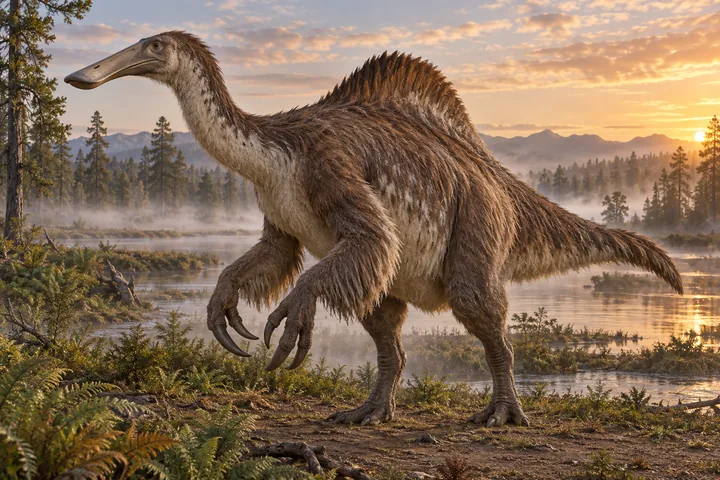
Deinocheirus
The mystery arms belonged to a humped, broad-beaked giant.
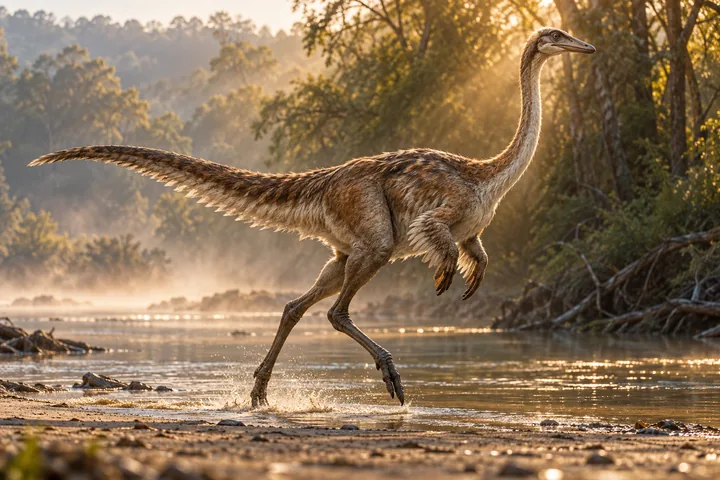
Gallimimus
An ostrichlike runner with a toothless, ducklike beak.
Oviraptor
An “egg thief” whose nest association tells a different story.