Body length
InferredAbout 10 m; museum reference
NHM gives a rounded genus reconstruction. It is not a measurement of every known specimen. [D1]
EXHIBIT 31
Deinocheirus
The mystery arms belonged to a humped, broad-beaked giant.
TWO WAYS TO PICTURE THE PAST
Compare the evidence with the familiar movie image. The illustrations are not to a shared scale.

The artist identifies this reconstruction as Deinocheirus mirificus. This view illustrates one form within the genus, rather than every species or individual. Fossil-informed anatomy: Bulky bipedal ornithomimosaur; broad elongated beak, deep jaw, large clawed hands, high spinal hump, short robust hind limbs and broad foot claws. Body shape informed by more complete fossil discoveries; feather covering and coloration are interpretive. Species reconstruction represents the genus. [1] [2]
Deinocheirus Restoration.png — PaleoNeolitic. CC BY 4.0. Remote source artwork displayed without additional cropping; Wikimedia supplies any display-size derivative.
Scientific picture served by Wikimedia · internet connection required.
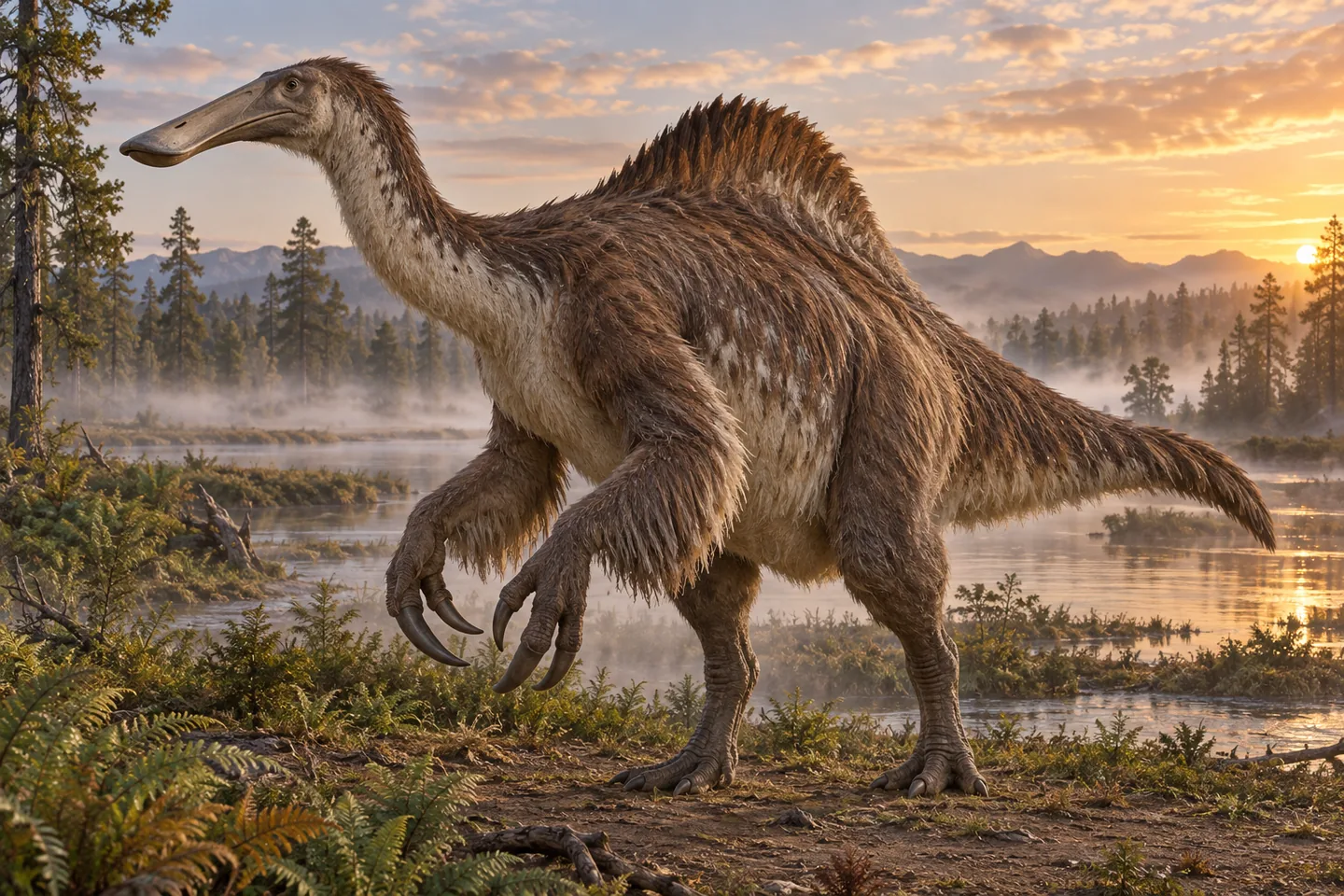
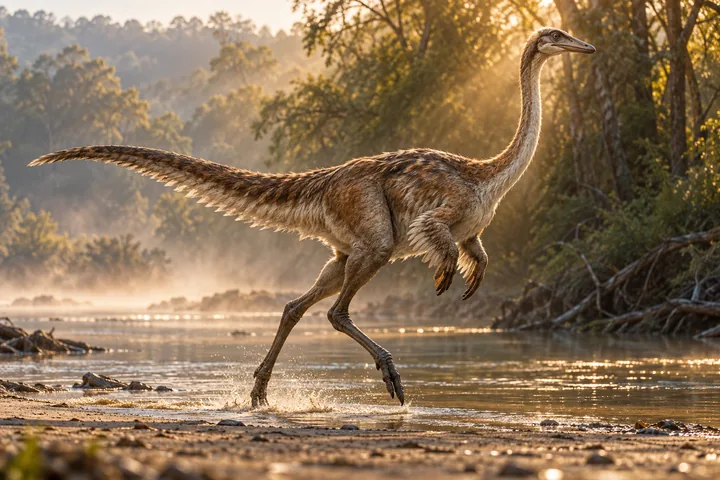
Cinematic Deinocheirus with bulky body, broad ducklike beak, tall high-backed silhouette and huge clawed arms; heavy stance beside a Mongolian wetland. Dramatic lighting, surface detail and scenery are artistic choices. This is an original cinema-inspired picture, rather than a frame from a film or a documented fossil locality.
Original artwork · artistic interpretation.
Scientific view: credited paleoart interpreting fossil evidence, served online by Wikimedia. Movie-style view: Original artistic interpretation. Colors, soft tissues and settings involve reconstruction.
MEET THE ANIMAL
Deinocheirus was a large dinosaur from Late Cretaceous Mongolia whose appearance took decades to understand. The Natural History Museum describes a toothless, duck-like head, long arms and a hump along its back. Its bulky form contrasts with the more familiar slender ostrich-like dinosaurs to which it belongs. A partial skeleton could not initially reveal that surprising combination of features. [D1]
The first spectacular clues were enormous arms recovered during a Polish-Mongolian expedition in 1965 in the Gobi Desert's Nemegt Valley. For years, the limited remains encouraged competing ideas about what sort of animal they came from. Much more complete skeletons, reported in 2014, finally showed that Deinocheirus belonged among the ornithomimosaurs, the dinosaurs often called ostrich mimics. [S1]
The new fossils replaced guesses based mostly on arms with a picture of an animal bearing a long, toothless snout and an unusually heavy body. They also changed interpretations of its lifestyle: frightening-looking hands did not require a fierce, powerful-biting predator. Deinocheirus illustrates how finding missing parts can transform a dinosaur's profile, while reminding us that an impressive claw alone does not identify an animal's diet. [S1]
PREHISTORIC ANIMAL DOSSIER
The animal, the evidence, and the questions still open.
Deinocheirus was a heavily built ornithomimosaur from Mongolia with giant forelimbs, a broad snout and tall back vertebrae. More complete specimens transformed it from a mysterious pair of arms into an unusual omnivore with fish remains and many stomach stones.
Profile scope: Genus: Deinocheirus; detailed anatomy and feeding evidence concerns D. mirificus.
Source supported identifies a description documented by the cited source. Inferred marks a reconstruction or functional estimate. Debated marks competing interpretations. Not established means the sources reviewed for this dossier do not support a firm conclusion; it does not mean a behavior never occurred.
A size reference is an estimate, not a population range. Nesting evidence does not by itself establish courtship, mate choice, or lifelong pairing.
About 10 m; museum reference
NHM gives a rounded genus reconstruction. It is not a measurement of every known specimen. [D1]
Not established here
The reviewed sources do not establish a numerical body-mass estimate for this record.
Omnivory inferred; fish consumption documented
The study reports fish remains as stomach contents and numerous gastroliths. A broad omnivorous diet is inferred from these remains together with skull form. [D2]
Moist environments of Mongolia's Nemegt Formation
The researchers infer mesic environments from the fossil and ecological context. This does not establish that it was exclusively aquatic. [D2]
Heavy biped; not a specialized runner
The study describes short hindlimbs and broad-tipped foot claws in a non-cursorial animal. This is skeletal interpretation, not an exact speed estimate. [D2]
Giant arms; broad snout; tall back spines
More complete D. mirificus specimens document these features. Tall neural spines supported the characteristic elevated profile of the back. [D2] [D1]
Not established here
The reviewed sources do not establish taxon-specific nest structure, clutch size or parental care.
Not established here
The reviewed sources do not establish a mating ritual, pair bond or breeding season for this taxon.
Not established here
The reviewed sources do not establish a taxon-specific group structure or social hierarchy.
Sources and inspection notes for the claims in this profile.
THE STORY IN THE FOSSILS
For decades, Deinocheirus was known mainly from gigantic arms collected during a Polish-Mongolian expedition. Two later specimens supplied the missing context. They revealed an ornithomimosaur with an elongated snout, deep lower jaw and tall vertebral spines, producing its distinctive high-backed profile. [2]
Its heavy body, comparatively short hind limbs and broad foot claws distinguish it from slender running ornithomimids. Researchers interpreted its skull anatomy, numerous stomach stones and preserved fish remains as evidence of omnivory. The fossils suggest an animal associated with environments that had available moisture. [2]
We have not established a comparable adult total-length estimate for this taxon in this draft. Specimen measurements in the text describe those individuals. The cited dates are approximately 70–66 million years ago. Approximate museum catalogue reference interval for the genus, not an exact duration for every species. Unknown does not mean zero.
Sources and evidence notes for this exhibit.
KEEP EXPLORING
Gallimimus
An ostrichlike runner with a toothless, ducklike beak.