Body length
InferredAbout 4 m; genus museum reference
NHM gives this rounded genus value without identifying a specimen, species or life stage. [D1]
EXHIBIT 33
Ornithomimus
A “bird mimic” with fossil evidence of feathers.
TWO WAYS TO PICTURE THE PAST
Compare the evidence with the familiar movie image. The illustrations are not to a shared scale.
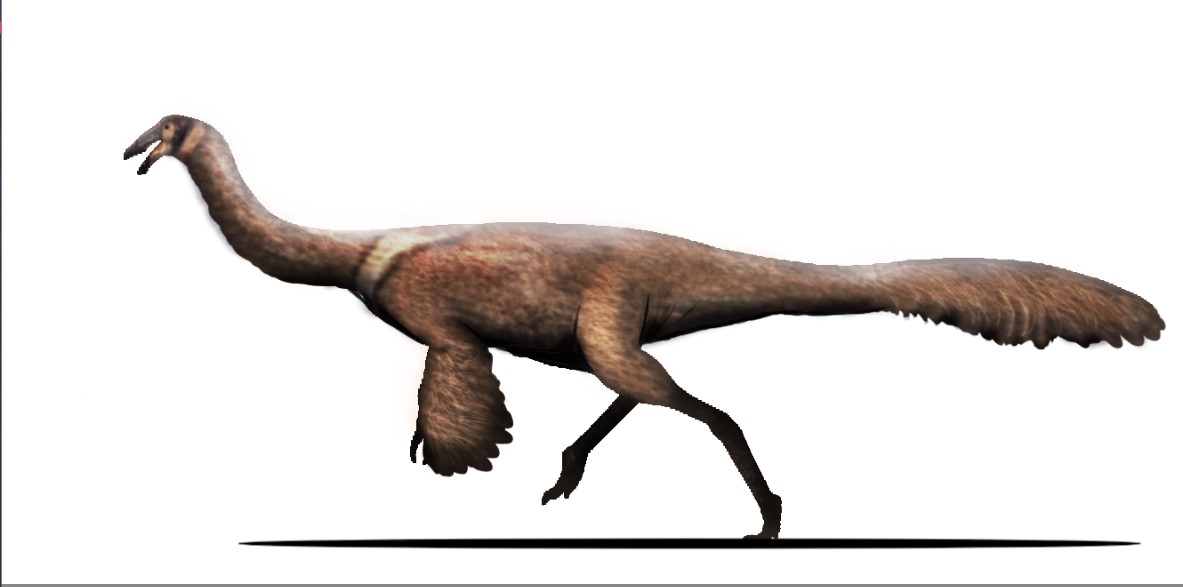
The artist identifies this reconstruction as Ornithomimus. Fossil-informed anatomy: Ostrichlike flightless biped with long legs and balancing tail; show downy body and adult feathered forearms, following O. edmontonicus evidence. The file page identifies the genus only. Colour, feather arrangement and soft-tissue contours are artistic reconstruction; no accuracy warning appears on the read page. [1] [2]
Ornithomimus based on Scott Hartman skeletal.jpg — Stegotyranno. CC BY-SA 4.0. Remote source artwork displayed without additional cropping; Wikimedia supplies any display-size derivative.
Scientific picture served by Wikimedia · internet connection required.
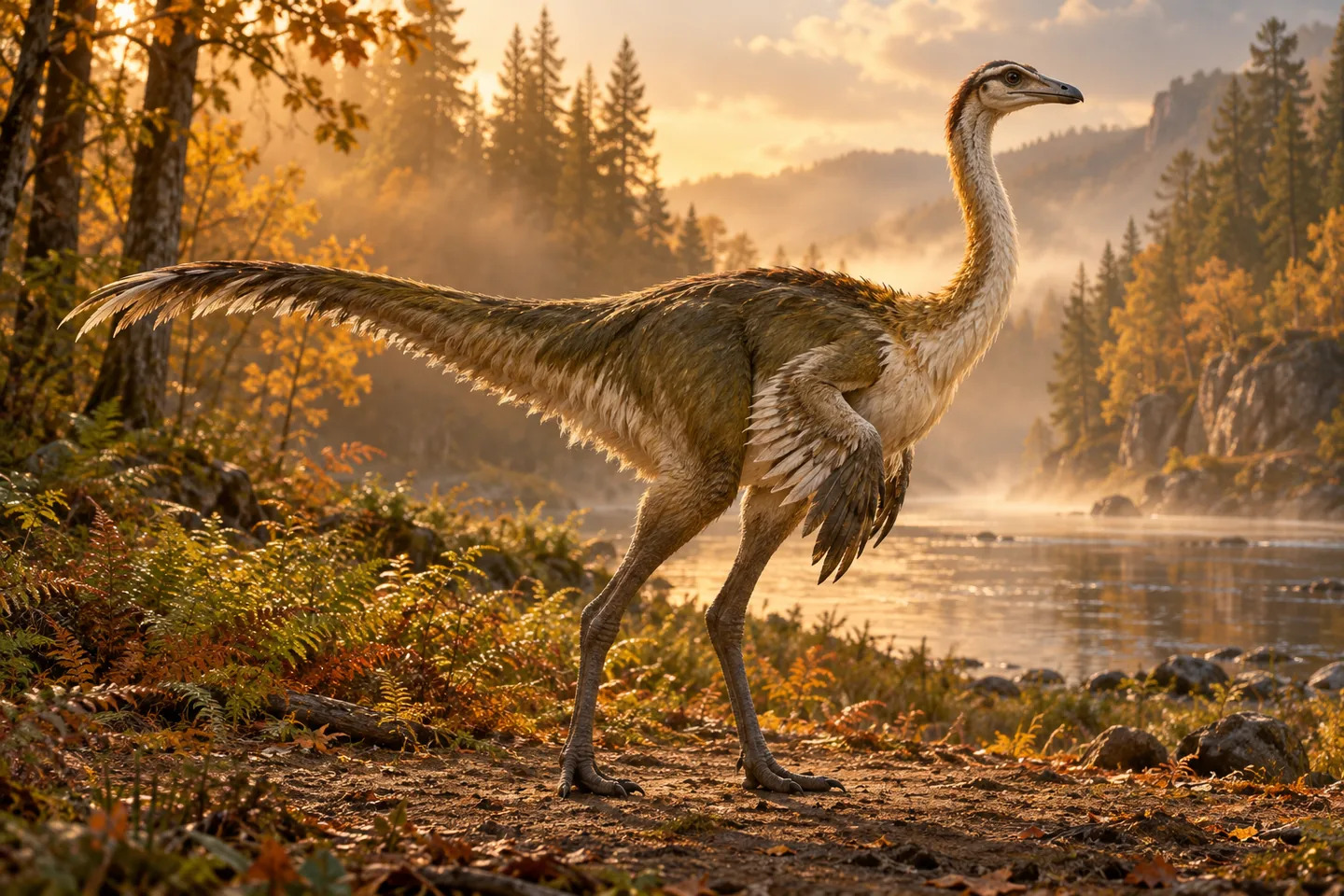
Cinematic adult Ornithomimus with long-legged running proportions, downy covering and feathered forearms; poised birdlike stance with balancing tail in soft floodplain light. Dramatic lighting, surface detail and scenery are artistic choices. This is an original cinema-inspired picture, rather than a frame from a film or a documented fossil locality.
Original artwork · artistic interpretation.
Scientific view: credited paleoart interpreting fossil evidence, served online by Wikimedia. Movie-style view: Original artistic interpretation. Colors, soft tissues and settings involve reconstruction.
MEET THE ANIMAL
Ornithomimus was an ostrich-like dinosaur, and a fossil from the Late Cretaceous Dinosaur Park Formation of Alberta shows just how bird-like its covering could be. Researchers reported preserved feathers on its body and tail together with patches of skin. This combination provides information that a skeleton alone cannot give, because the animal's outer surface rarely survives fossilization. [S1]
The fossil showed bare skin from around the middle of the thigh down the leg, as well as a skin web between the thigh and abdomen. Feathers covered other regions. Comparing this arrangement with ostriches, the researchers proposed that Ornithomimus could have used feathered and bare areas to help control body temperature. The resemblance supports an interpretation, rather than a direct measurement of its temperature. [S1]
Although burial had crushed the feathers, powerful microscopy revealed their surviving three-dimensional structure. That makes the specimen more than an outline of a fuzzy dinosaur: it preserves physical evidence of its covering. Ornithomimus helps show how traits familiar in living birds already existed in their dinosaur relatives, while its exact daily routines remain beyond what this fossil records. [S1]
PREHISTORIC ANIMAL DOSSIER
The animal, the evidence, and the questions still open.
Ornithomimus was a North American ornithomimid, and specimens assigned to O. edmontonicus preserve filamentous feathers. Adult forelimb feather structures provide evidence relevant to the evolution of wings before powered flight in this lineage.
Profile scope: Genus: Ornithomimus; feather and adult-function interpretations concern O. edmontonicus.
Source supported identifies a description documented by the cited source. Inferred marks a reconstruction or functional estimate. Debated marks competing interpretations. Not established means the sources reviewed for this dossier do not support a firm conclusion; it does not mean a behavior never occurred.
A size reference is an estimate, not a population range. Nesting evidence does not by itself establish courtship, mate choice, or lifelong pairing.
About 4 m; genus museum reference
NHM gives this rounded genus value without identifying a specimen, species or life stage. [D1]
About 160 kg; O. edmontonicus reference
Berkeley's adult O. edmontonicus account gives about 350 pounds, approximately 160 kg. This is a rounded reference estimate, not a genus-wide mass range. [D3]
Omnivory proposed
NHM lists the genus as omnivorous. The reviewed material does not demonstrate a particular mix of foods through gut contents. [D1]
North America; river-deposit feather specimens
NHM records Canada and the USA; the feather account reports river-associated deposits for O. edmontonicus. Burial setting is not an exclusive habitat preference. [D1] [D3]
Bipedal and flightless
Berkeley describes the ostrich-like, flightless skeleton of O. edmontonicus. Winglike arm feathers do not establish flight. [D3]
Filamentous plumage; adult winglike forelimb structures
The study describes filamentous feathers at different growth stages and winglike forelimb structures in adults. These observations are specimen evidence, not a complete record of all species. [D2]
Adult feathers may relate to reproduction
Adult-specific feather structures led researchers to propose reproductive functions, such as brooding or signaling. This is not a preserved Ornithomimus nest or proof of a parenting system. [D2] [D3]
Feather display possible; sequence unknown
Adult forelimb feathers have been interpreted as possible mate-attraction structures. Actual displays, sex differences and pair bonds remain unestablished. [D3]
Not established here
The reviewed sources do not establish a taxon-specific group structure or social hierarchy.
Sources and inspection notes for the claims in this profile.
THE STORY IN THE FOSSILS
Ornithomimus belongs to the ornithomimid branch of theropods and is recorded from Canada and the United States. Its ostrichlike skeleton gave it the name bird mimic. Museum profiles describe an omnivorous diet, but feather fossils provide its most distinctive evidence about living appearance. [1] [2]
A juvenile Ornithomimus edmontonicus preserved downy filaments, while an adult specimen showed traces of feathers with central shafts. Because this dinosaur was flightless, researchers proposed an adult role such as display or brooding. The finding broadened evidence for complex feathers among dinosaur lineages. [2]
We have not established a comparable adult total-length estimate for this taxon in this draft. Specimen measurements in the text describe those individuals. The cited dates are approximately 74–66 million years ago. Approximate museum catalogue reference interval for the genus, not an exact duration for every species. Unknown does not mean zero.
Sources and evidence notes for this exhibit.
KEEP EXPLORING
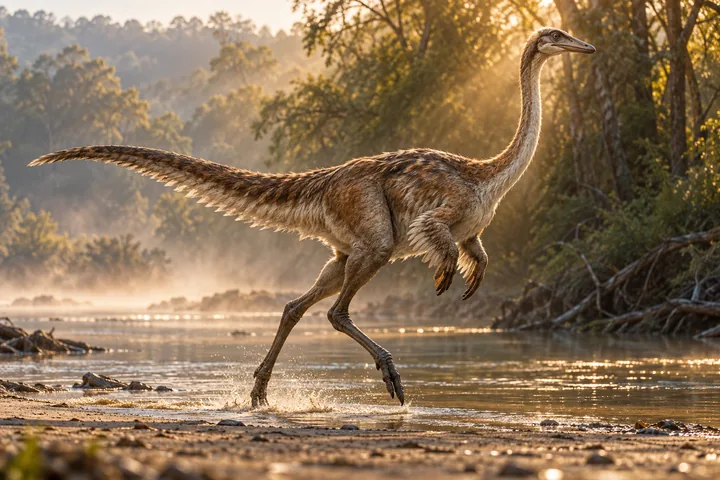
Gallimimus
An ostrichlike runner with a toothless, ducklike beak.
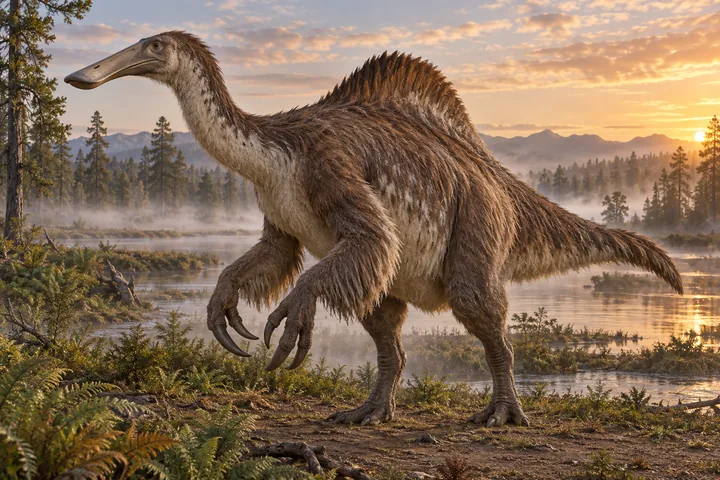
Deinocheirus
The mystery arms belonged to a humped, broad-beaked giant.