Body length
InferredAbout 6 m; museum reference
NHM supplies this rounded genus figure without identifying a particular specimen or life stage. [D1]
EXHIBIT 32
Gallimimus
An ostrichlike runner with a toothless, ducklike beak.
TWO WAYS TO PICTURE THE PAST
Compare the evidence with the familiar movie image. The illustrations are not to a shared scale.

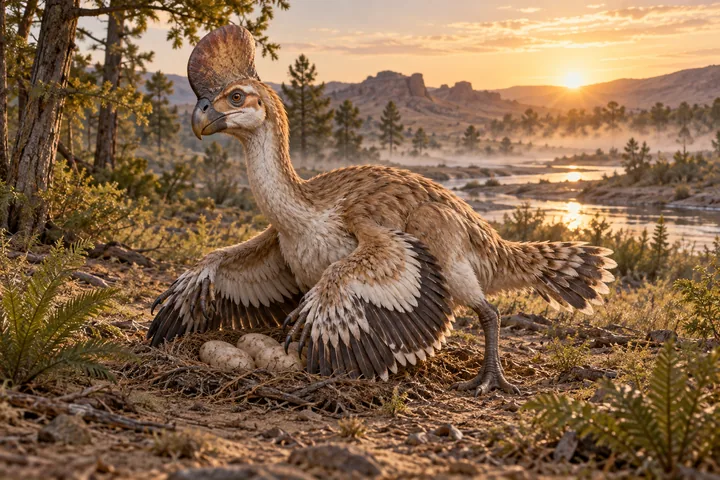
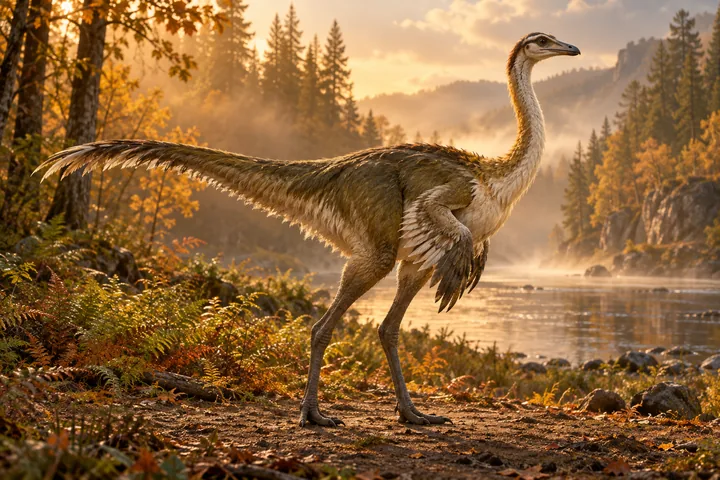
The artist identifies this reconstruction as Gallimimus bullatus. This view illustrates one form within the genus, rather than every species or individual. Fossil-informed anatomy: Slender bipedal ornithomimid with long legs, long neck, toothless ducklike beak and balancing tail; feather coat is inferred. Feather coverage extrapolates from Ornithomimus; the file page states this assumption. Colours and patterns are speculative. [1] [2]
Gallimimus Steveoc86.jpg — Steveoc 86. CC BY 2.5. Remote source artwork displayed without additional cropping; Wikimedia supplies any display-size derivative.
Scientific picture served by Wikimedia · internet connection required.
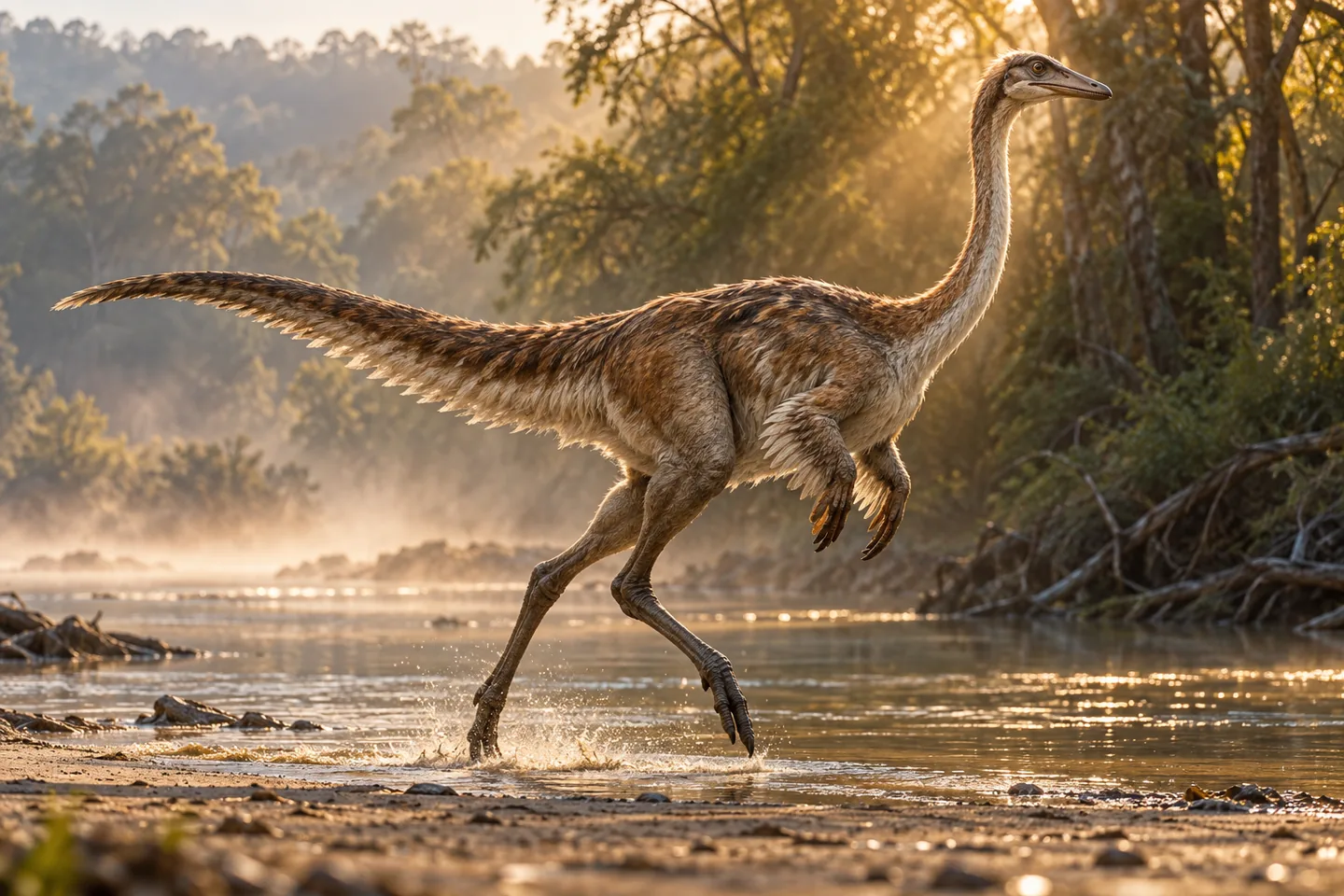
Cinematic Gallimimus with ostrichlike long-legged build, long neck, ducklike toothless beak and inferred feathers; dynamic running silhouette across a floodplain. Dramatic lighting, surface detail and scenery are artistic choices. This is an original cinema-inspired picture, rather than a frame from a film or a documented fossil locality.
Original artwork · artistic interpretation.
Scientific view: credited paleoart interpreting fossil evidence, served online by Wikimedia. Movie-style view: Original artistic interpretation. Colors, soft tissues and settings involve reconstruction.
MEET THE ANIMAL
Gallimimus was an ostrich-mimic dinosaur from the Late Cretaceous of Mongolia's Gobi Desert. The original scientific description examined fossils from the Nemegt beds, including a nearly complete skeleton with a skull. Its reconstruction shows a small head, long neck and tail, and long hind legs. These connected remains gave researchers more to work with than isolated bones could provide. [S1]
Its toothless jaws carried a beak. Remarkably, a fossil preserves part of the material that covered that beak, including small ridges along its inner surface. Researchers initially compared these structures with the filtering edges of duck beaks. That comparison led to a proposal that Gallimimus might have strained small food particles from water or sediment. [S2]
A later study challenged the filtering interpretation. It argued that the preserved structures could instead be ordinary ridges forming part of the beak, rather than separate flexible filters. This debate shows why a beak's shape does not give a complete menu. Gallimimus belonged to a group with unusual feeding adaptations, but the exact balance of its foods remains a research question. [S2]
PREHISTORIC ANIMAL DOSSIER
The animal, the evidence, and the questions still open.
Gallimimus was a large, long-legged ornithomimid from Late Cretaceous Mongolia with a toothless beak. Its skeleton supports a running lifestyle, while beak function and the exact mixture of plant and animal foods remain interpreted rather than directly observed.
Profile scope: Genus: Gallimimus; museum reference and inferred behavior.
Source supported identifies a description documented by the cited source. Inferred marks a reconstruction or functional estimate. Debated marks competing interpretations. Not established means the sources reviewed for this dossier do not support a firm conclusion; it does not mean a behavior never occurred.
A size reference is an estimate, not a population range. Nesting evidence does not by itself establish courtship, mate choice, or lifelong pairing.
About 6 m; museum reference
NHM supplies this rounded genus figure without identifying a particular specimen or life stage. [D1]
About 490 kg; museum estimate
The museum figure does not specify a specimen or mass reconstruction method and is not a species average. [D1]
Probable omnivore; feeding mechanics debated
NHM discusses proposals for filtering food, eating small animals and cropping vegetation. Its omnivore classification summarizes interpretation, rather than preserved mixed gut contents. [D1]
Late Cretaceous Mongolia
The museum identifies Mongolia as the fossil region. Habitat preference is not narrowed by this source. [D1]
Bipedal runner
Its long-legged skeleton supports running on two legs. Published speed estimates are models, not directly measured behavior. [D1]
Toothless beak; ostrich-like body form
Beak and skeleton are documented, while plumage is inferred from feathered relatives. Similarity to ostriches does not make Gallimimus an ostrich ancestor. [D1]
Not established here
The reviewed sources do not establish taxon-specific nest structure, clutch size or parental care.
Not established here
The reviewed sources do not establish a mating ritual, pair bond or breeding season for this taxon.
Grouping possible; flock structure unknown
NHM notes multiple skeletons in one bonebed as evidence consistent with grouping. Shared death alone does not resolve stable flock membership or coordinated movement. [D1]
Sources and inspection notes for the claims in this profile.
THE STORY IN THE FOSSILS
Gallimimus belonged to the ostrichlike ornithomimids, a group of two-legged theropods. Its name refers to neck vertebrae resembling those of chickens. Feathering is expected because relatives preserve it, while multiple skeletons in a bonebed suggest that at least some individuals died together. [1] [2]
The toothless beak has prompted competing feeding hypotheses. Some researchers compared internal structures with water-filtering birds; others interpreted them as ridges for handling plant food. The Natural History Museum regards omnivory as the most likely interpretation, while acknowledging uncertainty about the details. [1]
We have not established a comparable adult total-length estimate for this taxon in this draft. Specimen measurements in the text describe those individuals. The cited dates are approximately 70 million years ago. The NHM catalogue gives approximately 70 Ma; the cited Museums Victoria guide uses 70–65 Ma. Equal endpoints represent a reference age, not a full temporal range. Unknown does not mean zero.
Sources and evidence notes for this exhibit.
KEEP EXPLORING
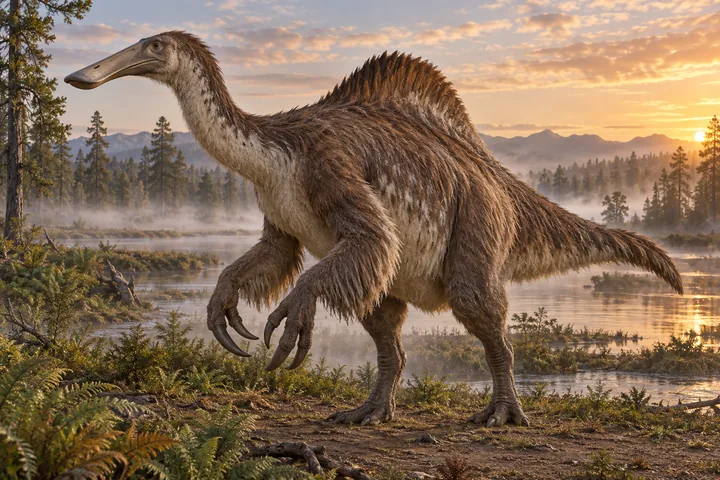
Deinocheirus
The mystery arms belonged to a humped, broad-beaked giant.