
Body length
Not establishedNot established here
The original reconstruction estimates a skull about 500 mm long; an incomplete skull without a body does not establish total length. [D1]
EXHIBIT 161
Dracovenator regenti
Dracovenator is known chiefly from disarticulated jaw and snout bones in South Africa’s upper Elliot Formation. [1]
TWO WAYS TO PICTURE THE PAST
Compare the evidence with the familiar movie image. The illustrations are not to a shared scale.
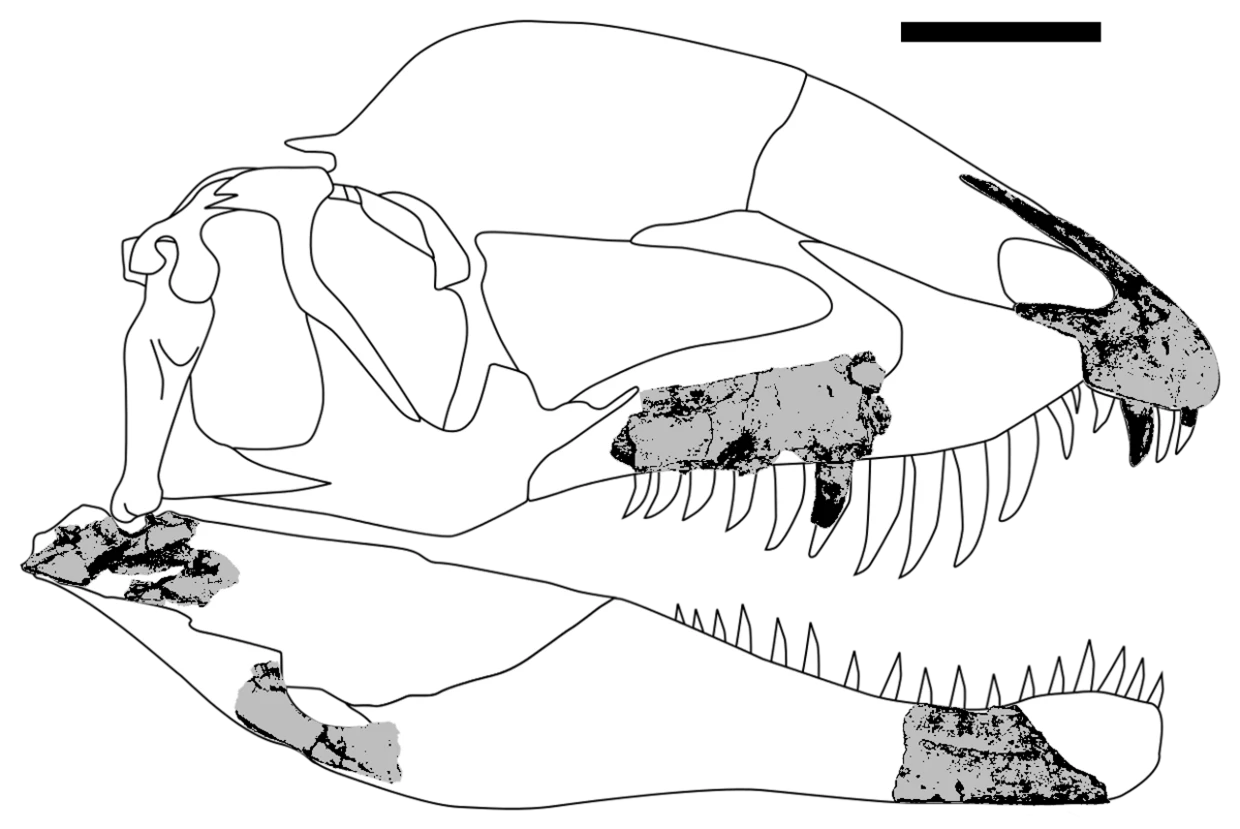
Dracovenator regenti fossil-material diagram by Ornitholestes, based on Yates’s original description. Preserved pieces are placed within a skull restoration based on Dilophosaurus. The complete head, high crest outline and unfilled regions are comparative restoration; the diagram does not demonstrate a fully preserved Dracovenator crest, body length or mature individual. [4]
Dracovenator fossils.png · Ornitholestes. Public domain. Commons preview proportionally reduced back to the source’s nominal 1240 px width, converted to WebP and reduced for thumbnail use. Original reconstruction retained; no cropping, mirroring, anatomical edits or compositing.
Skeletal mounts and drawings may restore missing parts; the caption identifies the displayed material.
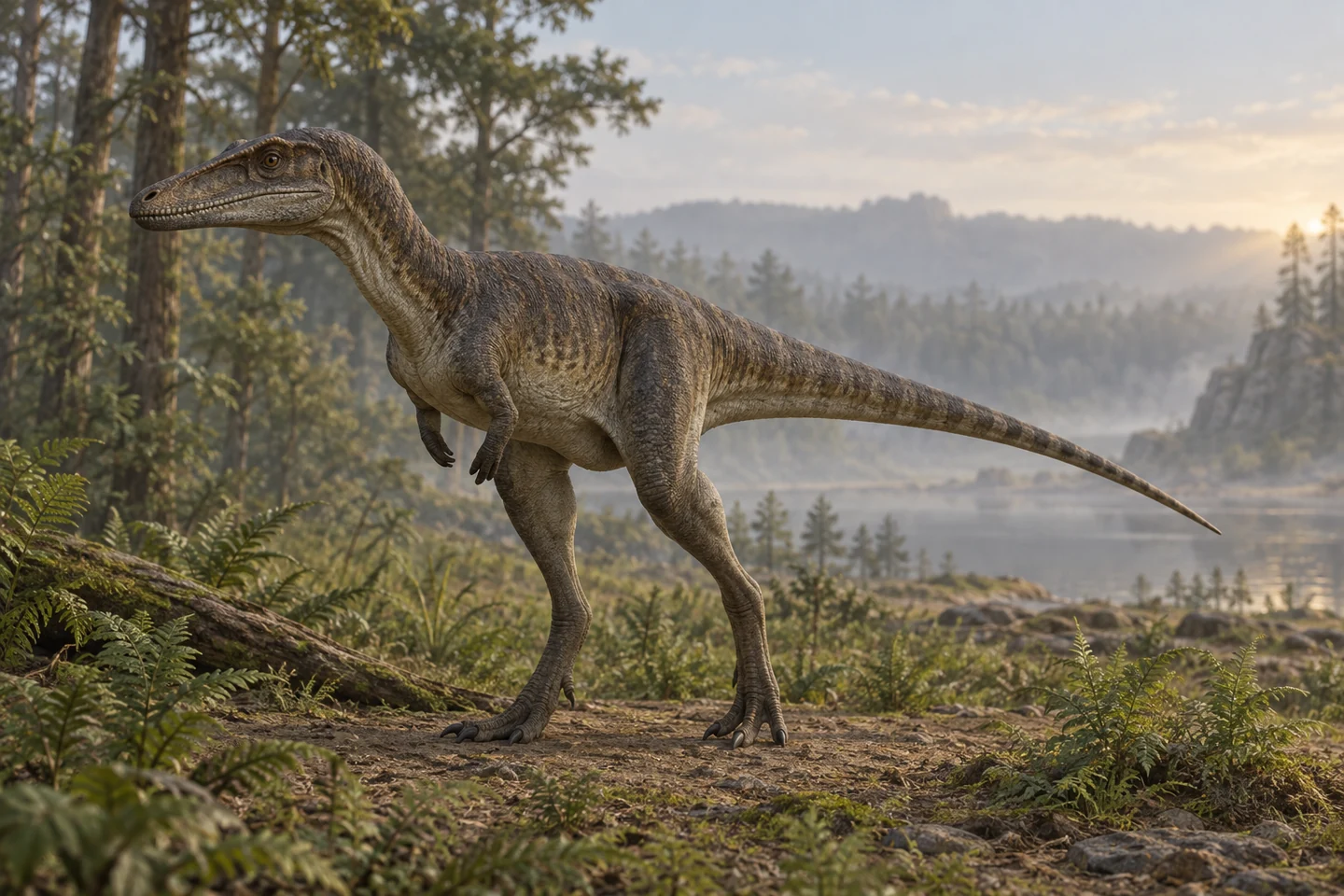
Original cinematic interpretation of Dracovenator. Fragmentary snout and jaw fossils constrain only part of the head; whole-body proportions and the crestless skull roof are comparative artistic choices. Lighting, colors and scenery are artistic choices; this image does not document directly observed behavior. Lighting, coloration and scenery are artistic choices. This image does not document a fossil locality or behavior.
Original artwork · artistic interpretation.
Scientific view: source-informed reconstruction, credited paleoart or specimen-based imagery. Movie-style view: Original artistic interpretation. Reconstructions involve uncertainty.
MEET THE ANIMAL
Dracovenator was an Early Jurassic dinosaur from South Africa. Its partial skull and teeth support a carnivorous interpretation, but the original fossil does not preserve its body. [D1]
The snout provides distinctive anatomy, while the complete crest configuration is unknown. Some related dinosaurs preserve clear paired crests, but their appearance cannot simply be copied onto Dracovenator as established fact. Small pieces of a skull do not reveal the whole outline above it. An impressive illustrated crest is therefore a reconstruction whose shape and possible purpose still need evidence. An unknown crest also cannot establish whether males and females looked different or how they courted. [D4]
A smaller skull has been tentatively referred to Dracovenator after a complicated naming history. That assignment remains uncertain. It cannot securely identify a young Dracovenator or supply a measured growth sequence for the species. Researchers must establish that the smaller fossil really belongs to the same dinosaur before using the pair to explain development, breeding age or the care of offspring. [D3]
PREHISTORIC ANIMAL DOSSIER
The animal, the evidence, and the questions still open.
The preserved snout supports distinctive cranial anatomy, while its body, full crest and secure juvenile identity remain unresolved. [D4] [D3]
Profile scope: Genus — Dracovenator; D. regenti type BP/1/5243 anchors the profile; the smaller referred skull is tentative. [D3]
Source supported identifies a description documented by the cited source. Inferred marks a reconstruction or functional estimate. Debated marks competing interpretations. Not established means the sources reviewed for this dossier do not support a firm conclusion; it does not mean a behavior never occurred.
A size reference is an estimate, not a population range. Nesting evidence does not by itself establish courtship, mate choice, or lifelong pairing.
Not established here
The original reconstruction estimates a skull about 500 mm long; an incomplete skull without a body does not establish total length. [D1]
Not established here
No postcranial type or defensible whole-body model is established by the reviewed original description. [D1]
Animal prey inferred
Preserved jaw and tooth anatomy supports carnivory. The name’s hunting interpretation does not document a specific prey animal. [D1]
Upper Elliot seasonal fluvial setting
The South African type belongs to upper Elliot deposits; regional work describes increasingly arid conditions and shallow ephemeral flood channels. [D1] [D2]
Two-legged restoration by comparison
No type limb bones establish gait. A bipedal body is comparative reconstruction, not a taxon-specific speed estimate. [D1]
Distinctive partial snout and jaw
Preserved features diagnose the type; the complete crest configuration remains unknown and should not copy Dilophosaurus uncritically. [D4] [D1]
Not established here
The smaller BP/1/5278 skull is tentatively referred. It cannot securely establish Dracovenator hatchlings, breeding age or parental care. [D3]
Not established here
An incompletely known cranial crest does not demonstrate sex differences, mate choice or a display ritual. [D4]
Not established here
The type and tentative smaller skull came from different localities; they do not document a social or family association. [D3] [D1]
Sources and inspection notes for the claims in this profile.
THE STORY IN THE FOSSILS
Later cranial comparisons classify the complete crest condition as unknown. Small preserved snout pieces cannot determine the profile of an entire crest. [4]
Regional upper Elliot studies refine the Early Jurassic environmental context without making the tentative small-skull referral certain. [2] [3]
The dossier identifies the scope of each reference estimate. A mount, an individual fossil and a species-wide adult range are different measurements. Comparison metrics remain unavailable where adult scope has not been established. Unknown does not mean zero.
Sources support the stated claims and scopes. Refer to the evidence notes for uncertainty.
KEEP EXPLORING
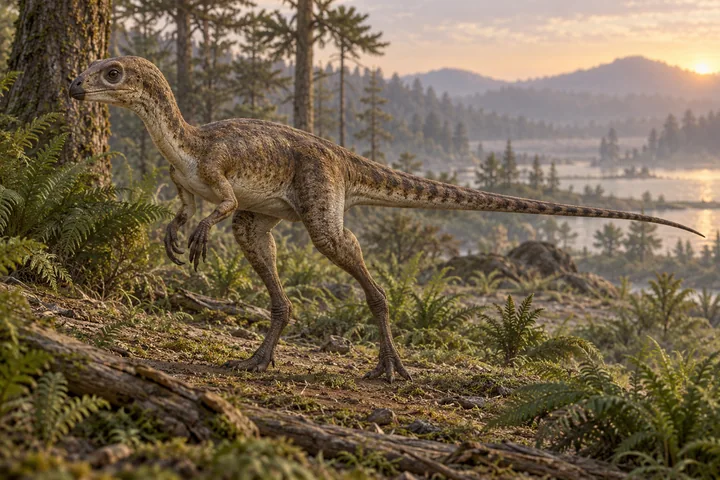
Eocursor parvus
Eocursor was a small early ornithischian with elongated hindlimbs, substantial hands and teeth consistent with at least some plant eating.
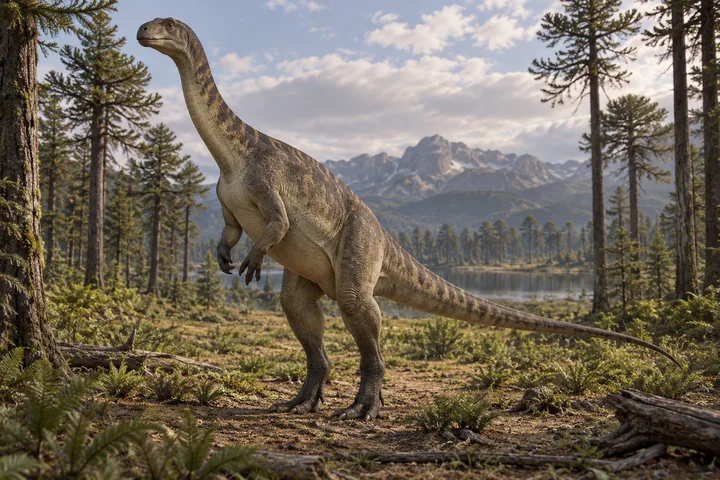
Mussaurus patagonicus
Mussaurus grew from tiny hatchlings into large sauropodomorphs. Eggs and clustered skeletons from Patagonia provide unusually rich evidence for nesting and age-related social organization.
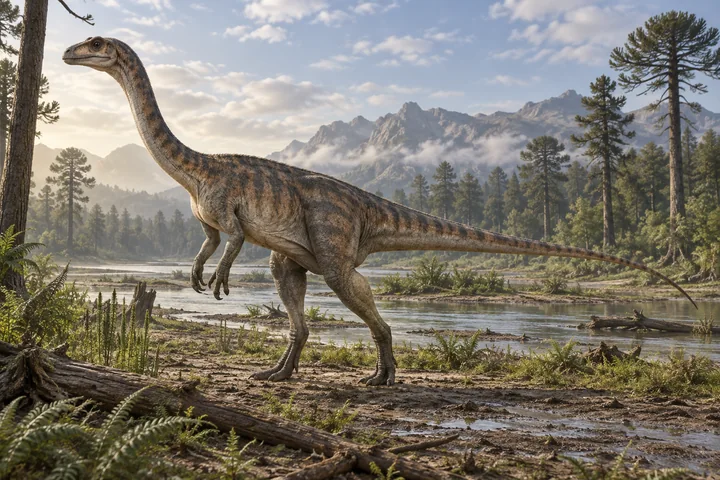
Massospondylus carinatus
Massospondylus was a southern African sauropodomorph with a long neck and a prominent thumb claw. Preserved eggs, embryos and nesting grounds illuminate reproduction while young-animal posture remains debated.