
Length
InferredAbout 1 m (holotype reconstruction)
The anatomical study’s abstract gives this approximate reconstruction; the individual’s ontogenetic status remains uncertain. It cannot establish an adult species range. [D2]
EXHIBIT 116
Eocursor parvus
Eocursor was a small early ornithischian with elongated hindlimbs, substantial hands and teeth consistent with at least some plant eating. [1]
TWO WAYS TO PICTURE THE PAST
Compare the evidence with the familiar movie image. The illustrations are not to a shared scale.
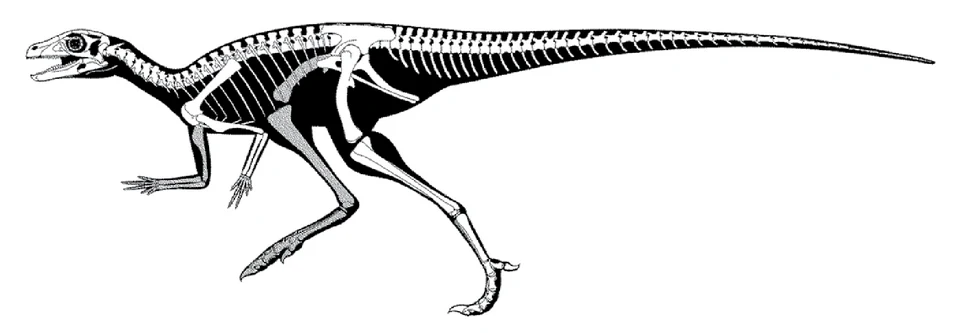
Published skeletal reconstruction of E. parvus after its partial holotype. Missing material is reconstructed; the silhouette does not establish adult size, colors or body covering. [1]
Eocursor (skeletal reconstruction) · D. B. Norman, M. G. Baron, M. S. Garcia and R. T. Müller. CC BY 4.0. Commons-listed 960 px preview converted to WebP; smaller responsive copy proportionally resized. Original diagram preserved without anatomy alterations.
Skeletal mounts and drawings may restore missing parts; the caption identifies the displayed material.
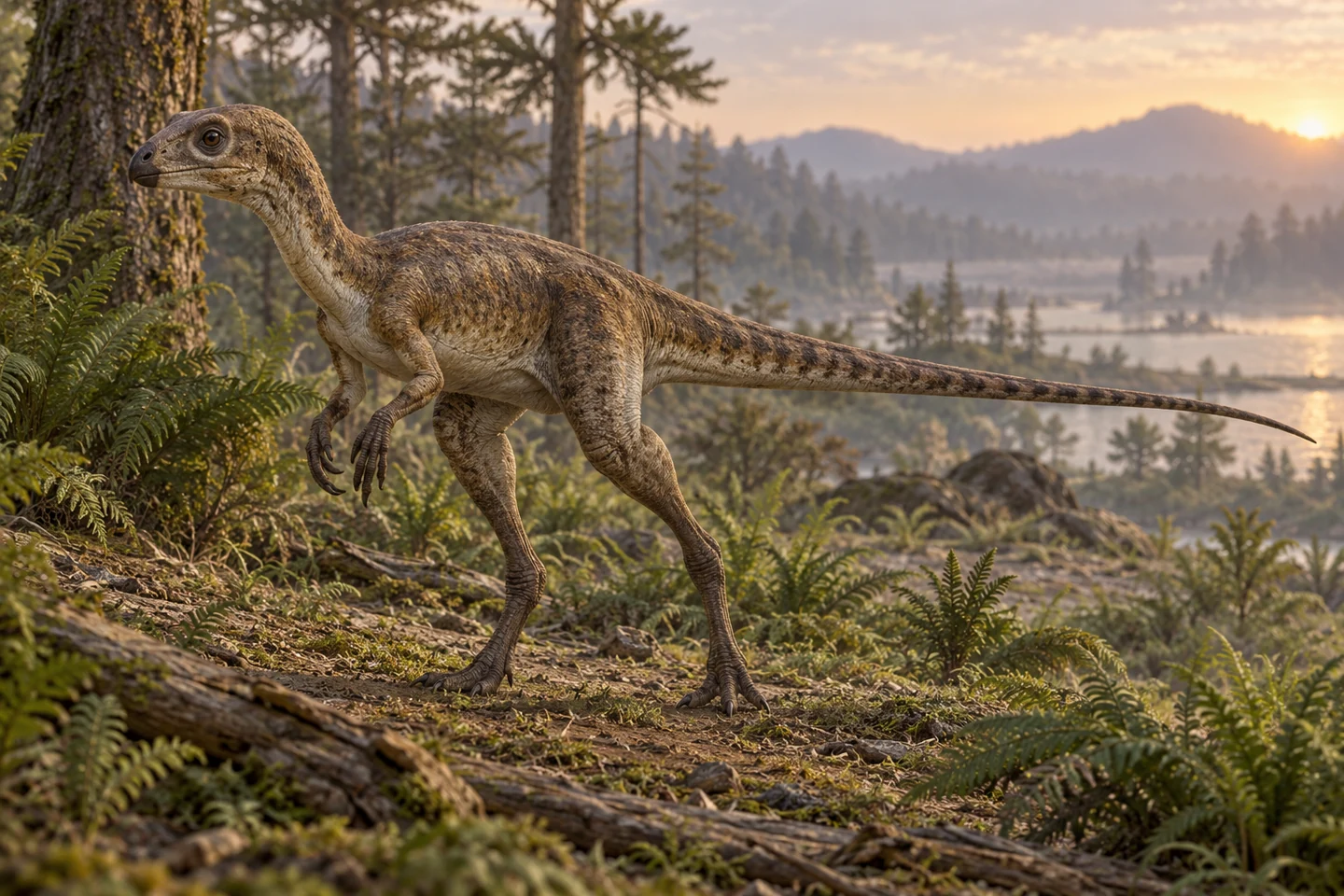
Original cinematic interpretation of Eocursor parvus. Colors, soft tissues, scenery and missing anatomy are reconstructed artistic choices; this is not a directly observed individual or behavior. Lighting, coloration and scenery are artistic choices. This image does not document a fossil locality or behavior.
Original artwork · artistic interpretation.
Scientific view: source-informed reconstruction, credited paleoart or specimen-based imagery. Movie-style view: Original artistic interpretation. Reconstructions involve uncertainty.
MEET THE ANIMAL
Eocursor was a small dinosaur known from a partial skull and body skeleton. An anatomical study reconstructs it at roughly one metre, but the individual's growth stage remains uncertain. That reference should not be read as an adult maximum. Its small body offers evidence about early ornithischians, one major branch of the dinosaur family tree. [D2]
Leaf-shaped teeth, relatively large hands and elongated lower hindlimbs help distinguish its anatomy. The leg proportions suggest an ability to run, while the pelvis combines features retained from earlier relatives with more advanced ones. Those comparisons help researchers investigate its relationships. They cannot recover an exact running speed or a complete living appearance from the preserved bones. [D2]
Its South African locality was originally assigned to the Late Triassic, but later fieldwork placed it in the Upper Elliot Formation, probably in the earliest Jurassic. A research review explains why that revision matters for the early history of ornithischians. Reassigning the fossil's rock layer changes its geological context; it does not directly measure the age of the individual dinosaur. [S1]
PREHISTORIC ANIMAL DOSSIER
The animal, the evidence, and the questions still open.
The skeleton combines primitive features with a bipedal body plan. Its incomplete preservation and uncertain maturity make the size reconstruction a reference for one fossil, rather than an adult species range. [D2] [D1]
Profile scope: E. parvus, based on partial holotype SAM-PK-K8025; its locality is reassigned to the Early Jurassic Upper Elliot Formation. [D3] [D1]
Source supported identifies a description documented by the cited source. Inferred marks a reconstruction or functional estimate. Debated marks competing interpretations. Not established means the sources reviewed for this dossier do not support a firm conclusion; it does not mean a behavior never occurred.
A size reference is an estimate, not a population range. Nesting evidence does not by itself establish courtship, mate choice, or lifelong pairing.
About 1 m (holotype reconstruction)
The anatomical study’s abstract gives this approximate reconstruction; the individual’s ontogenetic status remains uncertain. It cannot establish an adult species range. [D2]
About 3.5 kg (limb model)
Benson models SAM-PK-K8025 using estimated femoral circumference and flags an immature reference. This is not an adult mass; independent maturity remains uncertain. [D4]
At least partly herbivorous
Leaf-shaped teeth support facultative herbivory. They do not demonstrate an exclusively plant-based diet or identify particular non-plant foods. [D1]
Upper Elliot Formation; South Africa
Field reassessment places the Damplaats type locality in the Early Jurassic upper unit. This revises the older Late Triassic assignment rather than directly dating the fossil. [D3]
Bipedal movement inferred
Elongated hindlimbs support a two-legged reconstruction and likely cursorial ability; no measured running speed is available. [D1]
Primitive hands and teeth; elongated hindlimbs
The partial skeleton combines relatively substantial hands with leaf-shaped teeth and a gracile hindlimb plan. Complete body covering and living colors are unknown. [D1]
Not established here
No assigned eggs, nests, incubation pattern or parental care were established. An immature-reference flag does not provide an age at reproduction.
Not established here
The reviewed material does not establish sex differences, mate choice or a mating display. Behaviors of other ornithischians are not transferred to this species.
Not established here
The partial holotype does not establish herds, family groups or solitary behavior. No securely assigned social trace was identified in the focused review.
Sources and inspection notes for the claims in this profile.
THE STORY IN THE FOSSILS
Eocursor’s partial skeleton preserves a mosaic of early ornithischian features. The hands remain comparatively substantial, while the hindlimbs support a bipedal reconstruction. Much of the complete living silhouette must still be inferred. [1]
Rechecking the Damplaats geology changed the fossil’s temporal setting: the locality belongs to the Upper Elliot rather than the lower unit. That correction matters when using Eocursor to discuss dinosaur evolution across the Triassic–Jurassic boundary. [3]
The dossier identifies the scope of each reference estimate. A mount, an individual fossil and a species-wide adult range are different measurements. Comparison metrics remain unavailable where adult scope has not been established. Unknown does not mean zero.
Sources support the stated claims and scopes. Refer to the evidence notes for uncertainty.
KEEP EXPLORING
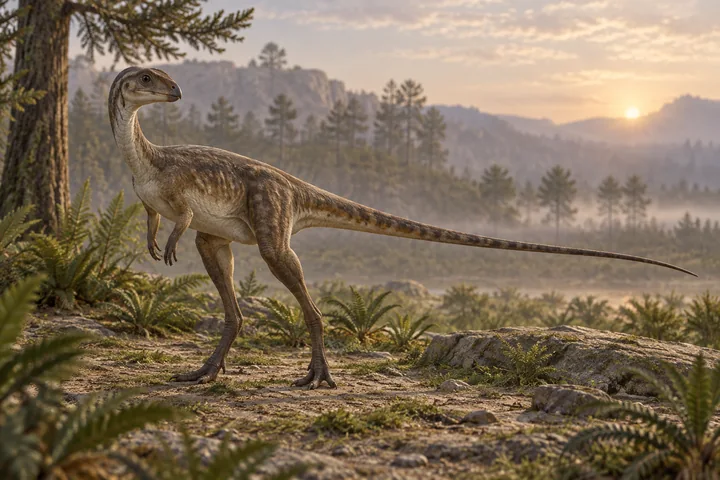
Lesothosaurus diagnosticus
Lesothosaurus was a small early ornithischian.
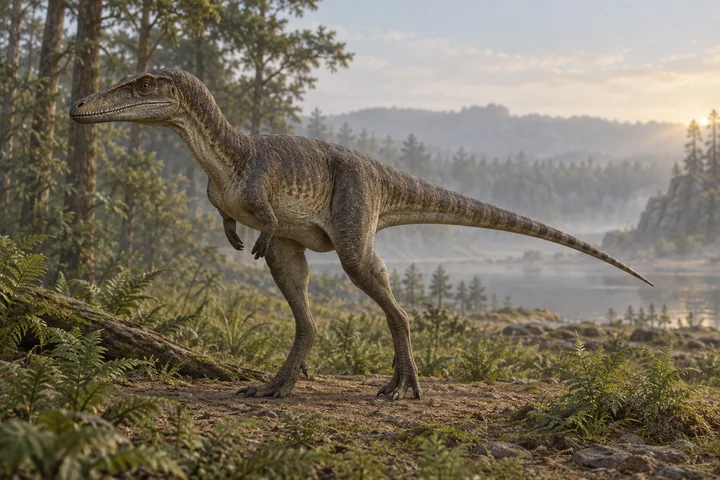
Dracovenator regenti
Dracovenator is known chiefly from disarticulated jaw and snout bones in South Africa’s upper Elliot Formation.
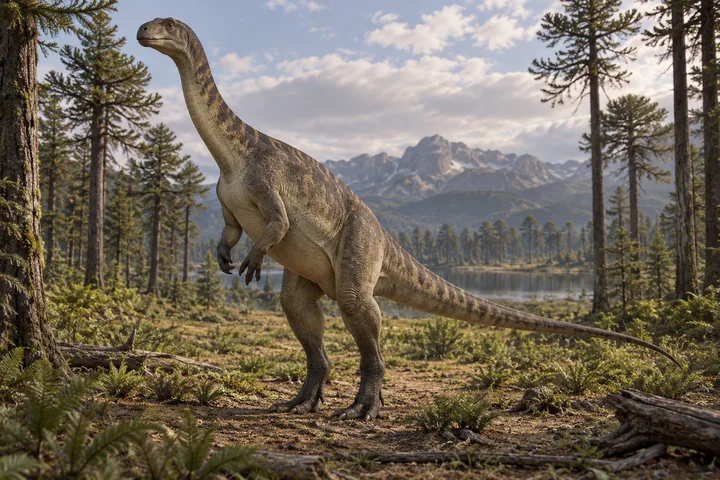
Mussaurus patagonicus
Mussaurus grew from tiny hatchlings into large sauropodomorphs. Eggs and clustered skeletons from Patagonia provide unusually rich evidence for nesting and age-related social organization.