
Body length
InferredAbout 3.4 m for modeled CMNH 5768
The orbit-opercular method gives about 3.4 m for one large, probably adult individual; CMNH 5936 is a separate fragment modeled near 4.1 m. [D2]
EXHIBIT 212
Dunkleosteus terrelli
Prehistoric fish
Dunkleosteus terrelli was an armored Devonian fish from Ohio. Bony jaw blades and preserved armor constrain its reconstruction, while much of the tail remains unknown. [3]
TWO WAYS TO PICTURE THE PAST
Compare the evidence with the familiar movie image. The illustrations are not to a shared scale.
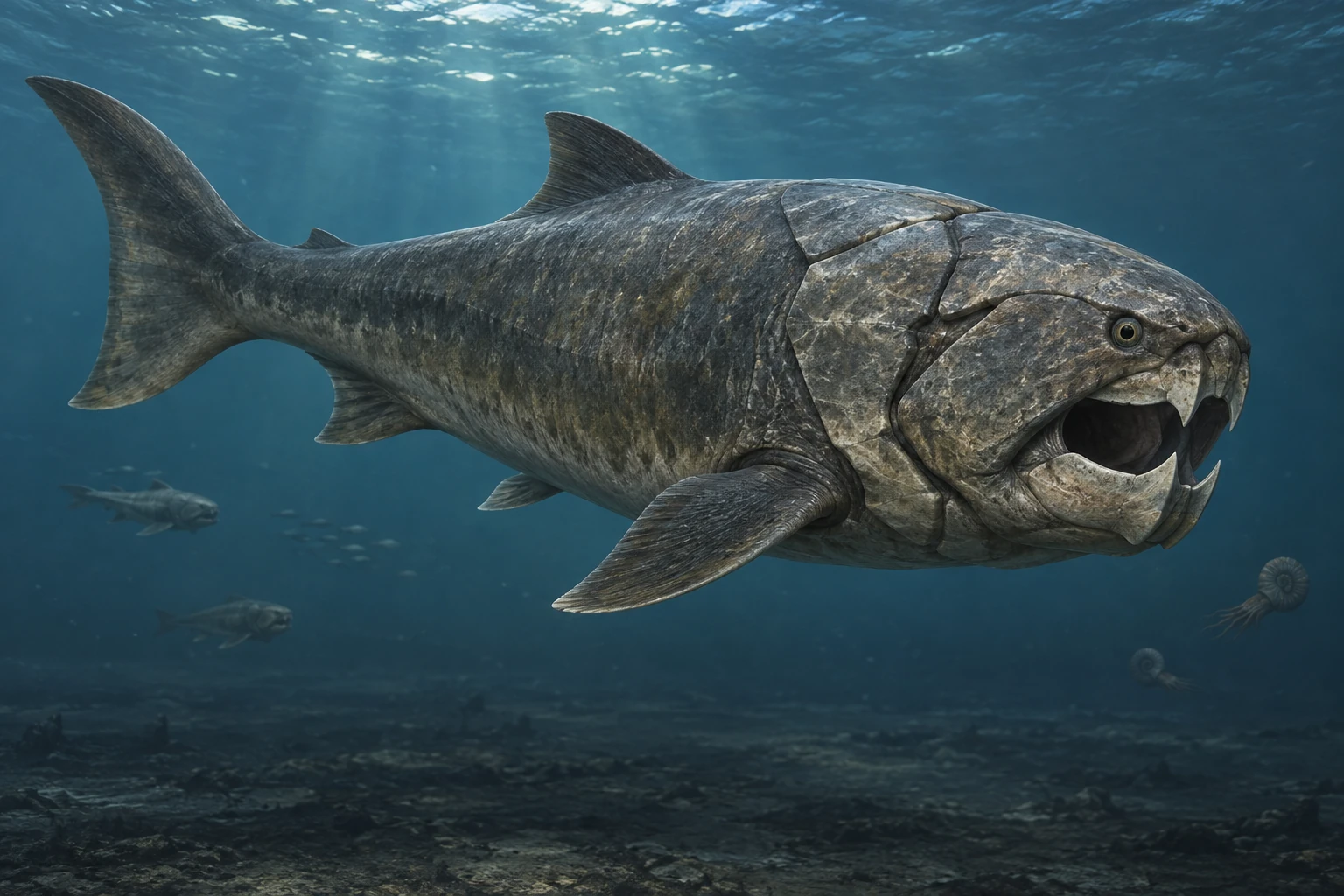
An illustrative reconstruction. Compare its anatomy with the evidence and limitations in the dossier. [3]
Source-informed reconstruction. Appearance evidence [3]. Original illustration; missing anatomy, coloration and scenery include interpretation.
Fossils constrain this life reconstruction. Missing anatomy, coloration and the environmental scene include interpretation; the dossier explains the evidence limits.
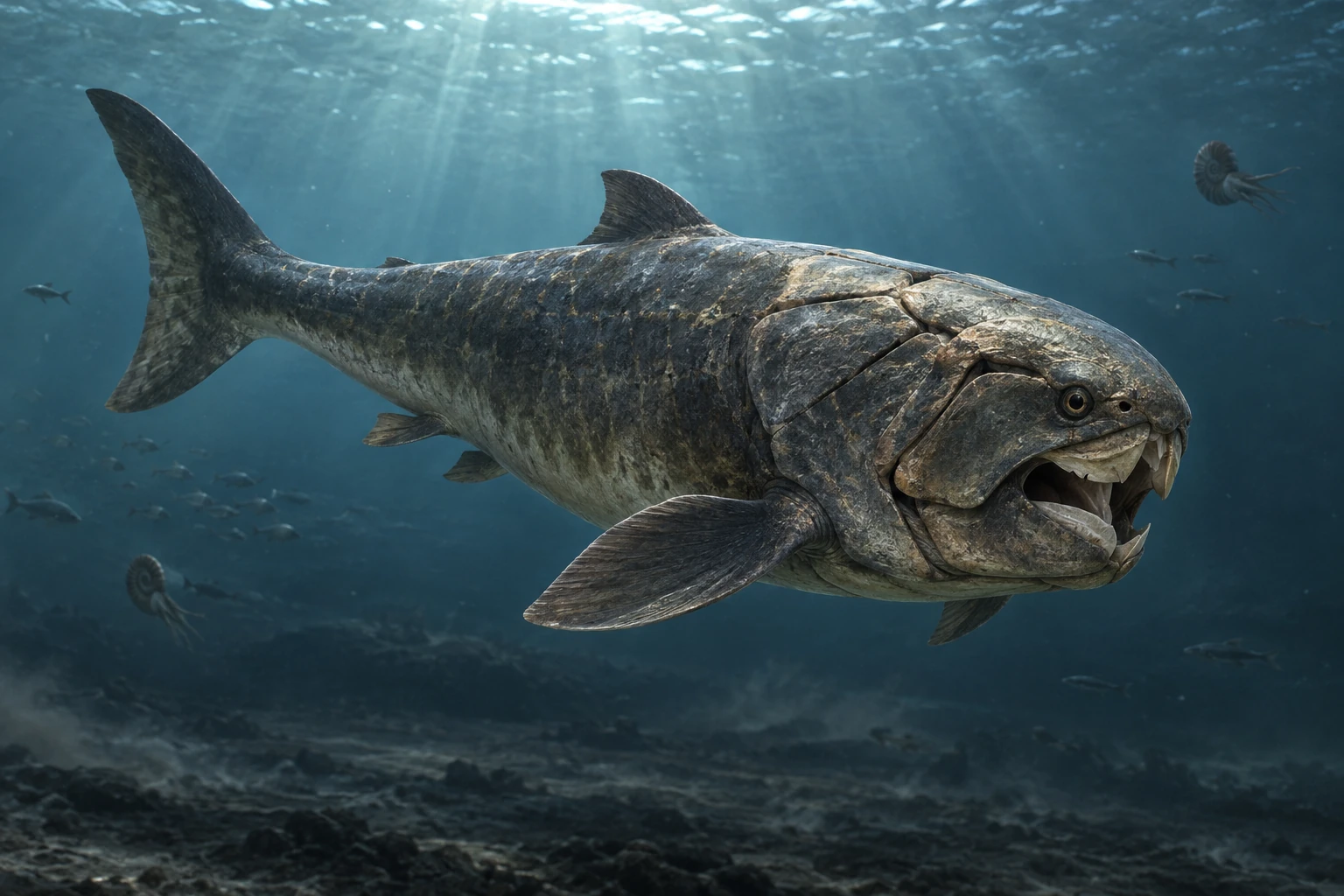
An illustrative reconstruction. Compare its anatomy with the evidence and limitations in the dossier. Lighting, coloration and scenery are artistic choices. This image does not document a fossil locality or behavior.
Original artwork · artistic interpretation.
Scientific view: source-informed reconstruction, credited paleoart or specimen-based imagery. Movie-style view: Original artistic interpretation. Reconstructions involve uncertainty.
MEET THE ANIMAL
Dunkleosteus terrelli was an armored fish from the Late Devonian sea in Ohio. It lived long before dinosaurs. Its fossils are especially well known from the Cleveland Shale, once mud on the seafloor. The strong bony head preserved much better than the cartilaginous body, so collections reveal more about its front than a complete tail. [D1]
Its mouth used sharp bony blades instead of the familiar rows of separate teeth in many modern predators. A mechanical model links the skull, lower jaw and trunk armor. It predicts a mouth that could open rapidly and close powerfully. Those results help explain possible feeding, but the forces are calculated from assumptions rather than directly measured in a living animal. [D4]
Recent reconstruction work favors a deep, stocky body with pectoral fins positioned close behind the head. Known armor and fin attachments constrain that picture, while the back half remains partly reconstructed from comparisons. Color and exact soft-tissue coverage are not settled. A convincing illustration must show those limits rather than treating an old extra-long outline as a complete fossil. [D3]
PREHISTORIC ANIMAL DOSSIER
The animal, the evidence, and the questions still open.
The skull and trunk armor preserve better than much of the cartilaginous skeleton. Cleveland collections allow comparisons among individuals, while complete tail anatomy is less securely known. [D1]
Profile scope: Genus Dunkleosteus, highlighting D. terrelli from the Cleveland Shale. Historical Dinichthys usage was a broad catch-all; an old combination does not make every Dinichthys species this animal. [D5]
Source supported identifies a description documented by the cited source. Inferred marks a reconstruction or functional estimate. Debated marks competing interpretations. Not established means the sources reviewed for this dossier do not support a firm conclusion; it does not mean a behavior never occurred.
A size reference is an estimate, not a population range. Nesting evidence does not by itself establish courtship, mate choice, or lifelong pairing.
About 3.4 m for modeled CMNH 5768
The orbit-opercular method gives about 3.4 m for one large, probably adult individual; CMNH 5936 is a separate fragment modeled near 4.1 m. [D2]
About 950–1200 kg for CMNH 5768
Alternative shape/length-weight models give this reference for the same individual. Broad prediction uncertainty is not an adult species mass range. [D2]
Powerful predatory jaw mechanism
A four-bar skull model supports rapid opening and forceful closing with bony blades. Modeled performance is not an observed meal or exact force. [D4]
Late Devonian offshore Cleveland Shale sea
Sediments indicate open water with oxygenated upper layers over a low-oxygen or anoxic bottom. Preferred depth is not directly observed. [D3]
Active swimming reconstructed from anatomy
Deep trunk, fin positions and a stiffened anterior body support a cruising reconstruction. Precise tail shape and speed remain uncertain. [D3]
Head and trunk armor with bony jaw blades
Fossils constrain the armored front and anterior fin positions. Much of the posterior skeleton was cartilage and is poorly preserved. [D3]
Not established here
The armor/body reconstruction supplies no assigned embryos, eggs or spawning traces. Other placoderms’ reproduction is not automatically Dunkleosteus evidence. [D3]
Not established here
Gnathal work concerns growth and taxonomic variation, not mating displays, breeding colors or mate choice. [D5]
Not established here
Many fossils permit anatomical comparison. Abundance and seafloor preservation do not alone establish schools, pairs or parental care. [D1]
Sources and inspection notes for the claims in this profile.
THE STORY IN THE FOSSILS
Cleveland Shale mud preserved armored heads after animals sank. Collectors assembled fragments into three-dimensional specimens that make comparisons possible. [1]
A mechanical model turns skull joints into testable predictions. Powerful biting is a modeled consequence, rather than a filmed hunting sequence. [4]
The dossier identifies the scope of each reference estimate. A mount, an individual fossil and a species-wide adult range are different measurements. Comparison metrics remain unavailable where adult scope has not been established. Unknown does not mean zero.
Sources support the stated claims and scopes. Refer to the evidence notes for uncertainty.
KEEP EXPLORING
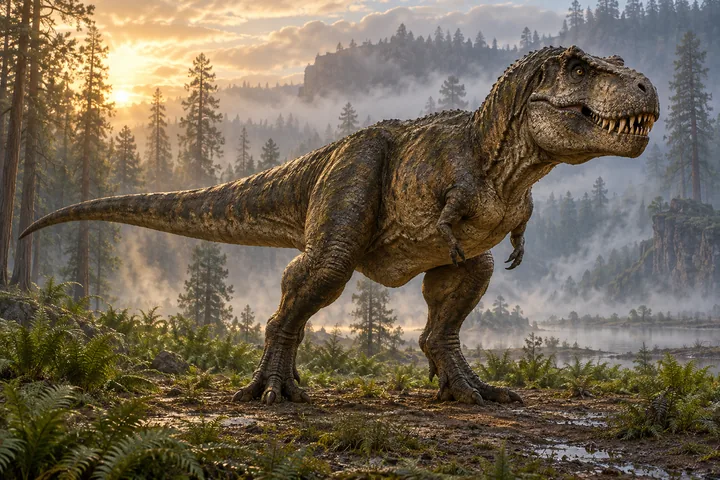
Tyrannosaurus rex
Tyrannosaurus rex was a large meat-eating dinosaur from the final part of the Cretaceous in western North America. Fossil teeth, bite marks and skeletons reveal a powerful animal whose behaviour still invites questions.
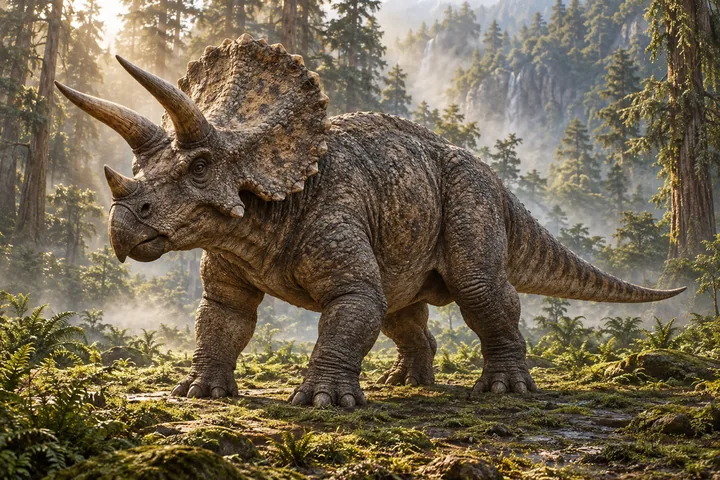
Triceratops horridus
Triceratops horridus was a horned dinosaur of the Late Cretaceous. Skin impressions attributed to this species reveal scales, while skulls and their positions in rock layers help researchers distinguish it from the later Triceratops prorsus.
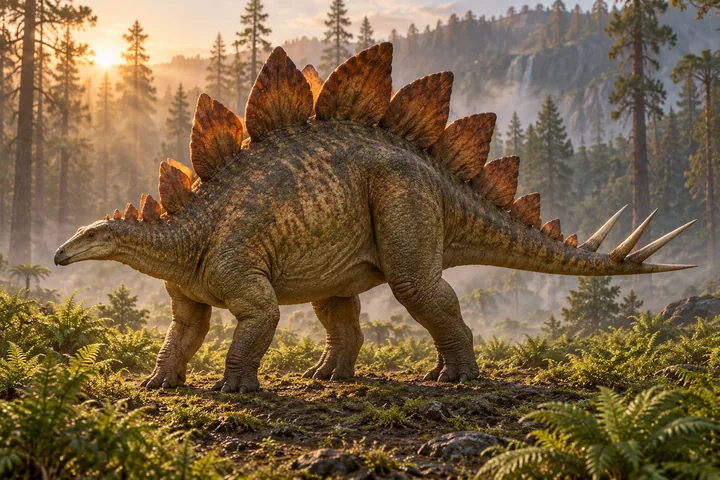
Stegosaurus stenops
Stegosaurus stenops was a plated, plant-eating dinosaur of the Late Jurassic. The remarkably complete specimen Sophie lets researchers examine its skeleton in three dimensions and reconstruct how its jaws processed vegetation.