
Length
InferredAbout 4 m (museum reference)
This educational genus estimate has no named individual, reconstruction method or maturity assessment. It does not define both species or an adult size range. [D1]
TWO WAYS TO PICTURE THE PAST
Compare the evidence with the familiar movie image. The illustrations are not to a shared scale.
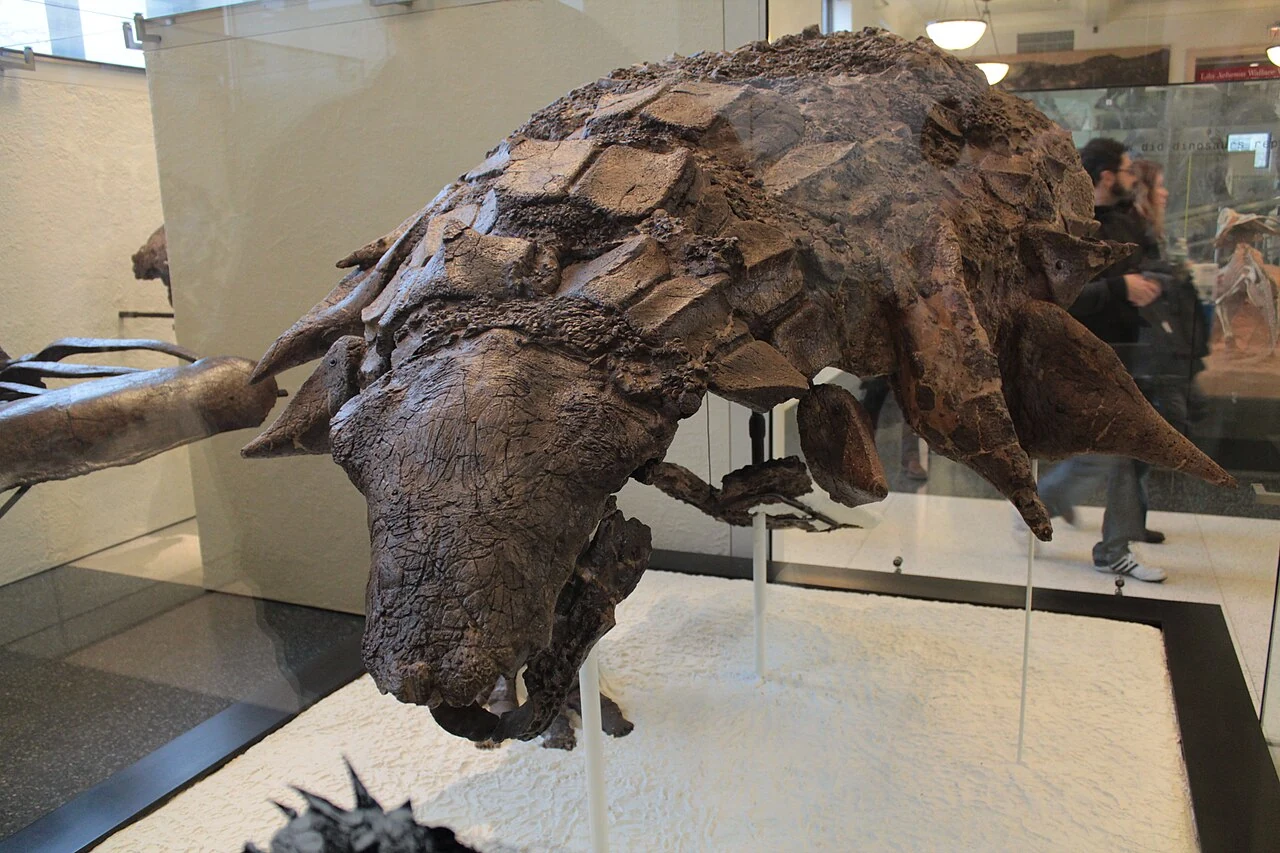
Edmontonia museum exhibit at AMNH, showing skull and neck armor. Assembly and missing soft tissues limit reconstruction; fossil colors do not establish living colors. The photograph’s individual specimen is not verified here. [2]
Edmontonia American Museum of Natural History · KatieThebeau. CC BY 2.0. Commons-listed 1280 px preview converted to WebP; smaller responsive copy proportionally resized. Original image preserved without anatomy alterations.
The photograph or figure shows the credited fossil material; displayed mounts and labels can include interpretation.
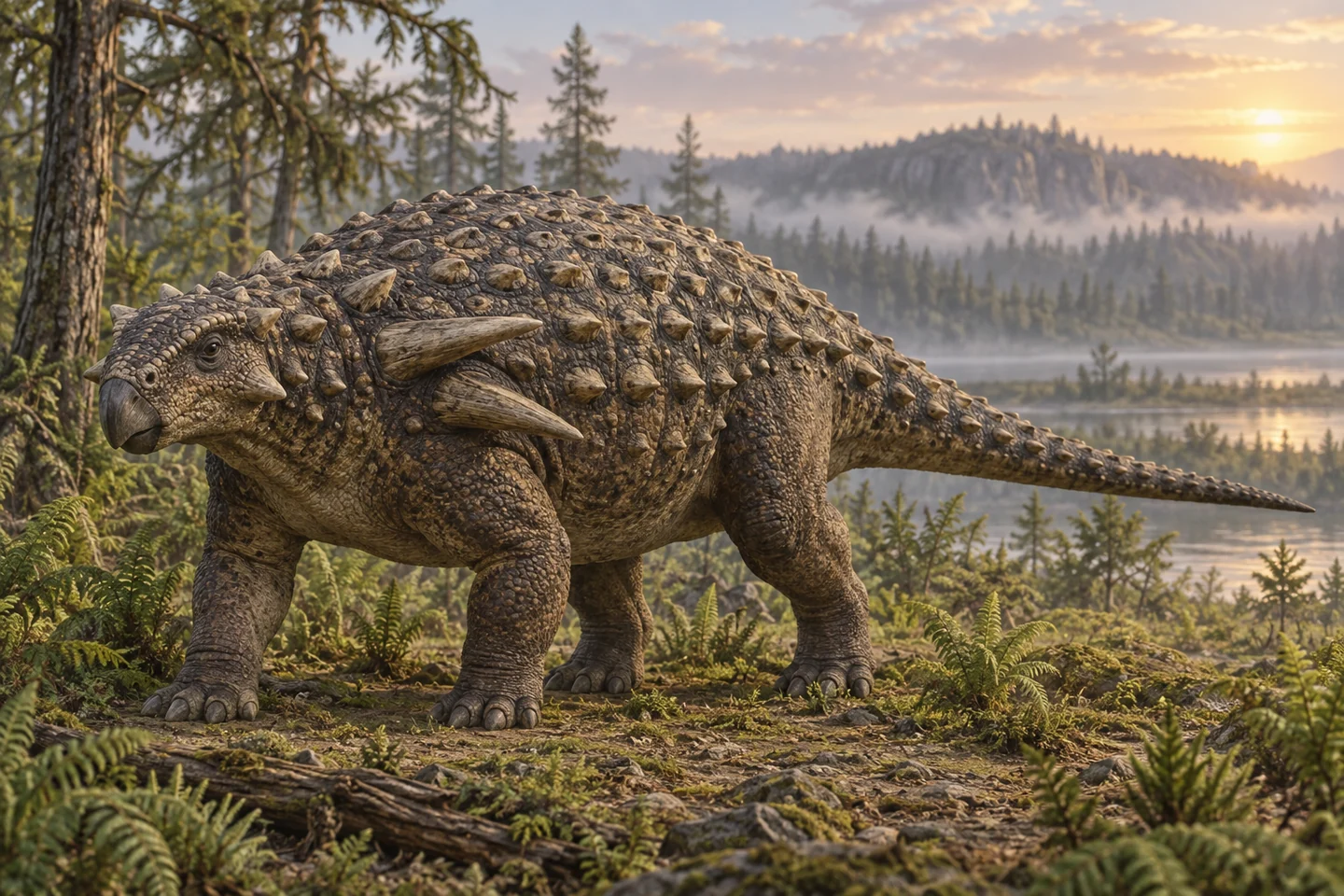
Original cinematic interpretation of Edmontonia rugosidens. Colors, soft tissues, scenery and missing anatomy are reconstructed artistic choices; this is not a directly observed individual or behavior. Lighting, coloration and scenery are artistic choices. This image does not document a fossil locality or behavior.
Original artwork · artistic interpretation.
Scientific view: source-informed reconstruction, credited paleoart or specimen-based imagery. Movie-style view: Original artistic interpretation. Reconstructions involve uncertainty.
MEET THE ANIMAL
Edmontonia was a plant-eating armored dinosaur from Late Cretaceous North America. It belonged to the nodosaurs, part of the wider armored dinosaur group. A museum reference of about four metres offers an educational introduction without identifying a measured adult or a size range for every species. Its fossil record includes evidence about growth as well as appearance. [D1]
An early study of a Montana fossil describes neck armor and lateral spikes. Its incomplete tail material does not show a heavy club like that of some other armored dinosaurs. [D4]
Thin sections of another specimen's limb bones reveal extensive rebuilding of older tissue and relatively slow deposition near the outside. These microscopic features help researchers investigate advanced growth. They preserve a record of bone formation rather than a direct view of the animal's activities. [D5]
That growth evidence does not establish an exact age at breeding. It also cannot automatically identify the maturity of a different specimen used in a body-size model. Edmontonia demonstrates why evidence about one individual's bones must stay separate from claims about every adult in a genus. [D5]
PREHISTORIC ANIMAL DOSSIER
The animal, the evidence, and the questions still open.
Preserved neck armor shows how densely protected its front end could be. Its small teeth, limb bones and microscopic bone structure reveal different parts of its biology. [D4] [D5]
Profile scope: Genus profile covering E. longiceps and E. rugosidens; their shoulder-spike proportions differ. [D2]
Source supported identifies a description documented by the cited source. Inferred marks a reconstruction or functional estimate. Debated marks competing interpretations. Not established means the sources reviewed for this dossier do not support a firm conclusion; it does not mean a behavior never occurred.
A size reference is an estimate, not a population range. Nesting evidence does not by itself establish courtship, mate choice, or lifelong pairing.
About 4 m (museum reference)
This educational genus estimate has no named individual, reconstruction method or maturity assessment. It does not define both species or an adult size range. [D1]
About 3.1 tonnes (composite model)
Paul models AMNH 5665 with USNM 11868 using volume and assumed density. Maturity is unspecified; this reconstruction combines material and is not a species-wide range. [D3]
Plant-eater
The museum identifies herbivory; preserved small, ridged teeth are consistent with plant processing. Specific food plants remain unresolved. [D1] [D4]
Late Cretaceous Alberta and Montana
Reviewed fossils come from the Horseshoe Canyon, Dinosaur Park and Two Medicine formations, spanning Campanian to early Maastrichtian deposits. [D2]
Four-legged walking inferred
The limb and trunk anatomy support a low quadrupedal reconstruction. No measured running speed is established. [D4]
Neck armor and lateral spikes; unclubbed tail
E. rugosidens has larger lateral spikes than E. longiceps. These species differences matter when restoring the animal. [D2] [D4]
Not established here
Limb histology records growth, not eggs, nests or parental care. Focused review established no precise reproductive age or breeding pattern. [D5]
Not established here
The armor does not by itself establish sex differences, mate selection or a courtship display. No genus-specific mating behavior was demonstrated in the reviewed sources.
Not established here
Reviewed associated skeletons establish individual anatomy, without demonstrating persistent herds, family groups or solitary behavior.
Sources and inspection notes for the claims in this profile.
THE STORY IN THE FOSSILS
Gilmore’s description documents neck plates and large lateral spikes in the Montana fossil now called E. rugosidens. Its preserved tail material does not carry the heavy club associated with some other armored dinosaurs. [4]
Microscopic sections from TMP 1998.98.1 show extensively remodeled limb bones and relatively slow deposition near the exterior. That growth evidence cannot supply an exact age at breeding or the maturity of a different size-model specimen. [5]
The dossier identifies the scope of each reference estimate. A mount, an individual fossil and a species-wide adult range are different measurements. Comparison metrics remain unavailable where adult scope has not been established. Unknown does not mean zero.
Sources support the stated claims and scopes. Refer to the evidence notes for uncertainty.
KEEP EXPLORING
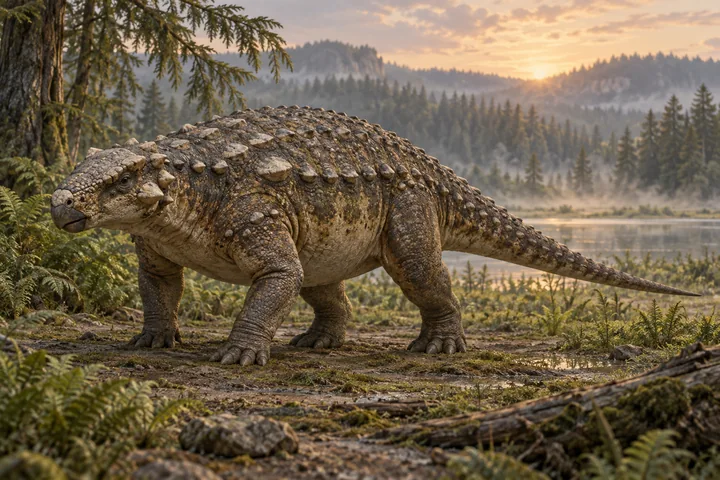
Panoplosaurus mirus
Panoplosaurus was an armored plant-eater whose skull preserves evidence about chewing and unusually winding nasal passages.
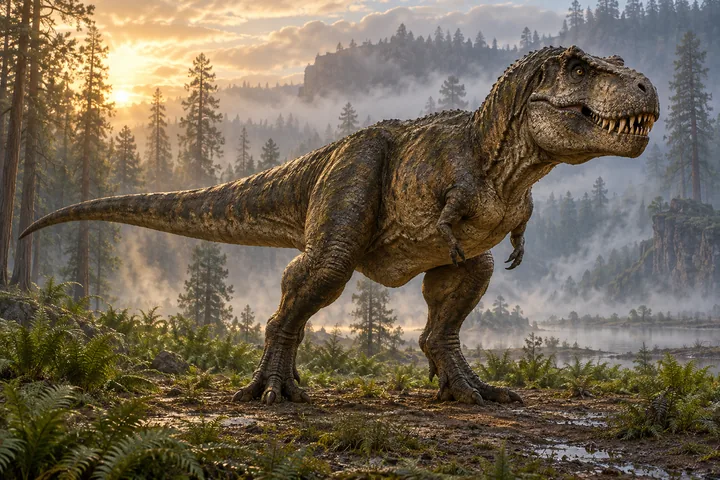
Tyrannosaurus rex
Tyrannosaurus rex was a large meat-eating dinosaur from the final part of the Cretaceous in western North America. Fossil teeth, bite marks and skeletons reveal a powerful animal whose behaviour still invites questions.
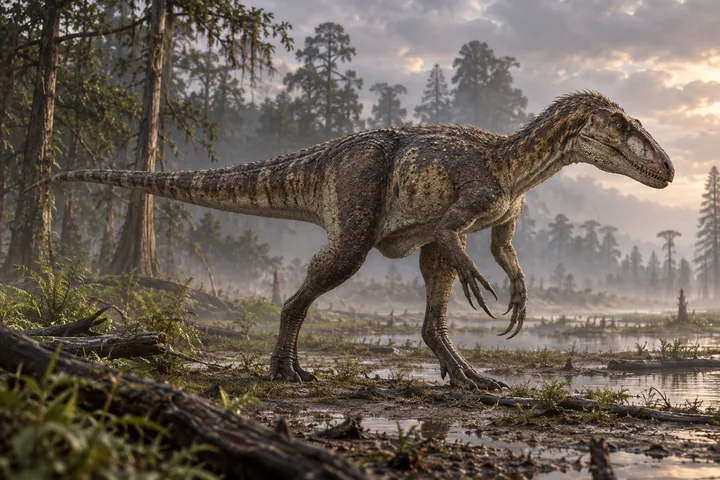
Dryptosaurus aquilunguis
Dryptosaurus was an eastern North American tyrannosauroid with a short upper arm and unusually large hand. Its partial skeleton and changing restorations reveal how evidence and imagination interact.