
Length
Inferred5 m (airflow-study reference)
The 2018 study uses Paul’s educational reconstruction as a modeling reference; individual and maturity are unspecified. This is not a measured adult range. [D3]
TWO WAYS TO PICTURE THE PAST
Compare the evidence with the familiar movie image. The illustrations are not to a shared scale.
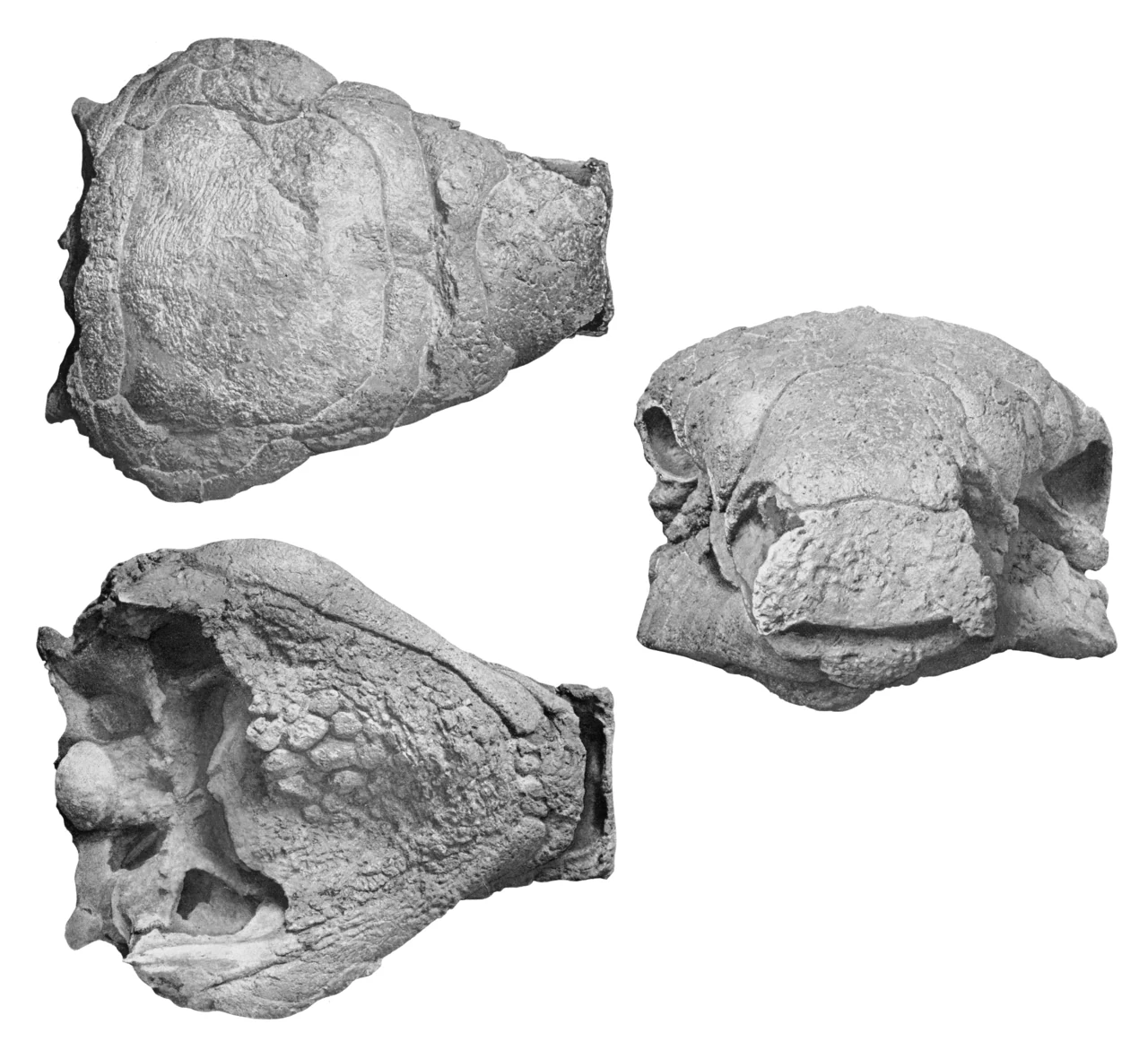
Original photographs of P. mirus type skull CMN 2759 in three views. These fossil views do not establish living colors, complete cheeks or other soft tissues. [3]
Panoplosaurus skull · Lawrence M. Lambe (1919 publication). Public domain (PD-Canada; 1919 publication). Commons-listed 1280 px preview converted to WebP; smaller responsive copy proportionally resized. Original image preserved without anatomy alterations.
The photograph or figure shows the credited fossil material; displayed mounts and labels can include interpretation.
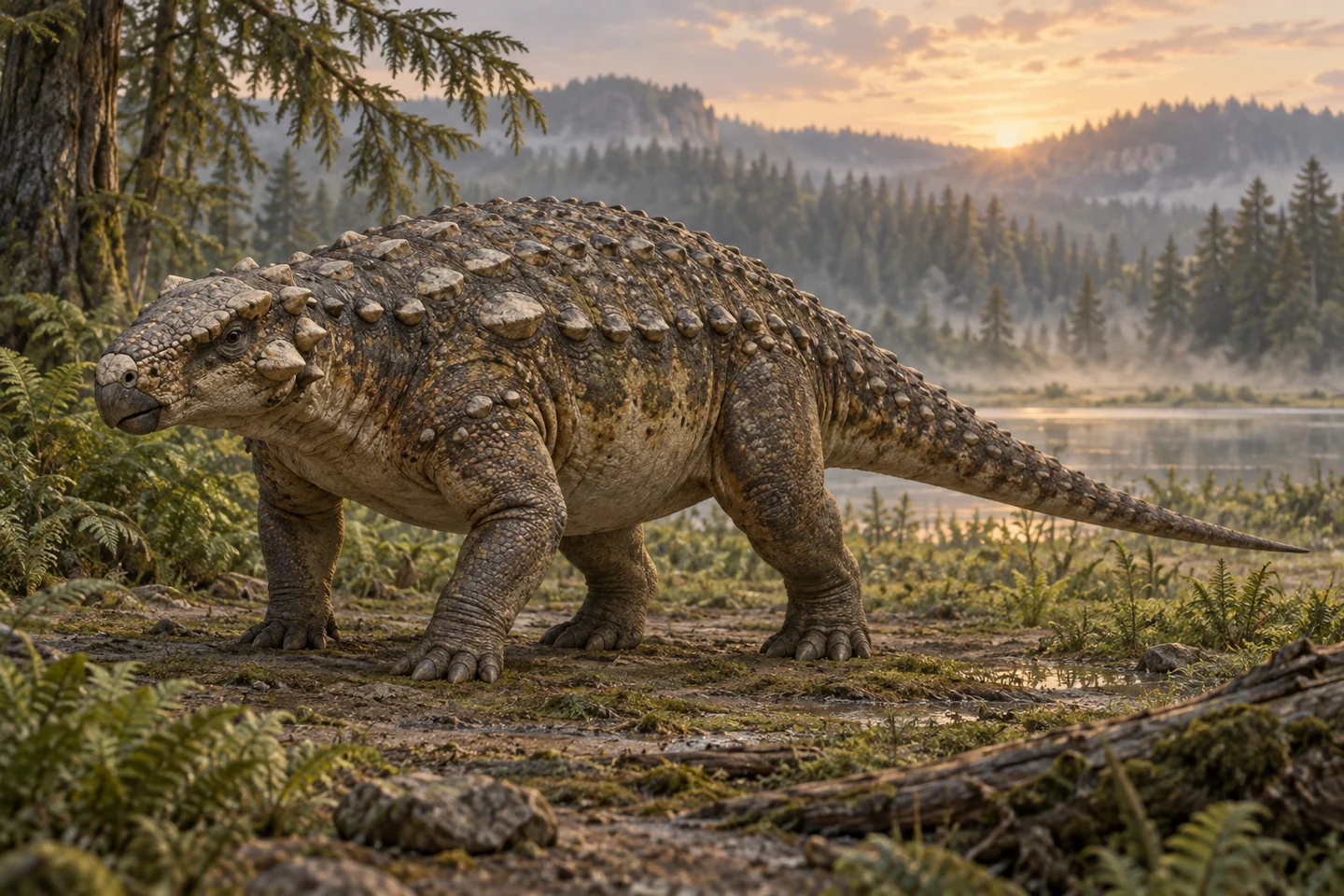
Original cinematic interpretation of Panoplosaurus mirus. Colors, soft tissues, scenery and missing anatomy are reconstructed artistic choices; this is not a directly observed individual or behavior. Lighting, coloration and scenery are artistic choices. This image does not document a fossil locality or behavior.
Original artwork · artistic interpretation.
Scientific view: source-informed reconstruction, credited paleoart or specimen-based imagery. Movie-style view: Original artistic interpretation. Reconstructions involve uncertainty.
MEET THE ANIMAL
Panoplosaurus was an armored plant eater from Late Cretaceous North America. It belonged to the nodosaurs, relatives within the wider armored dinosaur group. Understanding its body includes looking beyond the external covering: fossils of its mouth and jaw supply clues about processing food that a complete artistic outline cannot provide. [D1]
A missing cheek armor bone on the original skull exposes the relationship between the covering and the tooth row. Museum researchers interpret the arrangement as evidence for fleshy cheeks that may have helped retain food during chewing. The cheek itself is not preserved complete. The idea connects an anatomical feature with a possible function without turning that function into an observed feeding act. [D4]
A securely referred specimen, ROM 1215, preserves leaf-shaped teeth with worn surfaces. The wear records repeated food processing, helping reconstruct how the mouth worked. It does not identify every plant eaten or reveal a complete seasonal menu. Panoplosaurus shows how small details on a tooth or beside a jaw can illuminate life while still leaving the animal's exact food choices unresolved. [D5]
PREHISTORIC ANIMAL DOSSIER
The animal, the evidence, and the questions still open.
Skull scans and tooth wear offer complementary views of its biology. Its cheek armor helps reconstruct the mouth, while airflow simulations investigate a possible role for the nose in conditioning inhaled air. [D4] [D3]
Profile scope: P. mirus, using type CMN 2759 and referred ROM 1215; tentative Alaskan material is excluded. [D2]
Source supported identifies a description documented by the cited source. Inferred marks a reconstruction or functional estimate. Debated marks competing interpretations. Not established means the sources reviewed for this dossier do not support a firm conclusion; it does not mean a behavior never occurred.
A size reference is an estimate, not a population range. Nesting evidence does not by itself establish courtship, mate choice, or lifelong pairing.
5 m (airflow-study reference)
The 2018 study uses Paul’s educational reconstruction as a modeling reference; individual and maturity are unspecified. This is not a measured adult range. [D3]
About 1.1–2.0 tonnes (modeling reference)
The airflow study tabulates earlier estimates and uses 1,100 kg physiologically. This interval is not an observed population range or an independently measured ROM 1215 mass. [D3]
Plant-eater; tooth wear records processing
ROM 1215 preserves leaf-shaped teeth and wear from food processing. Exact food plants and a complete feeding repertoire remain uncertain. [D5] [D1]
Late Campanian Alberta; Dinosaur Park Formation
The 2026 review places the type in the lower formation. Tentatively identified Alaskan material does not establish a secure additional species range. [D2]
Four-legged walking inferred
Its nodosaur limb plan supports quadrupedality; no genus-specific running speed is established. [D2]
Armored skull; winding internal nasal passages
CT-based reconstruction of ROM 1215 reveals a convoluted airway. Heat and moisture exchange are modeled functions, rather than measurements from a living animal. [D3]
Not established here
Focused review found no securely assigned eggs, nests, incubation strategy or parental care for P. mirus.
Not established here
Neither cheek armor nor nasal anatomy establishes sexual dimorphism, mate selection or a mating display.
Not established here
The reviewed individual fossils do not establish stable herds, family structure or solitary living.
Sources and inspection notes for the claims in this profile.
THE STORY IN THE FOSSILS
A missing cheek osteoderm on the type skull exposes how the armor relates to the tooth row. The museum interprets this arrangement as evidence for fleshy cheeks that could help retain food during chewing. [4]
Tooth wear on ROM 1215 records repeated processing of plants. These surfaces offer evidence about mouth function without identifying every plant the animal consumed. [5]
The dossier identifies the scope of each reference estimate. A mount, an individual fossil and a species-wide adult range are different measurements. Comparison metrics remain unavailable where adult scope has not been established. Unknown does not mean zero.
Sources support the stated claims and scopes. Refer to the evidence notes for uncertainty.
KEEP EXPLORING
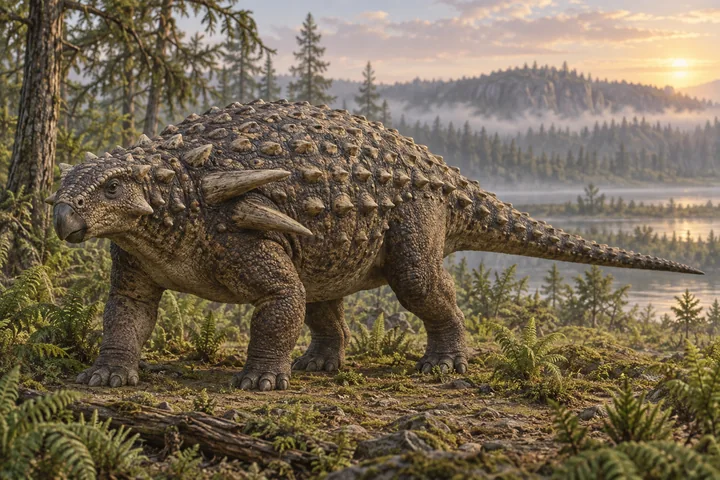
Edmontonia
Edmontonia was a Late Cretaceous North American plant-eater protected by bony plates and lateral spikes.
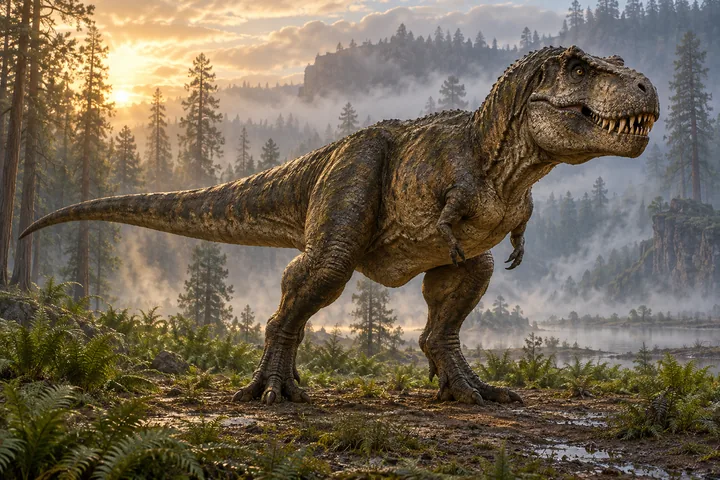
Tyrannosaurus rex
Tyrannosaurus rex was a large meat-eating dinosaur from the final part of the Cretaceous in western North America. Fossil teeth, bite marks and skeletons reveal a powerful animal whose behaviour still invites questions.
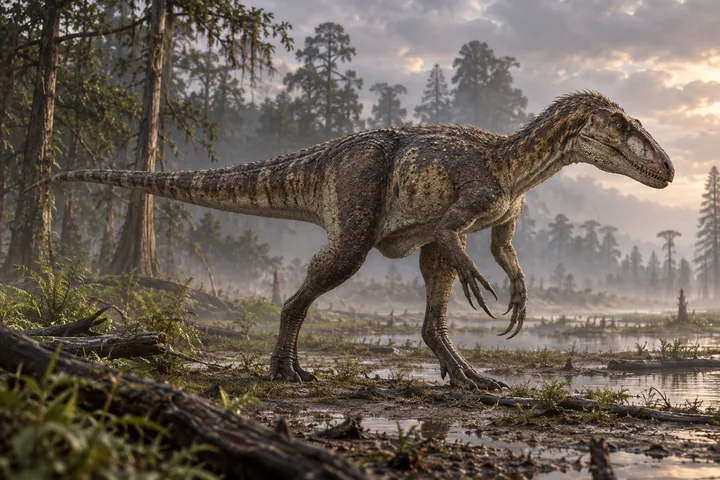
Dryptosaurus aquilunguis
Dryptosaurus was an eastern North American tyrannosauroid with a short upper arm and unusually large hand. Its partial skeleton and changing restorations reveal how evidence and imagination interact.