
Body length
Inferred1 m skeleton; 1.4 m exhibit reference
The original description reports a one-metre skeleton; the author's exhibit lists 1.4 m. These are different references, not a biological range. [D1] [D3]
EXHIBIT 59
Eoraptor lunensis
Eoraptor was a small, early dinosaur from Argentina's Ischigualasto Formation. Its mixed dental features have produced competing feeding interpretations, and later studies place it near the origin of sauropodomorphs.
TWO WAYS TO PICTURE THE PAST
Compare the evidence with the familiar movie image. The illustrations are not to a shared scale.
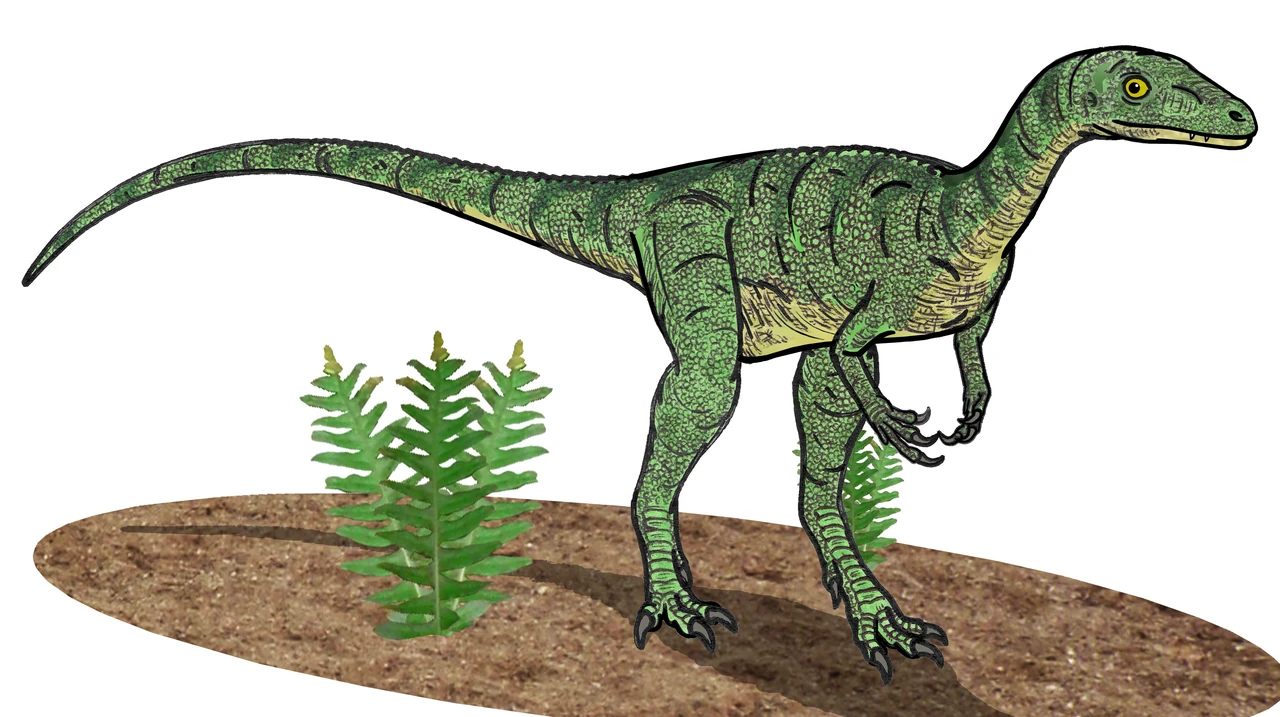
Life reconstruction of Eoraptor lunensis by Conty, using the current revised artwork. Missing anatomy and soft tissues are reconstructed; green coloration, markings and the illustrated plants are speculative. [1]
Eoraptor resto. 01.png · Conty. CC BY 3.0. Commons-listed 1280px preview converted to WebP; 640px thumbnail generated. Composition and colors unchanged.
Scientific reconstruction is an interpretation; source credit does not certify every anatomical detail.
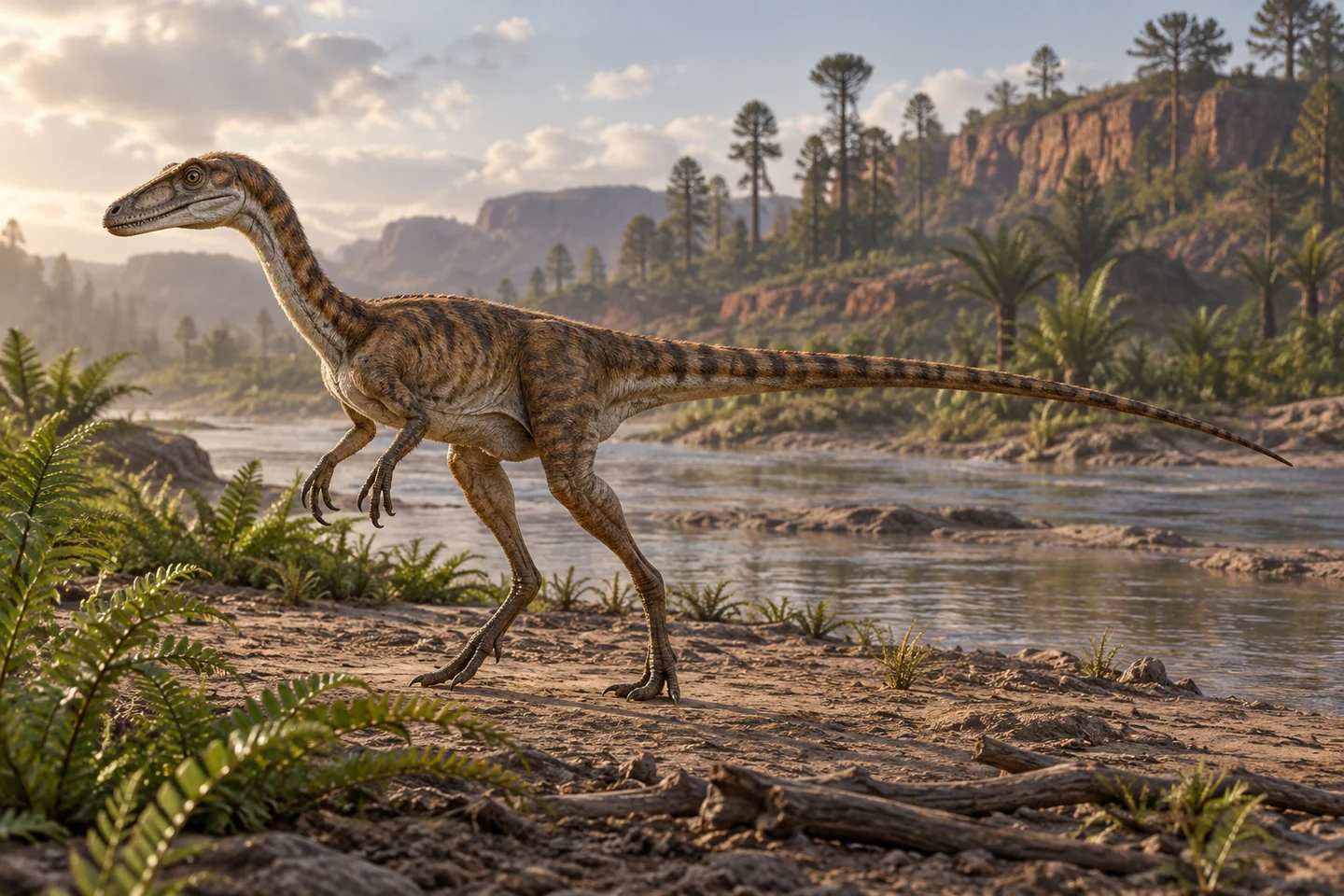
Original cinematic interpretation of Eoraptor. Anatomy, soft tissues and colors are reconstructed choices. Lighting, coloration and scenery are artistic choices. This image does not document a fossil locality or behavior.
Original artwork · artistic interpretation.
Scientific view: source-informed reconstruction, credited paleoart or specimen-based imagery. Movie-style view: Original artistic interpretation. Reconstructions involve uncertainty.
MEET THE ANIMAL
Eoraptor lunensis was a small two-legged dinosaur from Late Triassic Argentina. Its nearly complete skeleton and distinctive tooth shapes provide unusually useful evidence from an early stage of dinosaur evolution. The original description reported a skeleton about a metre long. That is a reference to preserved material, rather than a measured range of full-grown animals. [D1]
A detailed anatomical study favored plant eating, whereas the Natural History Museum identifies a carnivore. These are interpretations, rather than preserved meals. [D2] [S1]
Another anatomical analysis cautioned that proposed plant-eating features were not decisive: some teeth remained curved, and a tooth position alone did not reliably indicate herbivory. Feeding labels therefore require testing, rather than simply reading one feature. [S2]
The skeleton was discovered on a 1991 expedition to Argentina’s Valley of the Moon. Volcanic ash helped establish its age. The discoverer’s display includes both reconstructed casts and a cast showing the skeleton as preserved. Comparing these forms helps distinguish fossil evidence from the completed outline supplied by reconstruction, without turning an exhibit length into a biological size range. [D3]
PREHISTORIC ANIMAL DOSSIER
The animal, the evidence, and the questions still open.
Eoraptor captures an early stage in dinosaur diversification. Its small skeleton is informative, but its feeding ecology cannot be reduced confidently to a single menu.
Profile scope: Species — Eoraptor lunensis; size references and the nearly complete holotype are distinguished from a species-wide range. Feeding interpretations conflict.
Source supported identifies a description documented by the cited source. Inferred marks a reconstruction or functional estimate. Debated marks competing interpretations. Not established means the sources reviewed for this dossier do not support a firm conclusion; it does not mean a behavior never occurred.
A size reference is an estimate, not a population range. Nesting evidence does not by itself establish courtship, mate choice, or lifelong pairing.
1 m skeleton; 1.4 m exhibit reference
The original description reports a one-metre skeleton; the author's exhibit lists 1.4 m. These are different references, not a biological range. [D1] [D3]
Not established here
The reviewed modern anatomical and dental studies do not establish a comparable adult body-mass estimate here.
Competing plant- and meat-eating interpretations
The 2013 osteology favors herbivory; a 2022 quantitative dental study predicts carnivory. Both interpret anatomy rather than preserved meals. [D2] [D4]
Ischigualasto Formation, Argentina
The described specimens come from the Cancha de Bochas Member in northwestern Argentina. [D2]
Small biped
The reconstructed skeleton indicates two-legged movement. This does not establish a measured speed. [D1]
Distinctive mixed tooth shapes
The original skull description recognizes differentiated dentition; later work examines its feeding implications. [D1]
Not established here
The reviewed sources do not establish eggs, nests or species-specific parental care.
Not established here
No species-specific display, partner choice or mating ritual is established here.
Not established here
The reviewed descriptions do not establish habitual groups or cooperative behavior.
Sources and inspection notes for the claims in this profile.
THE STORY IN THE FOSSILS
Found on the 1991 Argentina expedition, Eoraptor became a reference point for studying early dinosaur anatomy. Later osteology describes it as an early sauropodomorph rather than adopting the older theropod label. [3] [2]
Its teeth illustrate the limits of inference: qualitative anatomical arguments favor plant eating, while quantitative shape and mechanical comparisons favor meat eating. The dossier keeps that disagreement visible. [2] [4]
The dossier identifies the scope of each reference estimate. A mount, an individual fossil and a species-wide adult range are different measurements. Comparison metrics remain unavailable where adult scope has not been established. Unknown does not mean zero.
Sources support the stated claims and scopes. Refer to the evidence notes for uncertainty.
KEEP EXPLORING
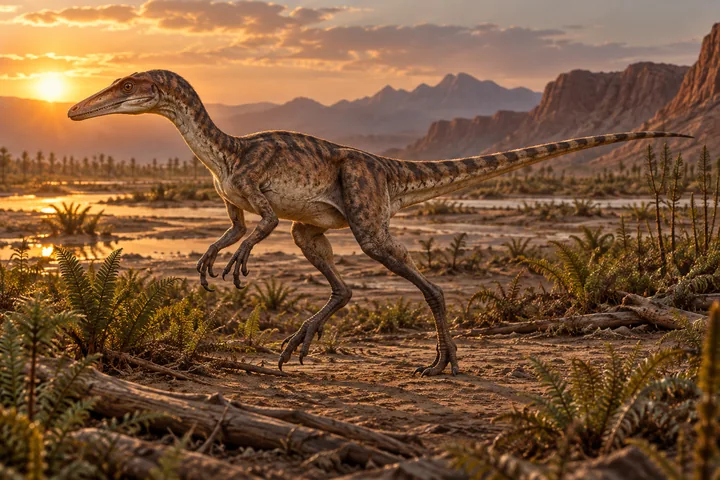
Eodromaeus murphi
Eodromaeus was a small predatory dinosaur from Argentina's Ischigualasto Formation. Curved teeth and grasping hands distinguish it from contemporary dinosaurs with different feeding adaptations.
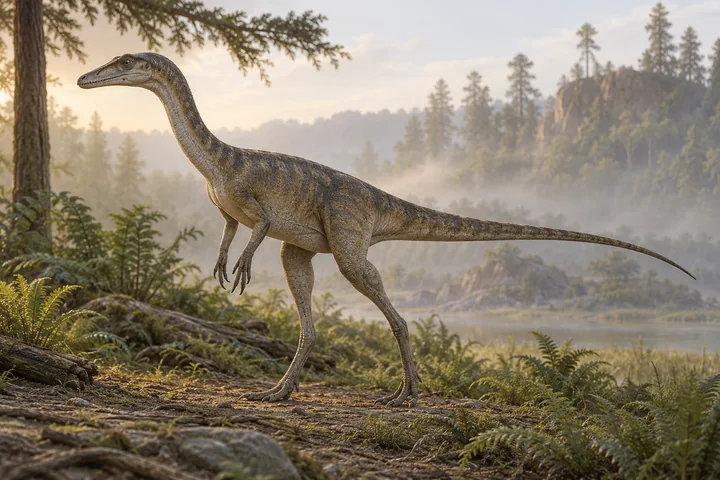
Tawa hallae
Tawa combined a long snout, slender limbs and a hand with three functional fingers.
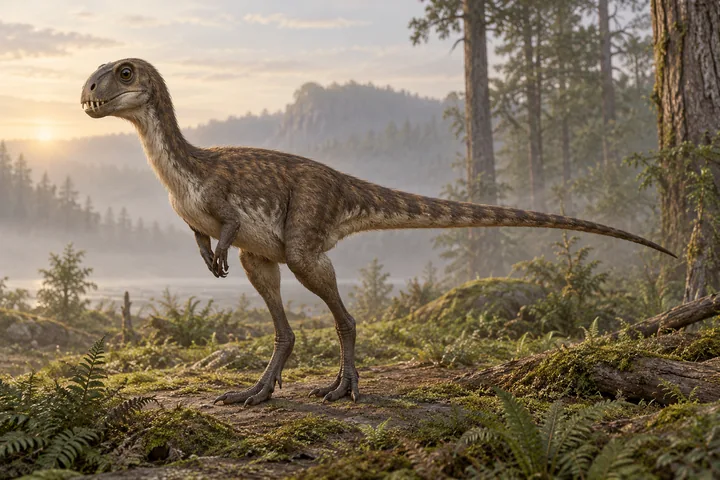
Daemonosaurus chauliodus
Daemonosaurus is known from a small, deep skull with unusually enlarged front teeth.