
Body length
InferredAbout 2 m (growing individual)
Institutional reconstruction of a juvenile; adult maximum is unestablished. [D3]
EXHIBIT 157
Tawa hallae
Tawa combined a long snout, slender limbs and a hand with three functional fingers. [1]
TWO WAYS TO PICTURE THE PAST
Compare the evidence with the familiar movie image. The illustrations are not to a shared scale.
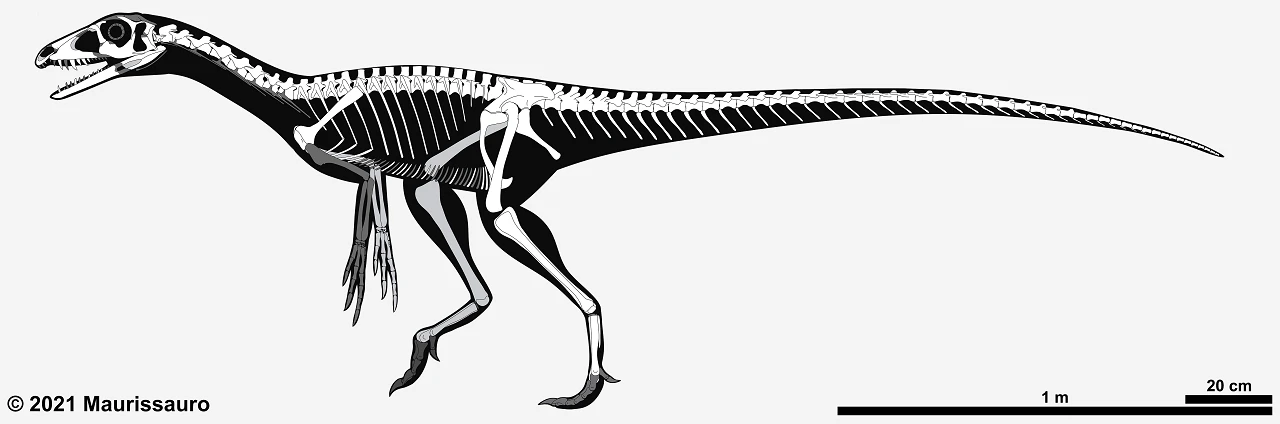
Tawa hallae known-material reconstruction by Maurissauro. White bones represent known material and grey bones complete missing regions; the surrounding outline and posture are hypothetical. The drawing combines the available skeletal evidence rather than documenting one complete adult individual, skin covering or an adult maximum. [1]
Tawa hallae skeleton.png · Maurissauro. CC BY-SA 4.0. Current Commons 1280 px preview converted to WebP and proportionally reduced for thumbnail use. No cropping, mirroring, anatomical edits or compositing; original scale bars retained. Derivatives retain CC BY-SA 4.0.
Skeletal mounts and drawings may restore missing parts; the caption identifies the displayed material.
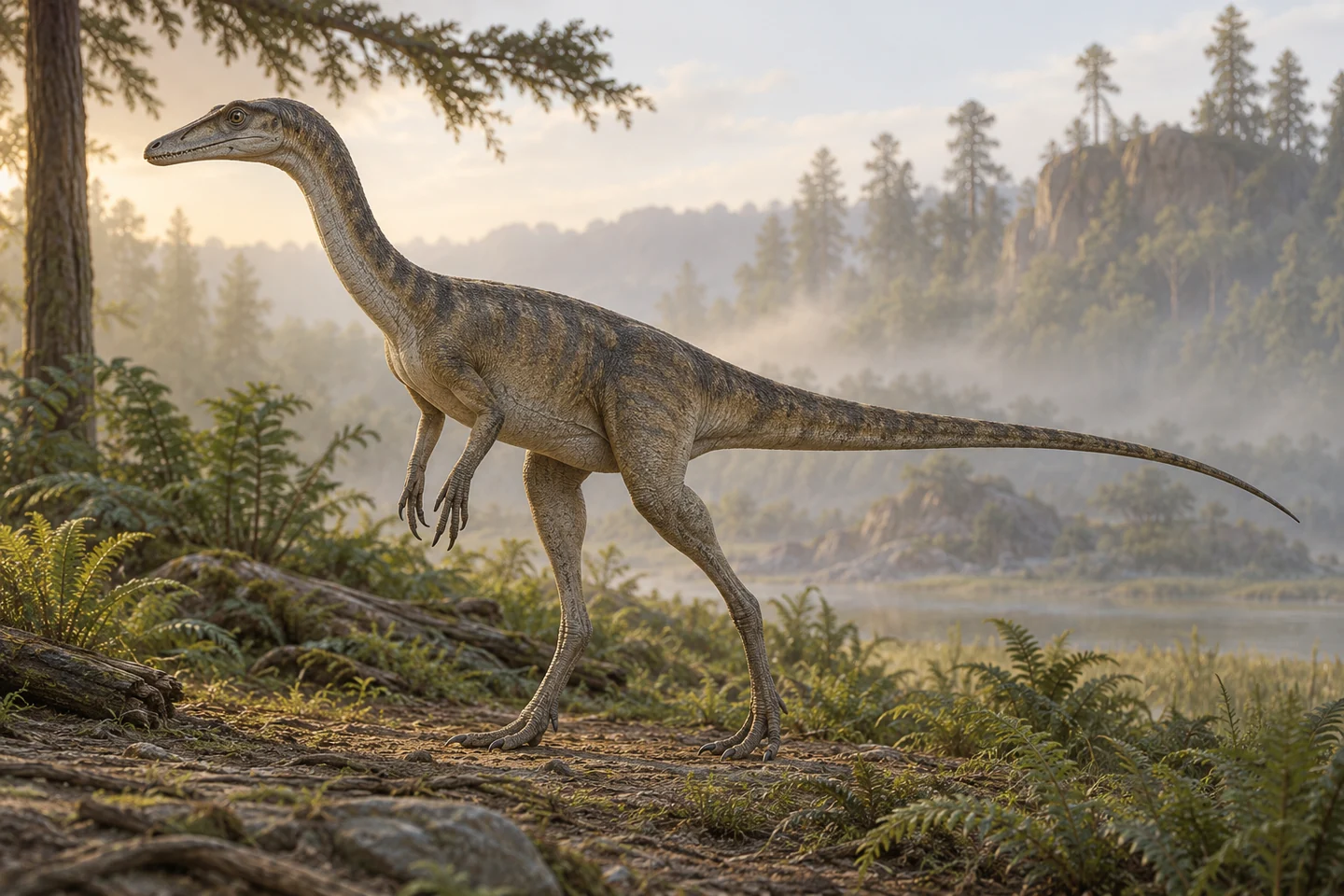
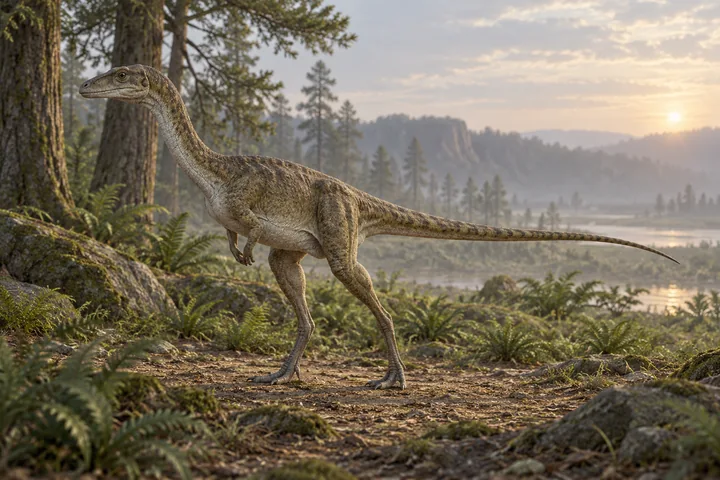
Original cinematic interpretation of Tawa. A lightly built reconstruction guided by preserved Tawa material; fine external covering, colors and posture are interpretive. Lighting, colors and scenery are artistic choices; this image does not document directly observed behavior. Lighting, coloration and scenery are artistic choices. This image does not document a fossil locality or behavior.
Original artwork · artistic interpretation.
Scientific view: source-informed reconstruction, credited paleoart or specimen-based imagery. Movie-style view: Original artistic interpretation. Reconstructions involve uncertainty.
MEET THE ANIMAL
Tawa was a carnivorous dinosaur from Late Triassic New Mexico. An institutional account reconstructed a growing individual at about two metres long. That is useful for imagining this particular animal, but does not tell us the maximum size of an adult Tawa. A juvenile reconstruction needs to be distinguished from a species-wide size range and from estimates based on other, separately identified fossils. [D3]
Researchers reconstructed its forelimb muscles by studying bone attachment sites and comparing living relatives of dinosaurs. The result suggests a hand capable of strong grasping. Besides three main fingers, the hand retained a strongly reduced fourth digit. Such anatomy tests what the arms could do; it does not preserve a hunting event or identify the exact prey being held. [D2]
The main skeleton was still growing, as indicated by open joins between parts of its vertebrae. Several skeletons accumulated in one small pocket of rock. Their proximity alone does not prove coordinated hunting, family relationships or a permanent social group. [D1]
PREHISTORIC ANIMAL DOSSIER
The animal, the evidence, and the questions still open.
A 2026 analysis groups it with Chindesaurus and Daemonosaurus in Morphoraptora; their deeper relationships remain uncertain. [D5]
Profile scope: Genus — Tawa; profile centered on T. hallae and its separately identified specimens. [D1]
Source supported identifies a description documented by the cited source. Inferred marks a reconstruction or functional estimate. Debated marks competing interpretations. Not established means the sources reviewed for this dossier do not support a firm conclusion; it does not mean a behavior never occurred.
A size reference is an estimate, not a population range. Nesting evidence does not by itself establish courtship, mate choice, or lifelong pairing.
About 2 m (growing individual)
Institutional reconstruction of a juvenile; adult maximum is unestablished. [D3]
About 3.7 kg (limb model)
Isolated GR 244 femur; estimated circumference, maturity unestablished. [D4]
Animal prey inferred
Theropod-like dentition supports carnivory. Front premaxillary teeth are unserrated; particular prey and hunting tactics are unverified. [D1]
Chinle Formation, New Mexico
Hayden Quarry 2, lower Petrified Forest Member; isotopic age approximately 211.9±0.7 million years ago. [D1] [D5]
Two-legged; grasping forelimbs inferred
Forelimb muscle reconstruction supports forceful digital flexion. This establishes functional potential rather than observed prey handling or a measured running speed. [D2]
Three main fingers; strongly reduced fourth
A slender skeleton combines a long neck and snout with an elongated first metatarsal; the fifth manual digit is absent. [D1]
Not established here
GR 241 was still growing, based on open sutures and larger referred bones. Neither breeding age nor nests are established. [D1]
Not established here
Reconstructed forelimb muscles do not demonstrate a display, sex difference or mating sequence. Focused searches found no direct courtship evidence. [D2]
Not established here
Several associated skeletons accumulated in one small pocket. Fossil proximity alone does not establish a social group, coordinated hunting or family association. [D1]
Sources and inspection notes for the claims in this profile.
THE STORY IN THE FOSSILS
Burch reconstructed missing muscles by comparing attachment evidence with living archosaurs. The result tests how the hand could function, without documenting a hunting event. [2]
The 2026 Morphoraptora proposal revisits the early dinosaur family tree; it does not merge these separately diagnosed genera. [5]
The dossier identifies the scope of each reference estimate. A mount, an individual fossil and a species-wide adult range are different measurements. Comparison metrics remain unavailable where adult scope has not been established. Unknown does not mean zero.
Sources support the stated claims and scopes. Refer to the evidence notes for uncertainty.
KEEP EXPLORING
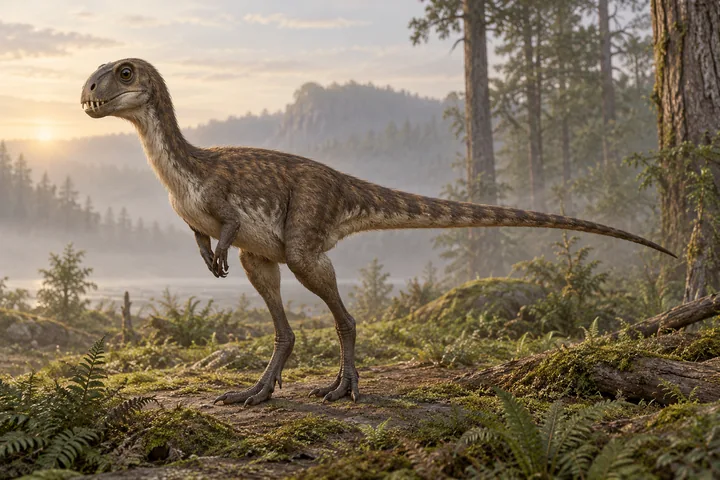
Daemonosaurus chauliodus
Daemonosaurus is known from a small, deep skull with unusually enlarged front teeth.
Chindesaurus bryansmalli
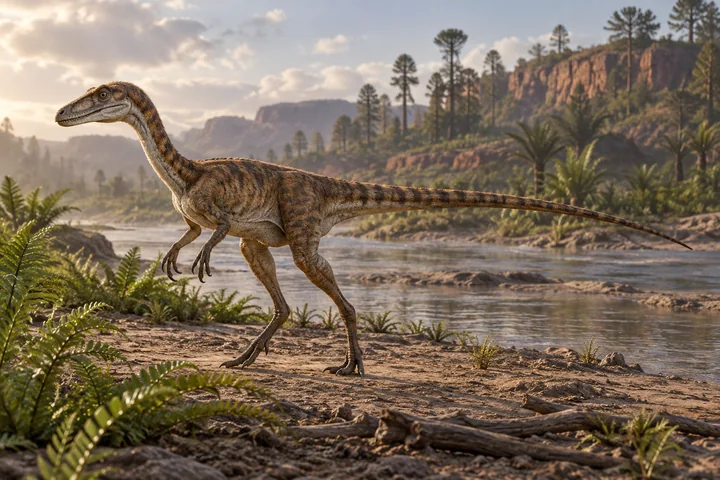
Chindesaurus is anchored to a partial postcranial skeleton from Arizona, rather than a complete skull-and-body fossil.
Eoraptor lunensis
Eoraptor was a small, early dinosaur from Argentina's Ischigualasto Formation. Its mixed dental features have produced competing feeding interpretations, and later studies place it near the origin of sauropodomorphs.