
Length
Not establishedNot established here
The reviewed original descriptions document a partial body; no scoped total-body estimate is provided. Widely repeated 7 m figures were not independently verified from their original model. [D1]
TWO WAYS TO PICTURE THE PAST
Compare the evidence with the familiar movie image. The illustrations are not to a shared scale.
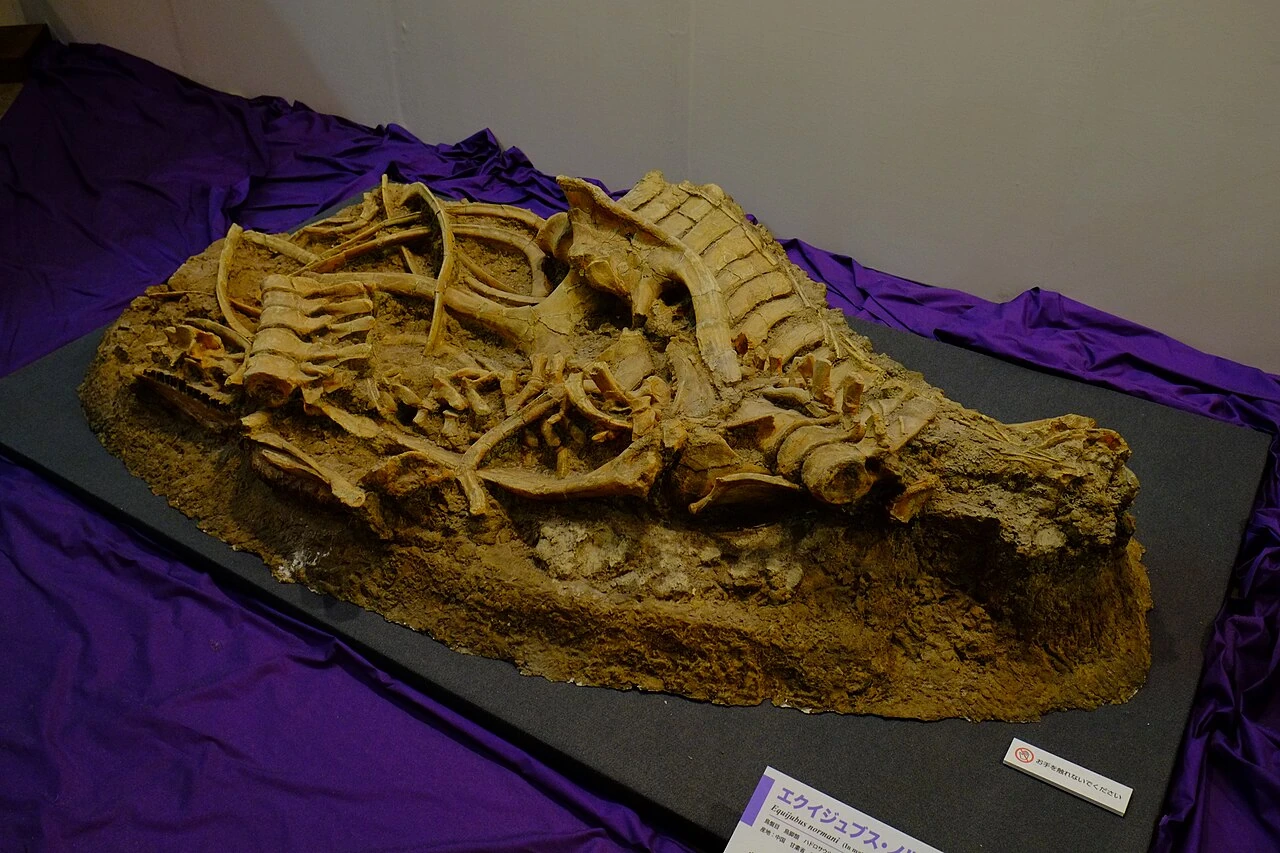
Display identified as E. normani; the Commons source does not establish its collection number or whether it is original material or a replica. Compression and missing body parts limit anatomical restoration. Fossil colors do not establish living colors or soft tissues. [2]
Equijubus normani.jpg · ★Kumiko★. CC BY-SA 2.0. Proportionally resized Commons preview and converted to WebP; no anatomy edits.
The photograph or figure shows the credited fossil material; displayed mounts and labels can include interpretation.
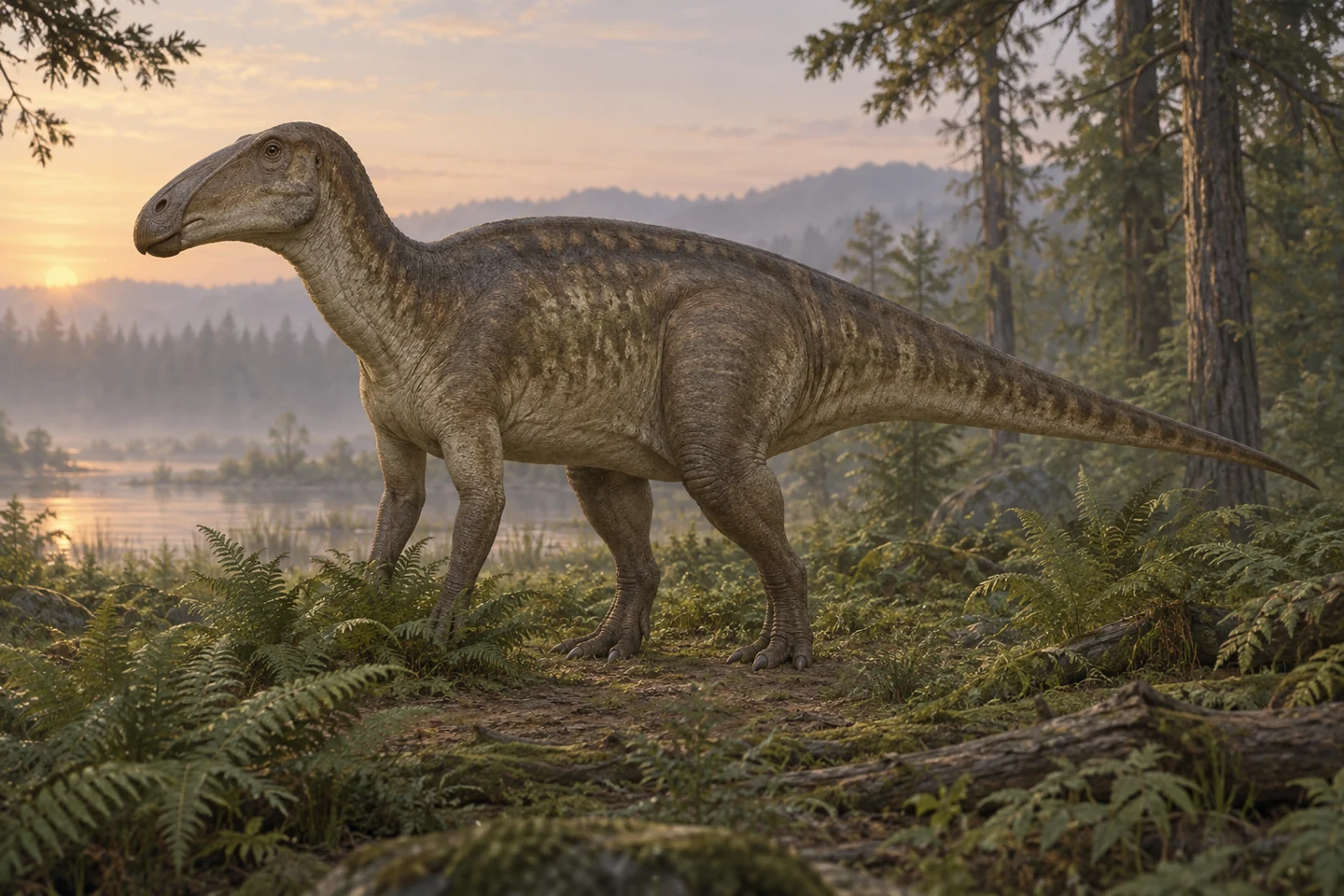
Original cinematic interpretation. The skull is crushed and most limbs and all hands are missing; head details, body posture and hands are restored comparatively. Colors, soft tissues and setting are illustrative. Lighting, coloration and scenery are artistic choices. This image does not document a fossil locality or behavior.
Original artwork · artistic interpretation.
Scientific view: source-informed reconstruction, credited paleoart or specimen-based imagery. Movie-style view: Original artistic interpretation. Reconstructions involve uncertainty.
MEET THE ANIMAL
Equijubus was a plant-eating dinosaur from Early Cretaceous China. It belonged among the early hadrosauroids, the wider group that includes duck-billed dinosaurs. Its place near the early part of that family tree does not demonstrate that it was a direct ancestor of every later duck-bill. The museum profile gives no body length or mass for this incomplete animal. [D5]
Tiny plant remains were recovered from a deposit along its teeth. They include fragments of plant surfaces and phytoliths, microscopic mineral structures made by plants. Researchers interpreted this association as evidence of grass consumption. It is a rare possible clue to feeding, but not a complete meal preserved in the stomach or proof that Equijubus ate only grass. [D3]
The known skull was compressed during preservation, and much of the body is missing. A broad beak and distinctive cheek-bone projection help characterize the head. Closed joins in the vertebrae suggest skeletal maturity, but do not reveal nesting behavior. Missing hands and incomplete limbs also limit the certainty of a full-body restoration. [D2]
PREHISTORIC ANIMAL DOSSIER
The animal, the evidence, and the questions still open.
Detailed anatomy places it among early hadrosauroids. Dental deposits offer a rare dietary clue, while much of its body and behavior remain uncertain. [D1] [D3]
Profile scope: E. normani, holotype IVPP V12534: compressed skull and incomplete postcranium of one individual; restored limbs are poorly constrained. [D2]
Source supported identifies a description documented by the cited source. Inferred marks a reconstruction or functional estimate. Debated marks competing interpretations. Not established means the sources reviewed for this dossier do not support a firm conclusion; it does not mean a behavior never occurred.
A size reference is an estimate, not a population range. Nesting evidence does not by itself establish courtship, mate choice, or lifelong pairing.
Not established here
The reviewed original descriptions document a partial body; no scoped total-body estimate is provided. Widely repeated 7 m figures were not independently verified from their original model. [D1]
Not established here
The available limb material is incomplete; this review found no inspectable individual mass model with its assumptions. [D2]
Plant eater; possible grass consumption
Grass epidermis and phytoliths occur in a deposit along the teeth. Authors interpret ingestion; this is an association-based inference, not a complete preserved meal or exclusive grazing diet. [D3]
Albian Gongpoquan Basin
The type comes from the Middle Grey Unit in Gansu, termed the Zhonggou Formation in the plant-microfossil study. This is an Early Cretaceous occurrence. [D3]
Exact stance unresolved
Comparative analysis could code only one quadrupedal correlate for Equijubus. Its incomplete limbs and unknown hands leave the proportion of two- versus four-legged locomotion poorly constrained. [D6]
Broad beak and distinctive cheek process
A finger-like jugal process helps diagnose the crushed skull. Six preserved sacrals are fused; missing sacral portions limit interpretation of the total count. [D2]
Not established here
Closed vertebral sutures support skeletal maturity of the type; they do not establish egg-laying details, nesting behavior or age at breeding. [D2]
Not established here
A single incomplete holotype does not establish sexual dimorphism or mating behavior. [D1]
Not established here
Regional dinosaur diversity in Mazongshan is not evidence for Equijubus herds or family groups. [D4]
Sources and inspection notes for the claims in this profile.
THE STORY IN THE FOSSILS
Equijubus belongs to a diverse Mazongshan fauna that also includes other distinct early hadrosauroids. Sharing a region and geological interval does not make those genera aliases of one another. [4]
The plant study extracted silicified epidermal fragments and phytoliths from deposits along the dentition. Its interpretation opens a possible window onto feeding, while the amount and frequency of grass consumption remain unknown. [3]
The dossier identifies the scope of each reference estimate. A mount, an individual fossil and a species-wide adult range are different measurements. Comparison metrics remain unavailable where adult scope has not been established. Unknown does not mean zero.
Sources support the stated claims and scopes. Refer to the evidence notes for uncertainty.
KEEP EXPLORING
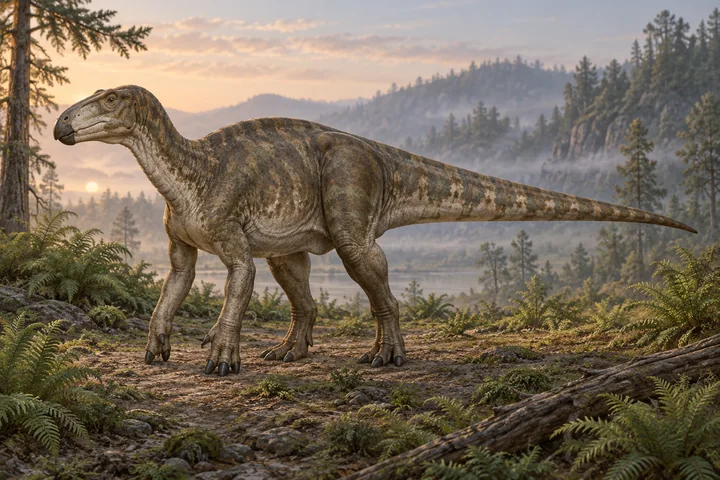
Jinzhousaurus yangi
Jinzhousaurus was a crestless plant-eating ornithopod with a distinctive skull and unusually short, stout hand bones.
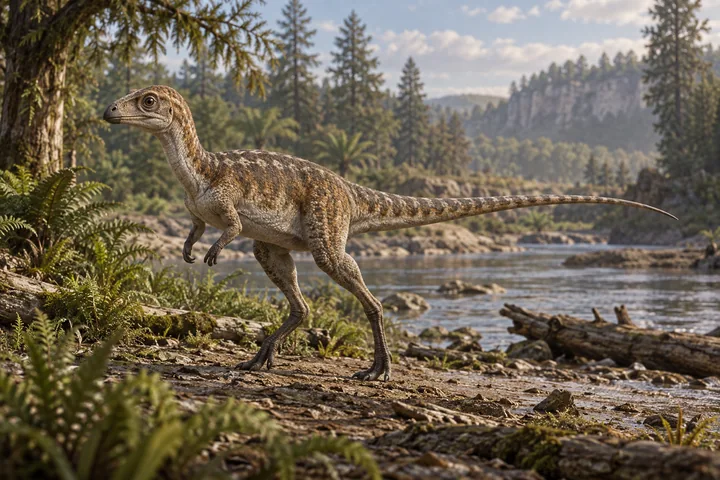
Hypsilophodon foxii
Hypsilophodon foxii was a small, ground-dwelling plant-eater from the Isle of Wight. Its lightly built skeleton and long hind limbs are consistent with agile running.
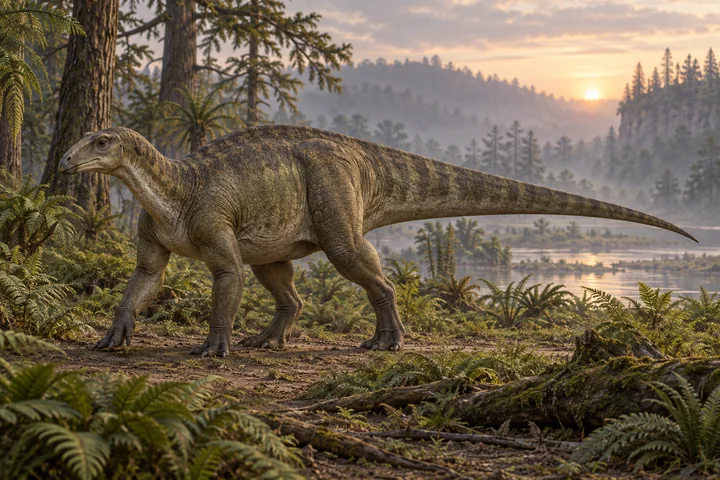
Tenontosaurus tilletti
Tenontosaurus offers evidence of growth, juvenile associations and reproduction before full skeletal maturity.