
Length
InferredAbout 5-5.5 m; holotype reconstruction
IVPP V12691 includes restored missing tail. Closed visible vertebral sutures suggest skeletal maturity; the interval is an individual estimate, not a species range. [D3]
TWO WAYS TO PICTURE THE PAST
Compare the evidence with the familiar movie image. The illustrations are not to a shared scale.
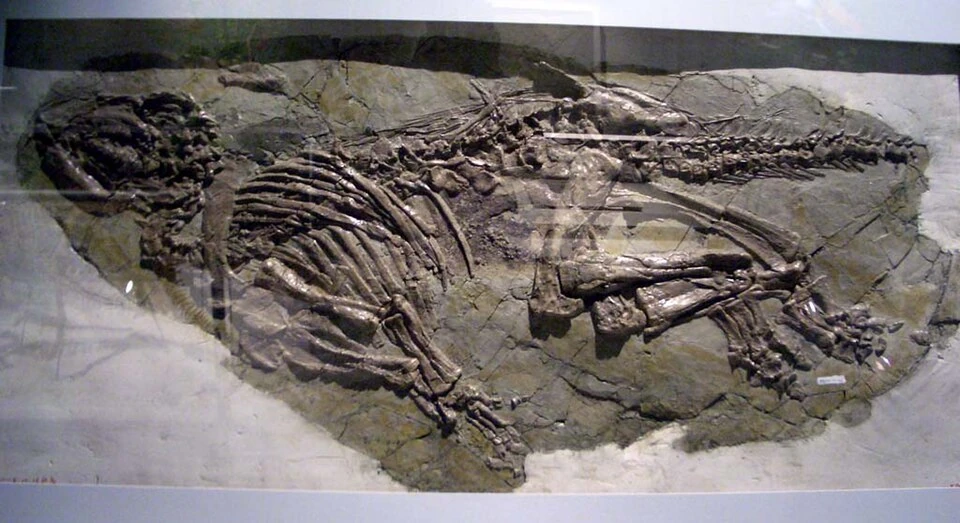
Hong Kong Science Museum display identified as J. yangi. The source does not establish its collection number or original-versus-replica status. The displayed tail and feet are incomplete; compression affects the skeleton. Fossil colors do not establish living colors or soft tissues. [3]
Jinzhousaurus yangi.JPG · I, Laikayiu. CC BY-SA 3.0. Proportionally resized Commons preview and converted to WebP; no anatomy edits.
The photograph or figure shows the credited fossil material; displayed mounts and labels can include interpretation.
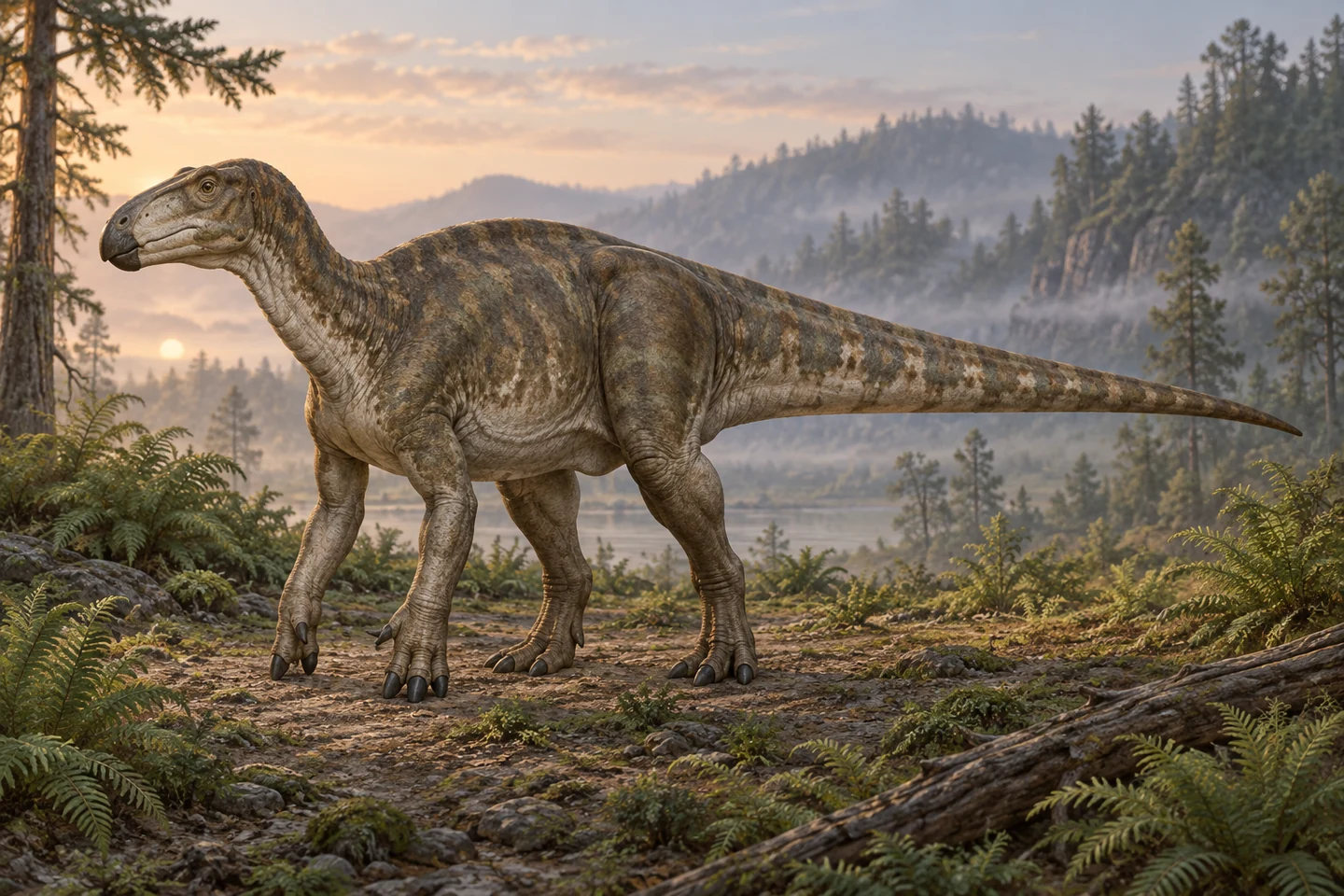
Original cinematic interpretation of the crestless head and short stout hands. The lateral thumb spike and hoof-like middle fingers reflect described anatomy; whole-body posture, colors, soft tissues and scenery remain reconstruction choices. Lighting, coloration and scenery are artistic choices. This image does not document a fossil locality or behavior.
Original artwork · artistic interpretation.
Scientific view: source-informed reconstruction, credited paleoart or specimen-based imagery. Movie-style view: Original artistic interpretation. Reconstructions involve uncertainty.
MEET THE ANIMAL
Jinzhousaurus was a plant-eating dinosaur from Early Cretaceous China. Its cheek teeth support a vegetation-based diet, although particular foods are not established in the reviewed evidence. The named species is Jinzhousaurus yangi. It is one of the named dinosaurs that help researchers investigate the early history of the wider duck-billed dinosaur group. [D4] [D1]
The original description recognized a mixture of skull and tooth features, combining more ancestral traits with others resembling those of hadrosaurs. That mixture helped identify a distinct dinosaur. It does not turn Jinzhousaurus into a confirmed direct ancestor of later species. Evolutionary comparisons describe relationships among branches, rather than proving that a particular fossil animal founded a later family. [D1]
Its skeleton came from Liaoning’s Yixian Formation, part of the Jehol record. Large dinosaurs are scarce in the deposits. Researchers have considered both ecological rarity and preservation bias, since the number of fossils found need not match the number of animals originally alive. [D2]
A triangular thumb spike distinguished its stout hand. Some other fingertips remain incomplete in the skeleton. [D3]
PREHISTORIC ANIMAL DOSSIER
The animal, the evidence, and the questions still open.
Skull studies identify a distinctive mixture of early hadrosauroid features. Its rare large skeleton also highlights preservation limits in the Jehol record. [D2]
Profile scope: J. yangi, articulated but compressed holotype IVPP V12691, with missing feet and incomplete tail. [D3]
Source supported identifies a description documented by the cited source. Inferred marks a reconstruction or functional estimate. Debated marks competing interpretations. Not established means the sources reviewed for this dossier do not support a firm conclusion; it does not mean a behavior never occurred.
A size reference is an estimate, not a population range. Nesting evidence does not by itself establish courtship, mate choice, or lifelong pairing.
About 5-5.5 m; holotype reconstruction
IVPP V12691 includes restored missing tail. Closed visible vertebral sutures suggest skeletal maturity; the interval is an individual estimate, not a species range. [D3]
About 0.5-1 t; comparative estimate
The primary paper compares its mature-inferred type with similarly sized iguanodontians. This is a broad reconstruction estimate, not a direct individual mass calculation. [D3]
Plant eater
Museum classification and its cheek teeth support herbivory. Specific foods and seasonal preferences are not established here. [D4]
Early Cretaceous Yixian Formation
The holotype comes from Baicaigou, western Liaoning, in the Dakangpu Member/Dawangzhangzi-equivalent beds associated with the Jehol fauna. [D2]
Possible facultative quadruped
Humerus length is about 67% of femur length; the original limb-proportion comparison suggests four-limb support as well as potential bipedality. [D3]
Short stout hands with a thumb spike
The type preserves a triangular digit-I ungual and hoof-like middle unguals; distal details of other fingers remain incomplete. [D3]
Not established here
The proposed skeletal maturity rests on vertebral sutures, without histology. It does not establish nesting, parental care or reproductive age. [D3]
Not established here
The reviewed single-type skull material does not establish sexual dimorphism, mate choice or a courtship ritual. [D2]
Not established here
Jehol faunal association and one articulated skeleton do not establish a Jinzhousaurus herd or family group. [D2]
Sources and inspection notes for the claims in this profile.
THE STORY IN THE FOSSILS
The original description recognized a mixture of more ancestral and hadrosaur-like skull features. Later work refined that diagnosis; the animal is not demonstrated to be the direct ancestor of later duck-billed dinosaurs. [1]
Large-bodied dinosaurs are scarce in the sampled Jehol record. The skull redescription considered both genuine ecological scarcity and preservation bias, illustrating why fossil abundance cannot simply be read as living population size. [2]
The dossier identifies the scope of each reference estimate. A mount, an individual fossil and a species-wide adult range are different measurements. Comparison metrics remain unavailable where adult scope has not been established. Unknown does not mean zero.
Sources support the stated claims and scopes. Refer to the evidence notes for uncertainty.
KEEP EXPLORING
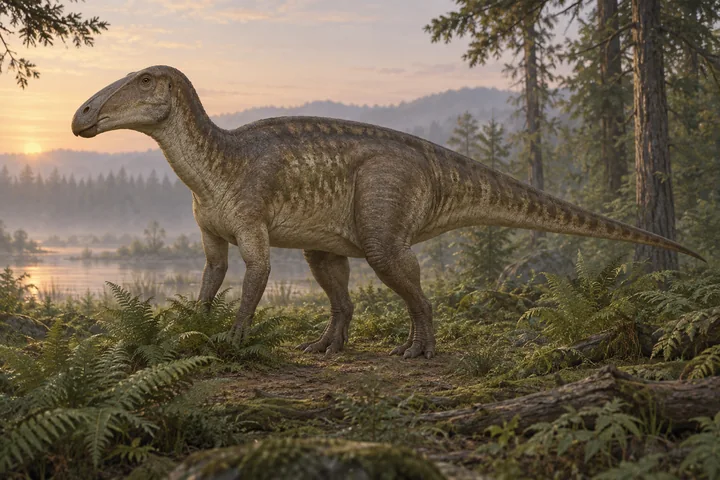
Equijubus normani
Equijubus was a crestless plant-eating hadrosauroid with a broad beak, distinctive cheek anatomy and plant microfossils associated with its teeth.
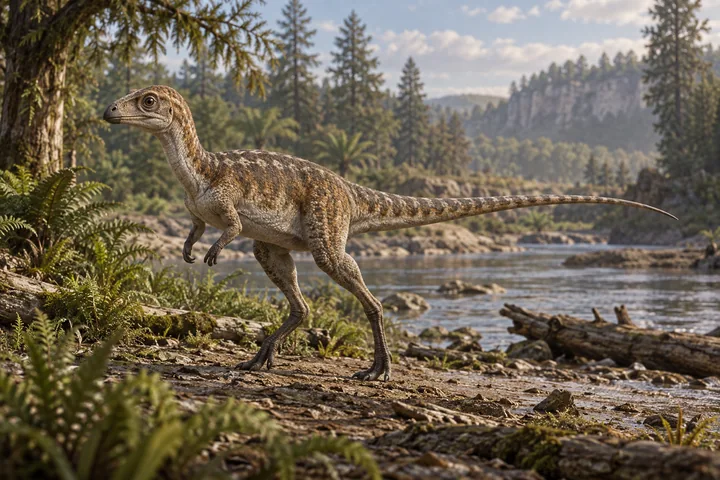
Hypsilophodon foxii
Hypsilophodon foxii was a small, ground-dwelling plant-eater from the Isle of Wight. Its lightly built skeleton and long hind limbs are consistent with agile running.
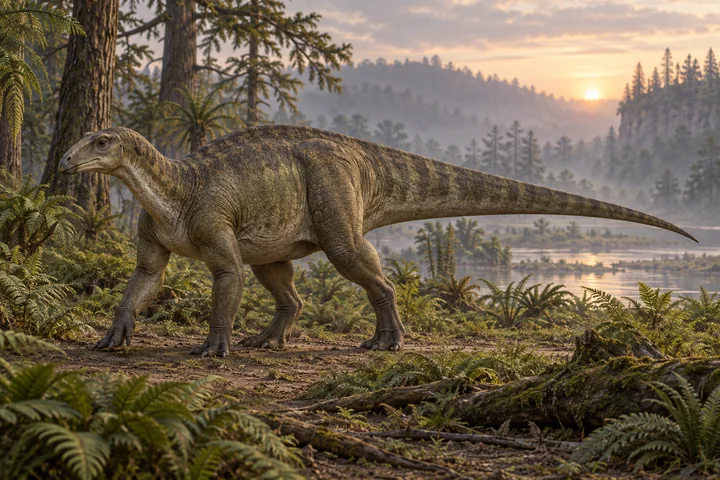
Tenontosaurus tilletti
Tenontosaurus offers evidence of growth, juvenile associations and reproduction before full skeletal maturity.