EXPLORE PREHISTORY 220 prehistoric animal profiles · Scientific & movie-style image galleries

EXHIBIT 190

Erlikosaurus

Erlikosaurus andrewsi

Erlikosaurus preserves a nearly complete skull, allowing detailed CT reconstruction. Models investigate how a proposed beak affected plant feeding. [1] [3]

Evidence profile
PERIODLate Cretaceous[5]
DIETHerbivore (inferred)Evidence and uncertainty in the dossier
TOTAL LENGTHSee the dossierEstimate scope matters
FOSSILS FOUNDMongolia[1]
CompareRead the dossierView the sources

MEET THE ANIMAL

Meet Erlikosaurus

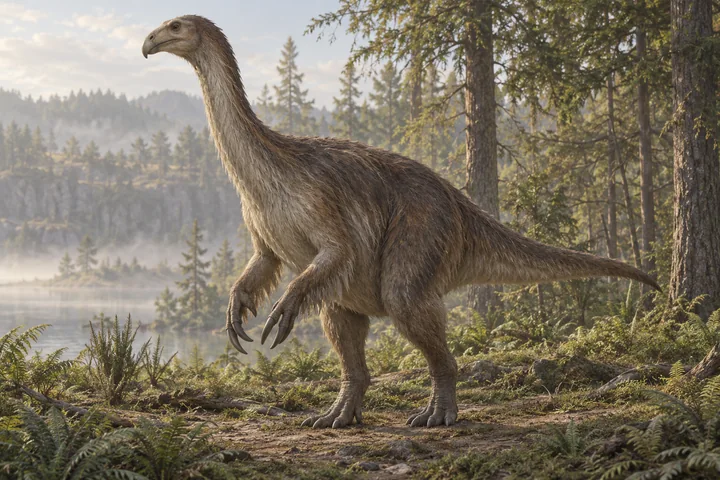
Erlikosaurus is known especially well from its skull, while much less of its body is preserved. The snout was toothless at the front, with teeth farther back in the jaws. This combination makes the head an important guide to its feeding anatomy. [D1]

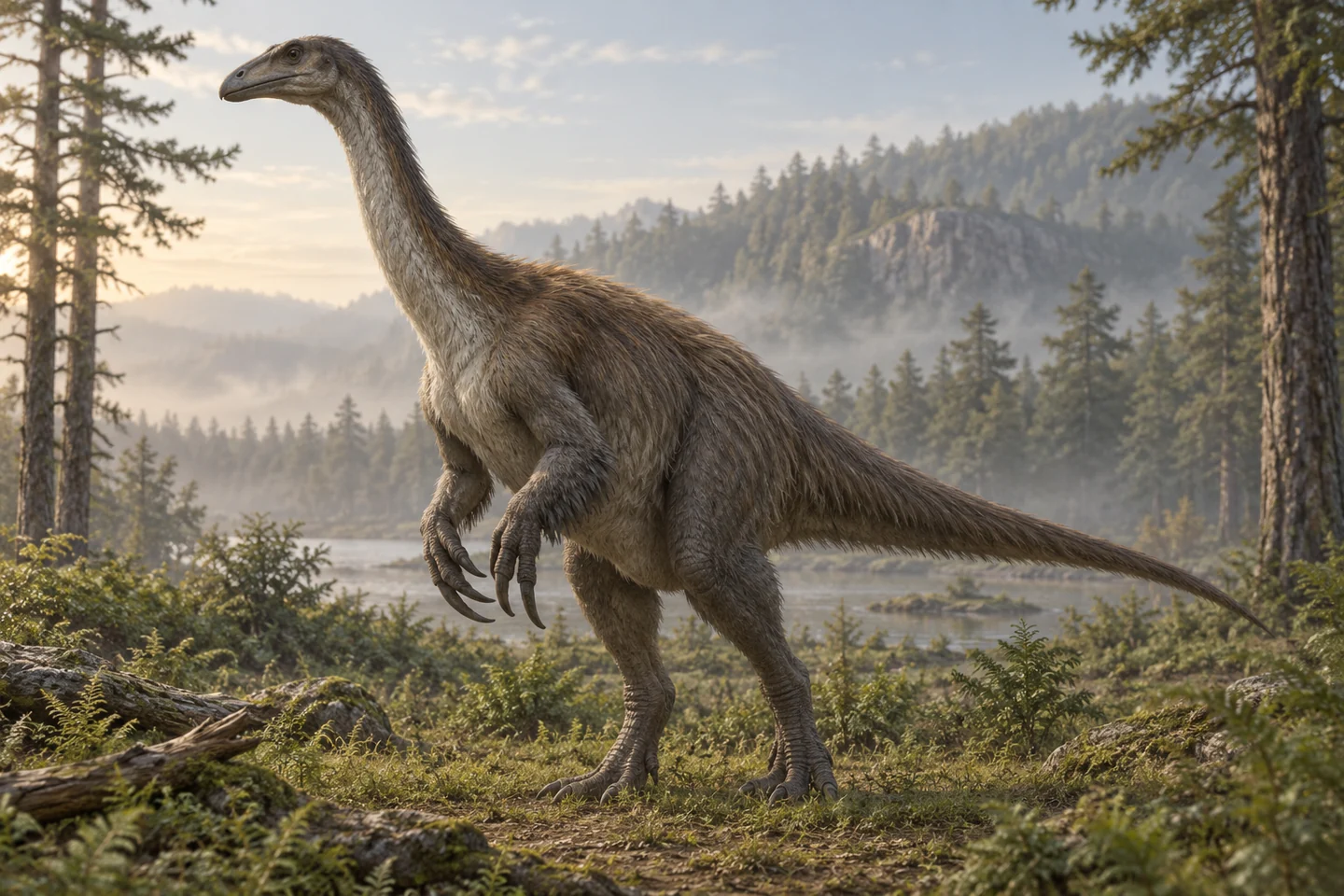
Researchers interpret it as a plant-feeding therizinosaur. The University of Bristol gives a broad body-length reference of three to four metres, but that is not a documented maximum for fully grown individuals. Its research report explains how scans and computer models can investigate a fossil skull without needing the animal's missing soft tissues to survive intact. [D4]

The models tested how a protective beak covering might change stress during feeding. A modeled beak reduced some stresses, helping researchers explore how the skull could work. This is a test of a proposed mechanical explanation, not a preserved beak or a directly measured bite. It also cannot identify a particular plant meal. Erlikosaurus shows how fossils and carefully stated models can answer different parts of the same question. [D3]

PREHISTORIC ANIMAL DOSSIER

A life in profile.

The animal, the evidence, and the questions still open.

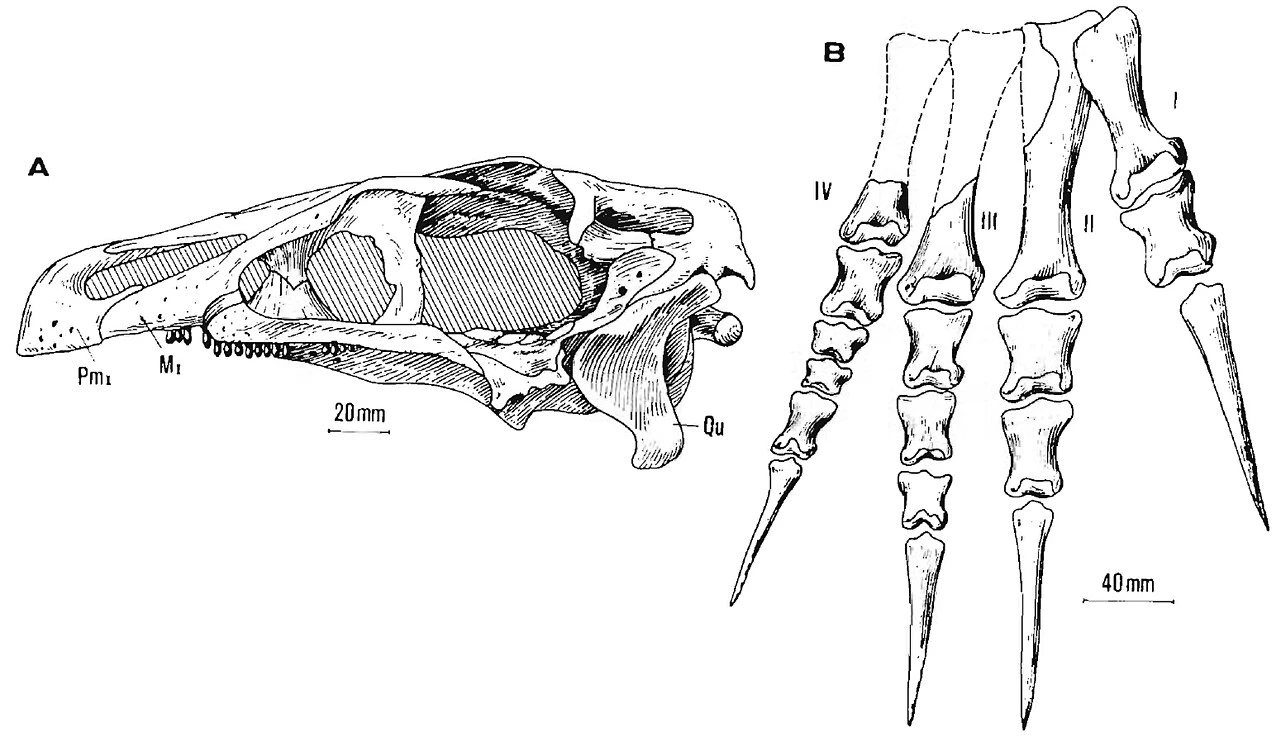
Its toothless snout, toothed jaws and internal skull cavities can be investigated directly. Digital restoration and soft-tissue models add interpretations that must remain separate from the preserved bones. [D3]

Profile scope: Genus profile centered on E. andrewsi type IGM 100/111. Its skull is much better known than its body, and full-body estimates remain reconstructions. [D1]

Time
Late Cretaceous
Fossil locations in this exhibit
Mongolia
How to read the evidence

Source supported identifies a description documented by the cited source. Inferred marks a reconstruction or functional estimate. Debated marks competing interpretations. Not established means the sources reviewed for this dossier do not support a firm conclusion; it does not mean a behavior never occurred.

A size reference is an estimate, not a population range. Nesting evidence does not by itself establish courtship, mate choice, or lifelong pairing.

Body length

Inferred

About 3–4 m; institutional restoration reference

The Bristol research report gives this body reference without a specimen-scoped length calculation or maturity assessment. It is not a measured complete skeleton or established adult range. [D4]
Body mass

Inferred

About 174 kg; humerus-to-femur model

The 2012 study uses the type’s 300 mm humerus to infer a 443.3 mm femur, then models 173.7 kg from femoral length. No type femur or independent adult-maturity assessment supports a direct measurement. [D2]

Diet

Inferred

Plant feeding inferred; beak mechanics modeled

Finite-element models suggest a keratin beak reduced skull stresses during feeding. The soft covering and loads are modeled, not a preserved meal, directly measured bite or proof of an exclusive diet. [D3]

Habitat & fossil setting

Source supported

Bayanshiree deposits of southeastern Mongolia

The type locality is Baishin Tsav. The formation’s broader Cenomanian–Santonian chronology and river/lake deposits provide context; an individual fossil is not directly dated by that entire interval. [D1] [D5]

Movement

Inferred

Bipedal restoration; broad four-digit pes

The original description documents a short, noncompact foot with four substantial digits. This supports a two-legged therizinosaur reconstruction; the missing complete body and pose remain restored. [D7]

Distinctive anatomy

Source supported

Toothless snout and 31 dentary tooth positions

The CT-based account describes the type skull and mandibular dentition. Near-complete cranial preservation does not mean the entire individual skeleton or living soft tissues survived. [D1]

Reproduction & life together

Reproduction & nesting

Not established

Not established here

Published Chinese therizinosauroid embryos are not securely assigned to Erlikosaurus in the inspected abstract. Its eggs, nest structure, incubation and parental care remain unresolved. [D6]

Courtship & mating

Not established

Not established here

CT endocasts permit sensory hypotheses, but do not identify sexes, mating behavior or a courtship ritual. Restored plumage is not direct display evidence. [D2]

Social behavior

Not established

Not established here

The reviewed type is an incomplete individual. Its preservation does not establish a herd, family group or interaction with other therizinosaurs. [D1]

Dossier research & sources

Sources and inspection notes for the claims in this profile.

  1. Cranial anatomy of Erlikosaurus andrewsi (Dinosauria, Therizinosauria): new insights based on digital reconstructionJournal of Vertebrate Paleontology; Lautenschlager, Witmer, Perle, Zanno & Rayfield (2014) · Accessed 2026-10-02Original 29-page author PDF inspected: type IGM 100/111, near-complete skull, 31 dentary tooth positions, limited postcranium, current spelling and CT reconstruction. · Inspected: page
  2. The Endocranial Anatomy of Therizinosauria and Its Implications for Sensory and Cognitive FunctionPLOS ONE; Lautenschlager and colleagues (2012) · Accessed 2026-10-02Original PDF inspected: methods p.2 and Table 2, femoral-length mass models, inferred Erlikosaurus femur from humerus, historical Alxasaurus estimate, CT-based sensory interpretations. · Inspected: page
  3. Edentulism, beaks, and biomechanical innovations in the evolution of theropod dinosaursPNAS; Lautenschlager and colleagues (2013) · Accessed 2026-10-02Original full text inspected: finite-element models of Erlikosaurus skull and hypothetical keratin beak, loading/stress results. A real preserved beak or measured in-life bite is not claimed. · Inspected: page
  4. New light on the functional importance of dinosaur beaksUniversity of Bristol (2013) · Accessed 2026-10-02Current institutional report of original research inspected: 3–4 m broad body reference, CT/finite-element modeling and herbivorous feeding interpretation; no length specimen/maturity calculation. · Inspected: page
  5. Azhdarchid pterosaur diversity in the Bayanshiree Formation, Upper Cretaceous of the Gobi Desert, MongoliaPeerJ; Pêgas, Zhou & Kobayashi (2025) · Accessed 2026-10-02Original full PDF inspected: formation-wide Cenomanian–Santonian framework, upper beds and fluvial/lacustrine depositional environments; ages are not direct dates on individual therizinosaurs. · Inspected: page
  6. Embryos of therizinosauroid theropods from the Upper Cretaceous of China: diagnosis and analysis of ossification patternsActa Zoologica; Kundrát, Cruickshank, Manning & Nudds (2008) · Accessed 2026-10-02Original publisher abstract inspected: Chinese therizinosauroid embryos compared with Neimongosaurus and Erliansaurus; not a secure clutch assignment to this genus. · Inspected: abstract
  7. Segnosauria, a new infraorder of carnivorous dinosaursActa Palaeontologica Polonica; Barsbold & Perle (1980) · Accessed 2026-10-02Original nine-page PDF inspected: initial genus/species description, type skull and broad four-digit foot; historical dietary terminology is superseded by modern biomechanical research. · Inspected: page

THE STORY IN THE FOSSILS

Meet Erlikosaurus.

A modeled keratin covering can change how a skull carries feeding loads. This tests a functional hypothesis without treating the reconstruction as an actually preserved beak. [3]

A note on scale and time

The dossier identifies the scope of each reference estimate. A mount, an individual fossil and a species-wide adult range are different measurements. Comparison metrics remain unavailable where adult scope has not been established. Unknown does not mean zero.

Sources & editorial notes

Sources support the stated claims and scopes. Refer to the evidence notes for uncertainty.

  1. Cranial anatomy of Erlikosaurus andrewsi (Dinosauria, Therizinosauria): new insights based on digital reconstructionJournal of Vertebrate Paleontology; Lautenschlager, Witmer, Perle, Zanno & Rayfield (2014) · Accessed 2026-10-02Original 29-page author PDF inspected: type IGM 100/111, near-complete skull, 31 dentary tooth positions, limited postcranium, current spelling and CT reconstruction. · Inspected: page
  2. The Endocranial Anatomy of Therizinosauria and Its Implications for Sensory and Cognitive FunctionPLOS ONE; Lautenschlager and colleagues (2012) · Accessed 2026-10-02Original PDF inspected: methods p.2 and Table 2, femoral-length mass models, inferred Erlikosaurus femur from humerus, historical Alxasaurus estimate, CT-based sensory interpretations. · Inspected: page
  3. Edentulism, beaks, and biomechanical innovations in the evolution of theropod dinosaursPNAS; Lautenschlager and colleagues (2013) · Accessed 2026-10-02Original full text inspected: finite-element models of Erlikosaurus skull and hypothetical keratin beak, loading/stress results. A real preserved beak or measured in-life bite is not claimed. · Inspected: page
  4. New light on the functional importance of dinosaur beaksUniversity of Bristol (2013) · Accessed 2026-10-02Current institutional report of original research inspected: 3–4 m broad body reference, CT/finite-element modeling and herbivorous feeding interpretation; no length specimen/maturity calculation. · Inspected: page
  5. Azhdarchid pterosaur diversity in the Bayanshiree Formation, Upper Cretaceous of the Gobi Desert, MongoliaPeerJ; Pêgas, Zhou & Kobayashi (2025) · Accessed 2026-10-02Original full PDF inspected: formation-wide Cenomanian–Santonian framework, upper beds and fluvial/lacustrine depositional environments; ages are not direct dates on individual therizinosaurs. · Inspected: page
  6. Embryos of therizinosauroid theropods from the Upper Cretaceous of China: diagnosis and analysis of ossification patternsActa Zoologica; Kundrát, Cruickshank, Manning & Nudds (2008) · Accessed 2026-10-02Original publisher abstract inspected: Chinese therizinosauroid embryos compared with Neimongosaurus and Erliansaurus; not a secure clutch assignment to this genus. · Inspected: abstract
  7. Segnosauria, a new infraorder of carnivorous dinosaursActa Palaeontologica Polonica; Barsbold & Perle (1980) · Accessed 2026-10-02Original nine-page PDF inspected: initial genus/species description, type skull and broad four-digit foot; historical dietary terminology is superseded by modern biomechanical research. · Inspected: page

FOLLOW YOUR CURIOSITY

Who will you meet next?

KEEP EXPLORING

More from the collection