EXPLORE PREHISTORY 220 prehistoric animal profiles · Scientific & movie-style image galleries

EXHIBIT 186

Falcarius

Falcarius utahensis

Falcarius combined long-clawed arms with unusual dentition. Utah’s abundant quarry material documents an early stage of therizinosaur dietary evolution. [1]

Evidence profile
PERIODEarly Cretaceous[2]
DIETPlant feeding (inferred)Evidence and uncertainty in the dossier
TOTAL LENGTHSee the dossierEstimate scope matters
FOSSILS FOUNDUnited States[2]
CompareRead the dossierView the sources

MEET THE ANIMAL

Meet Falcarius

Falcarius helps show how some relatives of meat-eating dinosaurs became adapted to plant food. Its skeleton combines older features with changes associated with herbivory. That makes it interesting as an evolutionary transition, although the bones do not prove that it ate only plants. The original four-metre restoration combines evidence rather than measuring one complete adult skeleton. [D1]

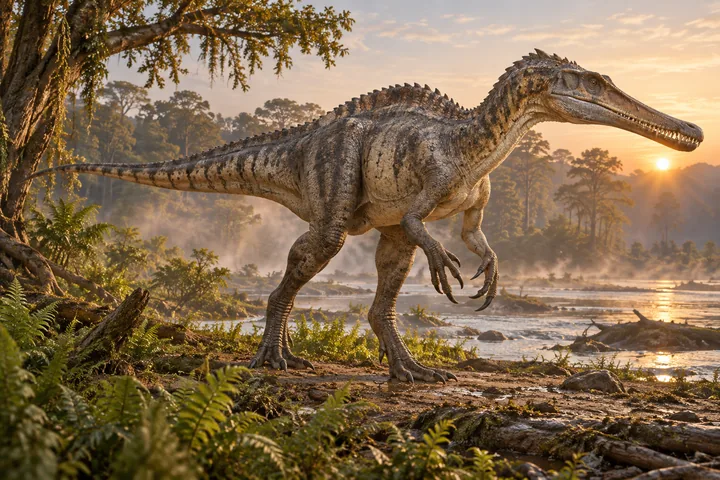
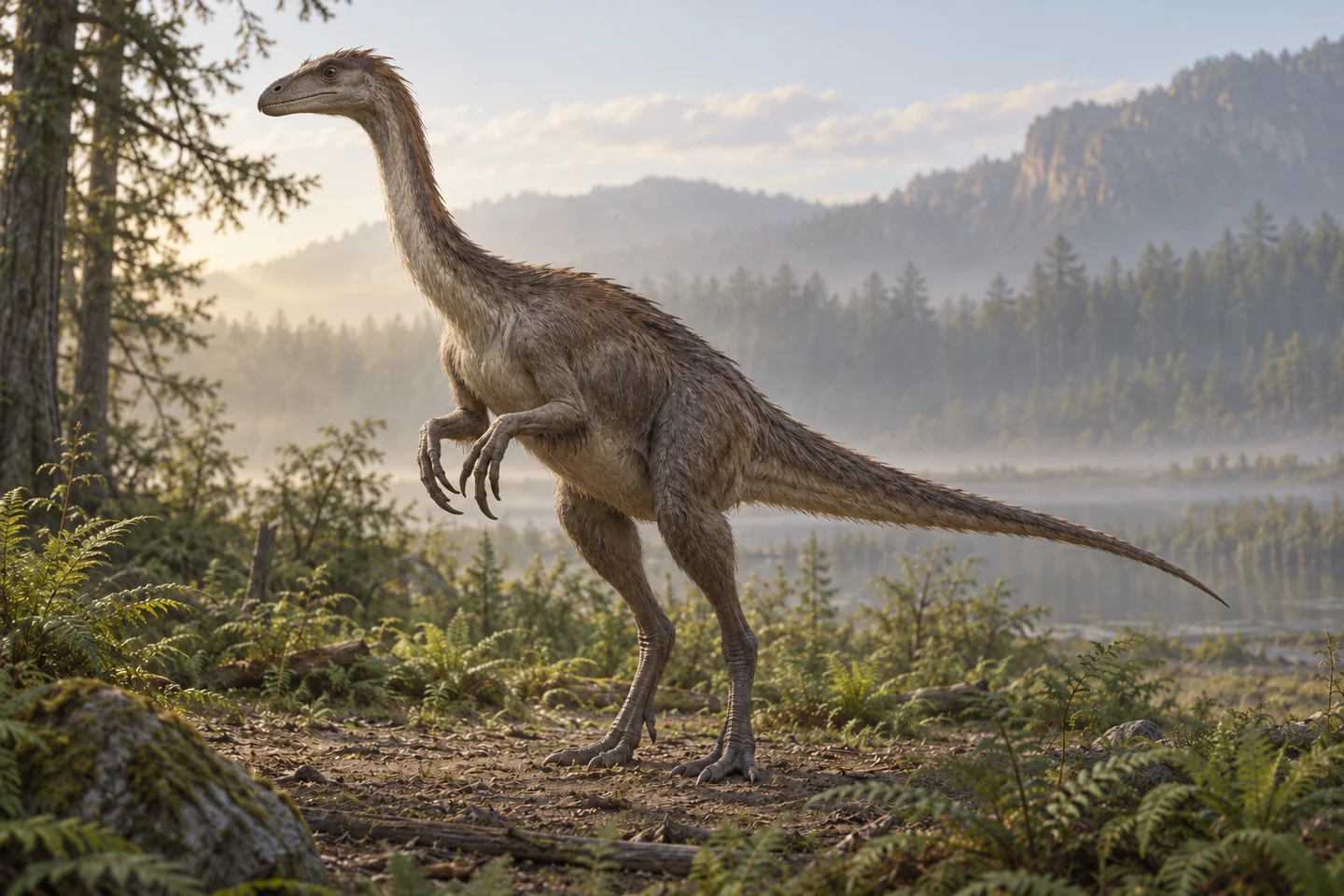
Imagine a two-legged dinosaur with long arms and curved claws. Museum reconstructions sometimes give it a downy covering, based on feathers preserved in related therizinosaurs. Those feathers are a comparative interpretation for Falcarius, rather than plumage found on its own skeleton. Its familiar illustrated appearance therefore brings together direct skeletal evidence and ideas drawn from relatives. [D4]

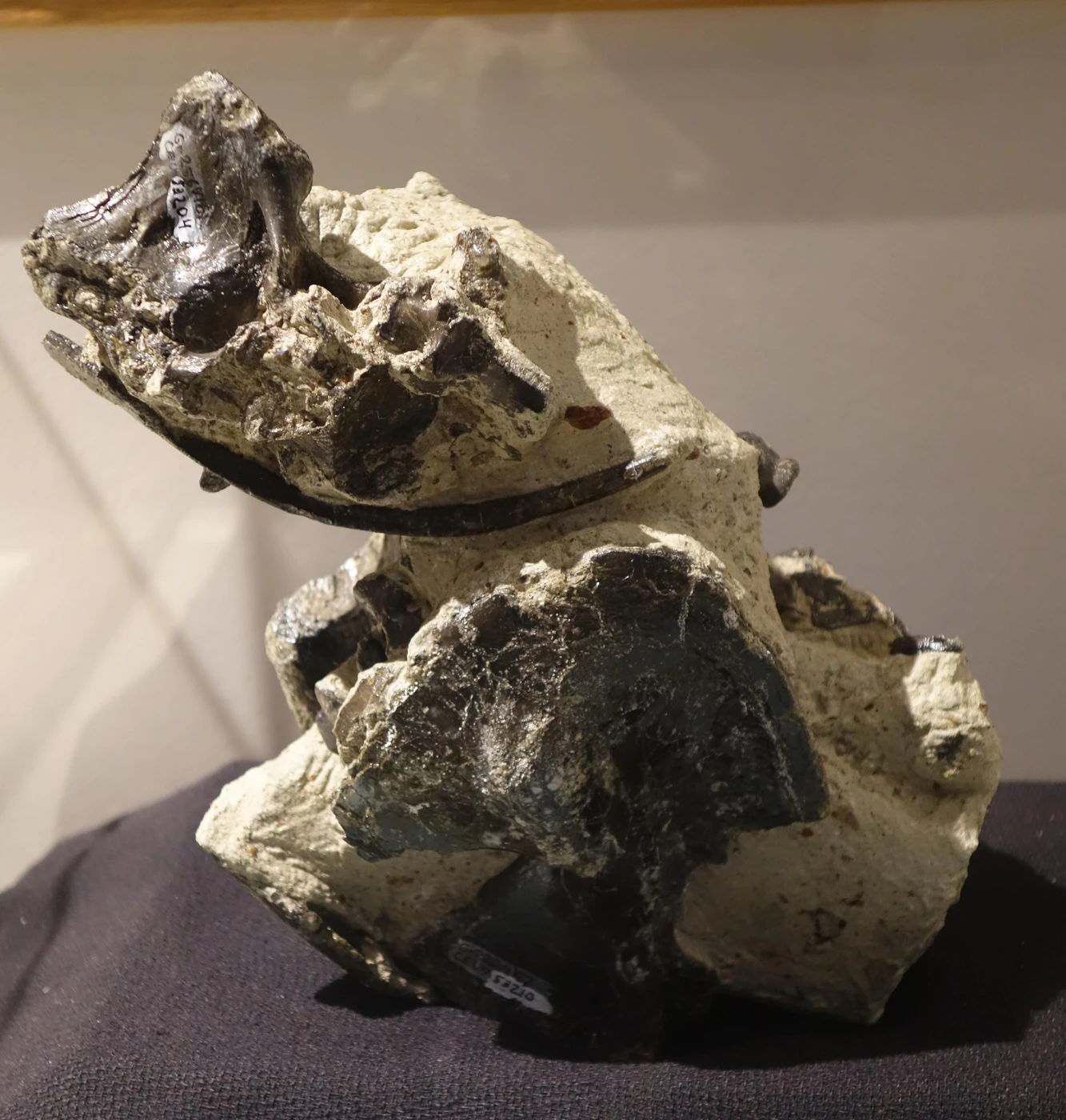
The Crystal Geyser quarry contains remains from many individuals, including skull and jaw material. Large front teeth are part of this animal's distinctive feeding equipment. Researchers have considered whether the accumulation records a social gathering. Finding many bones together raises that question, but it does not automatically establish a herd, a breeding colony or the cause of every animal's death. [D3]

PREHISTORIC ANIMAL DOSSIER

A life in profile.

The animal, the evidence, and the questions still open.

Large front dentary teeth contrast with the smaller teeth behind them. The quarry’s many bones supply a composite anatomical picture, rather than one intact four-metre animal. [D3]

Profile scope: Genus profile includes F. utahensis at Crystal Geyser and the September 2026 transfer F. suarezarum from the Suarez Site. Their measurements and depositional histories remain separate. [D2]

Time
Early Cretaceous
Fossil locations in this exhibit
United States
How to read the evidence

Source supported identifies a description documented by the cited source. Inferred marks a reconstruction or functional estimate. Debated marks competing interpretations. Not established means the sources reviewed for this dossier do not support a firm conclusion; it does not mean a behavior never occurred.

A size reference is an estimate, not a population range. Nesting evidence does not by itself establish courtship, mate choice, or lifelong pairing.

Body length

Inferred

About 4 m; F. utahensis composite restoration

The 2005 reconstruction combined material from several individuals. Its length is a restored reference, not one measured adult, an adult maximum or a size estimate for F. suarezarum. [D1]
Body mass

Inferred

About 128 kg; largest reviewed quarry-femur model

The 2012 study models a 403 mm femur, UMNH 13423, from Crystal Geyser at 127.7 kg using femoral length. Independent adult maturity is not established; this is not a genus-wide maximum. [D5]

Diet

Inferred

Plant feeding inferred from transitional anatomy

The original account interprets anatomical changes toward herbivory, while retaining primitive feeding features. Exact plants, animal-food intake and obligate herbivory are not demonstrated by a preserved meal. [D1]

Habitat & fossil setting

Source supported

Lower Yellow Cat Member, Utah; exact age uncertain

The 2026 revision recognizes distinct Crystal Geyser and Suarez horizons. Lower Yellow Cat age estimates span possible Berriasian–Aptian assignments; unreliable or reworked dates prevent a precise local age. [D2]

Movement

Inferred

Bipedal body; grasping hands

Museum anatomy depicts walking on the hindlimbs with long arms and manual claws. Downy covering is a comparison with other therizinosaurs, not preserved Falcarius plumage. [D4]

Distinctive anatomy

Source supported

Enlarged anterior dentary teeth

New F. utahensis jaws preserve large incisiform teeth near the front and different teeth posteriorly. A toothless hooked lower beak would conceal or contradict that documented front dentition. [D3]

Reproduction & life together

Reproduction & nesting

Not established

Not established here

Focused searches found no securely identified Falcarius eggs, nests or parental care. The quarry’s multiple individuals do not identify a breeding colony or nest producer. [D3]

Courtship & mating

Not established

Not established here

Focused searches did not establish sexes, mate choice, mating seasons or a particular courtship display. Restored colors and feather arrangements are artistic interpretations.

Social behavior

Inferred

Social aggregation proposed for Crystal Geyser

The cranial study interprets a population mass mortality and possible social aggregation. Separate REE signatures in three units and an unresolved death mechanism prevent treating every bone as one observed herd. [D3] [D6]

Dossier research & sources

Sources and inspection notes for the claims in this profile.

  1. A primitive therizinosauroid dinosaur from the Early Cretaceous of UtahNature; Kirkland and colleagues (2005) · Accessed 2026-10-02Original paper PDF inspected: type species F. utahensis, mixed-size Crystal Geyser material, composite four-metre restoration, bipedal anatomy and dietary transition. · Inspected: page
  2. Reassessment of the Early Cretaceous North American ‘troodontid’ Geminiraptor suarezarum as a therizinosaurian and mosaic evolution of coelurosaurian maxillaePLOS ONE; Freimuth, Lively & Zanno (30 September 2026) · Accessed 2026-10-02Original publisher full text inspected: Falcarius suarezarum new combination, CEUM 73719 type maxilla, diagnosis and uncertain lower Yellow Cat ages; separate species/locality scopes. · Inspected: page
  3. New craniodental materials of Falcarius utahensis (Theropoda: Therizinosauria) reveal patterns of intraspecific variation and cranial evolution in early coelurosauriansThe Anatomical Record; Freimuth and colleagues (2025 online/2026 issue) · Accessed 2026-10-02Original full text inspected: Crystal Geyser craniodental anatomy, anterior incisiform teeth, multiple individuals and taphonomic social-aggregation hypothesis; no identified nest producer. · Inspected: page
  4. Falcarius utahensisNatural History Museum of Utah · Accessed 2026-10-02Current museum page inspected: bipedal skeleton and comparative downy-feather interpretation; plumage is inferred from other therizinosaurs. · Inspected: page
  5. The Endocranial Anatomy of Therizinosauria and Its Implications for Sensory and Cognitive FunctionPLOS ONE; Lautenschlager and colleagues (2012) · Accessed 2026-10-02Original PDF inspected: methods p.2 and Table 2, femoral-length mass models, inferred Erlikosaurus femur from humerus, historical Alxasaurus estimate, CT-based sensory interpretations. · Inspected: page
  6. Rare earth element geochemistry and taphonomy of the Early Cretaceous Crystal Geyser Dinosaur Quarry, east-central UtahPALAIOS; Suarez and colleagues (2007) · Accessed 2026-10-02Original one-page abstract PDF inspected, not the full article: three lithologic units and distinct REE signatures; interunit reworking not supported. · Inspected: abstract

THE STORY IN THE FOSSILS

Meet Falcarius.

A new September 2026 analysis places the former Geminiraptor suarezarum in Falcarius. Its CEUM 73719 maxilla and Suarez locality are distinct from the F. utahensis type braincase and Crystal Geyser body material. [2]

Chemical signatures distinguish three quarry depositional units. That evidence helps test how bones accumulated, but does not directly reveal mate choice, family membership or synchronized group behavior. [6]

A note on scale and time

The dossier identifies the scope of each reference estimate. A mount, an individual fossil and a species-wide adult range are different measurements. Comparison metrics remain unavailable where adult scope has not been established. Unknown does not mean zero.

Sources & editorial notes

Sources support the stated claims and scopes. Refer to the evidence notes for uncertainty.

  1. A primitive therizinosauroid dinosaur from the Early Cretaceous of UtahNature; Kirkland and colleagues (2005) · Accessed 2026-10-02Original paper PDF inspected: type species F. utahensis, mixed-size Crystal Geyser material, composite four-metre restoration, bipedal anatomy and dietary transition. · Inspected: page
  2. Reassessment of the Early Cretaceous North American ‘troodontid’ Geminiraptor suarezarum as a therizinosaurian and mosaic evolution of coelurosaurian maxillaePLOS ONE; Freimuth, Lively & Zanno (30 September 2026) · Accessed 2026-10-02Original publisher full text inspected: Falcarius suarezarum new combination, CEUM 73719 type maxilla, diagnosis and uncertain lower Yellow Cat ages; separate species/locality scopes. · Inspected: page
  3. New craniodental materials of Falcarius utahensis (Theropoda: Therizinosauria) reveal patterns of intraspecific variation and cranial evolution in early coelurosauriansThe Anatomical Record; Freimuth and colleagues (2025 online/2026 issue) · Accessed 2026-10-02Original full text inspected: Crystal Geyser craniodental anatomy, anterior incisiform teeth, multiple individuals and taphonomic social-aggregation hypothesis; no identified nest producer. · Inspected: page
  4. Falcarius utahensisNatural History Museum of Utah · Accessed 2026-10-02Current museum page inspected: bipedal skeleton and comparative downy-feather interpretation; plumage is inferred from other therizinosaurs. · Inspected: page
  5. The Endocranial Anatomy of Therizinosauria and Its Implications for Sensory and Cognitive FunctionPLOS ONE; Lautenschlager and colleagues (2012) · Accessed 2026-10-02Original PDF inspected: methods p.2 and Table 2, femoral-length mass models, inferred Erlikosaurus femur from humerus, historical Alxasaurus estimate, CT-based sensory interpretations. · Inspected: page
  6. Rare earth element geochemistry and taphonomy of the Early Cretaceous Crystal Geyser Dinosaur Quarry, east-central UtahPALAIOS; Suarez and colleagues (2007) · Accessed 2026-10-02Original one-page abstract PDF inspected, not the full article: three lithologic units and distinct REE signatures; interunit reworking not supported. · Inspected: abstract

FOLLOW YOUR CURIOSITY

Who will you meet next?

KEEP EXPLORING

More from the collection