
Body length
InferredAbout 5.2 m; museum reconstruction reference
The museum gives a whole-body reference without a named individual, maturity assessment or estimation method. It does not establish a measured adult maximum or population range. [D3]
EXHIBIT 130
Fukuisaurus tetoriensis
Fukuisaurus was a plant-eating ornithopod from Japan. Newly recovered skull and forelimb parts have changed its museum reconstruction. [2]
TWO WAYS TO PICTURE THE PAST
Compare the evidence with the familiar movie image. The illustrations are not to a shared scale.
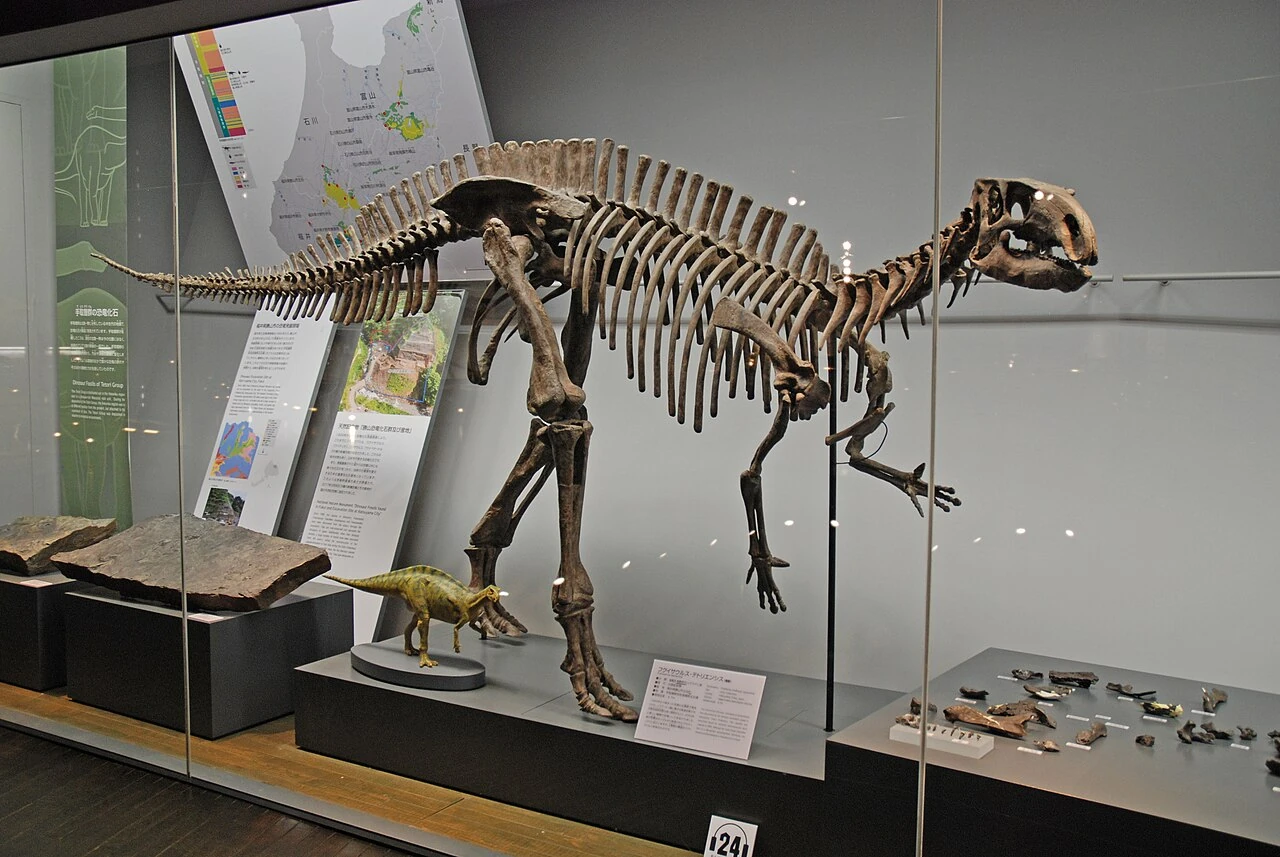
Fukuisaurus mount photographed in 2018 at the Fukui museum. Restored body parts and posture are interpretive; additional skull and forelimb discoveries have revised the museum’s head reconstruction. [1]
Fukuisaurus skeletal mount · Titomaurer. CC BY-SA 4.0. Resized proportionally and converted to WebP; no anatomical edits. Same source license applies.
Skeletal mounts and drawings may restore missing parts; the caption identifies the displayed material.
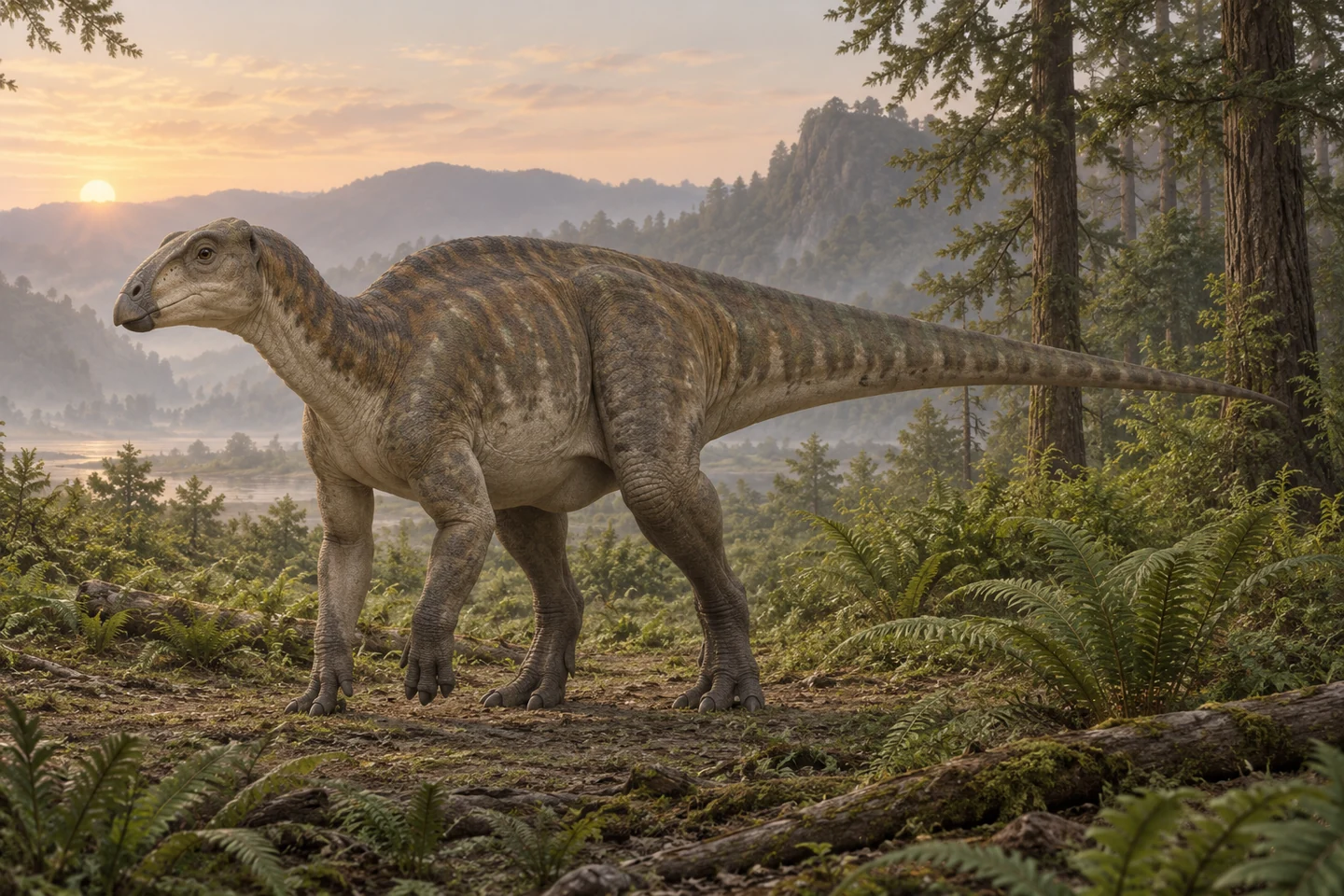
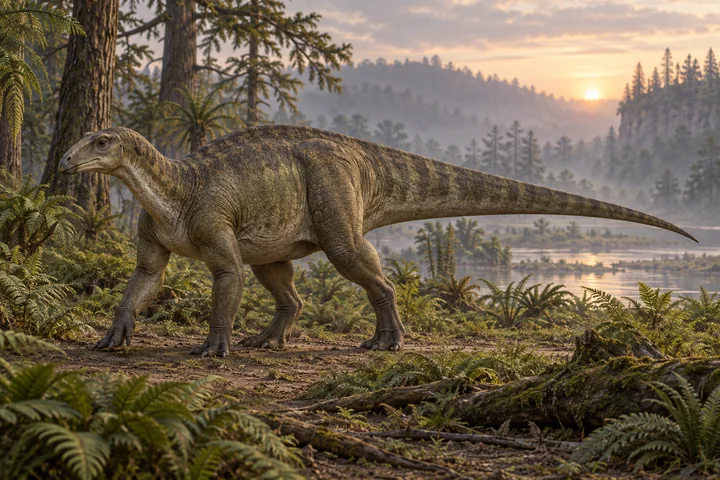
Original cinematic interpretation of Fukuisaurus tetoriensis. Colors, soft tissues, scenery and missing anatomy are reconstructed artistic choices; this is not a directly observed individual or behavior. Missing body anatomy and posture are comparative, and the living skull outline remains a reconstruction. Lighting, coloration and scenery are artistic choices. This image does not document a fossil locality or behavior.
Original artwork · artistic interpretation.
Scientific view: source-informed reconstruction, credited paleoart or specimen-based imagery. Movie-style view: Original artistic interpretation. Reconstructions involve uncertainty.
MEET THE ANIMAL
Fukuisaurus was a dinosaur from the Kitadani Formation near Katsuyama, Japan. A museum body-length reference of about 5.2 metres introduces its scale without identifying a complete measured adult. The formation is placed in the Aptian Early Cretaceous by current research. That geological setting should stay separate from any individual specimen's maturity or exact body dimensions. [D3] [D5]
Its skull contains a strong connection between the upper jaw and another palate bone. Researchers interpreted this joint as resisting the sideways movement proposed for some other plant-eating dinosaurs. The result constrains one part of the feeding apparatus, rather than every possible motion of the jaws. Detailed anatomy can therefore refine a feeding model without supplying a directly observed meal. [D1]
Another local plant eater, Koshisaurus, has been diagnosed separately. Their shared quarry does not make the genera duplicates or prove that every loose bone belongs to Fukuisaurus. Bonebeds contain several animals and different kinds of remains. Keeping the identifications separate allows researchers to compare the local dinosaur community without blending its members into one reconstructed animal. [D4]
PREHISTORIC ANIMAL DOSSIER
The animal, the evidence, and the questions still open.
A strong maxilla–vomer articulation distinguishes its upper jaw. The museum has revised the head as additional bones became available. [D1] [D2]
Profile scope: Genus profile centered on Fukuisaurus tetoriensis, named from skull material including type maxilla FPDM-V-40-1 and jugal FPDM-V-40-2; later finds expand the evidence. [D1] [D2]
Source supported identifies a description documented by the cited source. Inferred marks a reconstruction or functional estimate. Debated marks competing interpretations. Not established means the sources reviewed for this dossier do not support a firm conclusion; it does not mean a behavior never occurred.
A size reference is an estimate, not a population range. Nesting evidence does not by itself establish courtship, mate choice, or lifelong pairing.
About 5.2 m; museum reconstruction reference
The museum gives a whole-body reference without a named individual, maturity assessment or estimation method. It does not establish a measured adult maximum or population range. [D3]
Not established here
Focused searches did not produce an inspected, transparent specimen-specific mass model. Repeated book figures lacked a checked model and maturity scope, so no numerical weight is adopted here.
Plants
The museum identifies herbivory and a beaked plant-processing jaw. Differences from Koshisaurus may suggest dietary separation, but exact plant menus are not demonstrated. [D2]
Aptian Kitadani Formation, Fukui, Japan
Current primary research places this dinosaur-bearing formation in the Aptian Early Cretaceous near Katsuyama. Quarry bonebeds contain several dinosaur and other vertebrate taxa. [D5] [D4]
Comparative biped with possible forelimb support
A two-legged ornithopod body, potentially able to use its forelimbs, is a comparative reconstruction. Newly recovered forelimb parts improve it; the reviewed sources do not establish habitual gait or speed. [D2]
Strong, comparatively rigid upper-jaw connection
The maxilla–vomer joint was interpreted to resist the sideways upper-jaw movement proposed for some other ornithopods. This constrains one joint, not every possible motion during feeding. [D1]
Not established here
Small jaws interpreted as juvenile occur, but reviewed research and focused searches did not identify an assigned nest, egg clutch, incubation behavior or parental care. [D2]
Not established here
No reviewed evidence establishes mating displays, calls, sex-specific coloration or mate choice. Comparisons with later duck-billed dinosaurs cannot supply those details.
Not established here
Several dinosaurs occur in the mixed quarry. Their association does not establish persistent Fukuisaurus herds, family structure or relationships between individuals. [D4]
Sources and inspection notes for the claims in this profile.
THE STORY IN THE FOSSILS
The museum reports that new skull and forelimb finds, especially since 2016, changed its restoration. A historic mount remains useful evidence of interpretation, but its head is not the final anatomical word. [2]
Another local plant-eater, Koshisaurus, has been diagnosed separately. Their shared quarry does not make the two genera duplicates or guarantee that every loose bone belongs to Fukuisaurus. [4]
The dossier identifies the scope of each reference estimate. A mount, an individual fossil and a species-wide adult range are different measurements. Comparison metrics remain unavailable where adult scope has not been established. Unknown does not mean zero.
Sources support the stated claims and scopes. Refer to the evidence notes for uncertainty.
KEEP EXPLORING
Iguanodon
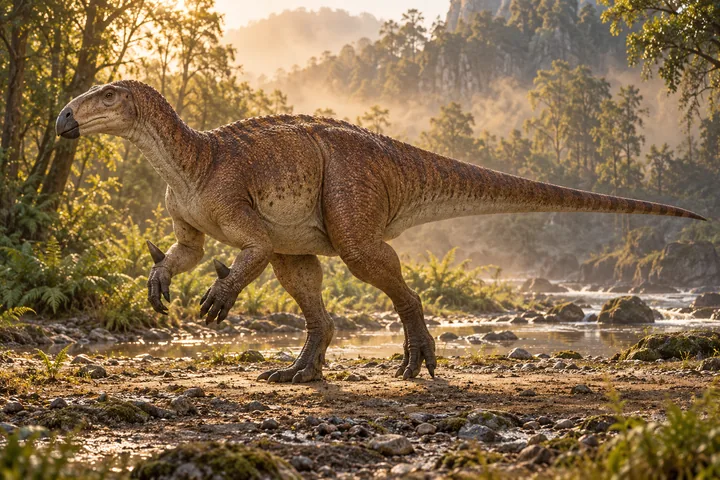
Iguanodon was a large Early Cretaceous ornithopod with a beak, chewing teeth and prominent thumb spikes. Revisions of old fossils have narrowed a genus that once gathered many different dinosaurs.
Tenontosaurus tilletti
Tenontosaurus offers evidence of growth, juvenile associations and reproduction before full skeletal maturity.
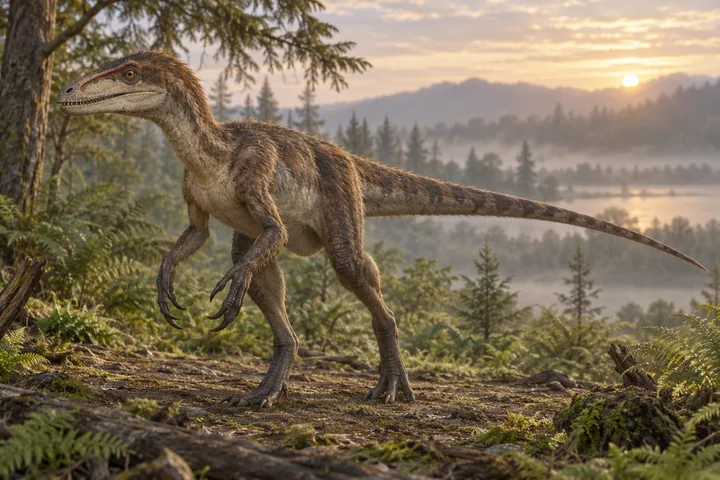
Fukuiraptor kitadaniensis
Fukuiraptor was a Japanese meat-eater with long hands and large, thin claws. Its well-known reconstructed individual was still growing.