
Size reference
Source supported6.62 mm fossil body reference
G. gracilis2014 holotype JZC Bu324A; not CASENT0741232’s measured length or a genus-wide range. [D2]
EXHIBIT 225
Gerontoformica
Prehistoric insect
Gerontoformica was a stem ant preserved in Cretaceous amber, with fossil evidence informing early cooperation. [1]
TWO WAYS TO PICTURE THE PAST
Compare the evidence with the familiar movie image. The illustrations are not to a shared scale.
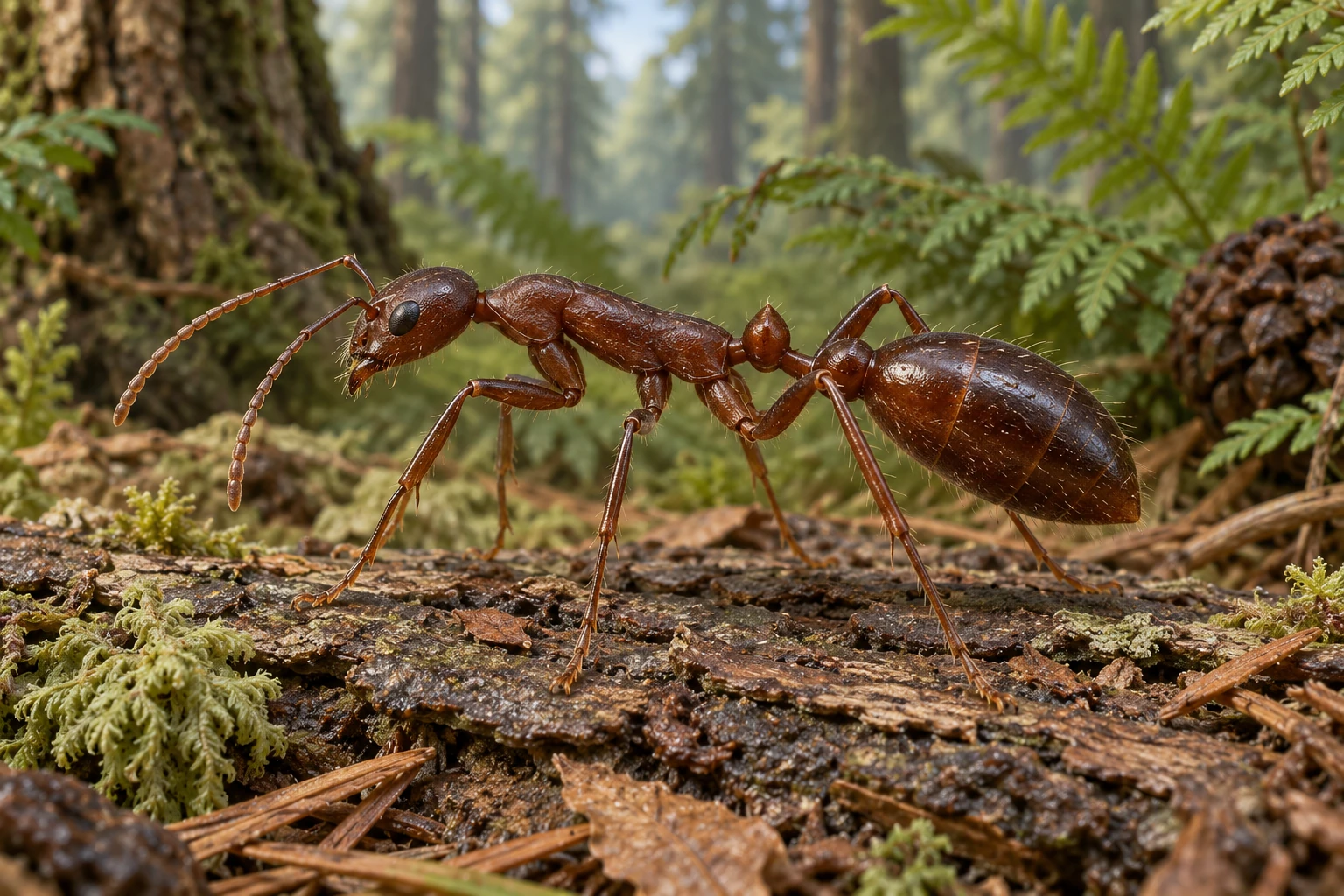
An illustrative reconstruction. Compare its anatomy with the evidence and limitations in the dossier. [2]
Source-informed reconstruction. Appearance evidence [2]. Original illustration; missing anatomy, coloration and scenery include interpretation.
Fossils constrain this life reconstruction. Missing anatomy, coloration and the environmental scene include interpretation; the dossier explains the evidence limits.
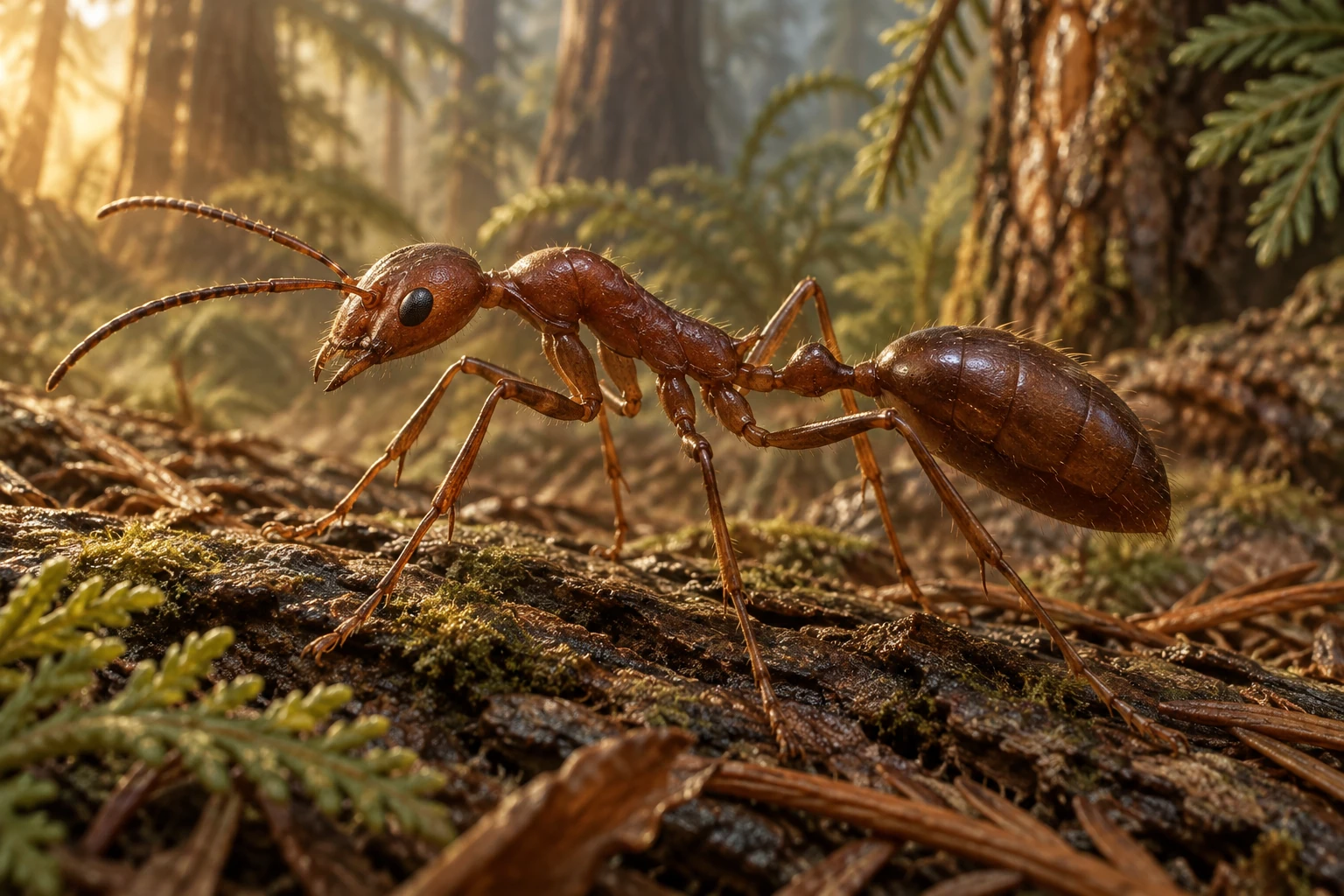
An illustrative reconstruction. Compare its anatomy with the evidence and limitations in the dossier. Lighting, coloration and scenery are artistic choices. This image does not document a fossil locality or behavior.
Original artwork · artistic interpretation.
Scientific view: source-informed reconstruction, credited paleoart or specimen-based imagery. Movie-style view: Original artistic interpretation. Reconstructions involve uncertainty.
MEET THE ANIMAL
Gerontoformica was an early ant genus known from Cretaceous amber in Myanmar and France. Its slender adults had six legs and a narrow waist. A2014 specimen of the species Gerontoformica gracilis was described as6.62 millimeters long. The paper used an older genus name, Sphecomyrmodes, so reading the later revision is necessary to connect the same species rather than count it twice. [D2]
One remarkable amber piece preserves an adult close to a pupa, an immature stage before an ant becomes an adult. Scans helped researchers identify both as Gerontoformica gracilis. Because a pupa cannot walk and the resin contained little loose debris, they proposed that an adult was transporting it. That interpretation supports cooperative brood care, while the fossil is still a snapshot rather than a film of the action. [D1]
More recent research adds different evidence. A2025 amber sample contains a queen-form Gerontoformica gracilis with three workers, helping compare female castes. The same study describes a male of another species, Gerontoformica priapos. Those discoveries strengthen the picture of early ant society, but they do not establish the size of a whole colony, its nest location or the details of mating behavior. [D4]
PREHISTORIC ANIMAL DOSSIER
The animal, the evidence, and the questions still open.
Head scans supply anatomical feeding clues; complete diet and particular prey are not preserved. [D3]
Profile scope: Genus — Gerontoformica; gallery anchored to wingless adult female G. gracilis CASENT0741232 from Kachin amber, Myanmar. [D1]
Source supported identifies a description documented by the cited source. Inferred marks a reconstruction or functional estimate. Debated marks competing interpretations. Not established means the sources reviewed for this dossier do not support a firm conclusion; it does not mean a behavior never occurred.
A size reference is an estimate, not a population range. Nesting evidence does not by itself establish courtship, mate choice, or lifelong pairing.
6.62 mm fossil body reference
G. gracilis2014 holotype JZC Bu324A; not CASENT0741232’s measured length or a genus-wide range. [D2]
Not established here
The inspected measured description gives no fossil-individual body-mass estimate. [D2]
Predatory feeding inferred
Comparative head muscles and mouthparts suggest above-ground predation; complete diet and prey remain unidentified. [D3]
Amber-forest surroundings inferred
French and Myanmar amber occurrences identify preservation settings; the focal specimen’s exact living microhabitat is unknown. [D1]
Wingless adult walking inferred
The focal female has six articulated legs; its speed is unmeasured, and other genus members have wings. [D2]
Slender body; one petiole
G. gracilis has long legs, bidentate jaws and short basal antennal segments; it lacks Haidomyrmex’s upcurved blades. [D2]
Pupa and adult stages documented
CT comparison links a wingless pupa with a nearby G. gracilis adult; eggs and an oviposition site are not described. [D1]
Not established here
A2025 G. priapos male shows sexual morphology, not mating behavior or a G. gracilis mating partner. [D4]
Cooperative brood care inferred
The adult–pupa association supports proposed brood transport; a 2025 queen–worker association provides additional caste evidence. [D1] [D4]
Sources and inspection notes for the claims in this profile.
THE STORY IN THE FOSSILS
Antenna microstructures provide another kind of evidence: comparison with modern ants suggests chemical recognition. That inference complements fossil associations without preserving an actual social exchange. [5]
The dossier identifies the scope of each reference estimate. A mount, an individual fossil and a species-wide adult range are different measurements. Comparison metrics remain unavailable where adult scope has not been established. Unknown does not mean zero.
Sources support the stated claims and scopes. Refer to the evidence notes for uncertainty.
KEEP EXPLORING
Wathondara
Prehistoric insect
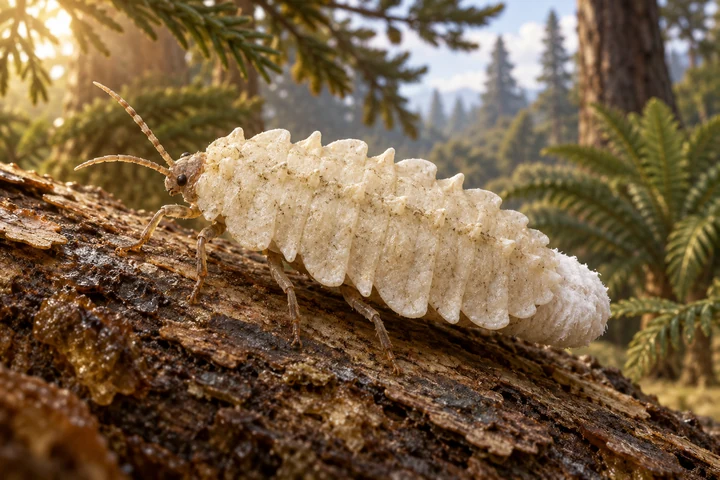
Wathondara was a Cretaceous scale insect whose amber fossil preserves a female, wax egg sac and young.
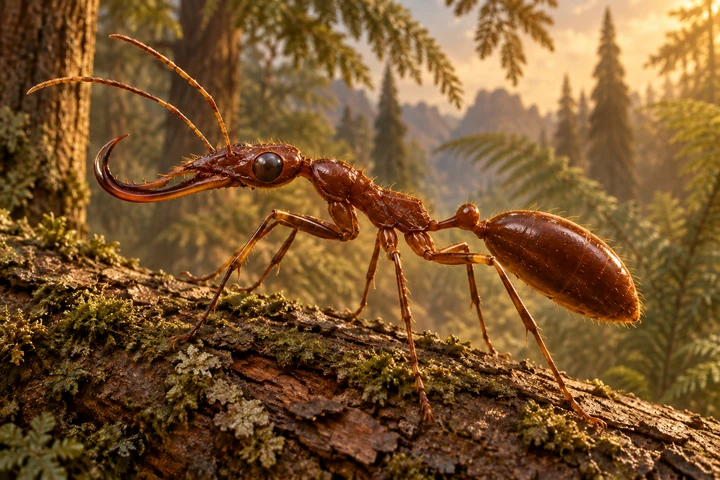
Haidomyrmex
Prehistoric insect
Haidomyrmex was a Cretaceous hell ant with upcurved jaws; its diet and arboreal habits are anatomical inferences.
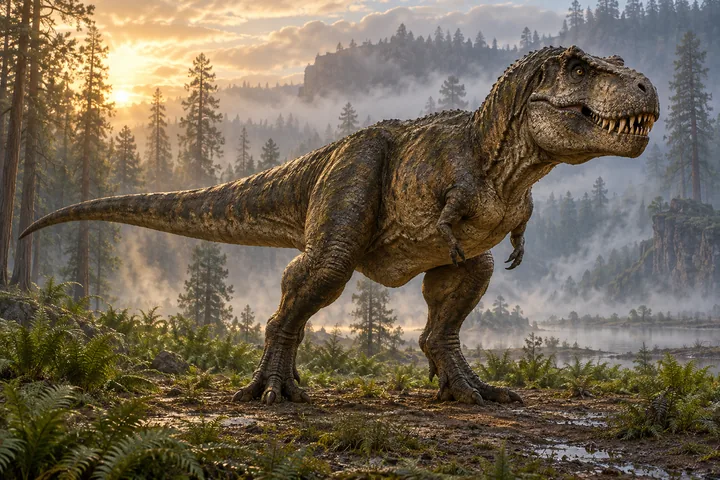
Tyrannosaurus rex
Tyrannosaurus rex was a large meat-eating dinosaur from the final part of the Cretaceous in western North America. Fossil teeth, bite marks and skeletons reveal a powerful animal whose behaviour still invites questions.