EXPLORE PREHISTORY 220 prehistoric animal profiles · Scientific & movie-style image galleries

EXHIBIT 168

Jobaria

Jobaria tiguidensis

Jobaria was a large Nigerien sauropod with a relatively short neck and broad teeth. Its geological age was revised after the original discovery. [4] [2]

Evidence profile
PERIODMiddle Jurassic[2]
DIETHerbivoreEvidence and uncertainty in the dossier
TOTAL LENGTHSee the dossierEstimate scope matters
FOSSILS FOUNDNiger[1]
CompareRead the dossierView the sources

MEET THE ANIMAL

Meet Jobaria

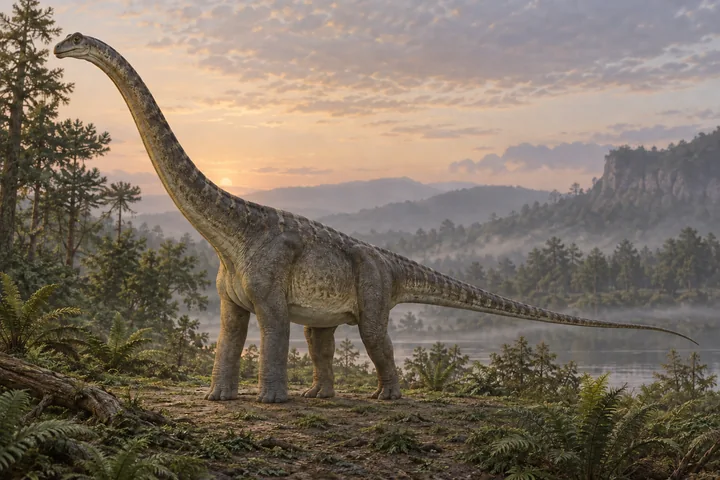
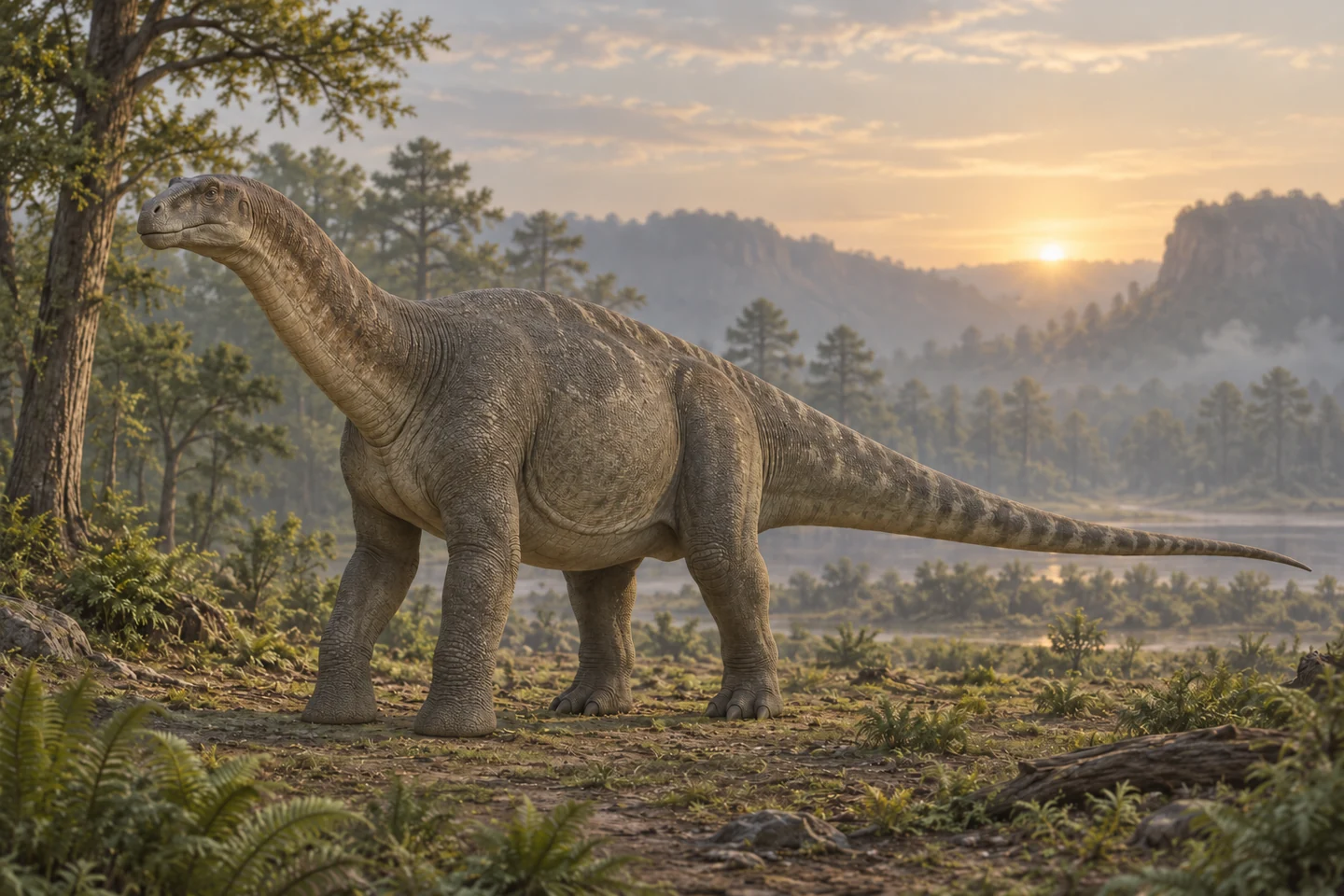
Jobaria was a sauropod from Niger. Reassessment of the Tiouarén Formation places its fauna near the Middle-to-Late Jurassic transition, rather than the Early Cretaceous age used in the original discovery announcement. This revision comes from comparing fossil faunas, not a direct radiometric date. Its geological age therefore retains an important qualification. [D2]

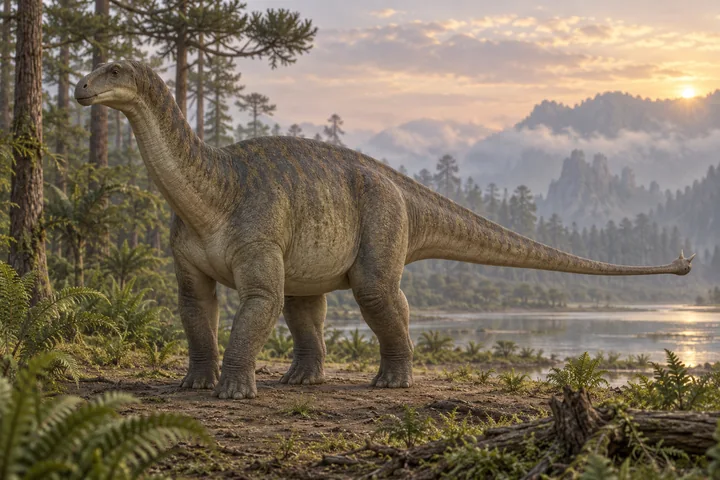
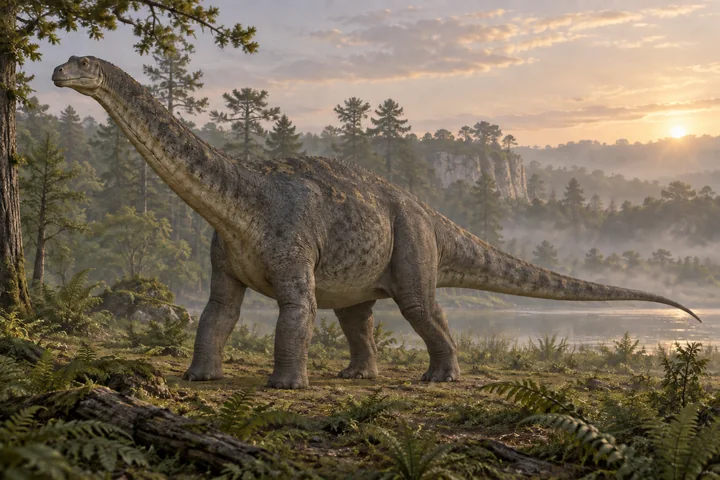
Broad, spoon-shaped teeth support plant browsing. Its relatively short neck differs from the extremely elongated necks familiar in some other sauropods. [D4]

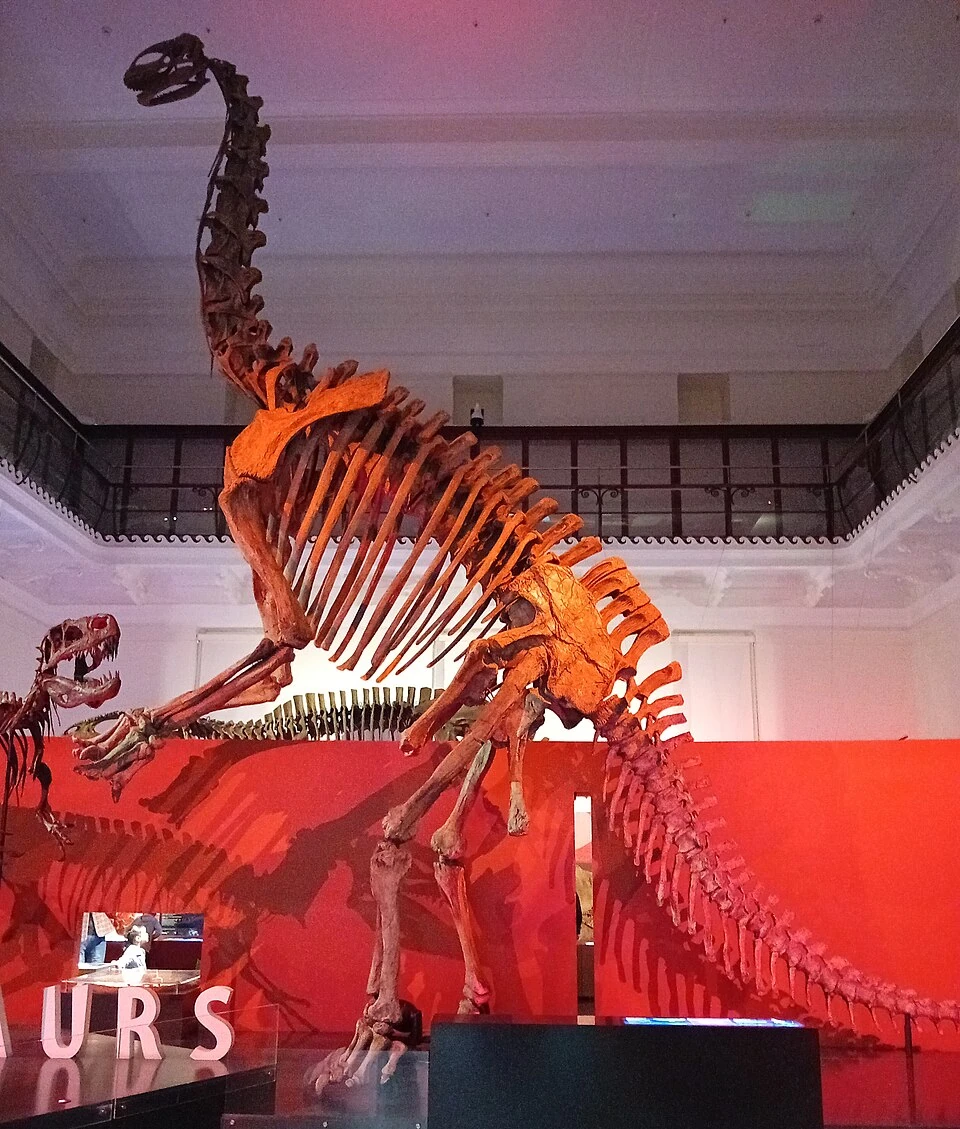
Researchers compared its limb proportions with an elephant's to explore whether Jobaria could rear onto its hind legs. The idea depends on how body mass was balanced and whether the bones could withstand the load. Such modeling tests a possible ability. It does not preserve an observed rearing event or establish a courtship or feeding routine. [S1]

Tooth marks on a juvenile's ribs helped inspire a museum scene showing a predator approaching while an adult Jobaria rears nearby. The marks are physical evidence, while the mounted encounter is an interpretation. The scene cannot independently prove parental defense, identify a family relationship or show the exact sequence that produced the damage. [S1]

Overview sources
  1. Jobaria and the ElephantUniversity of Chicago; Paul Sereno's original research outreach account · Accessed 2026-10-04Inspected: page

PREHISTORIC ANIMAL DOSSIER

A life in profile.

The animal, the evidence, and the questions still open.

The Tiouarén fauna probably belongs near the Middle–Late Jurassic transition, rather than the original Early Cretaceous assignment. Functional rearing and mixed-age grouping remain hypotheses. [D2] [D4]

Profile scope: Genus profile centered on Jobaria tiguidensis type MNN TIG3 and separate referred adults and subadults. Reconstructions combine preserved anatomy and explicitly substituted elements. [D1]

Time
Middle Jurassic
Fossil locations in this exhibit
Niger
How to read the evidence

Source supported identifies a description documented by the cited source. Inferred marks a reconstruction or functional estimate. Debated marks competing interpretations. Not established means the sources reviewed for this dossier do not support a firm conclusion; it does not mean a behavior never occurred.

A size reference is an estimate, not a population range. Nesting evidence does not by itself establish courtship, mate choice, or lifelong pairing.

Body length

Inferred

About 18 m; original adult reconstruction

Figure 3 and the burial footnote explicitly describe an 18 m adult reconstruction. Missing anatomy and an equal-sized individual’s substituted foot element prevent treating it as an intact measured animal or a species maximum. [D1]
Body mass

Inferred

About 17.7 tonnes; restored volume-density model

Table 10 assigns MNN TIG3 a modeled 17,740 kg using reconstructed body volumes and regional densities. Restoration and air-space assumptions affect the result; this is one model reference, not an adult population range. [D3]

Diet

Inferred

Plant browsing inferred from broad teeth

Broad, spoon-shaped teeth support plant feeding rather than the narrow-toothed feeding apparatus of some later sauropods. The institutional account’s browsing interpretation does not identify particular plants or actual stomach contents. [D4]

Habitat & fossil setting

Inferred

Tiouarén Formation; age near the Jurassic transition

Faunal reassessment favors the late Middle Jurassic, possibly early Late Jurassic, in Niger. This is a biochronological inference rather than a radiometric date; the original Early Cretaceous label is retained only as publication history. [D2]

Movement

Inferred

Quadrupedal; rearing capability proposed

The skeleton supports four-legged reconstruction. The discovery release argues rearing may have been mechanically feasible by comparison with elephants; that does not demonstrate routine bipedal walking, observed rearing or its behavioral purpose. [D4]

Distinctive anatomy

Source supported

Twelve cervical vertebrae and a short hand

The original account reconstructs twelve neck vertebrae and broad spatulate teeth. Metacarpal II is approximately 38% of radius length, documenting a relatively short hand rather than a proportion measured from an artistic silhouette. [D1]

Reproduction & life together

Reproduction & nesting

Not established

Not established here

The original assemblages include adult- and subadult-labeled skeletons. Life-stage differences do not identify reproductive maturity, sexes, eggs, nesting arrangements or parental care. [D1]

Courtship & mating

Not established

Not established here

Focused searches did not establish courtship displays, sex-specific ornamentation, calls or mating rituals. A functional possibility of rearing does not identify a reproductive behavior. [D4]

Social behavior

Inferred

Mixed-age grouping proposed; herds unconfirmed

The discovery account proposes herds from differently aged remains. Burial association cannot establish stable family groups or coordinated behavior. [D4]

Dossier research & sources

Sources and inspection notes for the claims in this profile.

  1. Cretaceous sauropods from the Sahara and the uneven rate of skeletal evolution among dinosaursScience; Sereno and colleagues (1999), institution-hosted published paper · Accessed 2026-10-02Original seven-page PDF inspected: MNN TIG3 anatomy, 18 m adult reconstruction in Figure3/footnote6, TIG4/5 adults and TIG6/7 subadults, two burial horizons and deposited scavenged carcasses. Its Early Cretaceous chronology is superseded. · Inspected: page
  2. Considerations on the age of the Tiouarén Formation (Iullemmeden Basin, Niger, Africa): Implications for Gondwanan Mesozoic terrestrial vertebrate faunasPalaeogeography, Palaeoclimatology, Palaeoecology; Rauhut & López-Arbarello (2009) · Accessed 2026-10-02Original publisher abstract/indexed original excerpts inspected: late Middle Jurassic, possibly early Late Jurassic biochronological reassignment; a direct radiometric age is not supplied. Full PDF not obtained. · Inspected: abstract
  3. A review and reappraisal of the specific gravities of present and past multicellular organisms, with an emphasis on tetrapodsThe Anatomical Record; Larramendi, Paul & Hsu (2021 issue; 2020 online) · Accessed 2026-10-02Original full publisher text inspected, Methods and Table10: MNN TIG3 volume 18,660 L, modeled mass 17,740 kg, separately estimated body-region densities; not a weighed animal. · Inspected: page
  4. Jobaria tiguidensis: Paul Sereno’s press releaseUniversity of Chicago; Paul Sereno (1999) · Accessed 2026-10-02Institutional release inspected: preserved broad teeth, short neck, mixed-age herd interpretation and functional rearing analogy. Its original 135-million-year chronology is not adopted. · Inspected: page

THE STORY IN THE FOSSILS

Meet Jobaria.

An adult lay over a smaller individual in a rapidly deposited bed, but that arrangement was produced during burial. It cannot independently reveal their living relationship. [1]

The current geological interpretation changes the exhibit’s period while preserving the original study’s anatomical contribution. Jurassic placement remains qualified because the evidence is faunal rather than a direct date. [2]

A note on scale and time

The dossier identifies the scope of each reference estimate. A mount, an individual fossil and a species-wide adult range are different measurements. Comparison metrics remain unavailable where adult scope has not been established. Unknown does not mean zero.

Sources & editorial notes

Sources support the stated claims and scopes. Refer to the evidence notes for uncertainty.

  1. Cretaceous sauropods from the Sahara and the uneven rate of skeletal evolution among dinosaursScience; Sereno and colleagues (1999), institution-hosted published paper · Accessed 2026-10-02Original seven-page PDF inspected: MNN TIG3 anatomy, 18 m adult reconstruction in Figure3/footnote6, TIG4/5 adults and TIG6/7 subadults, two burial horizons and deposited scavenged carcasses. Its Early Cretaceous chronology is superseded. · Inspected: page
  2. Considerations on the age of the Tiouarén Formation (Iullemmeden Basin, Niger, Africa): Implications for Gondwanan Mesozoic terrestrial vertebrate faunasPalaeogeography, Palaeoclimatology, Palaeoecology; Rauhut & López-Arbarello (2009) · Accessed 2026-10-02Original publisher abstract/indexed original excerpts inspected: late Middle Jurassic, possibly early Late Jurassic biochronological reassignment; a direct radiometric age is not supplied. Full PDF not obtained. · Inspected: abstract
  3. A review and reappraisal of the specific gravities of present and past multicellular organisms, with an emphasis on tetrapodsThe Anatomical Record; Larramendi, Paul & Hsu (2021 issue; 2020 online) · Accessed 2026-10-02Original full publisher text inspected, Methods and Table10: MNN TIG3 volume 18,660 L, modeled mass 17,740 kg, separately estimated body-region densities; not a weighed animal. · Inspected: page
  4. Jobaria tiguidensis: Paul Sereno’s press releaseUniversity of Chicago; Paul Sereno (1999) · Accessed 2026-10-02Institutional release inspected: preserved broad teeth, short neck, mixed-age herd interpretation and functional rearing analogy. Its original 135-million-year chronology is not adopted. · Inspected: page

FOLLOW YOUR CURIOSITY

Who will you meet next?

KEEP EXPLORING

More from the collection