
Length
InferredAbout 2 m; museum reference
Kronosaurus Korner’s educational reconstruction; Queensland Museum lists 2–3 m. Neither discloses a measured adult-individual method, so no comparison range is inferred. [D4] [D5]
EXHIBIT 174
Kunbarrasaurus ieversi
Kunbarrasaurus is an Australian armored dinosaur whose preserved gut contents provide direct evidence of plant eating. [4]
TWO WAYS TO PICTURE THE PAST
Compare the evidence with the familiar movie image. The illustrations are not to a shared scale.
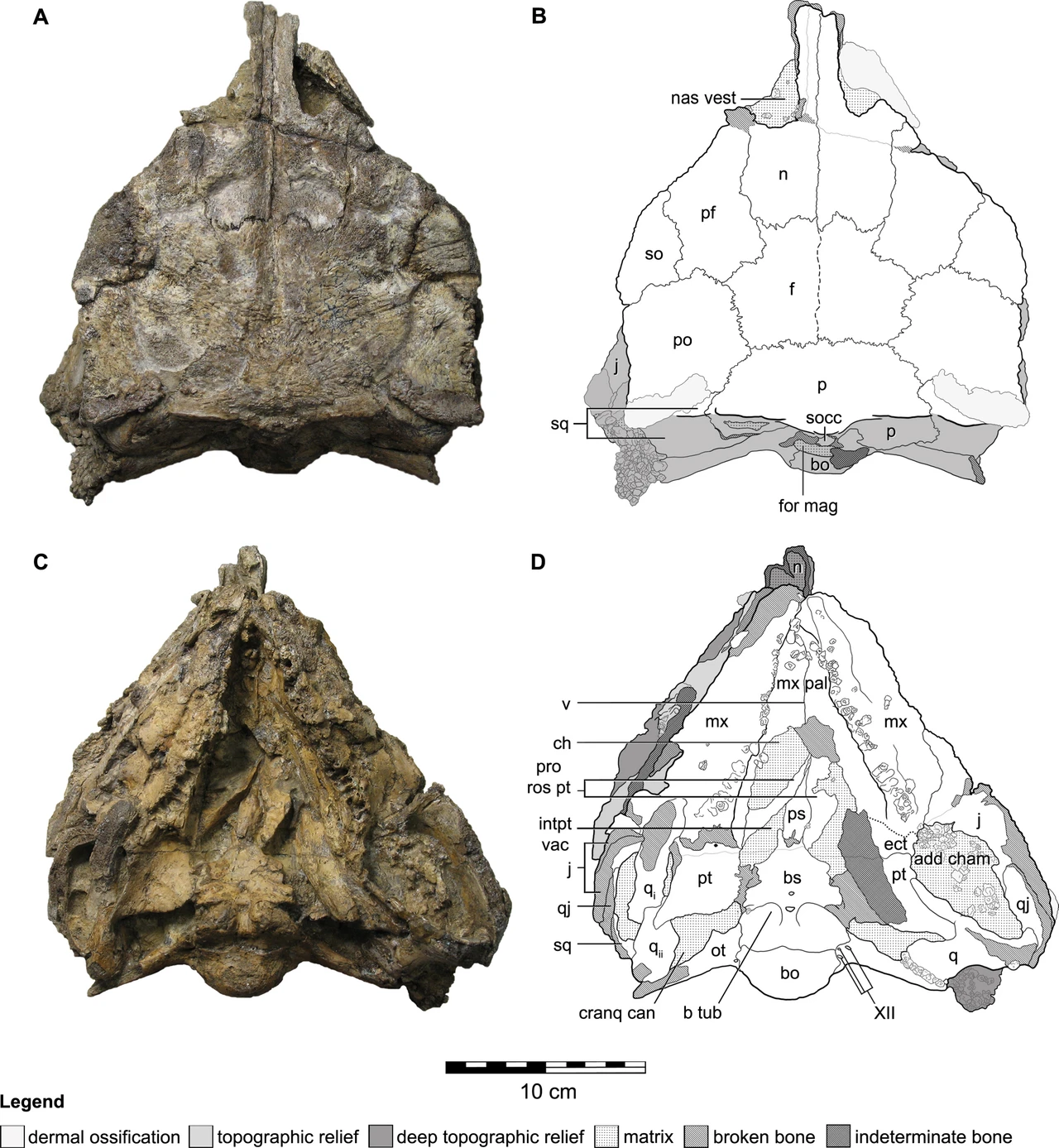
Dorsal and ventral views of K. ieversi holotype QM F 18101, previously called Minmi sp. Photographs and drawings distinguish bone, matrix, breaks and surface relief; this is distinct from Minmi paravertebra. Living colors and soft tissues are unknown. [3]
Kunbarrasaurus skull.png · Lucy G. Leahey, Ralph E. Molnar, Kenneth Carpenter, Lawrence M. Witmer and Steven W. Salisbury. CC BY 4.0. Proportional resizing and WebP conversion; no anatomy edits.
The photograph or figure shows the credited fossil material; displayed mounts and labels can include interpretation.
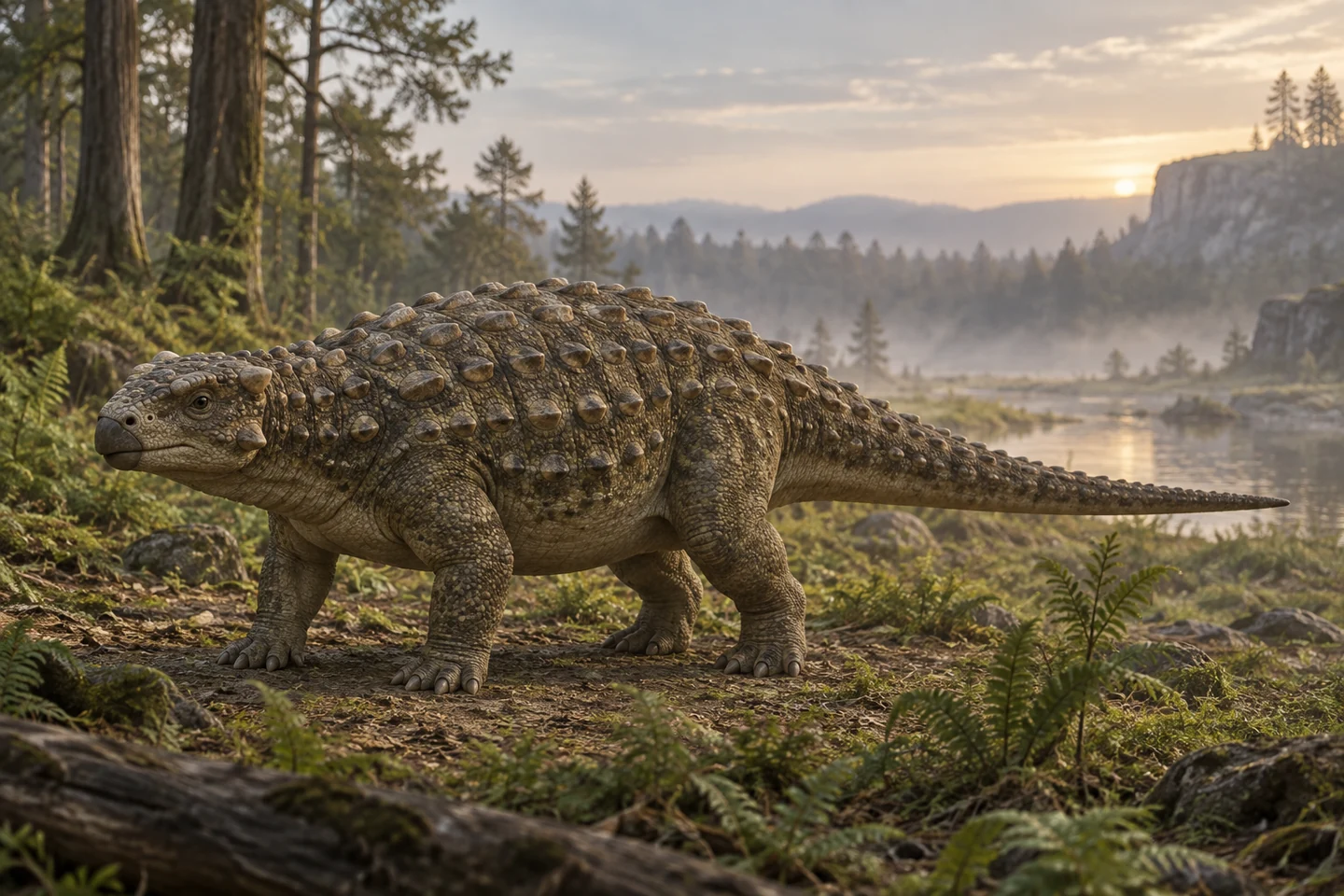
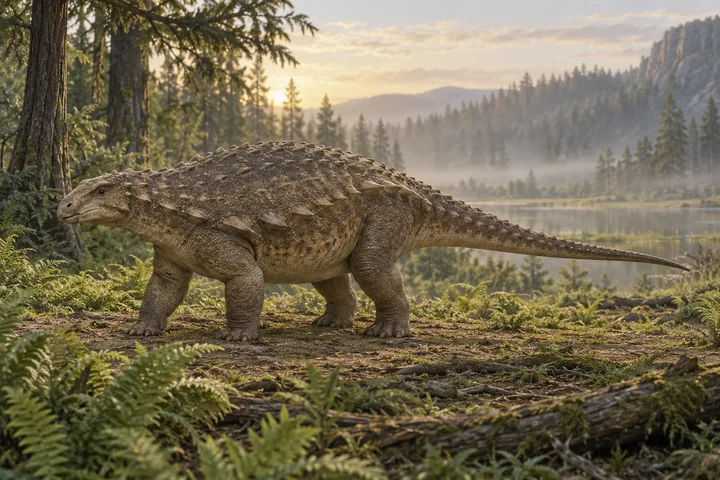
Original cinematic interpretation of Kunbarrasaurus. The flat-roofed distinctive skull guides the head. Armor distribution and a simple reconstructed tail tip are illustrative; the complete terminal tail weapon is not established by the reviewed material. Colors, lighting and scenery are artistic choices; this is not directly observed behavior. Lighting, coloration and scenery are artistic choices. This image does not document a fossil locality or behavior.
Original artwork · artistic interpretation.
Scientific view: source-informed reconstruction, credited paleoart or specimen-based imagery. Movie-style view: Original artistic interpretation. Reconstructions involve uncertainty.
MEET THE ANIMAL
Kunbarrasaurus was an armored plant-eating dinosaur from Early Cretaceous Queensland in Australia. The Queensland Museum gives a general length reference of about two to three metres. No individual measurement method is specified, so the interval is an educational reconstruction rather than a measured adult population range. Its relatively small scale distinguishes this profile from familiar giant armored silhouettes. [D5]
Preserved gut contents provide unusually direct evidence of plant feeding. They include plant fragments, seeds, fruiting bodies and pollen. Small, cleanly cut fragments suggest that food was processed in the mouth, although that remains an interpretation. The contents preserve dietary evidence for a particular animal, without identifying every food species or establishing its preferences throughout the year. [D4]
Scans of the skull reveal a looping nasal passage and an unusually large part of the inner ear. These hidden structures make its anatomy especially informative. Researchers leave the functional consequences uncertain, however. A large inner-ear structure does not by itself prove a particular hearing ability, mating call or social behavior; those explanations would need additional evidence. [D3]
PREHISTORIC ANIMAL DOSSIER
The animal, the evidence, and the questions still open.
Its flat box-like skull contains a looping nasal passage and an unusually large inner-ear vestibule. The consequences for sensory behavior remain unresolved. [D3]
Profile scope: K. ieversi, holotype QM F 18101 from Richmond; the Boulia skull SAMA P 40536 is only cf. Kunbarrasaurus sp. [D1] [D2]
Source supported identifies a description documented by the cited source. Inferred marks a reconstruction or functional estimate. Debated marks competing interpretations. Not established means the sources reviewed for this dossier do not support a firm conclusion; it does not mean a behavior never occurred.
A size reference is an estimate, not a population range. Nesting evidence does not by itself establish courtship, mate choice, or lifelong pairing.
About 2 m; museum reference
Kronosaurus Korner’s educational reconstruction; Queensland Museum lists 2–3 m. Neither discloses a measured adult-individual method, so no comparison range is inferred. [D4] [D5]
About 300 kg; museum reference
The museum discloses no specimen scaling, method or maturity assumptions. This is an educational estimate, not a weighed individual. [D4]
Plants preserved in the gut
Contents include vascular plant fragments, seeds, fruiting bodies and pollen. Small cleanly cut fragments suggest oral processing, which remains an interpretation. [D4]
Upper Albian Richmond, Queensland
The type comes from Allaru Mudstone. Shallow marine burial does not imply an aquatic lifestyle; it was a terrestrial dinosaur. [D1] [D2]
Quadrupedal armored dinosaur
The research team places it among four-legged herbivorous ankylosaurs; speed, gait and genus-specific tracks are not established here. [D3]
Flat skull; enlarged inner-ear vestibule
CT reveals a looping airway and proportionately unusual inner ear. The authors explicitly leave its functional consequences uncertain. [D3]
Not established here
The holotype was interpreted as near or newly mature; attempted histology failed because of fossil alteration. Reproductive maturity, nests and clutch sizes remain unestablished. [D1]
Not established here
An enlarged inner ear is not evidence of mating calls. The institutional account explicitly leaves its functional consequences unknown. [D3]
Not established here
The later skull is tentatively referred and comes from another locality/formation. It does not demonstrate a conspecific group or herd. [D2]
Sources and inspection notes for the claims in this profile.
THE STORY IN THE FOSSILS
Gut contents make this profile more than a dietary guess from teeth. Plant remains preserve a meal, while identifying particular food species and seasonal preferences remains difficult. [4]
Careful skull preparation and CT revealed differences from Roma’s Minmi specimen. Earlier reports of “Minmi sp.” gut contents belong to this individual, not automatically to Minmi paravertebra. [1]
The dossier identifies the scope of each reference estimate. A mount, an individual fossil and a species-wide adult range are different measurements. Comparison metrics remain unavailable where adult scope has not been established. Unknown does not mean zero.
Sources support the stated claims and scopes. Refer to the evidence notes for uncertainty.
KEEP EXPLORING
Gobisaurus domoculus
Gobisaurus was an armored plant eater identified principally through a skull from Inner Mongolia.
Cedarpelta bilbeyhallorum
Cedarpelta was a large armored plant eater with an elongate skull and comparatively subdued cranial ornament.
Hypsilophodon foxii
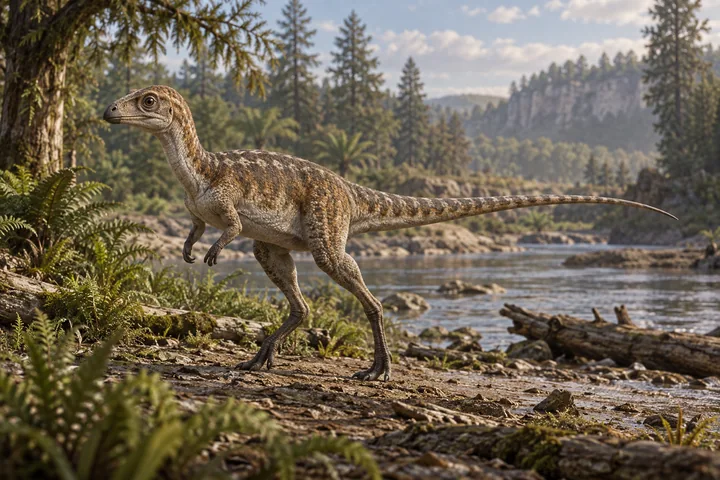
Hypsilophodon foxii was a small, ground-dwelling plant-eater from the Isle of Wight. Its lightly built skeleton and long hind limbs are consistent with agile running.