

Size reference
Source supportedAbout 70 cm wingspan
Museum reference for M. monyi; wing spread is not body length or a genus-wide adult range. [D1]
EXHIBIT 201
Meganeura
Prehistoric insect
Meganeura was a large flying insect from Carboniferous France, known for its expansive wings. [1]
TWO WAYS TO PICTURE THE PAST
Compare the evidence with the familiar movie image. The illustrations are not to a shared scale.
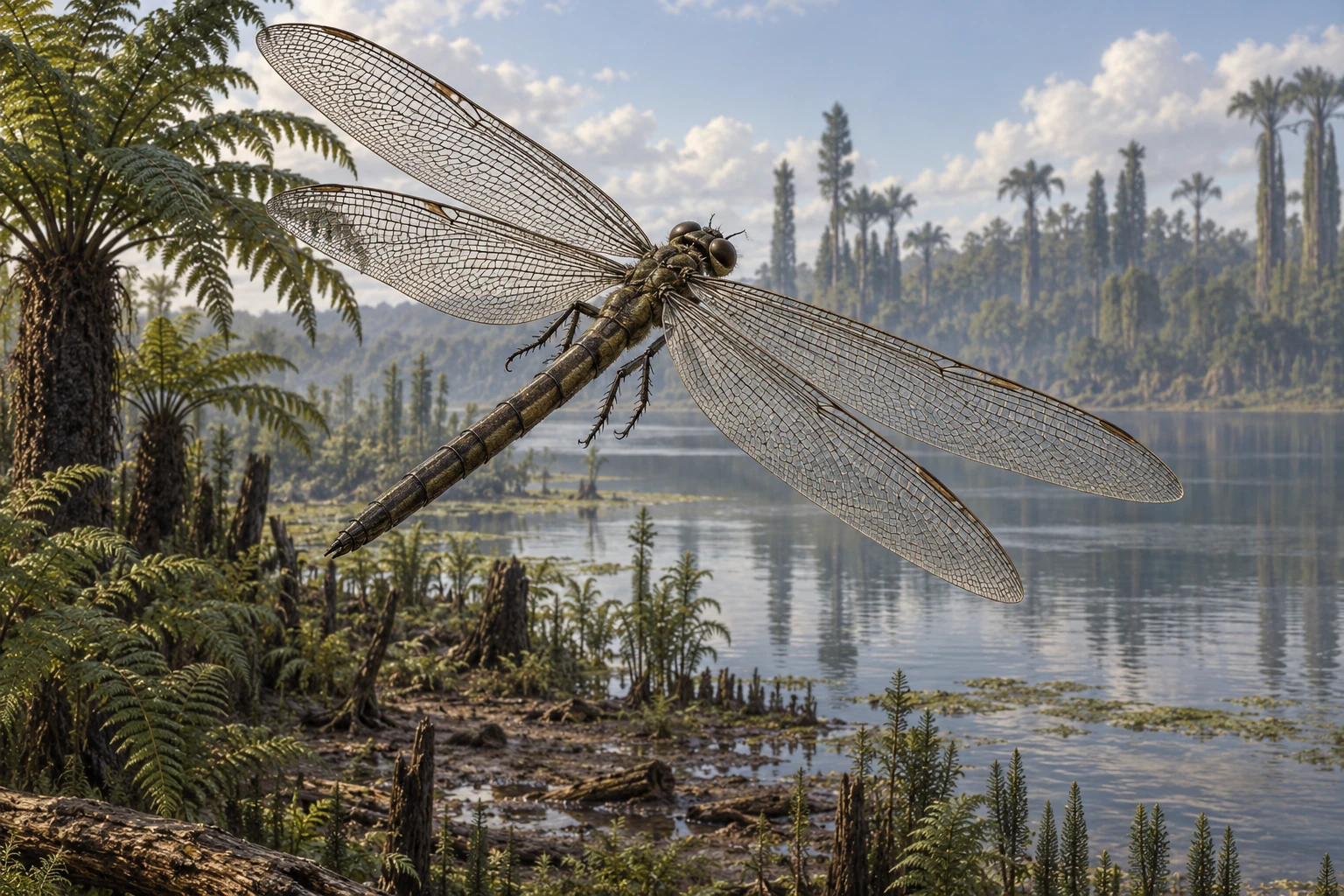
An illustrative reconstruction. Compare its anatomy with the evidence and limitations in the dossier. [4]
Source-informed reconstruction. Appearance evidence [4]. Original illustration; missing anatomy, coloration and scenery include interpretation.
Fossils constrain this life reconstruction. Missing anatomy, coloration and the environmental scene include interpretation; the dossier explains the evidence limits.
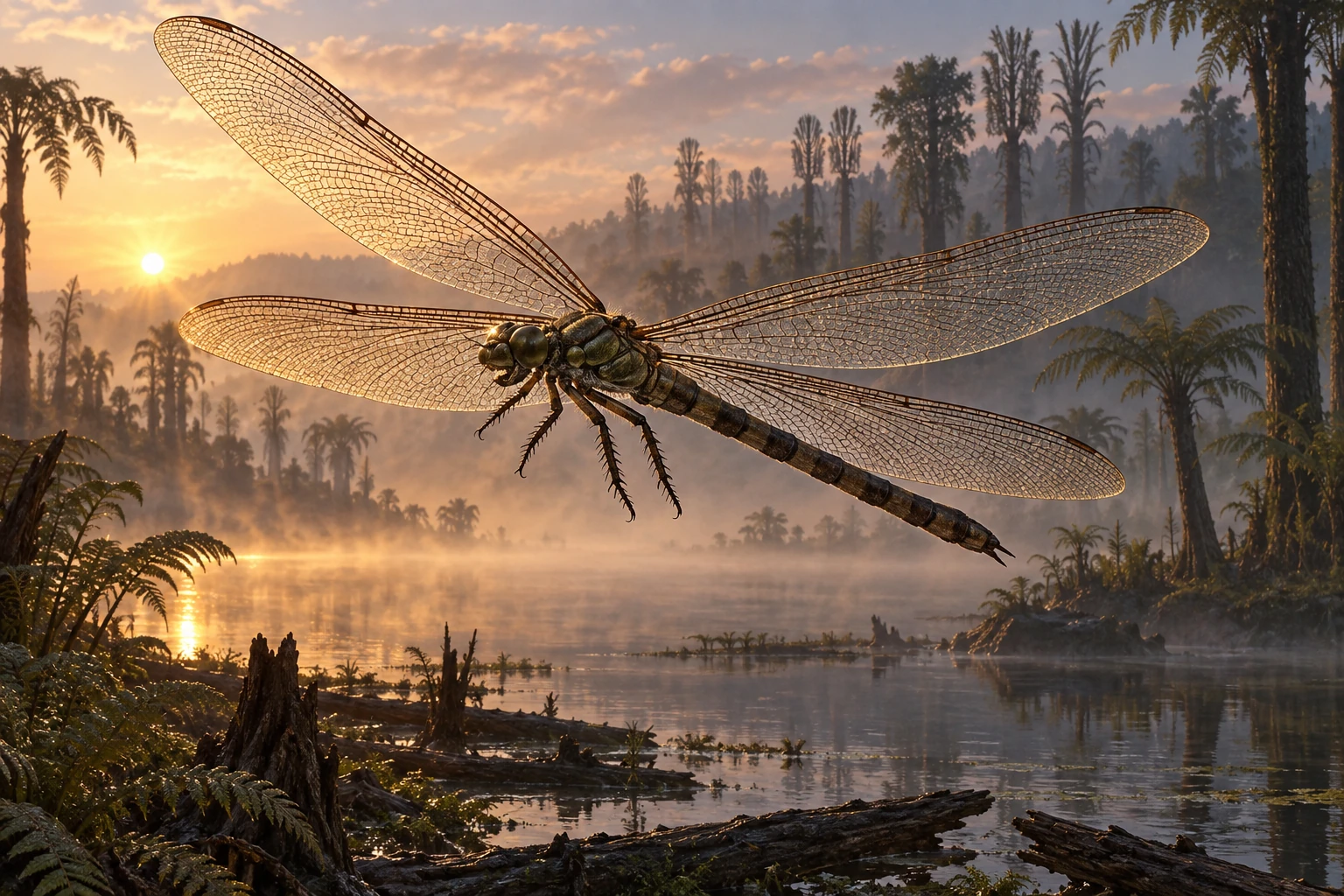
An illustrative reconstruction. Compare its anatomy with the evidence and limitations in the dossier. Lighting, coloration and scenery are artistic choices. This image does not document a fossil locality or behavior.
Original artwork · artistic interpretation.
Scientific view: source-informed reconstruction, credited paleoart or specimen-based imagery. Movie-style view: Original artistic interpretation. Reconstructions involve uncertainty.
MEET THE ANIMAL
Meganeura was an insect that flew over what is now France late in the Carboniferous Period, roughly 300 million years ago. The best-known species, Meganeura monyi, came from the coalfields of Commentry. Its wings could spread about 70 centimeters across. That number describes the distance between the wing tips, rather than the length of its body. It was a large insect, not a dinosaur. [D1]
Its fossils belong to a much larger collection of ancient insects. Workers and researchers recovered many specimens from the old Commentry coal workings, and museums kept them for later study. An insect wing can preserve a fine network of veins even when the rest of the body is missing. Those patterns help researchers recognize kinds of insects and reconsider names assigned long ago. [D2]
Spines on the legs fit a predatory lifestyle, but the clearest detailed evidence comes from a related insect called Meganeurites. Comparing relatives helps build a careful picture without making every feature certain. The reviewed fossils do not tell us how Meganeura courted a mate or exactly where it laid eggs. [D4]
PREHISTORIC ANIMAL DOSSIER
The animal, the evidence, and the questions still open.
Commentry collecting produced a remarkable insect archive; isolated wings make later identification and revision especially important. [D2]
Profile scope: Genus — Meganeura; reconstruction anchored to M. monyi from Commentry, France. [D1]
Source supported identifies a description documented by the cited source. Inferred marks a reconstruction or functional estimate. Debated marks competing interpretations. Not established means the sources reviewed for this dossier do not support a firm conclusion; it does not mean a behavior never occurred.
A size reference is an estimate, not a population range. Nesting evidence does not by itself establish courtship, mate choice, or lifelong pairing.
About 70 cm wingspan
Museum reference for M. monyi; wing spread is not body length or a genus-wide adult range. [D1]
Not established here
The inspected museum account supplies no defensible fossil-individual body-mass estimate. [D1]
Predatory feeding inferred
Spiny legs and comparison with better-preserved meganeurids support carnivory; the detailed mouthpart study concerns Meganeurites. [D4]
Commentry coal-basin surroundings
Fossils come from a limnic basin; open woodland margins are a comparative habitat interpretation, not a preserved home. [D4]
Wing-powered flight
Large wings support flight; precise speed and modern dragonfly maneuvers are not established. [D4]
Veined wings and spiny legs
Head details are poorly preserved; much of the complete living outline needs comparison with related insects. [D4]
Not established here
The reviewed anatomical study does not identify attributable eggs or a Meganeura life-cycle series. [D4]
Not established here
No genus-specific courtship sequence is established by the reviewed fossils. [D4]
Not established here
Shared burial does not demonstrate coordinated groups or social organization. [D2]
Sources and inspection notes for the claims in this profile.
THE STORY IN THE FOSSILS
The Commentry collection shows how an insect can become familiar through wings while much of its living biology remains difficult to reconstruct. [2]
The dossier identifies the scope of each reference estimate. A mount, an individual fossil and a species-wide adult range are different measurements. Comparison metrics remain unavailable where adult scope has not been established. Unknown does not mean zero.
Sources support the stated claims and scopes. Refer to the evidence notes for uncertainty.
KEEP EXPLORING
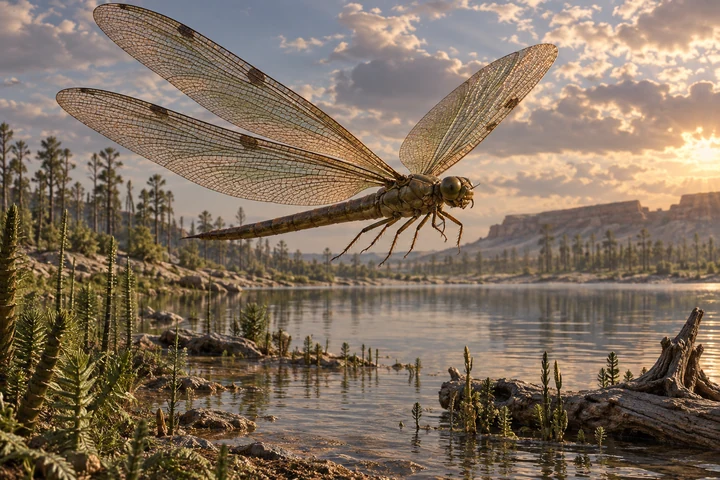
Meganeuropsis
Prehistoric insect
Meganeuropsis was an enormous Permian griffinfly, a relative of dragonflies with distinctive wing venation.
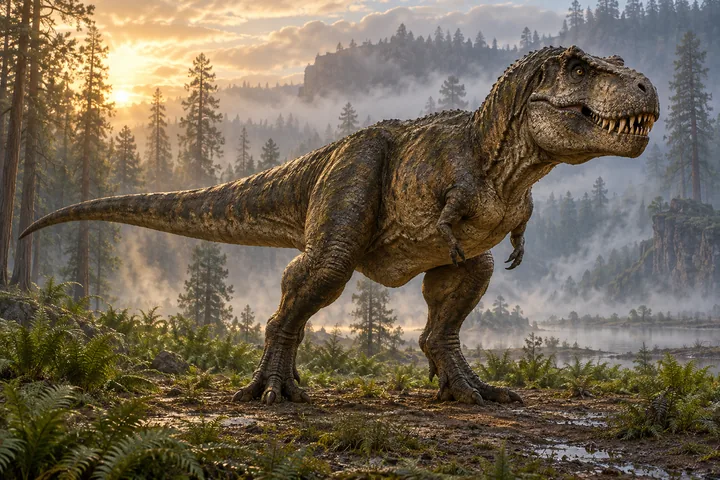
Tyrannosaurus rex
Tyrannosaurus rex was a large meat-eating dinosaur from the final part of the Cretaceous in western North America. Fossil teeth, bite marks and skeletons reveal a powerful animal whose behaviour still invites questions.
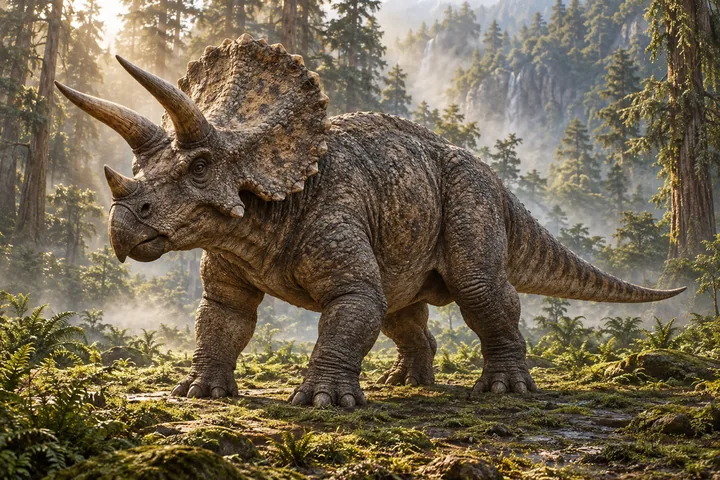
Triceratops horridus
Triceratops horridus was a horned dinosaur of the Late Cretaceous. Skin impressions attributed to this species reveal scales, while skulls and their positions in rock layers help researchers distinguish it from the later Triceratops prorsus.