
Size reference
Source supportedAbout 71 cm wingspan
NPS comparison for M. permiana; this is estimated wing spread, not preserved body length. [D2]
EXHIBIT 202
Meganeuropsis
Prehistoric insect
Meganeuropsis was an enormous Permian griffinfly, a relative of dragonflies with distinctive wing venation. [2]
TWO WAYS TO PICTURE THE PAST
Compare the evidence with the familiar movie image. The illustrations are not to a shared scale.
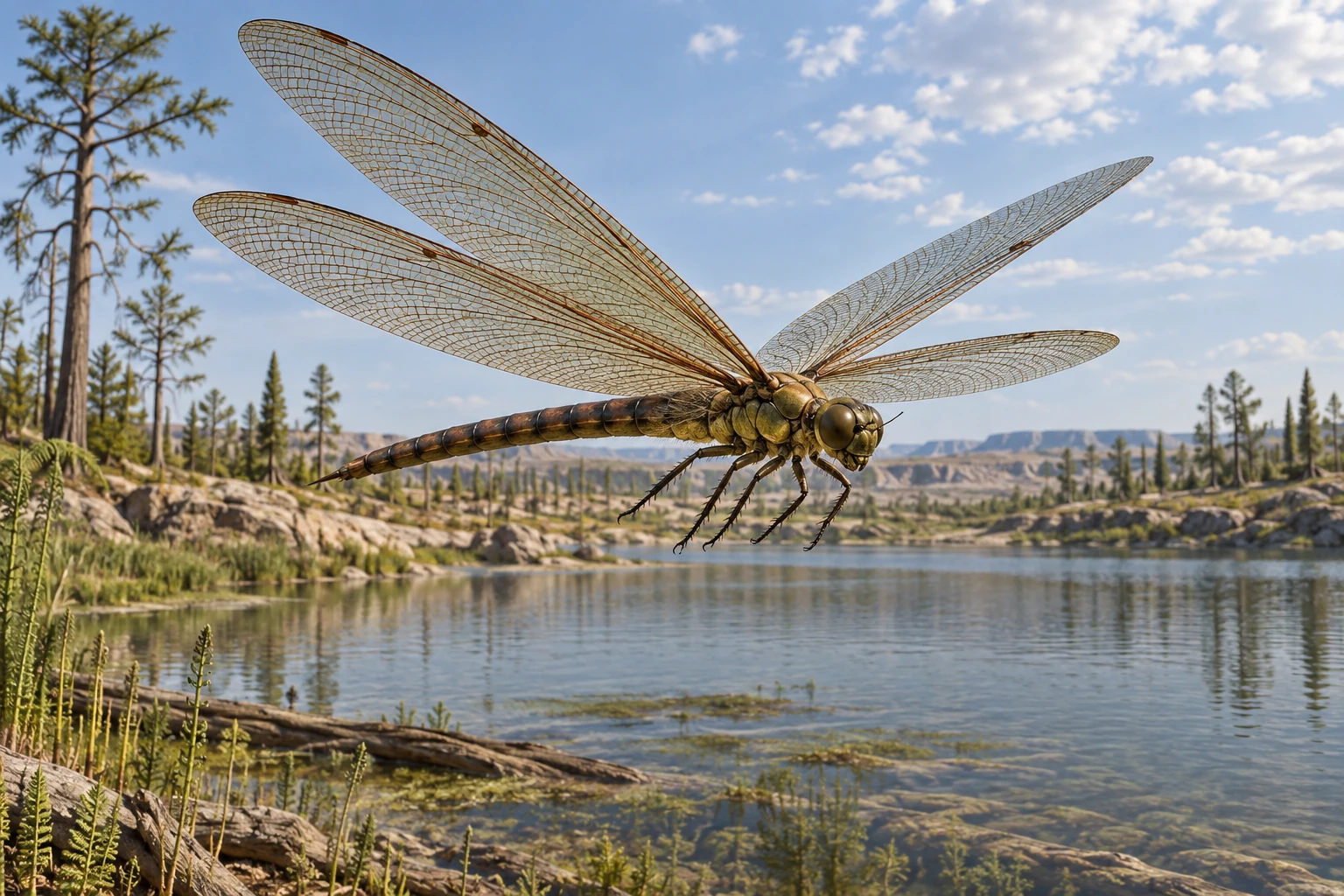
An illustrative reconstruction. Compare its anatomy with the evidence and limitations in the dossier. [4]
Source-informed reconstruction. Appearance evidence [4]. Original illustration; missing anatomy, coloration and scenery include interpretation.
Fossils constrain this life reconstruction. Missing anatomy, coloration and the environmental scene include interpretation; the dossier explains the evidence limits.
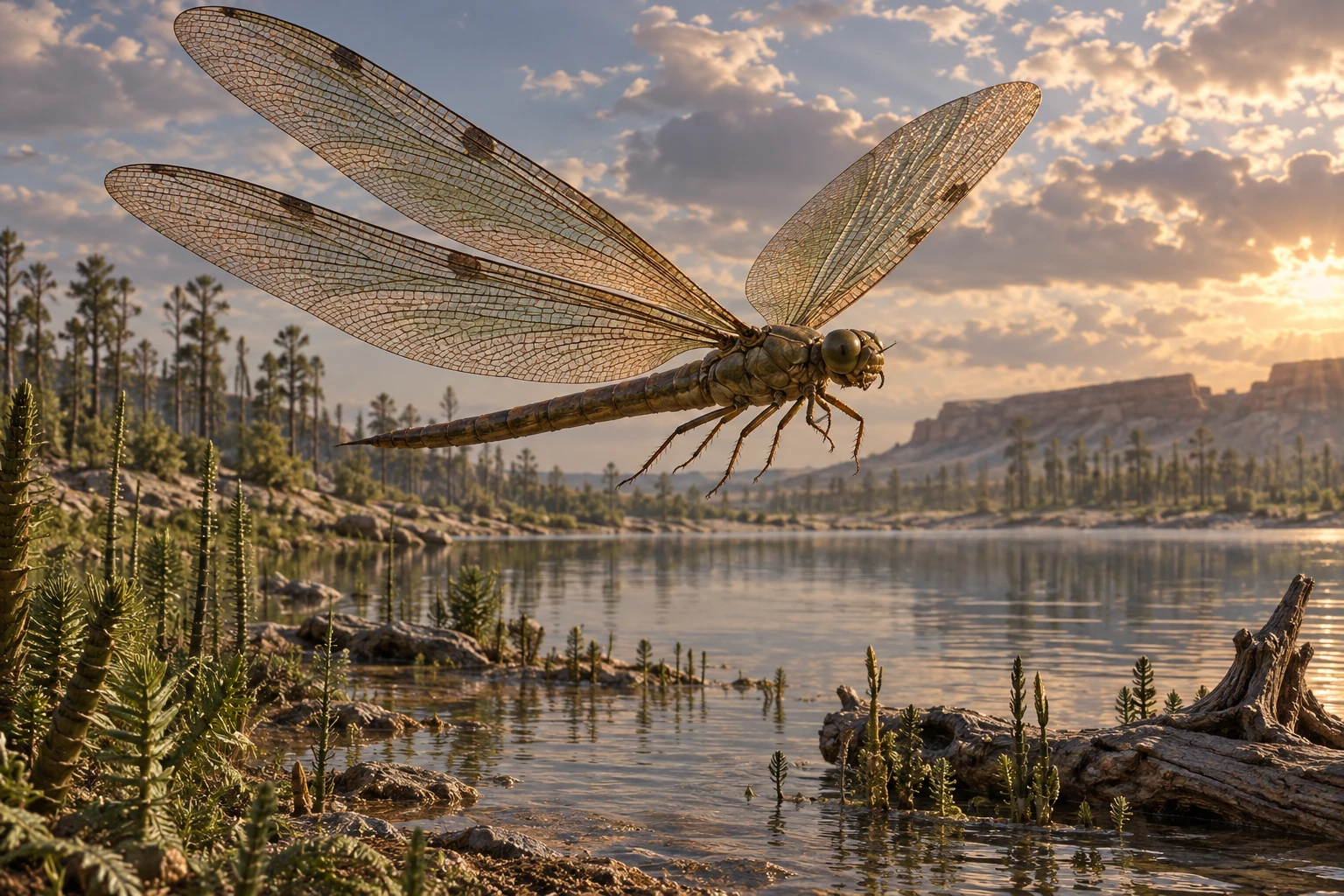
An illustrative reconstruction. Compare its anatomy with the evidence and limitations in the dossier. Lighting, coloration and scenery are artistic choices. This image does not document a fossil locality or behavior.
Original artwork · artistic interpretation.
Scientific view: source-informed reconstruction, credited paleoart or specimen-based imagery. Movie-style view: Original artistic interpretation. Reconstructions involve uncertainty.
MEET THE ANIMAL
Meganeuropsis was a very large flying insect from the Permian Period. It belonged to an extinct group of dragonfly relatives, rather than to the true dragonflies alive today. An institutional comparison gives Meganeuropsis permiana a wing spread of about 71 centimeters. Wing spread measures the distance across the opened wings. It does not mean its body was 71 centimeters long, and it does not measure every species. [D2]
The well-known Kansas species came from Elmo, where researchers found a rich collection of fossil insects in the Wellington Formation. The beds are interpreted as deposits of freshwater ponds or lakes. Insects could fall or be carried into that water from the surrounding land. Finding an adult wing in lake sediment therefore does not show that the flying insect normally lived under the water. [D3]
A second species, Meganeuropsis americana, is represented in Harvard’s collection by a huge wing from Oklahoma. Its wing is about 33 centimeters long. A single wing and a reconstructed full wing spread are different kinds of measurements. Neither gives us a complete account of feeding, egg laying or daily movement. [D5]
PREHISTORIC ANIMAL DOSSIER
The animal, the evidence, and the questions still open.
The Elmo beds preserve a rich insect fauna; lake burial records a regional environment rather than an adult insect’s underwater life. [D3]
Profile scope: Genus — Meganeuropsis; M. permiana of Kansas and M. americana of Oklahoma share this exhibit. [D5]
Source supported identifies a description documented by the cited source. Inferred marks a reconstruction or functional estimate. Debated marks competing interpretations. Not established means the sources reviewed for this dossier do not support a firm conclusion; it does not mean a behavior never occurred.
A size reference is an estimate, not a population range. Nesting evidence does not by itself establish courtship, mate choice, or lifelong pairing.
About 71 cm wingspan
NPS comparison for M. permiana; this is estimated wing spread, not preserved body length. [D2]
Not established here
The inspected Elmo review does not supply an individual mass estimate. [D3]
Predatory feeding inferred
Meganeurid comparisons support carnivory; detailed feeding anatomy in the cited study belongs to Meganeurites. [D6]
Elmo freshwater lake surroundings
Elmo deposits are interpreted as ponds or lakes; neighboring terrestrial habitats supplied insects to the water. [D3]
Flight supported by wings
Wing fossils establish a flying form; speed is unknown. [D2]
Griffinfly wing venation
A long abdomen and rounded head are broader-group reconstructions; wing veins distinguish these relatives from true dragonflies. [D4]
Not established here
No attributable egg series or developmental sequence is established in the inspected regional review. [D3]
Not established here
The reviewed museum record does not establish a mating display. [D1]
Not established here
Concentrations of transported insects do not establish group behavior. [D3]
Sources and inspection notes for the claims in this profile.
THE STORY IN THE FOSSILS
The Oklahoma M. americana wing and Kansas M. permiana reference belong to different species. Their dimensions should not be blended into a single measured individual. [5]
The dossier identifies the scope of each reference estimate. A mount, an individual fossil and a species-wide adult range are different measurements. Comparison metrics remain unavailable where adult scope has not been established. Unknown does not mean zero.
Sources support the stated claims and scopes. Refer to the evidence notes for uncertainty.
KEEP EXPLORING
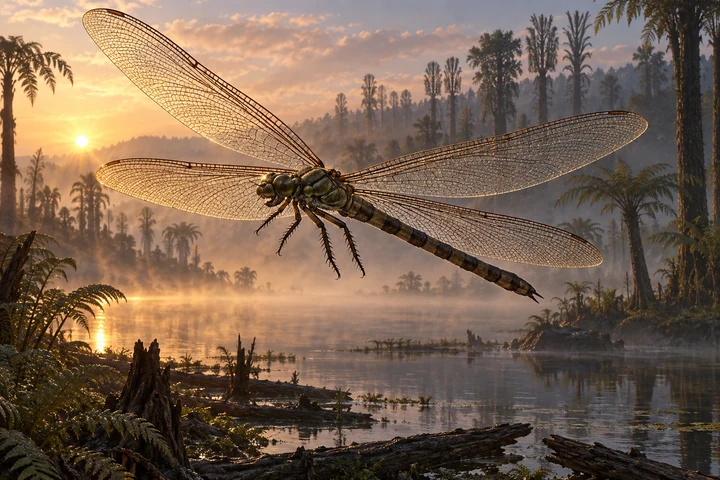
Meganeura
Prehistoric insect
Meganeura was a large flying insect from Carboniferous France, known for its expansive wings.
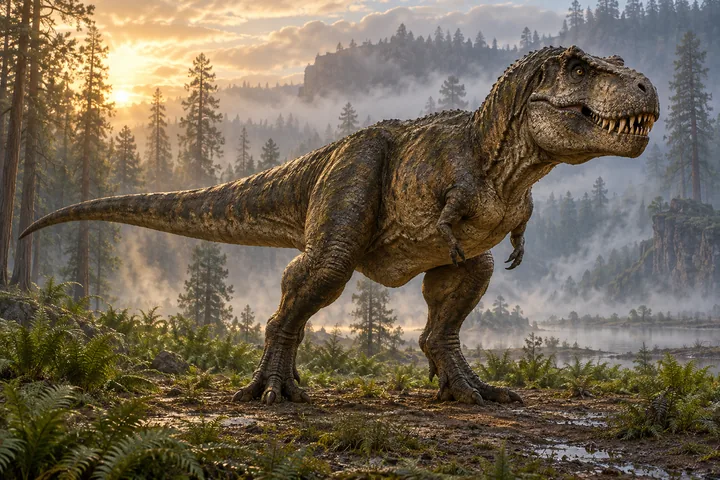
Tyrannosaurus rex
Tyrannosaurus rex was a large meat-eating dinosaur from the final part of the Cretaceous in western North America. Fossil teeth, bite marks and skeletons reveal a powerful animal whose behaviour still invites questions.
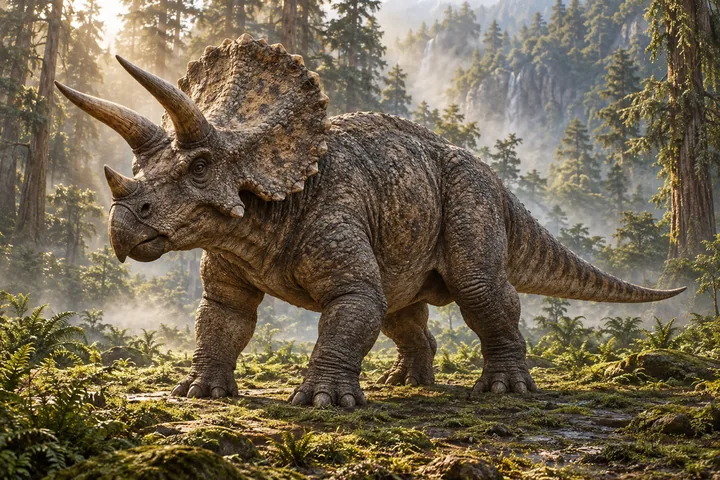
Triceratops horridus
Triceratops horridus was a horned dinosaur of the Late Cretaceous. Skin impressions attributed to this species reveal scales, while skulls and their positions in rock layers help researchers distinguish it from the later Triceratops prorsus.