
Body length
InferredAbout 0.8 m; museum reference
NHM uses a rounded genus value; individual size and taxonomic assignments vary among specimens. [D1]
EXHIBIT 26
Microraptor
Flight feathers grew on its hind legs as well as its arms.
TWO WAYS TO PICTURE THE PAST
Compare the evidence with the familiar movie image. The illustrations are not to a shared scale.
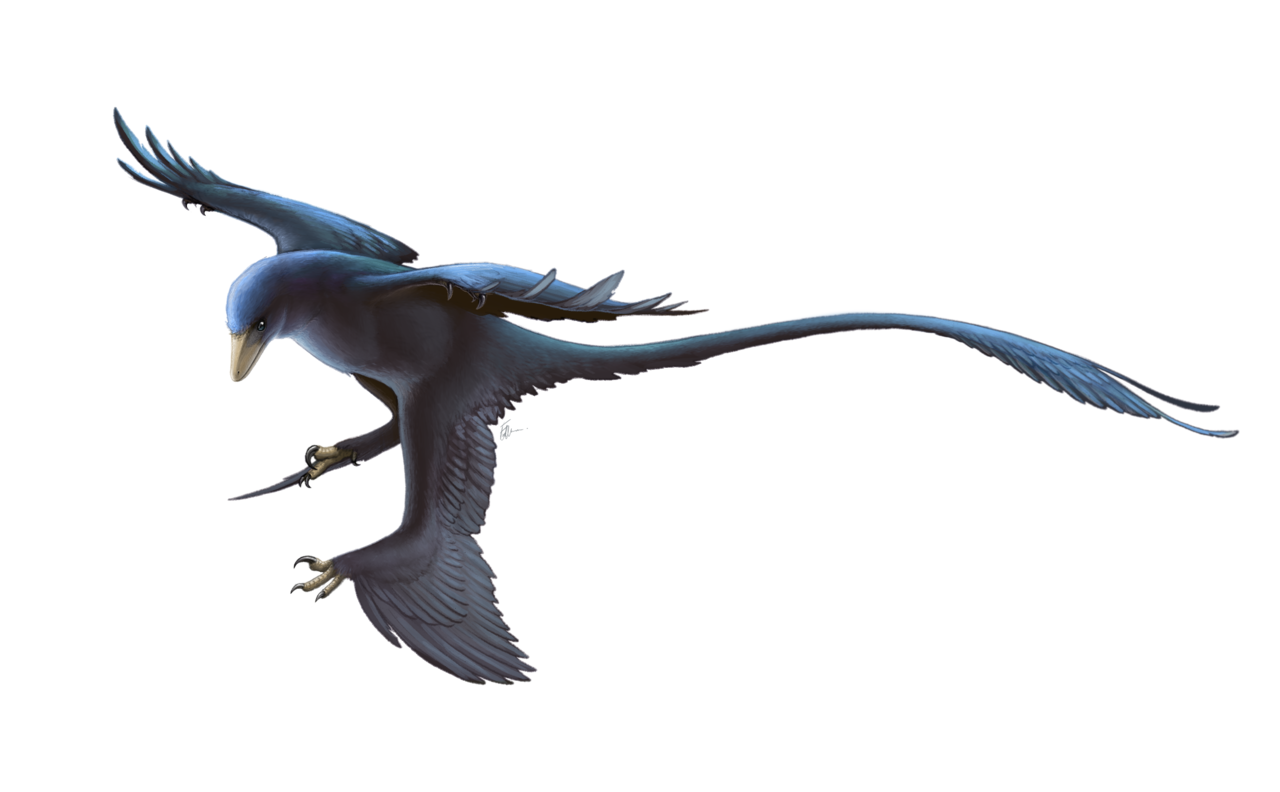
The artist identifies this reconstruction as Microraptor gui. This view illustrates one form within the genus, rather than every species or individual. Fossil-informed anatomy: Tiny toothed dromaeosaur with arm and leg flight feathers, long tail and narrow feather fan; glossy dark plumage is specimen-supported inference. Four-winged feather arrangement is supported by fossils; exact soft tissues and coloration are interpretive. Species reconstruction represents the genus. [1] [2]
Microraptor Restoration.png — Fred Wierum. CC BY-SA 4.0. Remote source artwork displayed without additional cropping; Wikimedia supplies any display-size derivative.
Scientific picture served by Wikimedia · internet connection required.
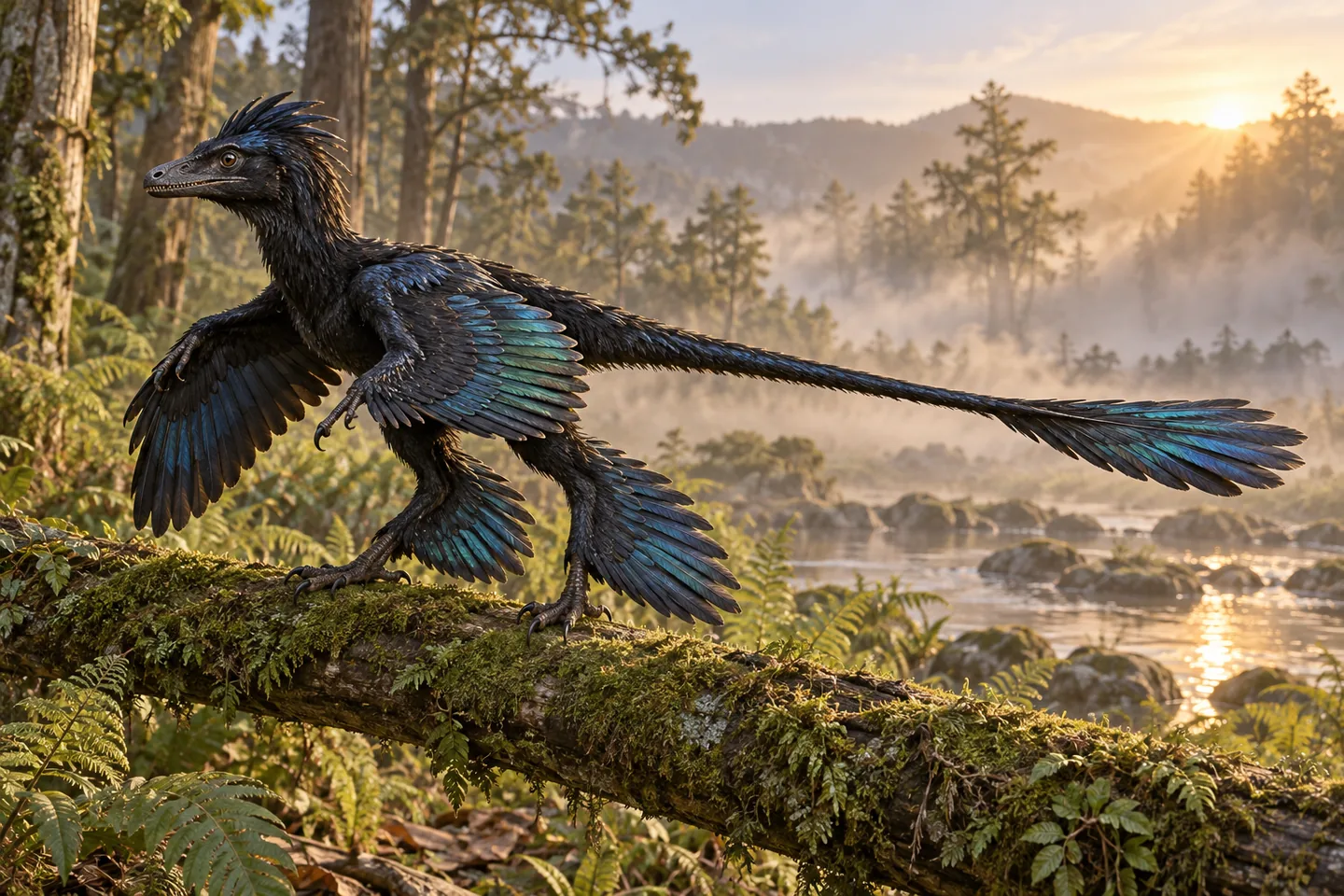
Cinematic Microraptor on a branch, four feathered limbs clearly visible, long narrow tail fan and subdued blue-black iridescence; delicate full-body silhouette. Dramatic lighting, surface detail and scenery are artistic choices. This is an original cinema-inspired picture, rather than a frame from a film or a documented fossil locality.
Original artwork · artistic interpretation.
Scientific view: credited paleoart interpreting fossil evidence, served online by Wikimedia. Movie-style view: Original artistic interpretation. Colors, soft tissues and settings involve reconstruction.
MEET THE ANIMAL
Microraptor had long feathers on its arms, legs and tail, giving it the famous four-winged outline. Those feathers made it an important animal for understanding how dinosaur flight developed. Researchers have tested different arrangements of its limbs and feathers, because a fossil preserves the animal's parts rather than every movement it could make. [S1]
This small flying dinosaur relative lived in northeastern China during the Early Cretaceous. Its feet offer clues about feeding as well as movement. A research team examined preserved toe pads, scales, joints and claws, then compared them with those of living birds. The combination suggested feet suited to grasping prey, with similarities to the feet of modern hawks. [S2]
That comparison supports an active predatory lifestyle, but it does not turn Microraptor into a modern hawk. The interpretation comes from anatomy and comparisons, rather than an observed hunting scene. Its importance lies in showing that specialized roles now filled by birds could also be occupied by their extinct dinosaur relatives while early flying animals were evolving. [S2]
PREHISTORIC ANIMAL DOSSIER
The animal, the evidence, and the questions still open.
Microraptor was a small feathered dromaeosaur with long wing feathers on its arms and legs. Fossil stomach contents provide unusually direct evidence of varied animal meals, and pigment structures support glossy dark plumage in a studied specimen.
Profile scope: Genus: Microraptor; size and diet are genus references; plumage study concerns one specimen.
Source supported identifies a description documented by the cited source. Inferred marks a reconstruction or functional estimate. Debated marks competing interpretations. Not established means the sources reviewed for this dossier do not support a firm conclusion; it does not mean a behavior never occurred.
A size reference is an estimate, not a population range. Nesting evidence does not by itself establish courtship, mate choice, or lifelong pairing.
About 0.8 m; museum reference
NHM uses a rounded genus value; individual size and taxonomic assignments vary among specimens. [D1]
About 1 kg; museum estimate
The museum's rounded estimate is not tied to a specified specimen, age or mass reconstruction method. [D1]
Small vertebrates, including fish and lizards
NHM reports preserved stomach remains of mammals, birds, fish and a lizard. This establishes consumption, rather than proving every meal was hunted. [D1]
Early Cretaceous northeastern China
Reviewed accounts locate Microraptor fossils in northeastern China. They do not resolve whether it spent most of its time in trees or on the ground. [D1] [D2]
Aerial locomotion; flight mechanics debated
Wing feathers support aerial capability; interpretations include gliding and powered flight. NHM notes uncertainty about hindlimb position and hip flexibility. [D1]
Four feathered limbs; narrow ornamental tail fan
Fossils preserve long arm and leg feathers. A studied pigment-bearing specimen supports dark iridescent plumage and elongated tail feathers. [D1] [D2]
Not established here
The reviewed sources do not establish taxon-specific nest structure, clutch size or parental care.
Feather display is a research inference
The researchers interpret iridescence and elongated tail feathers as possible visual signals, including courtship. Actual mating rituals and the specimen's sex are not established. [D2]
Not established here
The reviewed sources do not establish a taxon-specific group structure or social hierarchy.
Sources and inspection notes for the claims in this profile.
THE STORY IN THE FOSSILS
Long feathers on both arms and hind legs gave Microraptor its distinctive four-winged outline. Its relationship to dromaeosaurs shows that feathered aerial experiments extended beyond birds. Researchers still examine how the hind wings were positioned and what movements its hips could actually permit. [1]
A study of fossil pigment structures predicted glossy black plumage with a weak blue sheen in the specimen examined. The same work reconstructed a narrow tail fan with two elongated feathers and proposed a display role. Other fossils preserve remains of fish, birds and mammals. [2] [1]
We have not established a comparable adult total-length estimate for this taxon in this draft. Specimen measurements in the text describe those individuals. The cited dates are approximately 120 million years ago. The NHM catalogue gives approximately 120 Ma; the cited AMNH research report uses approximately 130 Ma. Equal endpoints represent a reference age, not a full temporal range. Unknown does not mean zero.
Sources and evidence notes for this exhibit.
KEEP EXPLORING
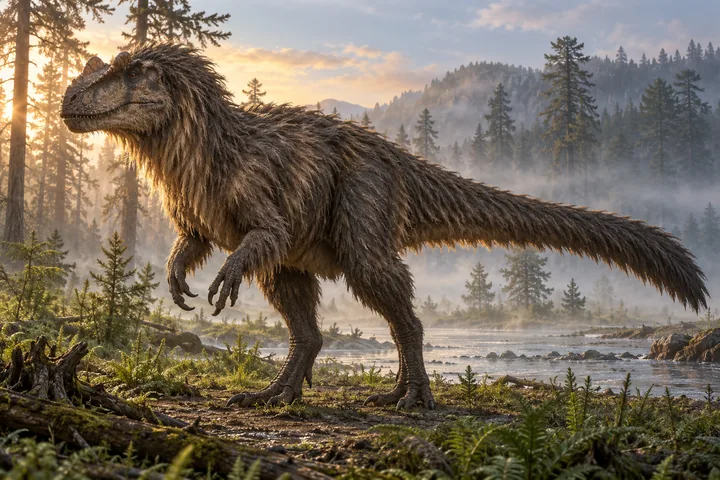
Yutyrannus huali
Yutyrannus preserves direct evidence of long filamentous feathers on a giant theropod.
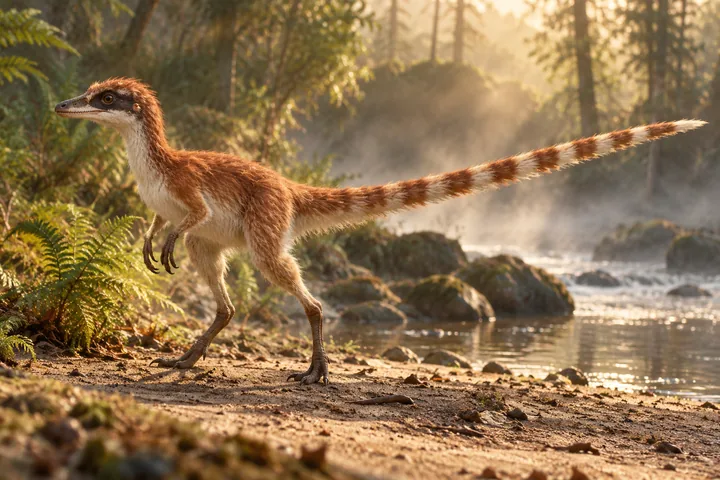
Sinosauropteryx
A fuzzy predator with a banded tail and inferred eye mask.
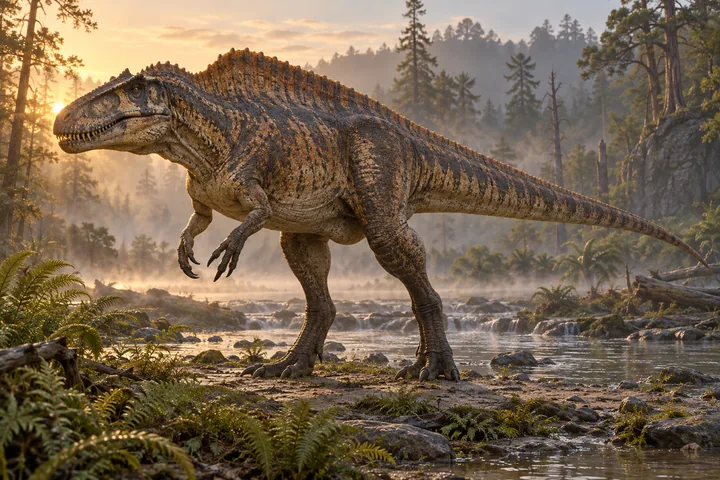
Acrocanthosaurus
Acrocanthosaurus carried unusually tall spines on its back, hip and tail vertebrae.