Body length
InferredAbout 5.3 m (educational genus reference)
The museum does not identify one measured individual or growth stage; this is not a species maximum. [D2]
EXHIBIT 214
Nothronychus mckinleyi and N. graffami
Dinosaur
Nothronychus was a therizinosaur with a small head, long neck, broad abdomen and impressive hand claws. [3]
TWO WAYS TO PICTURE THE PAST
Compare the evidence with the familiar movie image. The illustrations are not to a shared scale.
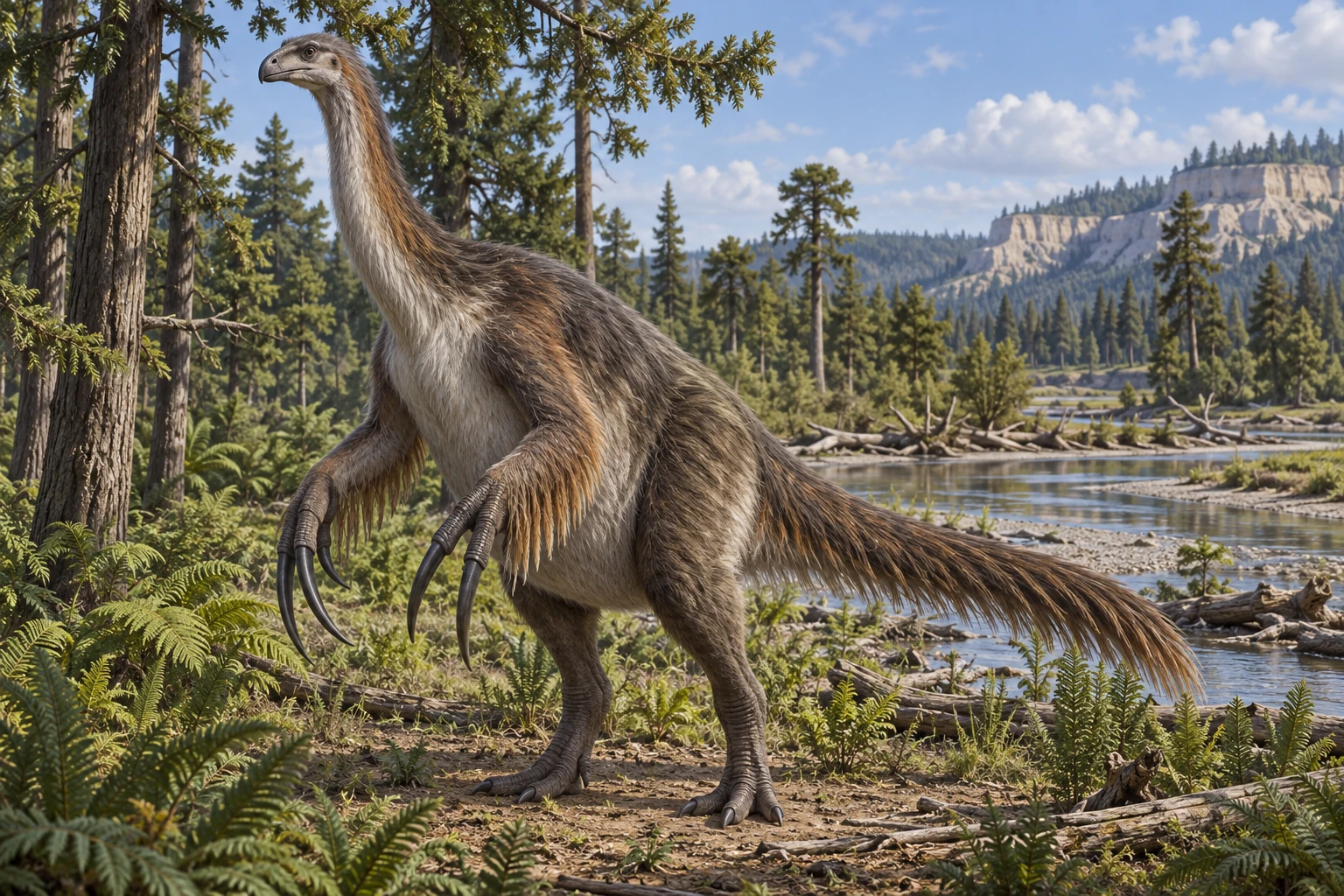
An illustrative reconstruction. Compare its anatomy with the evidence and limitations in the dossier. [3]
Source-informed reconstruction. Appearance evidence [3]. Original illustration; missing anatomy, coloration and scenery include interpretation.
Fossils constrain this life reconstruction. Missing anatomy, coloration and the environmental scene include interpretation; the dossier explains the evidence limits.
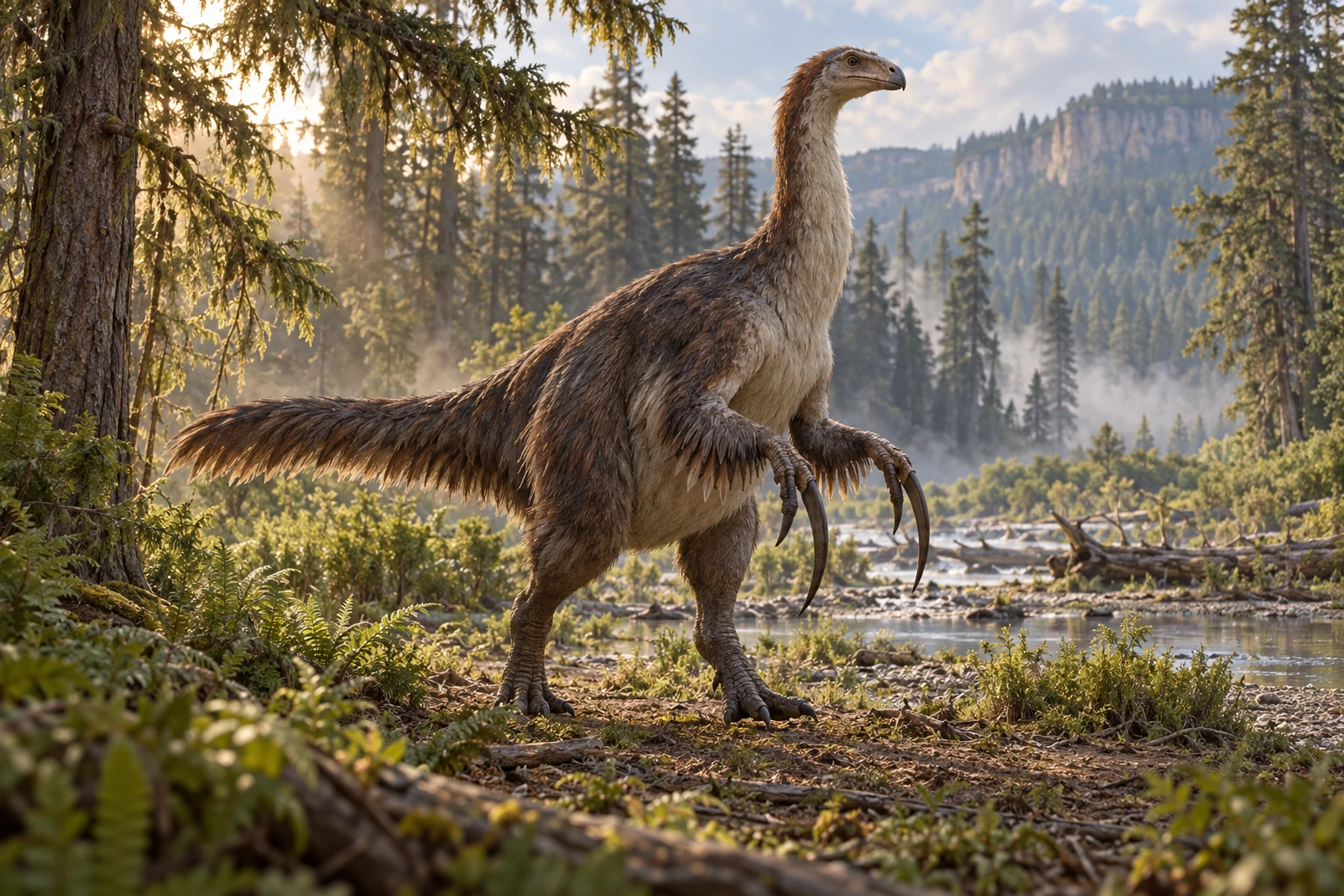
An illustrative reconstruction. Compare its anatomy with the evidence and limitations in the dossier. Lighting, coloration and scenery are artistic choices. This image does not document a fossil locality or behavior.
Original artwork · artistic interpretation.
Scientific view: source-informed reconstruction, credited paleoart or specimen-based imagery. Movie-style view: Original artistic interpretation. Reconstructions involve uncertainty.
MEET THE ANIMAL
Nothronychus belonged to the therizinosaurs, an unusual branch of the two-legged theropod dinosaurs. Its long neck, small head and roomy belly made it look very different from a large meat-eating hunter. The Natural History Museum of Utah interprets this body plan as suited to plant feeding. Its unusually large, curved hand claws are striking, but their appearance alone does not reveal every activity they performed. The Utah specimen reached a sea after death, although its anatomy belonged to a land animal. [D3]
Two species have separate skeletons. Burial pressure altered some bone shapes; the Utah body lacks a skull. [D1]
Scientists can investigate movement even when muscles and ligaments are missing. A recent study reconstructed hip ligaments using marks on the bones and comparisons with other animals. Its model suggests a wide-legged, slower-moving dinosaur whose knees supplied much of its leg motion. That is a tested anatomical hypothesis, rather than a film of a walking animal or a measurement of its running speed. [D4]
PREHISTORIC ANIMAL DOSSIER
The animal, the evidence, and the questions still open.
Partial skull and body bones help reconstruct this unusual theropod. Hip-ligament research proposes a slow, wide-legged gait rather than measuring an actual walking animal. [D2] [D4]
Profile scope: Genus — Nothronychus; two species represented by separate partial skeletons. [D1]
Source supported identifies a description documented by the cited source. Inferred marks a reconstruction or functional estimate. Debated marks competing interpretations. Not established means the sources reviewed for this dossier do not support a firm conclusion; it does not mean a behavior never occurred.
A size reference is an estimate, not a population range. Nesting evidence does not by itself establish courtship, mate choice, or lifelong pairing.
About 5.3 m (educational genus reference)
The museum does not identify one measured individual or growth stage; this is not a species maximum. [D2]
Not established here
The inspected sources provide no comparable, maturity-qualified body-mass estimate adopted here. [D2]
Plant feeding inferred
Small head and capacious gut support herbivory; a museum also labels the genus omnivorous. No particular meal is established. [D3] [D2]
Terrestrial western North America
The Utah carcass reached an offshore sea; marine Tropic Shale burial does not show an aquatic lifestyle. [D3]
Bipedal, broad-gauge gait proposed
A ligament model suggests restricted hip motion and slower progression. It does not provide an observed gait or measured speed. [D4]
Long neck and large claws
The Utah museum emphasizes a small head and broad gut in its plant-feeding reconstruction. [D3]
Not established here
Focused searches and reviewed osteology found no assigned eggs, nests or parental-care evidence. [D1]
Not established here
The reviewed museum directory supplies no taxon-specific mating, courtship or sex-color evidence. [D2]
Not established here
Transported bones do not demonstrate a living herd. [D1]
Sources and inspection notes for the claims in this profile.
THE STORY IN THE FOSSILS
The best-known Utah skeleton came from rocks laid down at sea. Its bones nevertheless belong to a land-dwelling dinosaur. [3]
Reconstructing motion also means restoring missing soft tissues. The proposed hip ligaments constrain a possible gait without preserving actual footsteps. [4]
The dossier identifies the scope of each reference estimate. A mount, an individual fossil and a species-wide adult range are different measurements. Comparison metrics remain unavailable where adult scope has not been established. Unknown does not mean zero.
Sources support the stated claims and scopes. Refer to the evidence notes for uncertainty.
KEEP EXPLORING
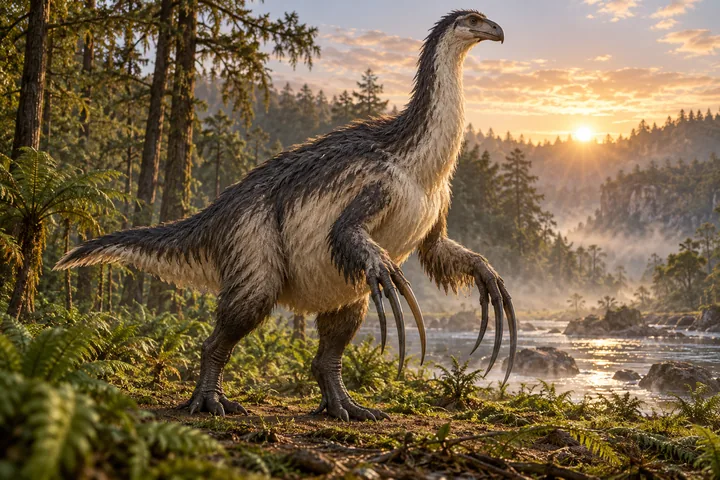
Therizinosaurus
Therizinosaurus lived in Late Cretaceous Mongolia. Its long hand claws are well known, while much of its body must be reconstructed from relatives.
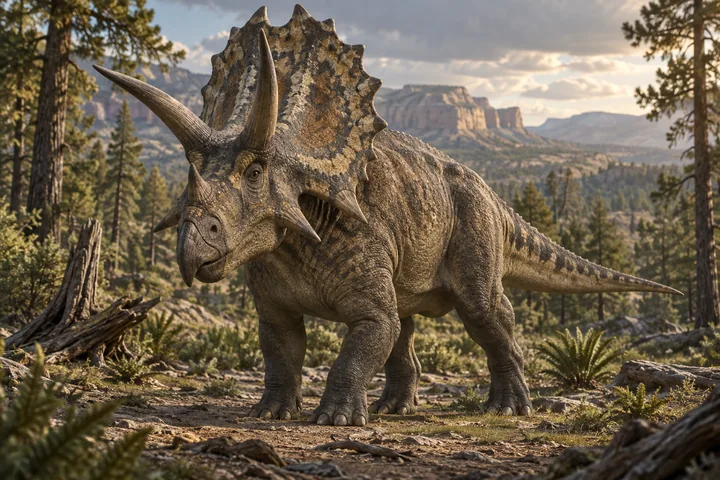
Pentaceratops sternbergii
Pentaceratops was a horned plant eater from Late Cretaceous New Mexico. Its name counts the prominent cheek projections alongside the nasal and brow horns, while disputed giant material requires separate treatment.
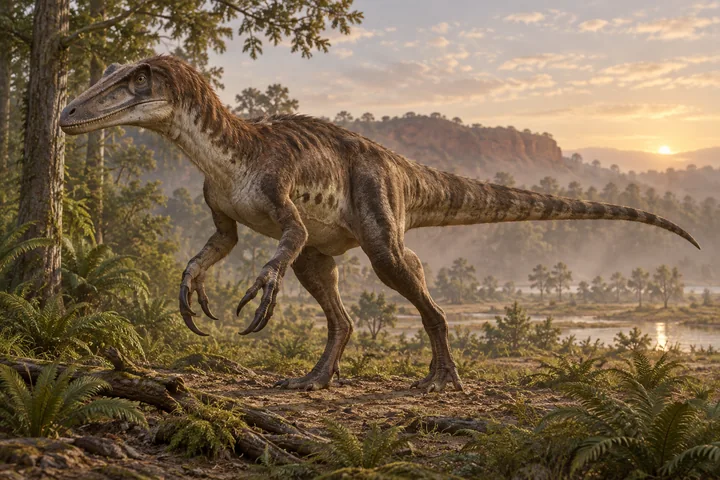
Australovenator wintonensis
Australovenator preserves powerful grasping arms and large hand claws.