
Body length
InferredAbout 2 m (museum reference)
The rounded institutional value has no explicit adult-maturity basis; incomplete anatomy requires restoration, and this is not a population maximum. [D1]
EXHIBIT 122
Ornitholestes hermanni
Ornitholestes is a small Morrison theropod with a historically misleading nose restoration. [2]
TWO WAYS TO PICTURE THE PAST
Compare the evidence with the familiar movie image. The illustrations are not to a shared scale.
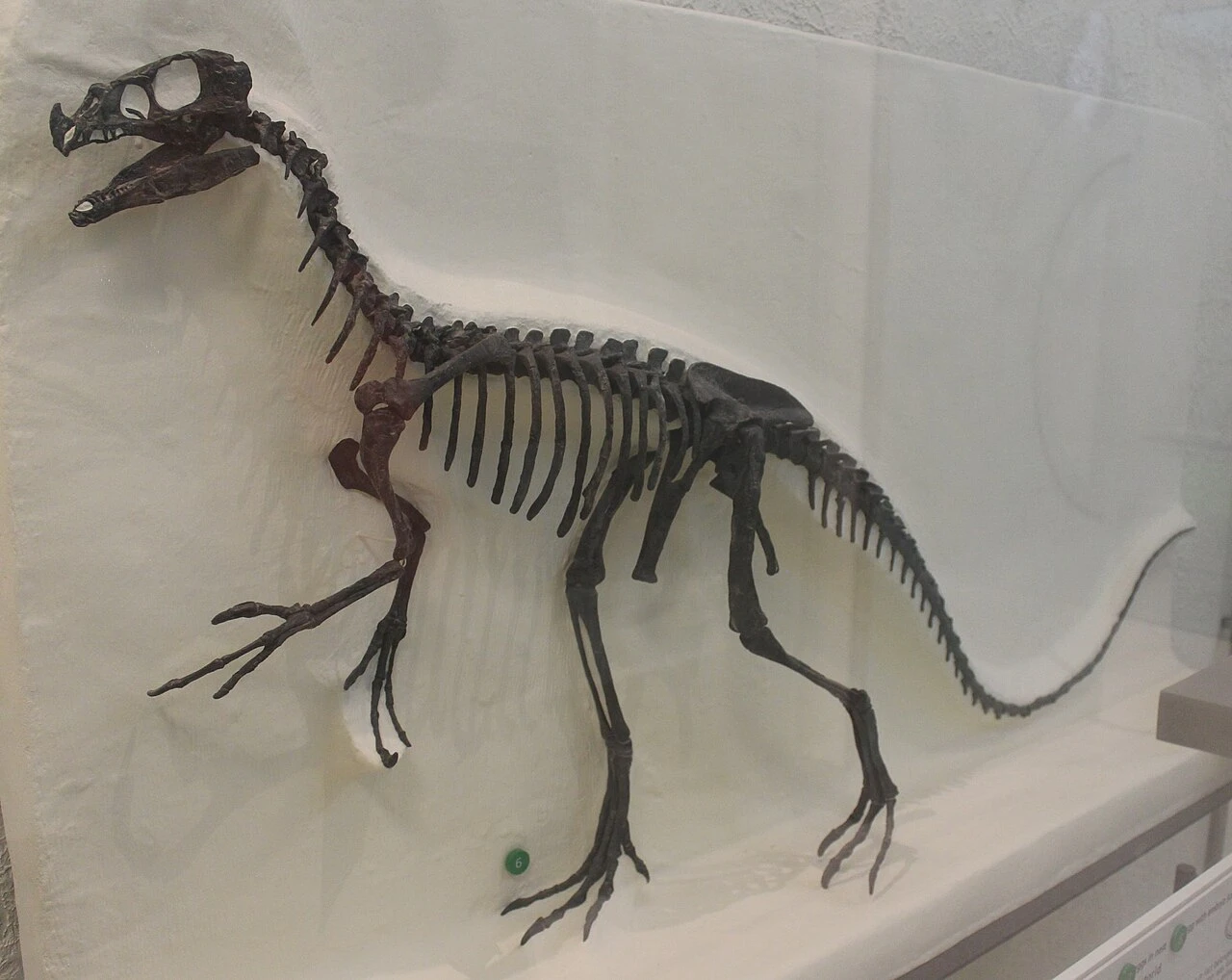
Ornitholestes hermanni holotype display, AMNH619, photographed by Jonathan Chen at the American Museum of Natural History. The mount restores absent portions and retains historical skull contours: the visible nose projection is not evidence of a living nasal horn, which later re-examination rejected. Its complete hands and pose should not be treated as an inventory of preserved type bones. [2]
Ornitholestes hermanni Holotype AMNH.jpg · Jonathan Chen. CC BY-SA 4.0. Current Commons image converted to WebP and proportionally resized; no cropping, mirroring, anatomical edits or compositing. Original annotations retained. The source license applies to these versions.
Skeletal mounts and drawings may restore missing parts; the caption identifies the displayed material.
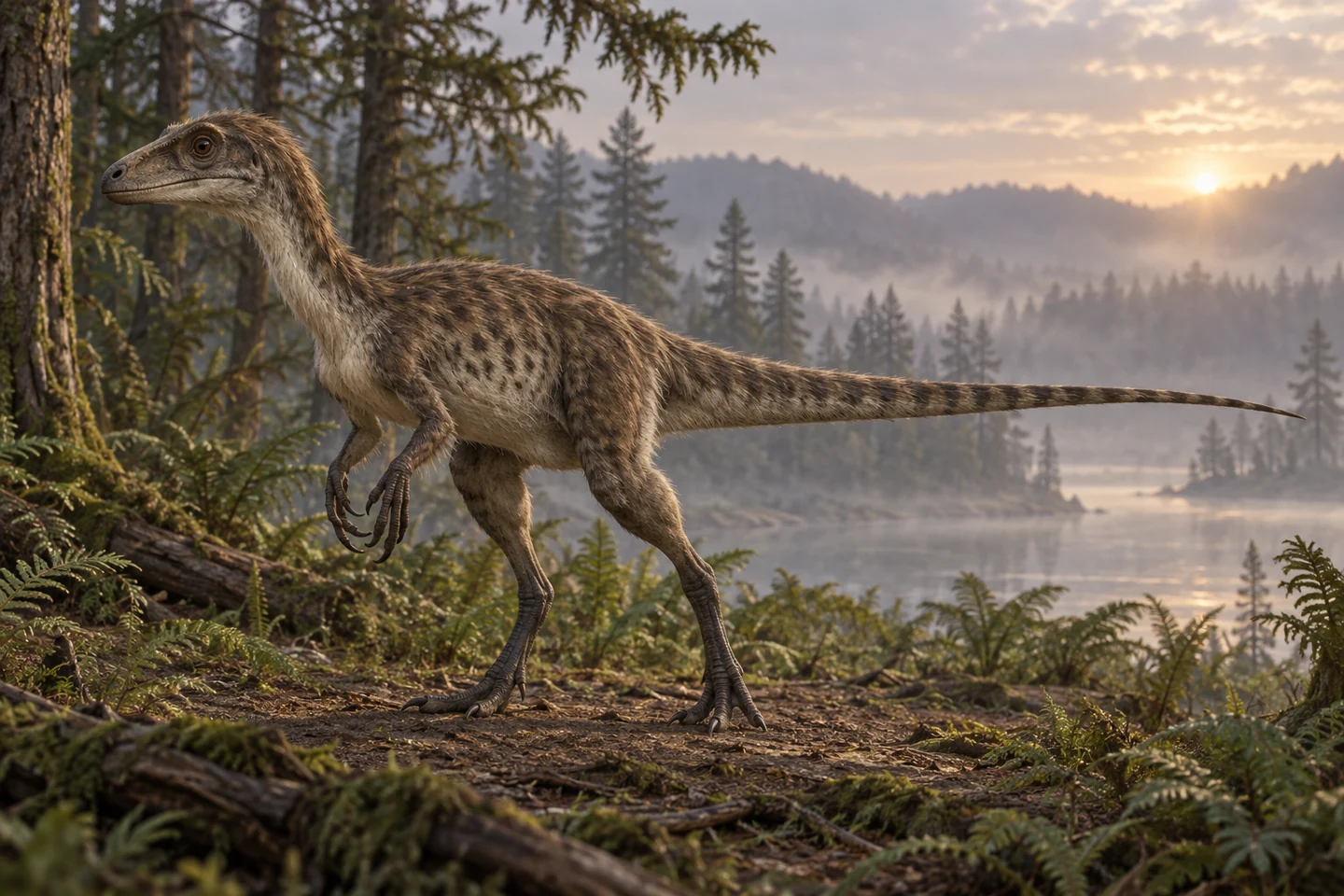
Original cinematic interpretation of Ornitholestes hermanni. Colors, soft tissues, scenery and missing anatomy are reconstructed artistic choices; this is not a directly observed individual or behavior. The historical nose horn is omitted; missing hands, tail details and body covering are interpreted comparatively. Lighting, coloration and scenery are artistic choices. This image does not document a fossil locality or behavior.
Original artwork · artistic interpretation.
Scientific view: source-informed reconstruction, credited paleoart or specimen-based imagery. Movie-style view: Original artistic interpretation. Reconstructions involve uncertainty.
MEET THE ANIMAL
Ornitholestes was a small meat-eating dinosaur from Late Jurassic North America. It is reconstructed standing on two legs, and a museum reference of about two metres gives a rough idea of size. That figure is not a confirmed adult maximum. Its familiar public image has also been shaped by historical artwork rather than fossil anatomy alone. [D1]
Early illustrations pictured it as an agile bird hunter. The dramatic scene and its name helped popularize that idea, but neither identifies a preserved meal. A historical reconstruction can be important to the story of discovery without establishing a particular prey preference. The animal's actual diet needs evidence different from a compelling picture. [D4]
Researchers have also manipulated casts of the forelimb bones to investigate possible movement. The joints allowed substantial elbow bending, while some hand joints had limited backward movement. These results test what the reconstructed arms could do without recording how they were used during hunting. Ornitholestes demonstrates the difference between a possible action supported by anatomy and an everyday habit inferred from an illustration. [D3]
PREHISTORIC ANIMAL DOSSIER
The animal, the evidence, and the questions still open.
Re-examination rejected the familiar nasal horn. Forelimb-cast studies explore possible motion, while the name’s bird-hunting implication remains an unconfirmed prey interpretation. [D2] [D3] [D4]
Profile scope: Genus — Ornitholestes; the profile focuses on O. hermanni and type AMNH619. [D2]
Source supported identifies a description documented by the cited source. Inferred marks a reconstruction or functional estimate. Debated marks competing interpretations. Not established means the sources reviewed for this dossier do not support a firm conclusion; it does not mean a behavior never occurred.
A size reference is an estimate, not a population range. Nesting evidence does not by itself establish courtship, mate choice, or lifelong pairing.
About 2 m (museum reference)
The rounded institutional value has no explicit adult-maturity basis; incomplete anatomy requires restoration, and this is not a population maximum. [D1]
About 11.9 kg (volume model)
Reconstruction for O. hermanni AMNH619; maturity is unspecified. It is an individual model reference, not a measured mass or species range. [D5]
Carnivory inferred; bird prey unconfirmed
The museum classifies it as a carnivore. No inspected gut contents or tooth marks establish birds as regular or exclusive food. [D1]
Morrison Formation, Wyoming
The redescription examines Upper Jurassic Morrison material. Fossil occurrence does not establish an exclusive habitat preference. [D2]
Bipedal body plan; strongly flexing elbows
Cast manipulations show considerable elbow flexion and limited hyperextension in preserved hand joints. Possible forelimb functions are biomechanical inferences, not observed actions. [D3]
No demonstrated nasal horn
The apparent projection was attributed to crushing and displacement in the type skull. Historical restored mounts can retain that contour and reconstructed missing bones. [D2]
Not established here
Focused searches did not identify an assigned Ornitholestes egg, nest, clutch size, incubation period or parental-care observation.
Not established here
No reviewed type anatomy or historical reconstruction demonstrates a mating ornament, ritual or pair bond. The rejected nose horn cannot establish sexual display. [D2]
Not established here
Focused social searches did not establish a genus-specific group assemblage or coordinated hunt. A mounted pursuit scene is a restoration, not evidence of social organization.
Sources and inspection notes for the claims in this profile.
THE STORY IN THE FOSSILS
Early imagery presented Ornitholestes as an agile bird hunter. That restoration popularized the animal, but a name and dramatic scene do not substitute for identified fossil prey. [4]
The nasal horn familiar from older reconstructions was rejected after re-examination of the damaged skull. Current life art therefore omits it, while the scientific view identifies the museum display as partly restored. [2]
The dossier identifies the scope of each reference estimate. A mount, an individual fossil and a species-wide adult range are different measurements. Comparison metrics remain unavailable where adult scope has not been established. Unknown does not mean zero.
Sources support the stated claims and scopes. Refer to the evidence notes for uncertainty.
KEEP EXPLORING
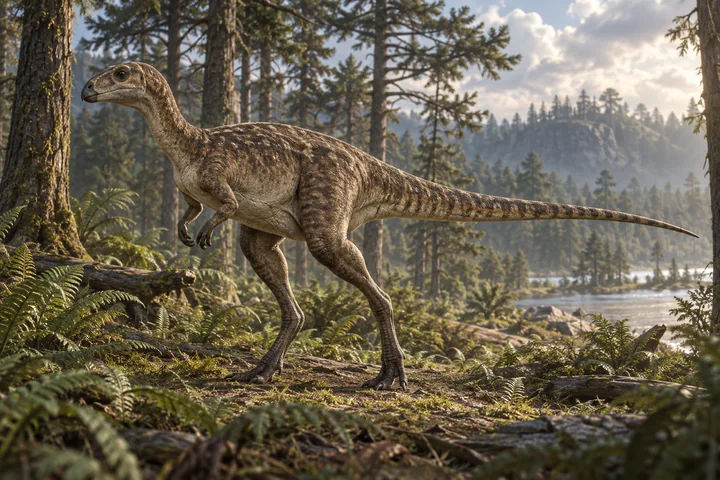
Dryosaurus altus
Dryosaurus altus was a small bipedal plant-eater from the Late Jurassic of western North America. Revised identifications separate it from famous Utah skeletons assigned to Dryosaurus elderae.
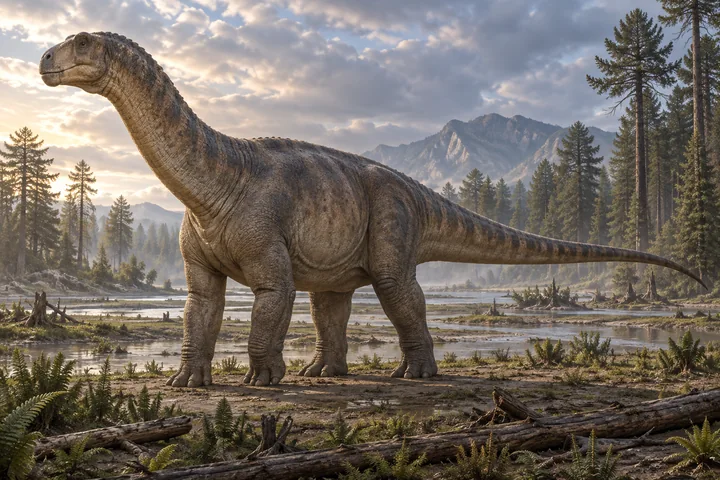
Camarasaurus
Camarasaurus was a Late Jurassic North American sauropod with broad teeth, a boxy skull and air-filled vertebrae.
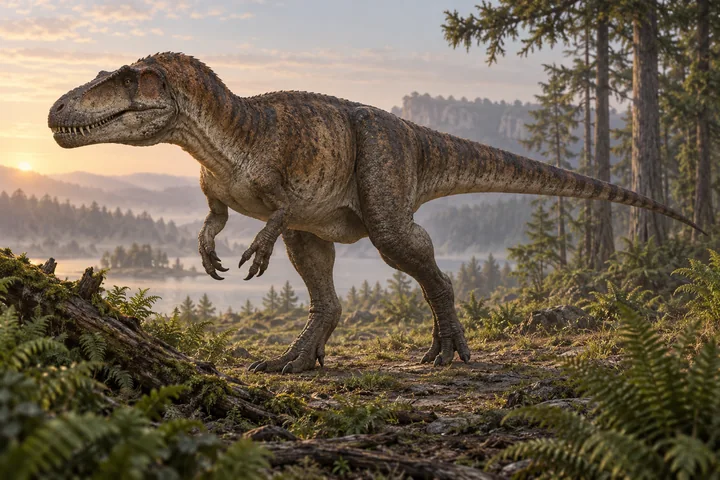
Torvosaurus tanneri
Torvosaurus combined powerful jaws with a rare embryonic record.