
Body length
InferredAbout 9 m for T. tanneri (reference)
The park's rounded reference has no stated specimen or maturity basis; it is not an observed population average or adult maximum. [D2]
TWO WAYS TO PICTURE THE PAST
Compare the evidence with the familiar movie image. The illustrations are not to a shared scale.
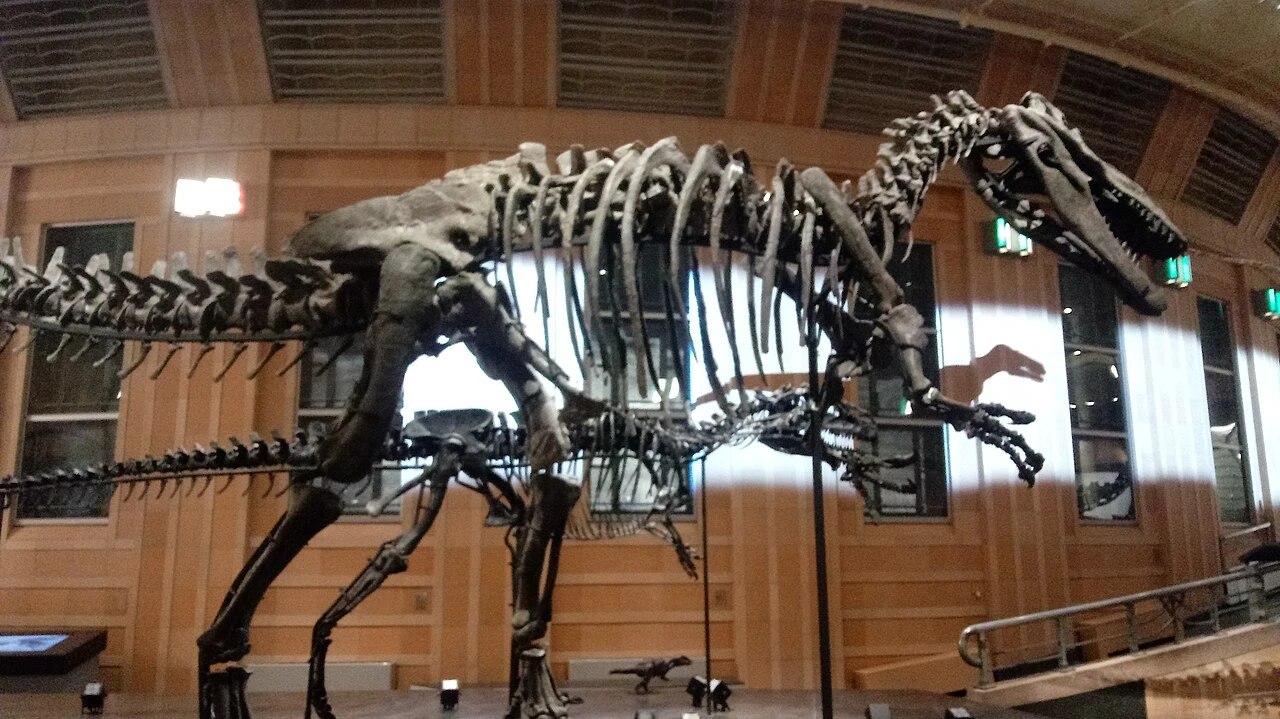
Mounted reconstruction identified as Torvosaurus tanneri at Cincinnati Museum Center, photographed by Fritzmann2002. A full mount restores absent anatomy and its pose; the Commons record does not identify a fossil inventory number or establish that all displayed bones are originals. [1]
Torvosaurus tanneri skeleton at Union Terminal.jpg · Fritzmann2002. CC BY-SA 4.0. Current Commons image converted to WebP and proportionally resized for the thumbnail; no cropping, mirroring, anatomical edits or compositing. Original scale bars and annotations retained where present. Same source license applies.
Skeletal mounts and drawings may restore missing parts; the caption identifies the displayed material.
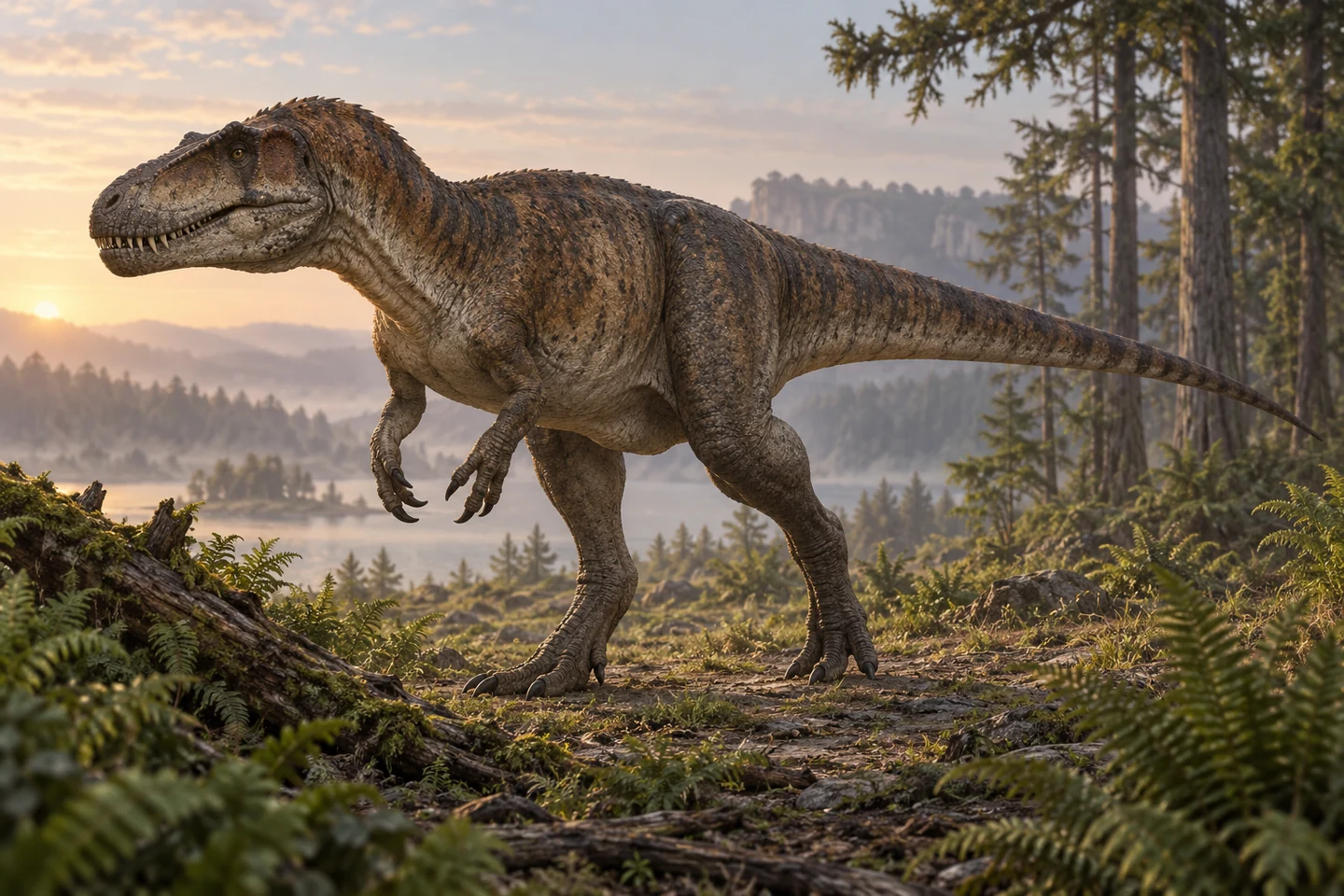
Original cinematic interpretation of Torvosaurus tanneri. Colors, soft tissues, scenery and missing anatomy are reconstructed artistic choices; this is not a directly observed individual or behavior. Lighting, coloration and scenery are artistic choices. This image does not document a fossil locality or behavior.
Original artwork · artistic interpretation.
Scientific view: source-informed reconstruction, credited paleoart or specimen-based imagery. Movie-style view: Original artistic interpretation. Reconstructions involve uncertainty.
MEET THE ANIMAL
Torvosaurus tanneri was a large meat-eating dinosaur in Late Jurassic North America. Fossils from the Morrison Formation place it among a community of other dinosaurs. A park reference of about nine metres gives a sense of its scale, but does not identify a measured adult maximum. Finding herbivores in the same deposits also does not establish which species it regularly ate. [D2]
Portuguese crushed eggs preserve embryonic bones assigned to Torvosaurus, offering a rare view of this genus before hatching. Embryos are animals developing inside eggs. Their discovery is strong reproductive evidence, yet does not tell us how long incubation lasted or whether a parent stayed nearby. A fossil egg can answer an important question while leaving many parts of nesting behavior open. [D3]
Other work describes juvenile remains referred to Torvosaurus tanneri among a mixed accumulation of theropod fossils. That collection should not be pictured automatically as a living pack. Bones can gather through burial processes as well as animal behavior. Comparing young and larger fossils is valuable, but a quarry's contents do not preserve the social rules of the animals represented there. [D4]
PREHISTORIC ANIMAL DOSSIER
The animal, the evidence, and the questions still open.
Portuguese embryos are identified separately from adult fossils. [D3]
Profile scope: Genus — Torvosaurus; identified species are separated. [D1]
Source supported identifies a description documented by the cited source. Inferred marks a reconstruction or functional estimate. Debated marks competing interpretations. Not established means the sources reviewed for this dossier do not support a firm conclusion; it does not mean a behavior never occurred.
A size reference is an estimate, not a population range. Nesting evidence does not by itself establish courtship, mate choice, or lifelong pairing.
About 9 m for T. tanneri (reference)
The park's rounded reference has no stated specimen or maturity basis; it is not an observed population average or adult maximum. [D2]
About 4–5 tonnes (T. gurneyi reconstruction)
The 2014 description scales the large Portuguese maxilla ML 1100 into an approximately 10 m animal using published body-model references. Maturity is unestablished; this is not a T. tanneri measurement or species-wide range. [D1]
Meat-eating predator
The Morrison record places T. tanneri among large predatory theropods. Co-occurrence with herbivores does not identify a confirmed prey menu. [D2]
Morrison and Lourinhã continental deposits
North American T. tanneri and Portuguese T. gurneyi are separate Late Jurassic occurrences; fossil locations do not establish identical habitat preferences. [D1]
Two-legged reconstruction
The restored theropod skeleton infers hindlimb support and a balancing tail; it does not supply a measured running speed. [D1]
Deep maxilla with large cutting teeth
Maxillary tooth count and the inner jaw wall distinguish T. gurneyi from T. tanneri. A museum mount restores absent parts. [D1]
Portuguese crushed eggs with embryos
A clutch with embryonic bones was assigned to Torvosaurus. The 2014 description tentatively refers this material to T. gurneyi; no parental feeding, incubation duration or mating system is demonstrated. [D3] [D1]
Not established here
Focused courtship and reproductive searches did not establish pairing, mate choice or sexual dimorphism in the reviewed Torvosaurus sources.
Not established here
Quarry 12 contains juvenile T. tanneri referrals among mixed theropod remains. An accumulated fossil assemblage does not demonstrate a permanent herd or coordinated hunting. [D4]
Sources and inspection notes for the claims in this profile.
THE STORY IN THE FOSSILS
Torvosaurus is unusually informative at the beginning of life: crushed Portuguese eggs preserve embryos identifiable to the genus. Embryos document reproduction; they do not directly preserve parental attendance or nest care. [3]
At Dinosaur National Monument, its record is sparse. A vertebra collected during early quarry excavations later moved from the Carnegie Museum to Denver. Rarity in one quarry does not directly reveal its population density. [2]
The dossier identifies the scope of each reference estimate. A mount, an individual fossil and a species-wide adult range are different measurements. Comparison metrics remain unavailable where adult scope has not been established. Unknown does not mean zero.
Sources support the stated claims and scopes. Refer to the evidence notes for uncertainty.
KEEP EXPLORING
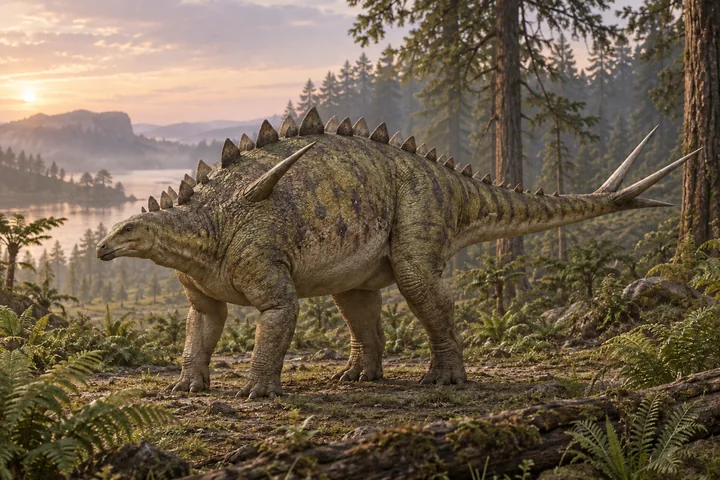
Dacentrurus armatus
Dacentrurus was a heavily built European stegosaur, combining bony armor with a substantial pelvis and limbs.
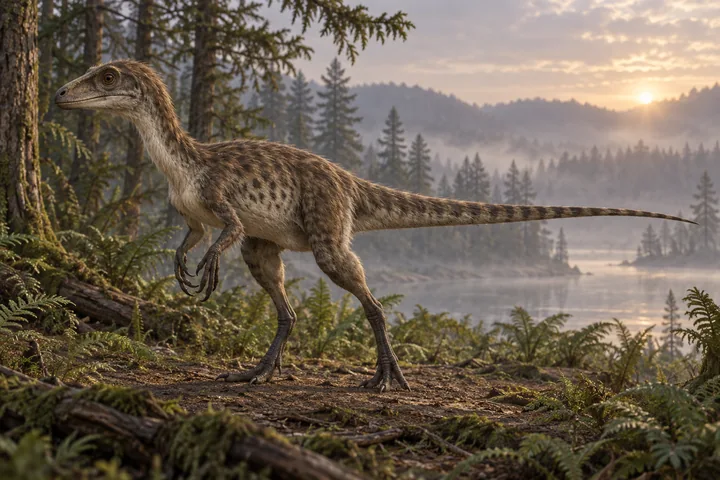
Ornitholestes hermanni
Ornitholestes is a small Morrison theropod with a historically misleading nose restoration.
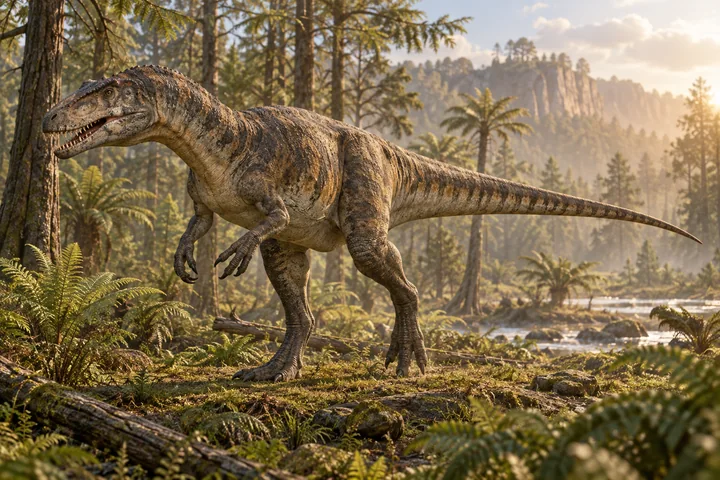
Megalosaurus bucklandii
Megalosaurus bucklandii was a Jurassic predator from England. Its fragmentary bones helped launch dinosaur science, while its modern identity is anchored by a distinctive lower jaw.