
Body length
InferredAbout 37.5 m; museum reference
The directory does not tie this estimate to one complete individual. Composite reconstructions and incomplete growth preclude treating it as a proven adult maximum. [D1] [D2]
EXHIBIT 86
Patagotitan mayorum
Patagotitan was an enormous Argentine titanosaur known from several individuals buried in successive floodplain deposits.
TWO WAYS TO PICTURE THE PAST
Compare the evidence with the familiar movie image. The illustrations are not to a shared scale.
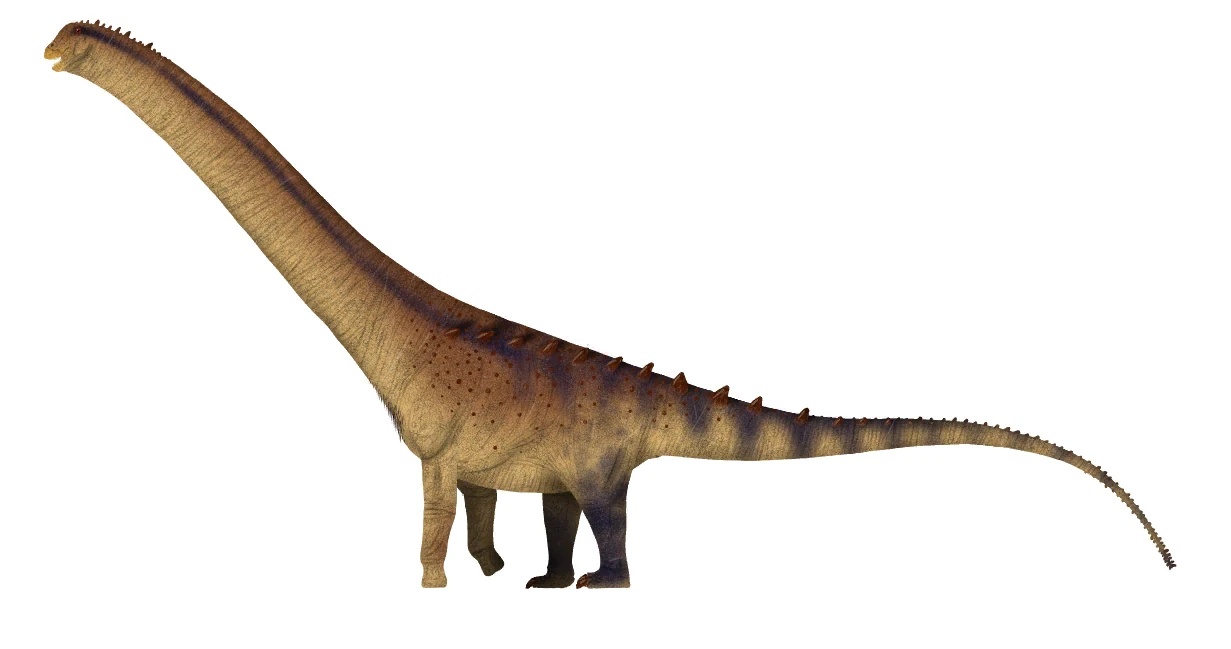
Artist reconstruction of Patagotitan. Colours, skin, soft tissues and dorsal contour are interpretive; its outline is not a complete preserved individual or a direct body-size measurement. [2]
Patagotitan.png · Sphenaphinae. CC BY-SA 4.0. Resized proportionally and converted to WebP; no anatomical edits. Same source license applies.
Scientific reconstruction is an interpretation; source credit does not certify every anatomical detail.
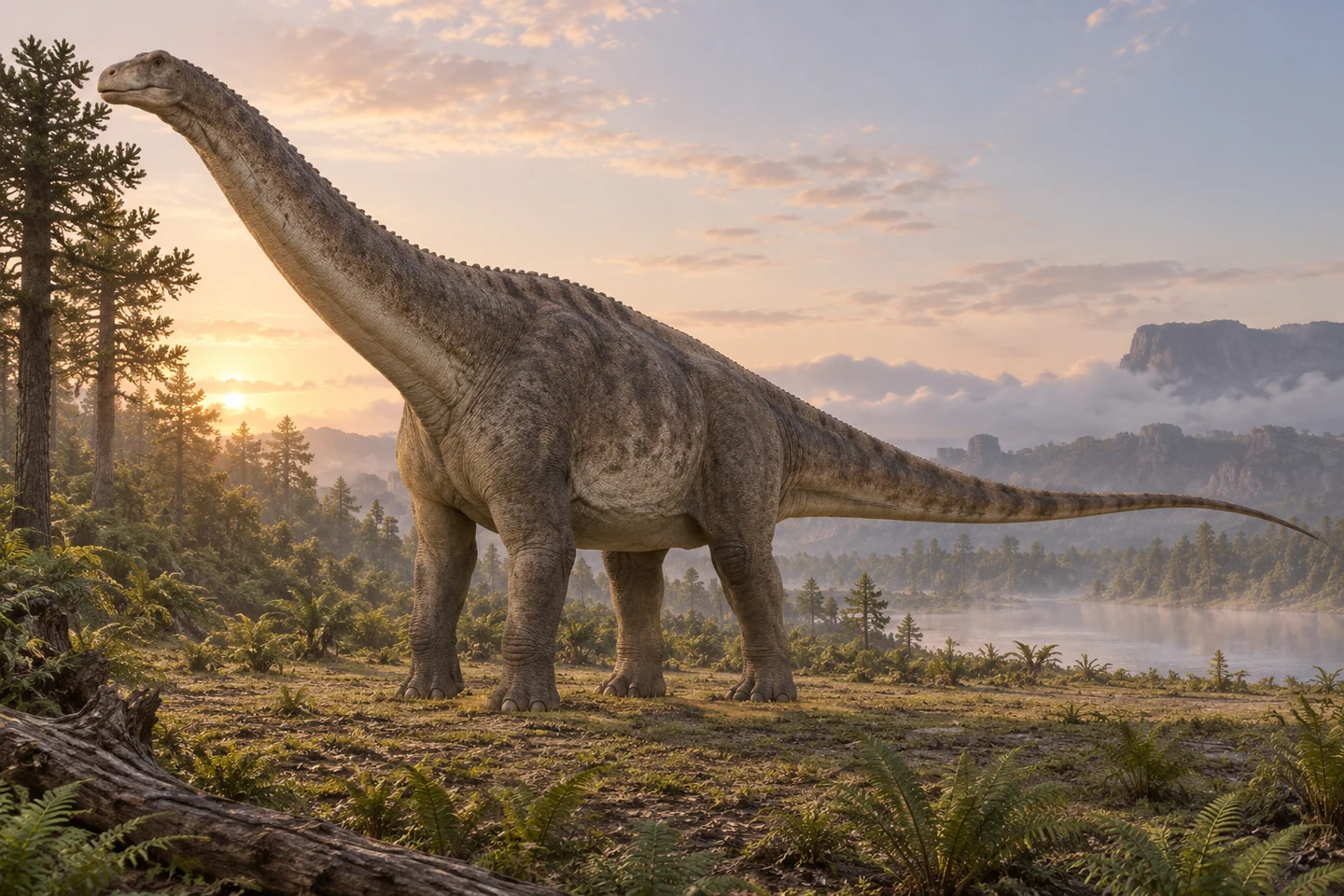
Original cinematic interpretation of Patagotitan mayorum. Coloration, soft tissues and scenery are artistic choices; reconstructed proportions do not establish a measured individual. Lighting, coloration and scenery are artistic choices. This image does not document a fossil locality or behavior.
Original artwork · artistic interpretation.
Scientific view: source-informed reconstruction, credited paleoart or specimen-based imagery. Movie-style view: Original artistic interpretation. Reconstructions involve uncertainty.
MEET THE ANIMAL
Patagotitan was an enormous plant-eating sauropod from Early Cretaceous Argentina. It is reconstructed standing on four legs, with a long neck and tail. Museum length references make its scale easier to imagine, but no single complete fossil animal establishes a secure adult maximum. Its huge size is a scientific reconstruction with important limits. [D1]
The American Museum of Natural History's long cast uses information from 84 recovered fossils. A cast is a replica made for display, and this assembled animal is not one intact fossil individual. Bringing preserved bones and restored parts together lets visitors understand the overall body plan without making every displayed piece original evidence. [D4]
Body weight is estimated rather than directly measured. A 2020 study revised limb-based calculations and obtained model estimates spanning 42 to 71 tonnes, with a mean of 57 tonnes. Those numbers describe outcomes of a modelling method applied to sampled material. They are not a measured range from the lightest to heaviest living adults. Patagotitan shows why extraordinary size claims need both the number and an explanation of how it was produced. [D3]
PREHISTORIC ANIMAL DOSSIER
The animal, the evidence, and the questions still open.
Model assumptions and growth stage matter when comparing this giant’s estimated dimensions.
Profile scope: Genus profile centered on Patagotitan mayorum; size models combine incomplete, still-growing individuals.
Source supported identifies a description documented by the cited source. Inferred marks a reconstruction or functional estimate. Debated marks competing interpretations. Not established means the sources reviewed for this dossier do not support a firm conclusion; it does not mean a behavior never occurred.
A size reference is an estimate, not a population range. Nesting evidence does not by itself establish courtship, mate choice, or lifelong pairing.
About 37.5 m; museum reference
The directory does not tie this estimate to one complete individual. Composite reconstructions and incomplete growth preclude treating it as a proven adult maximum. [D1] [D2]
42–71 tonnes; model interval, mean 57
The 2020 study revised limb-scaling estimates with a quadratic correction. These are alternative model estimates for sampled material, not an adult population range. [D3]
Plant-eater
The museum identifies herbivory; reviewed material does not resolve a particular plant menu. [D1]
Latest-Albian Chubut floodplain
The original study dates La Flecha’s Cerro Barcino sequence to 101.62 ± 0.18 million years ago, within the Early Cretaceous. [D2]
Four-legged terrestrial walker
The museum reconstructs locomotion on four supporting limbs; it does not establish speed. [D1]
Huge titanosaurs represented by multiple skeletons
The description diagnoses limb and vertebral features from incomplete individuals; the assembled outline includes restored missing elements. [D2]
Not established here
Focused egg and nesting searches did not establish clutches attributable to Patagotitan. Titanosaur nests elsewhere cannot supply its clutch size or parental behavior.
Not established here
Reviewed anatomy and focused courtship searches do not establish a mating system, display sequence or sex-specific ornamentation.
Repeated site use inferred
At least six similar-sized individuals span three burial horizons. The authors infer site fidelity; this does not demonstrate one simultaneous herd or its lasting organization. [D2]
Sources and inspection notes for the claims in this profile.
THE STORY IN THE FOSSILS
Patagotitan’s fossils record several deaths at a repeatedly flooded site. Separating burial episodes makes the possible aggregation evidence more informative than simply counting animals in one quarry. [2]
The American Museum’s 122-foot cast combines information from 84 recovered fossils. A display reconstruction is valuable for visualizing the animal, but it is not a complete fossil individual. [4]
The dossier identifies the scope of each reference estimate. A mount, an individual fossil and a species-wide adult range are different measurements. Comparison metrics remain unavailable where adult scope has not been established. Unknown does not mean zero.
Sources support the stated claims and scopes. Refer to the evidence notes for uncertainty.
KEEP EXPLORING
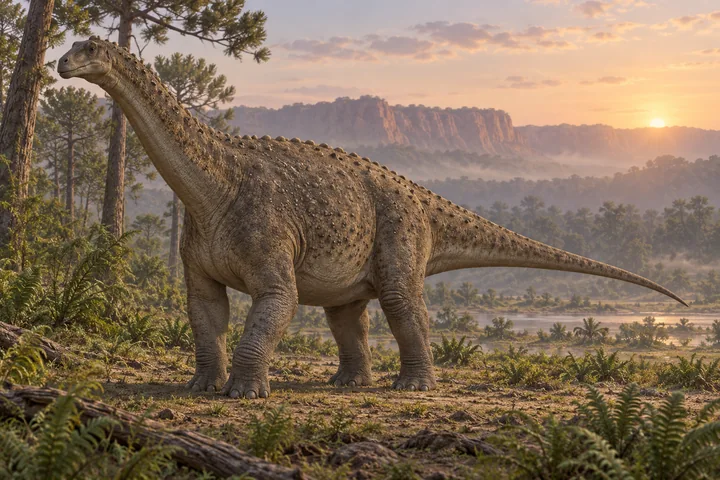
Saltasaurus loricatus
Saltasaurus was an Argentine titanosaur whose fossils preserve bony plates and tiny skin ossicles.
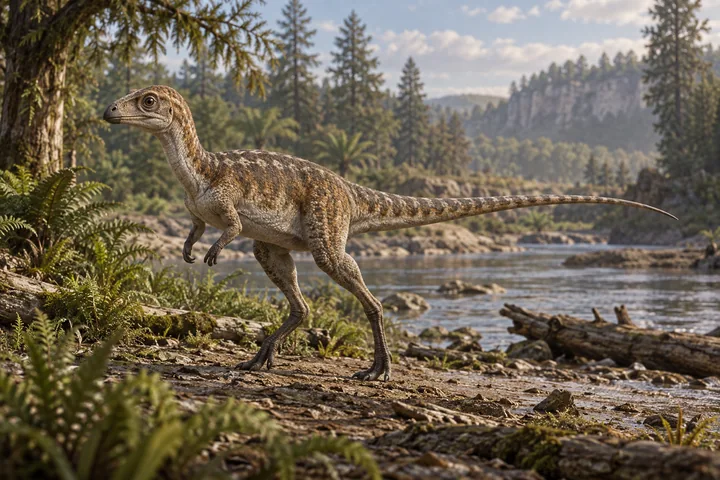
Hypsilophodon foxii
Hypsilophodon foxii was a small, ground-dwelling plant-eater from the Isle of Wight. Its lightly built skeleton and long hind limbs are consistent with agile running.
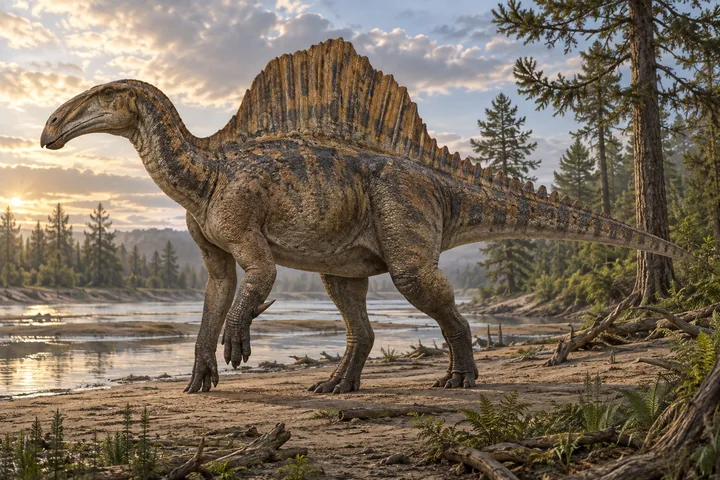
Ouranosaurus nigeriensis
Ouranosaurus nigeriensis was a plant-eating ornithopod from Niger with tall vertebral spines. Studies investigate their possible roles and skeleton growth stages.