
Body length
InferredAbout 4.2 m (museum reference)
Educational genus estimate, without an identified measured fossil individual or maturity statement. [D3]
EXHIBIT 235
Piatnitzkysaurus floresi
Dinosaur
Piatnitzkysaurus was a Patagonian theropod with comparatively long, functional forelimbs. [2]
TWO WAYS TO PICTURE THE PAST
Compare the evidence with the familiar movie image. The illustrations are not to a shared scale.
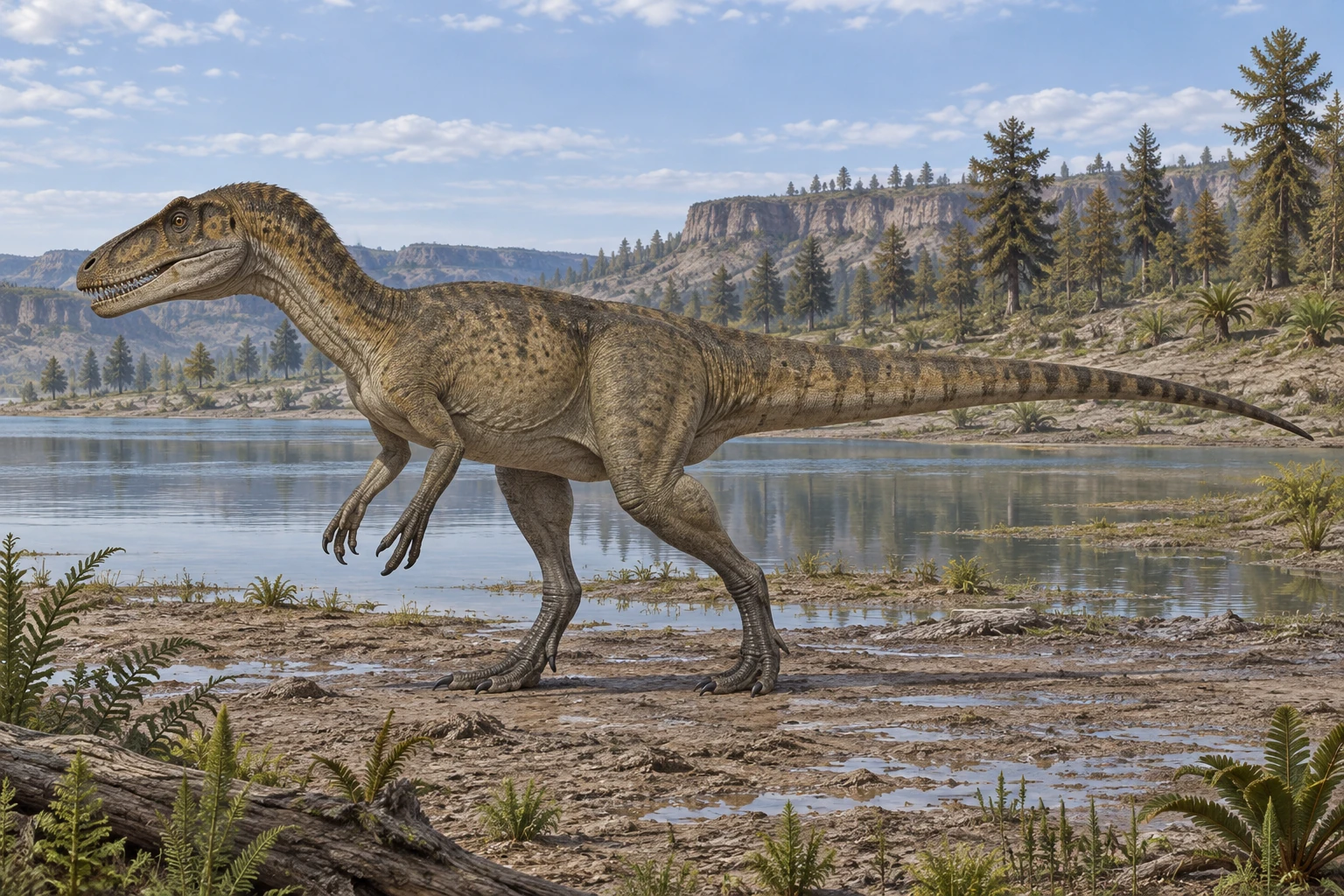
An illustrative reconstruction. Compare its anatomy with the evidence and limitations in the dossier. [2]
Source-informed reconstruction. Appearance evidence [2]. Original illustration; missing anatomy, coloration and scenery include interpretation.
Fossils constrain this life reconstruction. Missing anatomy, coloration and the environmental scene include interpretation; the dossier explains the evidence limits.
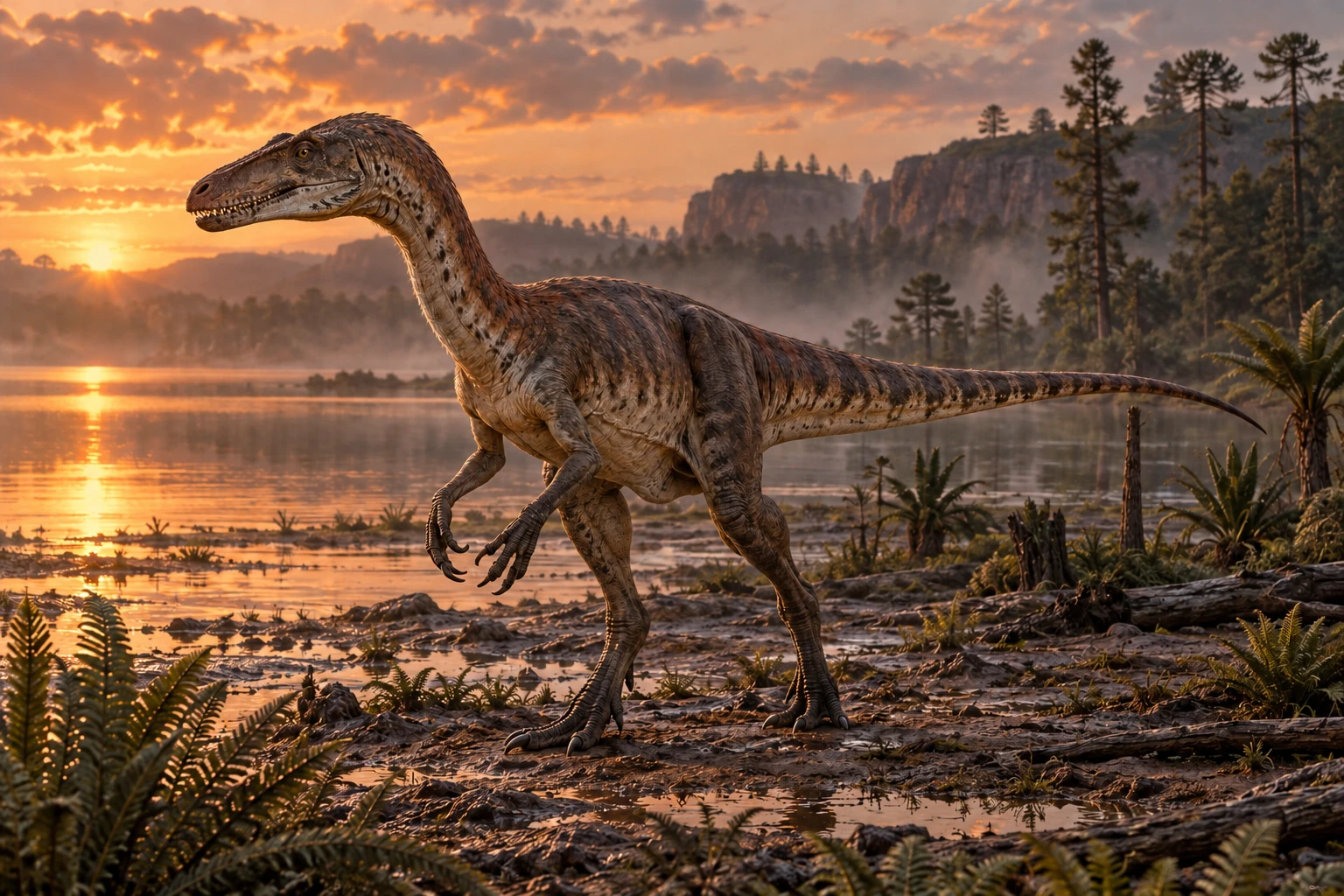
An illustrative reconstruction. Compare its anatomy with the evidence and limitations in the dossier. Lighting, coloration and scenery are artistic choices. This image does not document a fossil locality or behavior.
Original artwork · artistic interpretation.
Scientific view: source-informed reconstruction, credited paleoart or specimen-based imagery. Movie-style view: Original artistic interpretation. Reconstructions involve uncertainty.
MEET THE ANIMAL
Piatnitzkysaurus was a meat-eating dinosaur from what is now Argentina. The museum directory gives a useful length reference of about 4.2 meters, but that number is an educational estimate rather than a maximum measured from one complete animal. It helps convey scale while leaving room for the incomplete fossils and the uncertainties of reconstructing a whole body. [D3]
New studies place its fossil-bearing beds in the Early Jurassic. Dates from the relevant layers fall around 178.8 to 178.1 million years ago. The animal is known from two incomplete specimens, including parts of the head and backbone. Scientists inspect which bones really belong together instead of assuming every nearby tooth or fragment came from the same dinosaur. [D1]
Its arms were more substantial than the tiny arms familiar from some famous predators. The preserved upper arm and forearm bones help establish that difference, although the hands still need careful restoration. Recent researchers also compare small details of the hip and limbs with other early theropods. These comparisons help identify the animal without turning an incomplete skeleton into a copy of Allosaurus. [D2]
PREHISTORIC ANIMAL DOSSIER
The animal, the evidence, and the questions still open.
Modern redescriptions distinguish its forelimbs and vertebrae from those of better-known theropods. [D2]
Profile scope: Genus — Piatnitzkysaurus floresi; incomplete specimens PVL 4073 and MACN-Pv CH 895. [D1]
Source supported identifies a description documented by the cited source. Inferred marks a reconstruction or functional estimate. Debated marks competing interpretations. Not established means the sources reviewed for this dossier do not support a firm conclusion; it does not mean a behavior never occurred.
A size reference is an estimate, not a population range. Nesting evidence does not by itself establish courtship, mate choice, or lifelong pairing.
About 4.2 m (museum reference)
Educational genus estimate, without an identified measured fossil individual or maturity statement. [D3]
Not established here
The reviewed directory does not provide a comparable maturity-qualified mass. [D3]
Animal feeding inferred
The museum identifies a carnivore; no preserved meal or specific hunting strategy is adopted. [D3]
Patagonian terrestrial basin
The Cañadón Asfalto fossils come from a continental basin; type-bearing beds are Toarcian Early Jurassic, about 178.8–178.1 million years old. [D1]
Bipedal reconstruction
The pelvis and hindlimbs support two-legged movement; reconstructed movement is not a measured speed. [D2]
Relatively long forelimbs
Humerus and ulna support functional arms. Incomplete hands require comparative restoration; they are not tyrannosaur-style stubs. [D2]
Not established here
The reviewed axial material provides no assigned nest, egg or embryo. [D1]
Not established here
The reviewed appendicular fossils do not reveal mating signals. [D2]
Not established here
Association with other dinosaurs in a bonebed does not demonstrate cooperative hunting. [D1]
Sources and inspection notes for the claims in this profile.
THE STORY IN THE FOSSILS
Recent dating puts the type beds in the Early Jurassic, updating older educational age assignments. [1]
The length displayed here is a museum reference rather than a measured species maximum. [3]
The dossier identifies the scope of each reference estimate. A mount, an individual fossil and a species-wide adult range are different measurements. Comparison metrics remain unavailable where adult scope has not been established. Unknown does not mean zero.
Sources support the stated claims and scopes. Refer to the evidence notes for uncertainty.
KEEP EXPLORING
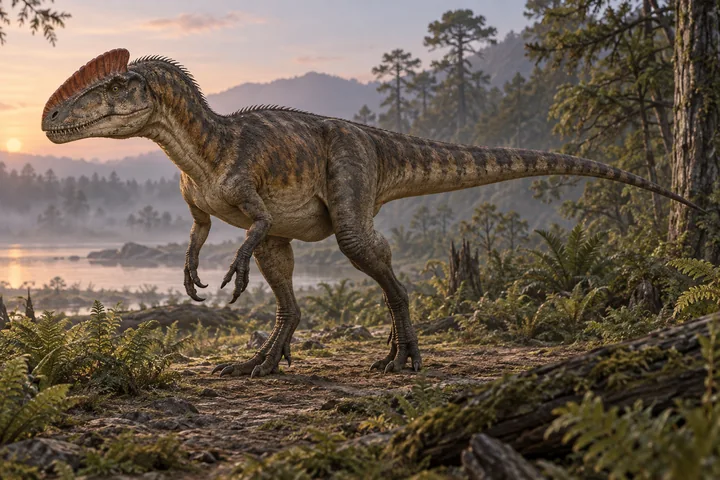
Monolophosaurus jiangi
Monolophosaurus is recognized by a single crest along its skull.
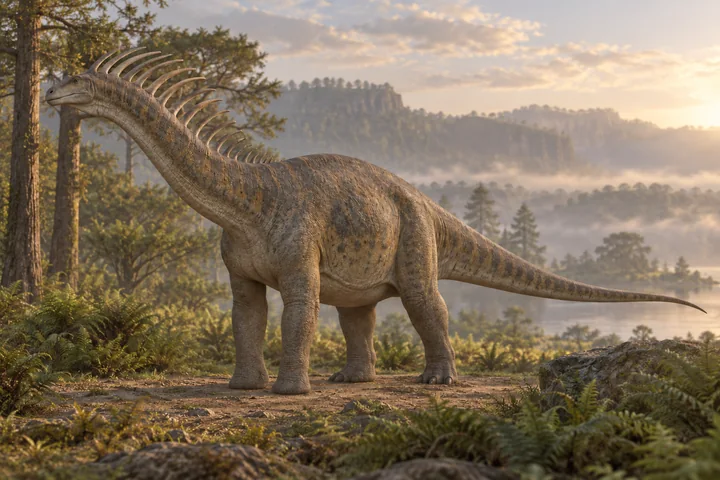
Bajadasaurus pronuspinax
Bajadasaurus was an Argentine sauropod with striking forward-directed neck spines. Its informative skull contrasts with a largely unknown body.
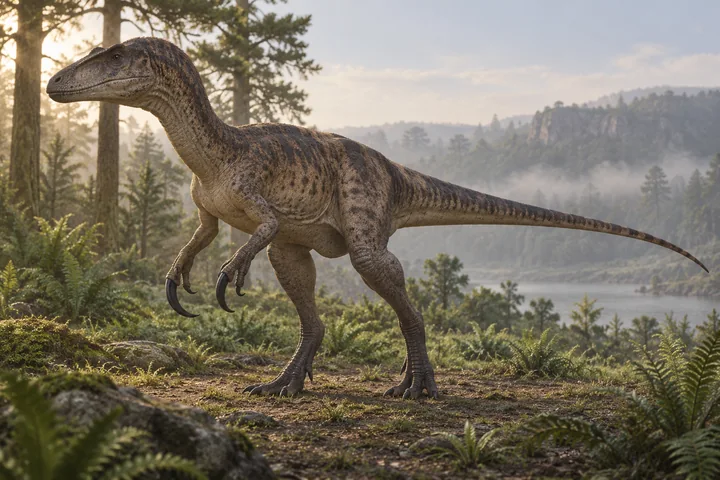
Megaraptor namunhuaiquii
Megaraptor was a Patagonian predator with an enormous claw on its first finger. A juvenile preserves much of the known skull anatomy.