
Length
InferredAbout 7 m (museum reference)
A rounded museum reference, not a measured population range; the page does not specify the specimen, method or growth stage. [D1]
EXHIBIT 55
Plateosaurus
Grasping hands on a bipedal relative of the giant sauropods.
TWO WAYS TO PICTURE THE PAST
Compare the evidence with the familiar movie image. The illustrations are not to a shared scale.

The artist identifies this reconstruction as Plateosaurus. Fossil-informed anatomy: Bipedal early sauropodomorph with long mobile neck and tail, strong grasping arms, five-fingered hands and prominent thumb claws; hands not planted for walking. File identifies the genus only; do not relabel as a species. Colour and soft-tissue contours are artistic reconstruction. [1] [2]
Plateosaurus TD.png — TotalDino. CC BY-SA 4.0. Remote source artwork displayed without additional cropping; Wikimedia supplies any display-size derivative.
Scientific picture served by Wikimedia · internet connection required.
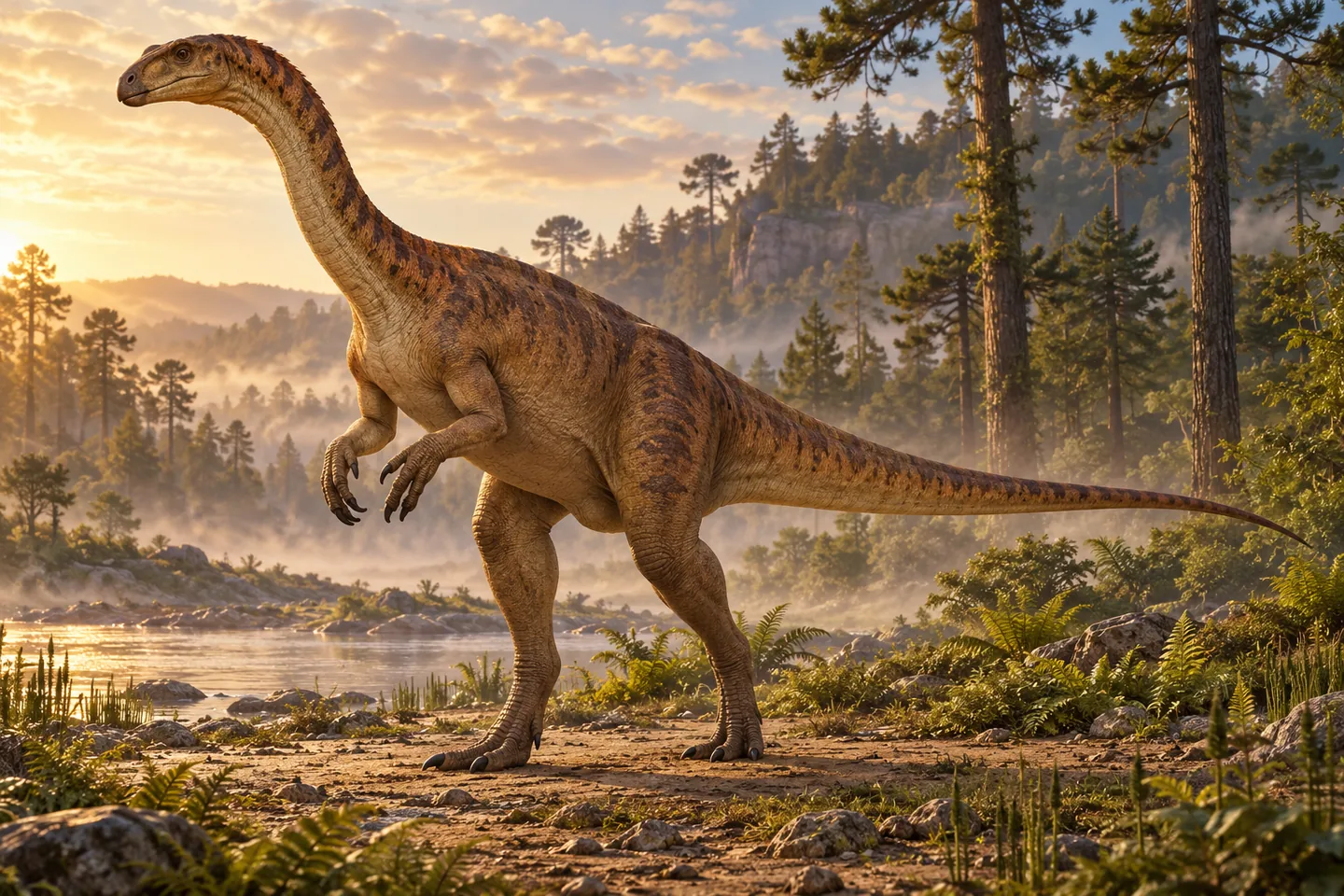
Cinematic bipedal Plateosaurus with a long flexible neck and balancing tail; strong grasping arms held off the ground, five-fingered hands and large thumb claws, speculative colours. Dramatic lighting, surface detail and scenery are artistic choices. This is an original cinema-inspired picture, rather than a frame from a film or a documented fossil locality.
Original artwork · artistic interpretation.
Scientific view: credited paleoart interpreting fossil evidence, served online by Wikimedia. Movie-style view: Original artistic interpretation. Colors, soft tissues and settings involve reconstruction.
MEET THE ANIMAL
Plateosaurus was a plant-eating dinosaur from Late Triassic Europe. A rich German fossil locality at Trossingen preserves skeletons referred to Plateosaurus trossingensis, one species within the genus. These animals lived about 205 million years ago. Their remains occur in clay-rich rocks that formed in an ancient landscape affected by mud and changing wet conditions, rather than in a modern European environment. [S1]
Joint models favor walking on two legs. Hands could grasp, but limited forelimb movement hindered effective quadrupedal strides. [D2]
Quadrupedal means moving on four legs, an older alternative tested by those models. Trossingen’s many skeletons also invite questions about social life, yet the deposits built up over time: some bones lay exposed and weathered before burial. That history complicates the idea that every accumulation represents a single living herd. Thin sections of bone and scans can investigate growth, while the exact circumstances of death at the locality remain under study. The site offers many individuals to compare, rather than one preserved snapshot of a whole community. [S1]
PREHISTORIC ANIMAL DOSSIER
The animal, the evidence, and the questions still open.
Plateosaurus had five-fingered grasping hands and a large thumb claw. Digital joint-motion modelling makes a four-legged walking cycle impractical, supporting a bipedal reconstruction despite older alternatives.
Profile scope: Genus: Plateosaurus; digital locomotor study uses material described as P. engelhardti.
Source supported identifies a description documented by the cited source. Inferred marks a reconstruction or functional estimate. Debated marks competing interpretations. Not established means the sources reviewed for this dossier do not support a firm conclusion; it does not mean a behavior never occurred.
A size reference is an estimate, not a population range. Nesting evidence does not by itself establish courtship, mate choice, or lifelong pairing.
About 7 m (museum reference)
A rounded museum reference, not a measured population range; the page does not specify the specimen, method or growth stage. [D1]
About 4,000 kg (museum reference)
A rounded museum reference, not a measured population range; the page does not specify the specimen, method or growth stage. [D1]
Plant eater
The museum identifies herbivory. Use of the hands for collecting food is proposed rather than directly documented. [D1]
Late Triassic European fossil localities
Reviewed museum records include France, Germany and Switzerland. They do not establish a preferred habitat within those regions. [D1]
Bipedal walking favored by joint-motion model
The digital study found forelimb reach too restricted for practical quadrupedal walking. This functional result is more specific than the directory's older two-or-four-leg alternatives. [D2] [D1]
Five-fingered grasping hands and large thumb claw
The claw is fossil anatomy; food gathering and defence are proposed uses. Digital modelling supports grasping motions beneath and beside the front torso. [D1] [D2]
Not established here
The reviewed sources do not establish nest structure, incubation or parental care for Plateosaurus.
Not established here
The reviewed sources do not establish a courtship sequence or mating system for Plateosaurus.
Herd living proposed from German finds
The museum suggests grouping from German fossil finds. Its summary does not establish whether each accumulation represents a living herd or repeated deaths at a site. [D1]
Sources and inspection notes for the claims in this profile.
THE STORY IN THE FOSSILS
Plateosaurus had five fingers and a conspicuous thumb claw. Their use in gathering food or defence has been proposed, but is not directly observed. Fossils from France, Germany and Switzerland place this early sauropodomorph in Europe long before the largest Jurassic and Cretaceous sauropods. [1]
A digital skeletal study examined the possible movement of its arms, legs, neck and tail. The hands suit grasping, while limited forelimb reach makes a four-legged walking cycle impractical. The neck could bend vertically and sideways, and the many tail vertebrae allowed considerable flexibility. [2]
We have not established a comparable adult total-length estimate for this taxon in this draft. Specimen measurements in the text describe those individuals. The cited dates are approximately 210 million years ago. Approximate reference age, represented by equal endpoints; not a demonstrated full temporal range. Unknown does not mean zero.
Sources and evidence notes for this exhibit.
KEEP EXPLORING
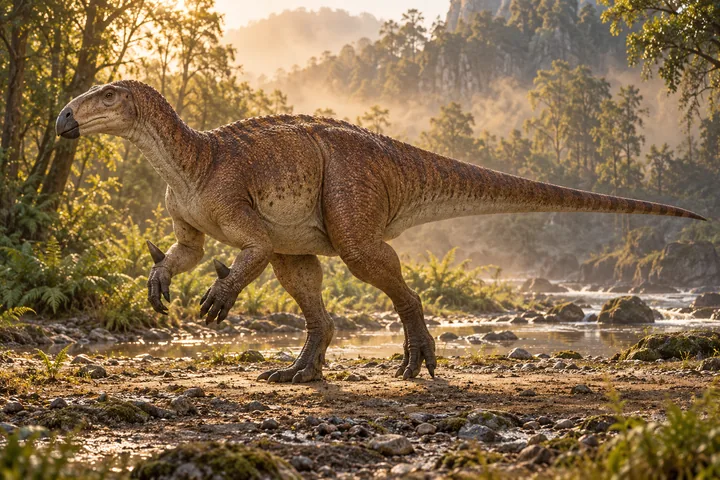
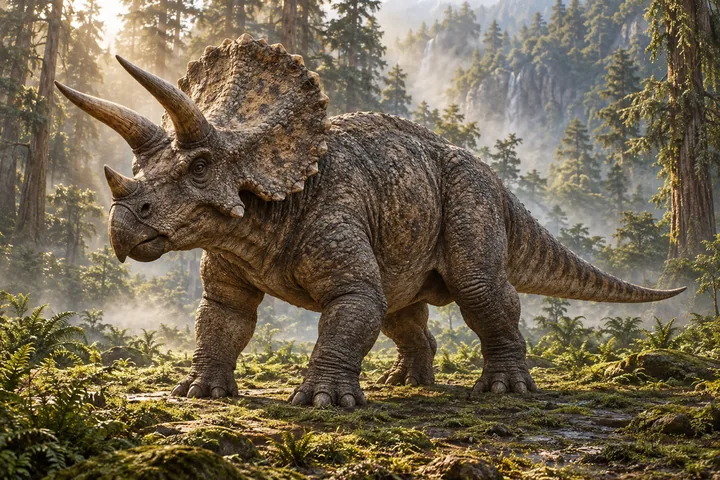
Triceratops horridus
Three horns, a broad frill, and a plant-eater beneath the formidable silhouette.
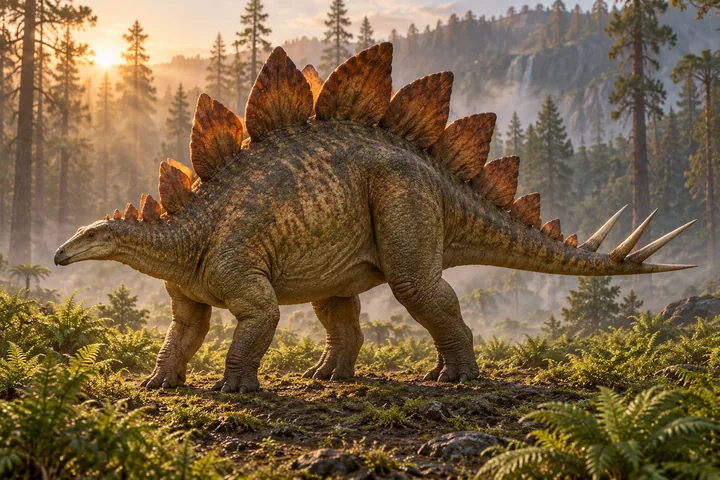
Stegosaurus stenops
A small head, a skyline of plates, and four spikes at the tail.