
Body length
InferredAbout 4.4 m; skull-based type model
The allometric analysis gives MNN IGU1 about 4.39 ±0.39 m from cranial regressions. Its possible subadult status and absent body bones prevent using this as an adult range. [D3] [D2]
TWO WAYS TO PICTURE THE PAST
Compare the evidence with the familiar movie image. The illustrations are not to a shared scale.
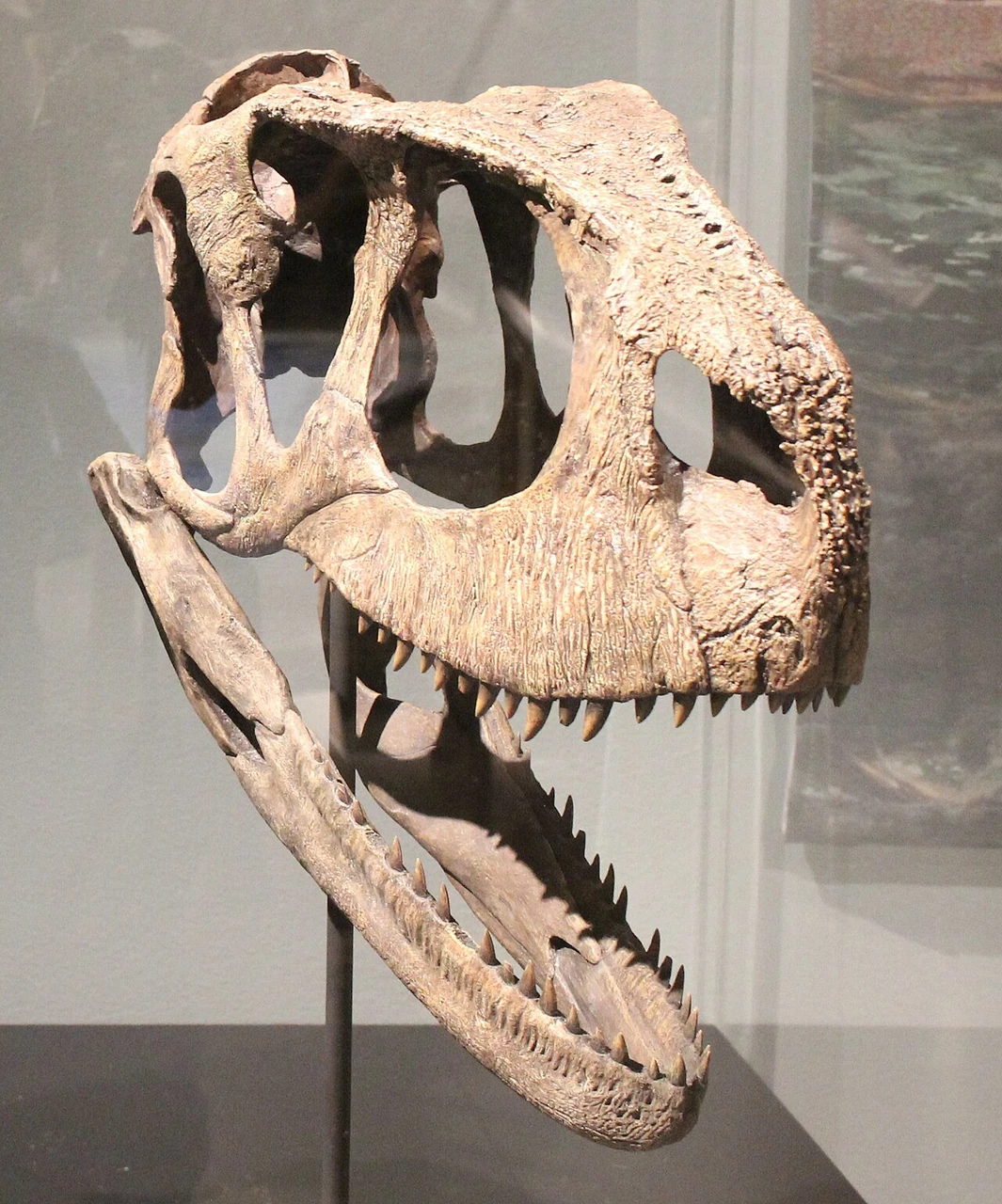
Rugops skull display at the National Geographic Museum’s Spinosaurus exhibition. The source does not identify original fossil material; complete jaws and absent cranial portions should be read as reconstruction. [1]
Rugops skull display · Ryan Somma. CC BY 2.0. Resized proportionally and converted to WebP; no anatomical edits. Same source license applies.
Skeletal mounts and drawings may restore missing parts; the caption identifies the displayed material.
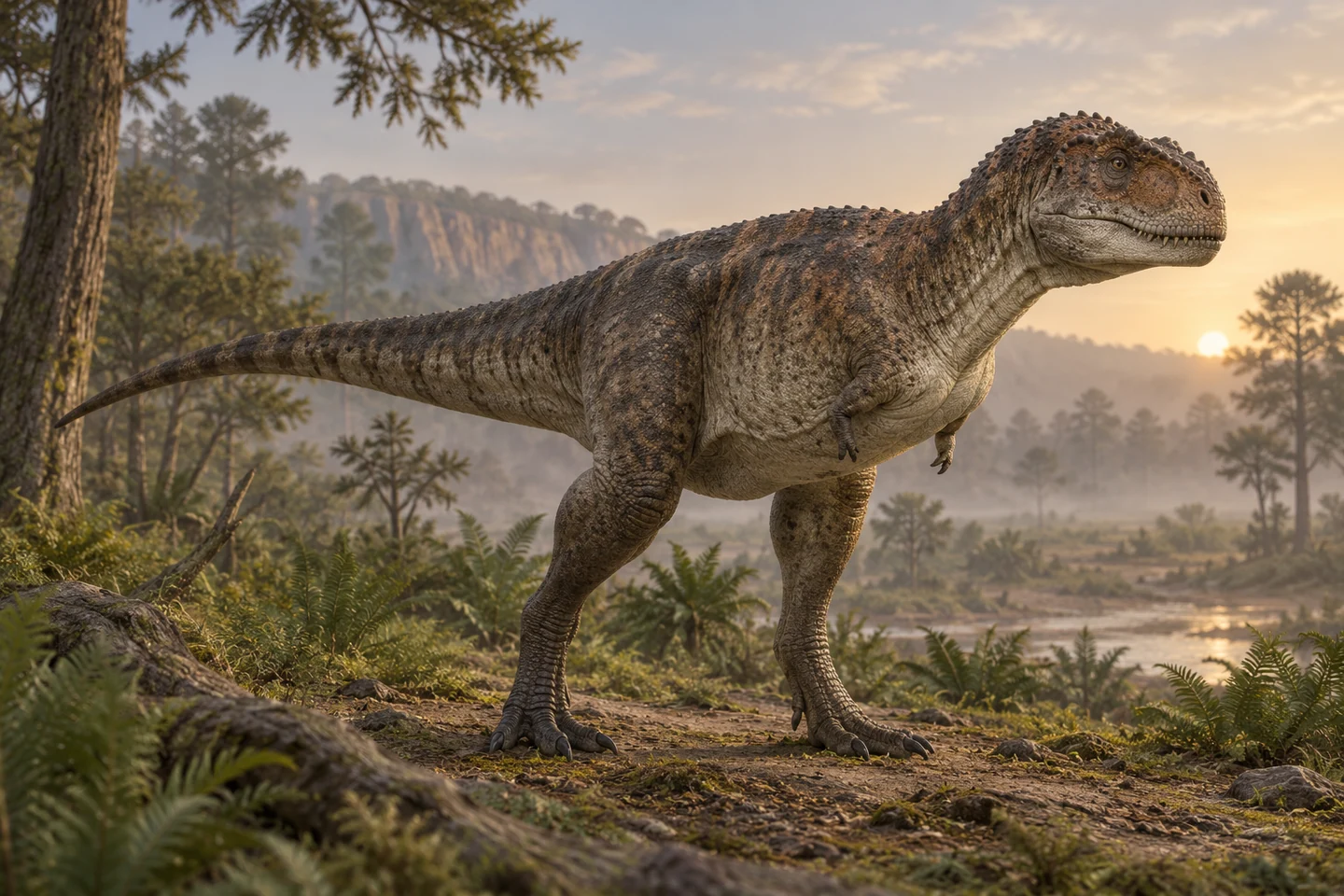
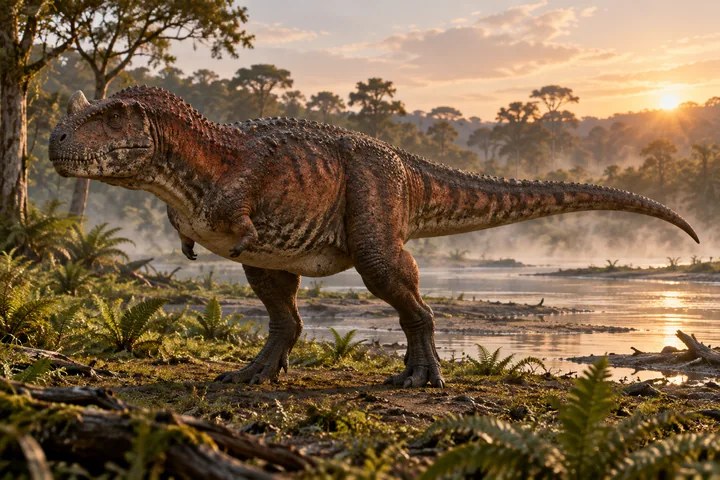
Original cinematic interpretation of Rugops primus. Colors, soft tissues, scenery and missing anatomy are reconstructed artistic choices; this is not a directly observed individual or behavior. The genus is anchored by an incomplete skull, possibly subadult; the body and facial soft tissues are comparative interpretations. Lighting, coloration and scenery are artistic choices. This image does not document a fossil locality or behavior.
Original artwork · artistic interpretation.
Scientific view: source-informed reconstruction, credited paleoart or specimen-based imagery. Movie-style view: Original artistic interpretation. Reconstructions involve uncertainty.
MEET THE ANIMAL
Rugops was a meat-eating dinosaur from Niger, known through a partial skull. The institutional discovery account places it around 95 million years ago. Its animal-food diet is clearer than its exact feeding habits. A suggestion that it scavenged remains conditional, rather than proof that it ate only carcasses or avoided hunting altogether. [D4]
A study estimated total body length from skull measurements using comparisons with other dinosaurs. Its result of about 4.4 metres is a model, not a complete animal measured from nose to tail. Different skull-based calculations produced some disagreement. That variation concerns estimates for the original material rather than a range describing adult animals in a living population. [D3]
The animal beyond its skull must be reconstructed largely from relatives. Open skull joints have also raised the possibility that the individual was not fully grown. Surface features invite hypotheses about missing tissues, but a fleshy covering is not directly preserved. Rugops is therefore a useful reminder that a vivid full-body picture can rest on a small, informative piece of an animal rather than a complete skeleton. [D2]
PREHISTORIC ANIMAL DOSSIER
The animal, the evidence, and the questions still open.
The hornless skull bears extensive grooves and paired rows of pits. These structures inform soft-tissue hypotheses while leaving the living face uncertain. [D1]
Profile scope: Genus profile centered on Rugops primus and partial skull MNN IGU1. No type postcranial skeleton supports an exact whole-body reconstruction. [D1]
Source supported identifies a description documented by the cited source. Inferred marks a reconstruction or functional estimate. Debated marks competing interpretations. Not established means the sources reviewed for this dossier do not support a firm conclusion; it does not mean a behavior never occurred.
A size reference is an estimate, not a population range. Nesting evidence does not by itself establish courtship, mate choice, or lifelong pairing.
About 4.4 m; skull-based type model
The allometric analysis gives MNN IGU1 about 4.39 ±0.39 m from cranial regressions. Its possible subadult status and absent body bones prevent using this as an adult range. [D3] [D2]
Not established here
Focused searches did not yield an inspected, transparent Rugops mass calculation. A skull-derived length is not a weight measurement and does not validate common unreferenced mass figures.
Animal foods; scavenging is a hypothesis
The discovery page discusses possible scavenging. It does not establish exclusive scavenging, a particular prey menu or the force generated by the jaws. [D4]
Cenomanian Echkar Formation, Niger
The type comes from near In Abangharit, in Cenomanian Echkar deposits, about 95 million years ago. Associated vertebrates establish a fossil setting, not specific predator–prey interactions. [D1]
Biped inferred from theropod relatives
A terrestrial two-legged reconstruction follows comparative theropod anatomy. Because the reviewed type is skull-only, its particular limb proportions, speed and stride are not directly established. [D2]
Hornless skull with rows of nasal pits
Seven pits on each nasal and extensive surface grooves characterize the skull. Their function and overlying soft tissues remain uncertain; inferred dermal coverings are not preserved skin. [D1]
Not established here
Reviewed sources and focused egg/nesting searches did not identify assigned Rugops nests, clutch size, incubation or parental care.
Not established here
Soft-tissue and low-motion head-butting hypotheses do not establish rituals. A 2026 comparative study favors sexual-selection explanations for abelisaurid ornaments; this does not demonstrate Rugops mate choice, sexual dimorphism or display colors. [D2] [D5]
Not established here
One type skull cannot establish solitary habits, stable groups or pack hunting. [D1]
Sources and inspection notes for the claims in this profile.
THE STORY IN THE FOSSILS
The discovery offered valuable evidence for African abelisaurids, but almost all of the animal beyond its skull must be reconstructed comparatively. The institutional scavenging suggestion is conditional. [4]
Surface grooves and nasal pits provide clues to tissue attachment. Their presence is more secure than any particular reconstruction of a fleshy display or protective covering. [1]
The dossier identifies the scope of each reference estimate. A mount, an individual fossil and a species-wide adult range are different measurements. Comparison metrics remain unavailable where adult scope has not been established. Unknown does not mean zero.
Sources support the stated claims and scopes. Refer to the evidence notes for uncertainty.
KEEP EXPLORING
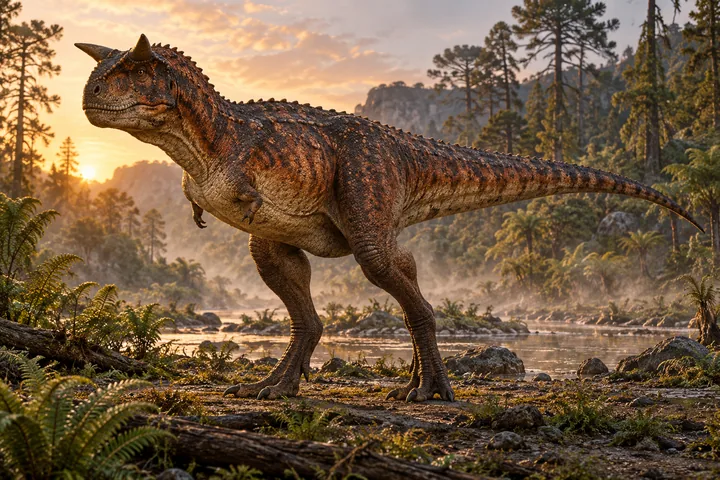
Carnotaurus
This Argentine abelisaurid had a short snout and a narrow skull. Preserved skin reveals a mixture of small scales and larger conical scales.
Majungasaurus crenatissimus
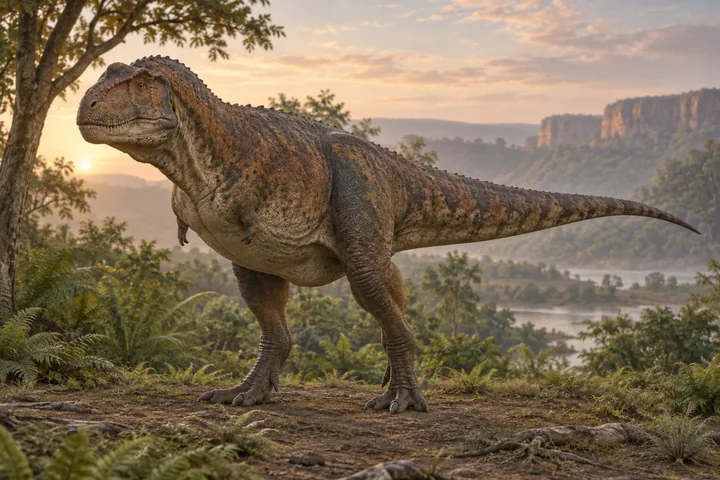
Majungasaurus crenatissimus was an abelisaurid from Madagascar. It combined a robust, ornamented skull with remarkably reduced but anatomically complex forelimbs.
Rajasaurus narmadensis
Rajasaurus was a meat-eating abelisaurid from India with a single short horn on its skull roof.