
Body length
InferredAbout 4 m; museum reference
The museum lists 4 m without identifying a specimen, age or estimation method. Treat it as a general reference, not a species size interval. [D1]
EXHIBIT 64
Scelidosaurus harrisonii
Scelidosaurus harrisonii was an Early Jurassic plant-eater from Dorset, England. Its well-preserved skeleton records bony body armour and a distinctive skull.
TWO WAYS TO PICTURE THE PAST
Compare the evidence with the familiar movie image. The illustrations are not to a shared scale.
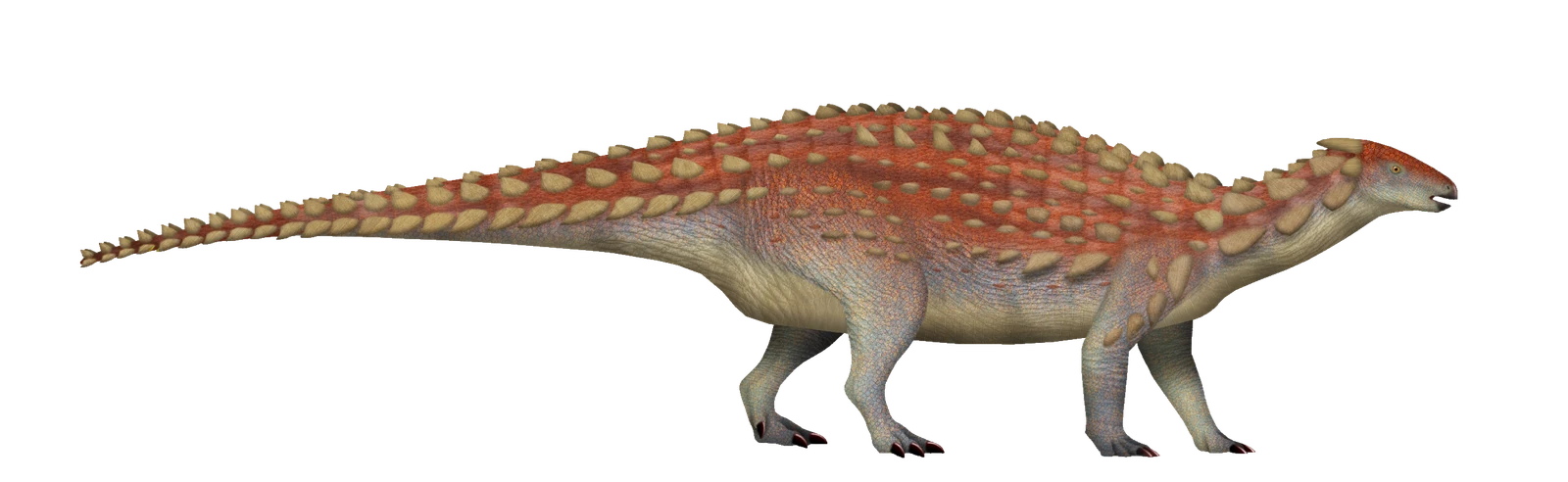
Artist reconstruction of Scelidosaurus harrisonii. Colours and soft tissues are interpretive; the image does not document behavior. [2]
Scelidosaurus TD.png · TotalDino. CC BY 4.0. Resized proportionally and converted to WebP; no anatomical edits. Same source license applies.
Scientific reconstruction is an interpretation; source credit does not certify every anatomical detail.
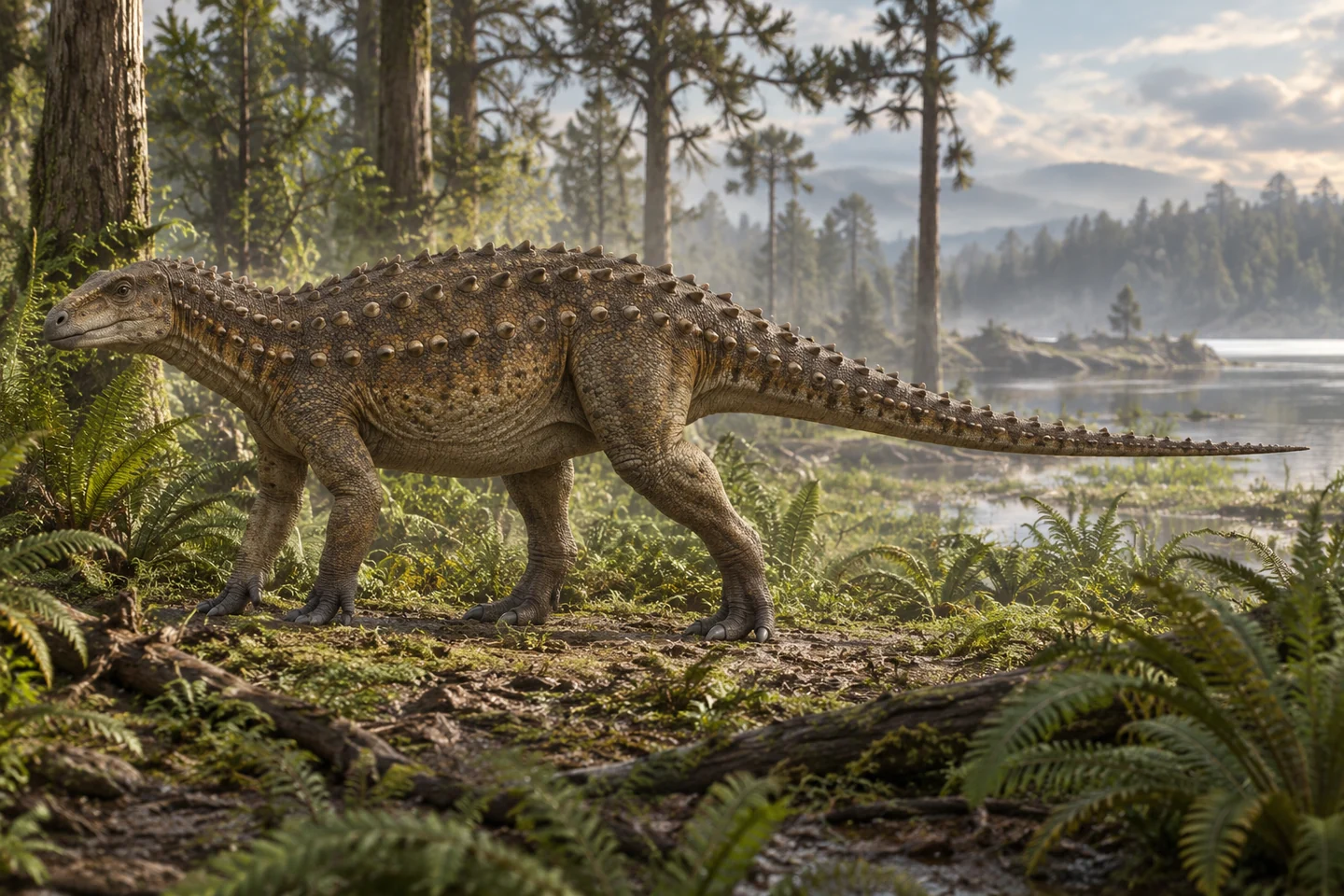
Original cinematic interpretation of Scelidosaurus. Anatomy, soft tissues and colors are reconstructed choices. Lighting, coloration and scenery are artistic choices. This image does not document a fossil locality or behavior.
Original artwork · artistic interpretation.
Scientific view: source-informed reconstruction, credited paleoart or specimen-based imagery. Movie-style view: Original artistic interpretation. Reconstructions involve uncertainty.
MEET THE ANIMAL
Scelidosaurus harrisonii had a complicated covering of bony armor. Raised plates ran along the neck and body, smaller armor bones occurred on the limbs, and rows surrounded the tail. Its head carried additional bony structures. These skin-associated bones are called osteoderms; they add another layer of anatomy beyond the main skeleton. [S1]
Its armor also changed as the animal grew. A modern study describes smaller specimens that help show how some neck plates developed and fused into larger arrangements. The shape and position of each piece therefore matter when reconstructing the animal. A loose armor bone cannot automatically tell us how the entire covering looked on a fully grown individual. [S1]
The Natural History Museum identifies it as a plant eater from Early Jurassic England and gives a length reference of about four metres. That is an educational reconstruction without a named measured individual or growth stage, rather than a complete species-wide size range. [D1]
Its Dorset fossils were buried in marine rocks, but researchers interpret the animals as land dwellers washed into the sea. The place a skeleton was buried need not be its living habitat. [D2]
PREHISTORIC ANIMAL DOSSIER
The animal, the evidence, and the questions still open.
Scelidosaurus combines a plant-processing jaw with rows of bony armour. Detailed modern study has changed interpretations of its skull, movement and place among armoured dinosaurs.
Profile scope: Species: Scelidosaurus harrisonii. Museum size reference is not a measured individual or a complete adult size range.
Source supported identifies a description documented by the cited source. Inferred marks a reconstruction or functional estimate. Debated marks competing interpretations. Not established means the sources reviewed for this dossier do not support a firm conclusion; it does not mean a behavior never occurred.
A size reference is an estimate, not a population range. Nesting evidence does not by itself establish courtship, mate choice, or lifelong pairing.
About 4 m; museum reference
The museum lists 4 m without identifying a specimen, age or estimation method. Treat it as a general reference, not a species size interval. [D1]
Not established here
A specimen-scoped body-mass estimate was not established in the reviewed sources.
Plant-eater
The museum identifies herbivory; reconstructed jaw action suggests pulping and shearing vegetation rather than establishing particular plant species. [D1] [D3]
Early Jurassic Dorset; marine burial
The Cambridge account places the fossils in approximately 193-million-year-old Dorset rocks and interprets terrestrial animals as having been washed into the sea. [D2]
Facultative quadruped
Norman's limb and muscle reconstructions suggest an animal able to use four legs. This is a functional interpretation of skeletal anatomy, not a measured speed. [D3]
Bony plates and spikes; horned rear skull
The Cambridge report describes body osteoderms and skull horns. Hardened scutes over the skull are inferred from bone surface texture. [D2] [D3]
Not established here
The reviewed sources do not establish species-specific nests, clutch sizes or parental care.
Not established here
Armour and skull projections do not by themselves establish mate choice, sex differences or a courtship sequence.
Not established here
The reviewed sources do not establish persistent groups or cooperative behavior.
Sources and inspection notes for the claims in this profile.
THE STORY IN THE FOSSILS
A near-complete skeleton recovered from the Dorset coast gave early researchers much more information than isolated dinosaur teeth and bones could provide. Detailed modern study has revealed armour embedded in the skin and unexpected horns at the rear of the skull. [2]
A biological reconstruction suggests that its jaws processed vegetation and that it could move on four legs. These interpretations connect anatomy to everyday life; they do not identify a top speed or demonstrate the animal's mating or social habits. [3]
The dossier identifies the scope of each reference estimate. A mount, an individual fossil and a species-wide adult range are different measurements. Comparison metrics remain unavailable where adult scope has not been established. Unknown does not mean zero.
Sources support the stated claims and scopes. Refer to the evidence notes for uncertainty.
KEEP EXPLORING
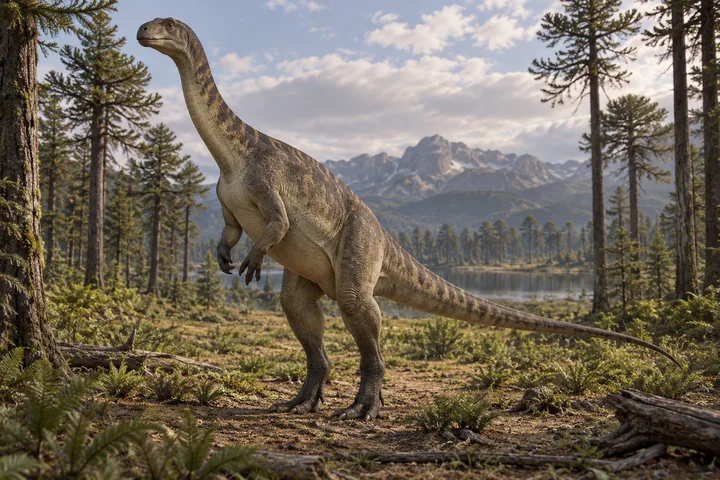
Mussaurus patagonicus
Mussaurus grew from tiny hatchlings into large sauropodomorphs. Eggs and clustered skeletons from Patagonia provide unusually rich evidence for nesting and age-related social organization.
Massospondylus carinatus
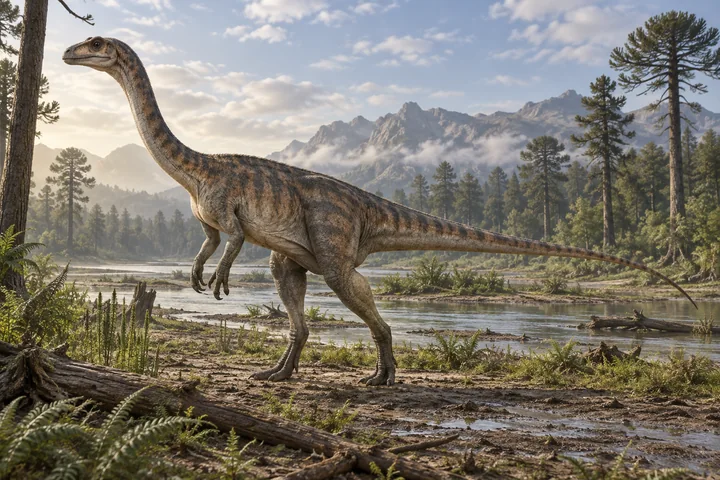
Massospondylus was a southern African sauropodomorph with a long neck and a prominent thumb claw. Preserved eggs, embryos and nesting grounds illuminate reproduction while young-animal posture remains debated.
Heterodontosaurus tucki
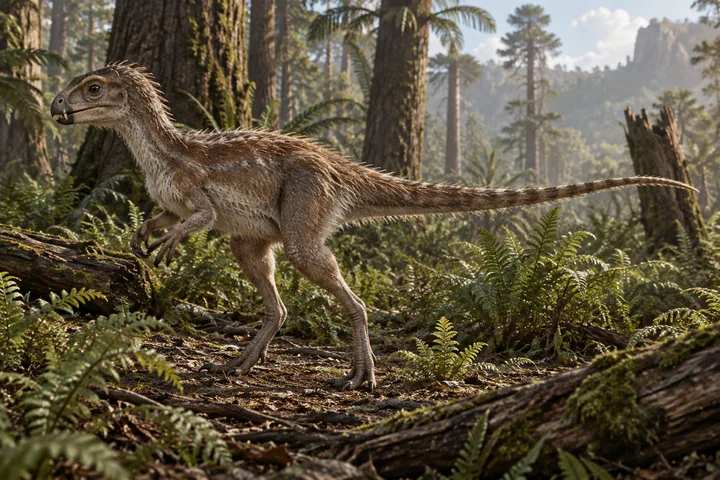
Heterodontosaurus was a small southern African ornithischian with contrasting tooth types. Its tusk-like teeth, chewing adaptations and unusual chest anatomy open different windows onto its biology.