Length
Inferred11–16 m (WUC fossil-individual estimates)
Humeri 31–45 cm and published body correlations estimate sampled Nevada individuals; not a species-wide adult range. [D1]
EXHIBIT 291
Shonisaurus popularis
Marine reptile
A giant ichthyosaur whose Nevada fossils include adults and embryos, supporting a proposed recurring birthing area. [2]
TWO WAYS TO PICTURE THE PAST
Compare the evidence with the familiar movie image. The illustrations are not to a shared scale.
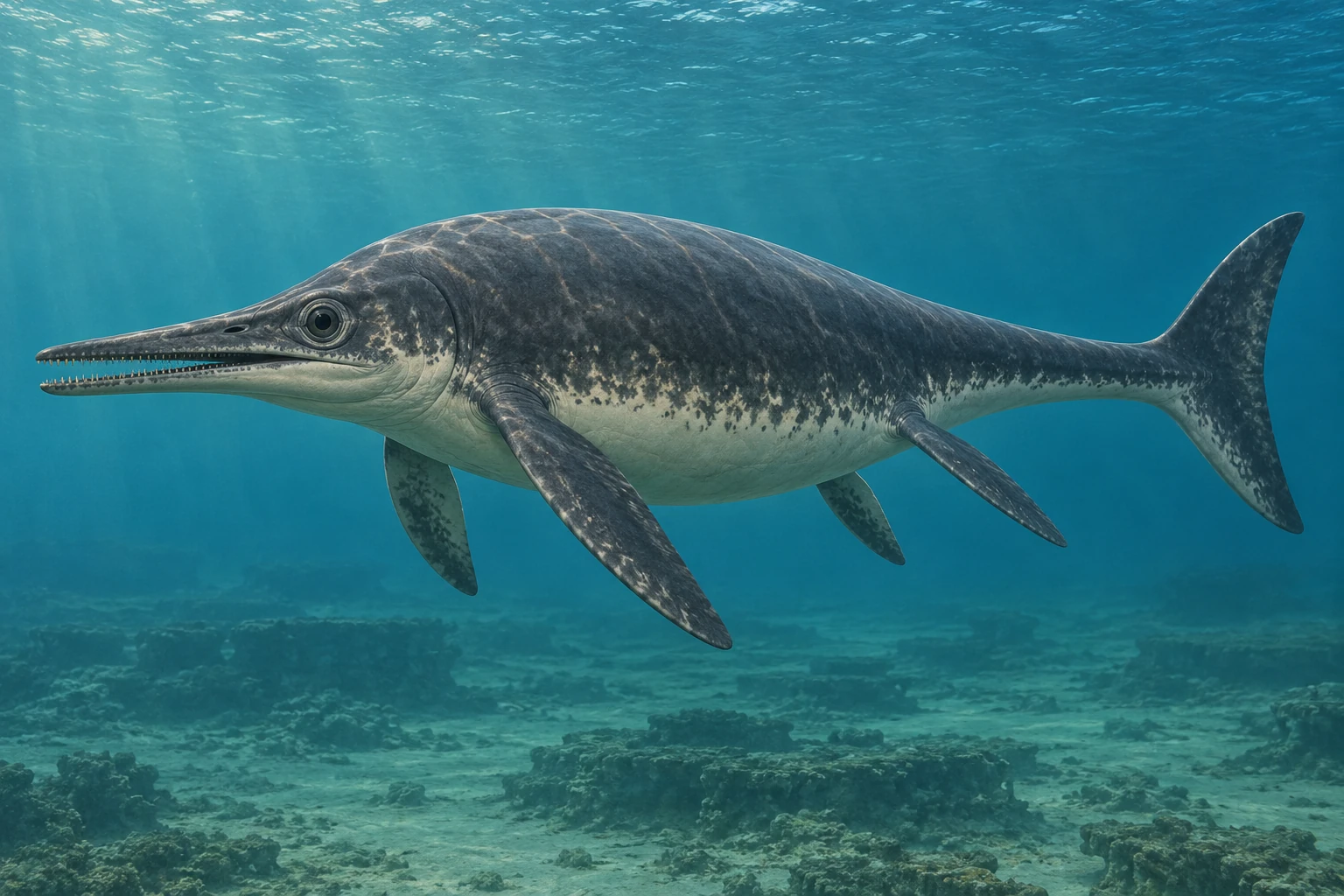
An illustrative reconstruction. Compare its anatomy with the evidence and limitations in the dossier. [1]
Source-informed reconstruction. Appearance evidence [1]. Original illustration; missing anatomy, coloration and scenery include interpretation.
Fossils constrain this life reconstruction. Missing anatomy, coloration and the environmental scene include interpretation; the dossier explains the evidence limits.
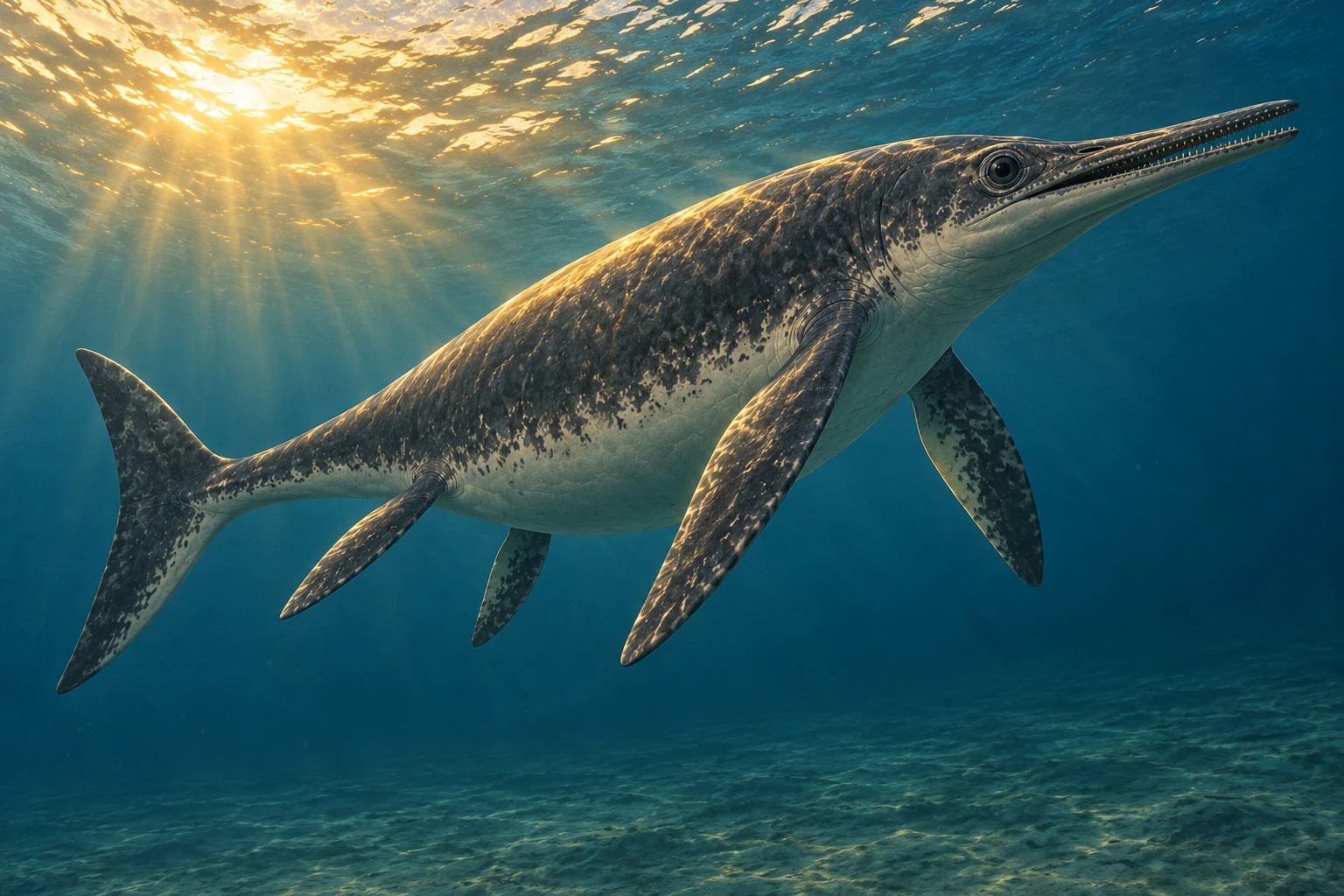
An illustrative reconstruction. Compare its anatomy with the evidence and limitations in the dossier. Lighting, coloration and scenery are artistic choices. This image does not document a fossil locality or behavior.
Original artwork · artistic interpretation.
Scientific view: source-informed reconstruction, credited paleoart or specimen-based imagery. Movie-style view: Original artistic interpretation. Reconstructions involve uncertainty.
MEET THE ANIMAL
Shonisaurus was an ichthyosaur, a marine reptile whose ancestors returned to life in water. The Nevada fossils belong to Shonisaurus popularis. They now lie in a desert landscape, but the rocks record a Triassic sea. Nevada State Parks protects an especially remarkable concentration of these skeletons. [D3]
Large adult jaws preserve strong teeth, so this species should not automatically be imagined as a toothless filter feeder. Researchers also identified tiny vertebrae within the rear abdomen of the type specimen. Their location and bone structure support an interpretation as developing offspring rather than swallowed food. [D1]
The fossils have a surprising pattern: many very large adults and some extremely small young, with few intermediate sizes in the studied assemblage. New research proposes that animals returned to this area to reproduce. This resembles questions researchers ask about modern marine gatherings, but the exact behavior was not observed. [D2]
The wider genus history requires caution. A huge Canadian species has been assigned both to Shonisaurus and Shastasaurus in different studies. Its disputed classification and measurements are excluded here. Keeping the Nevada species separate prevents a dramatic size claim from being attached to the wrong animal. [D4]
PREHISTORIC ANIMAL DOSSIER
The animal, the evidence, and the questions still open.
Adult and very small individuals occur repeatedly at the site. Researchers propose reproductive gatherings, while exact migration and social arrangements remain inference. [D2]
Profile scope: S. popularis in Nevada only; excluded sikanniensis has disputed Shonisaurus/Shastasaurus placement, reserved conservatively. [D1]
Source supported identifies a description documented by the cited source. Inferred marks a reconstruction or functional estimate. Debated marks competing interpretations. Not established means the sources reviewed for this dossier do not support a firm conclusion; it does not mean a behavior never occurred.
A size reference is an estimate, not a population range. Nesting evidence does not by itself establish courtship, mate choice, or lifelong pairing.
11–16 m (WUC fossil-individual estimates)
Humeri 31–45 cm and published body correlations estimate sampled Nevada individuals; not a species-wide adult range. [D1]
Not established here
No specimen mass calculated; park comparisons cannot substitute. [D1]
Large animal prey inferred
Adult jaws preserve cutting teeth, contradicting older toothless reconstructions; the complete menu remains unknown. [D1]
Moderately deep tropical marine ramp
Luning sedimentology lies below normal-wave influence but within storm influence; modern Nevada desert is not its life habitat. [D1]
Swimming with tail and paddles
Ichthyosaur body reconstruction supports aquatic movement; the institutional interpretation does not supply measured speed or diving depth. [D2]
Giant toothed ichthyosaur
Adult jaws preserve teeth with folded roots; external contours and coloration require reconstruction. [D1]
Live birth supported
Tiny vertebrae in the holotype’s pelvic region match embryonic anatomy and lack digestive etching; authors interpret embryos rather than gut contents. [D1]
Not established here
A proposed birthing site does not establish mate choice, pair bonds or mating displays. [D2]
Repeated grouping proposed
Adults and embryonic/neonatal remains recur through strata. Geochemistry and burial setting weaken repeated-stranding or environmental-kill explanations; migration remains inferred. [D2]
Sources and inspection notes for the claims in this profile.
THE STORY IN THE FOSSILS
Sedimentology, geochemistry and age distribution jointly test whether a recurring fossil concentration reflects life history rather than a single catastrophe. [2]
Protected fossil sites preserve contextual information that detached bones alone cannot reveal. [3]
The dossier identifies the scope of each reference estimate. A mount, an individual fossil and a species-wide adult range are different measurements. Comparison metrics remain unavailable where adult scope has not been established. Unknown does not mean zero.
Sources support the stated claims and scopes. Refer to the evidence notes for uncertainty.
KEEP EXPLORING
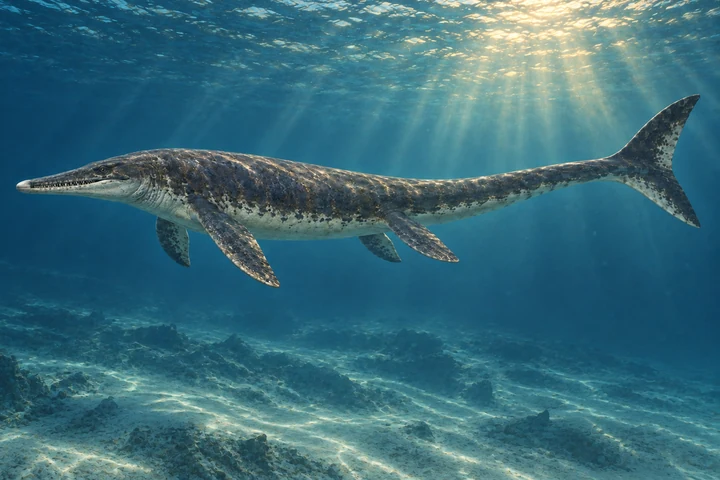
Tylosaurus proriger
Marine reptile
A marine lizard with an elongated adult snout tip, whose fossil identities are still being revised.
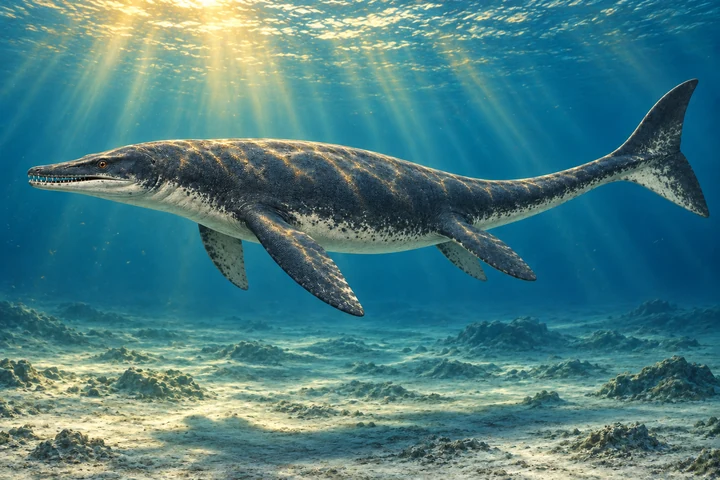
Platecarpus tympaniticus
Marine reptile
A streamlined mosasaur known from an exceptional fossil preserving skin traces and digested fish.
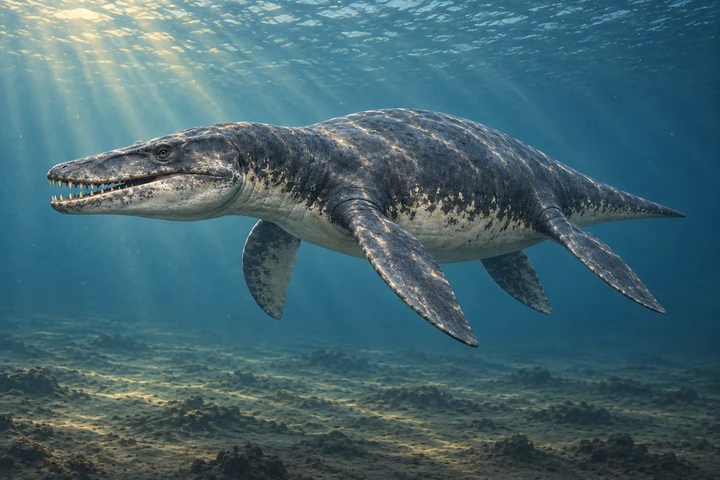
Pliosaurus kevani
Marine reptile
A large-skulled pliosaur whose Dorset holotype provides a detailed view of a Jurassic marine predator.