

Length
Inferred1.8–2.0 m (typical studied reconstructions)
The 2005 skeleton sample suggests typical 1.8–2m S. falcatus, probably below 3 m; reconstructed sample, not a measured adult population range. [D1]
EXHIBIT 289
Squalicorax falcatus
Fish
An extinct shark known from teeth and skeletons, with evidence for eating other animals and scavenging. [1]
TWO WAYS TO PICTURE THE PAST
Compare the evidence with the familiar movie image. The illustrations are not to a shared scale.
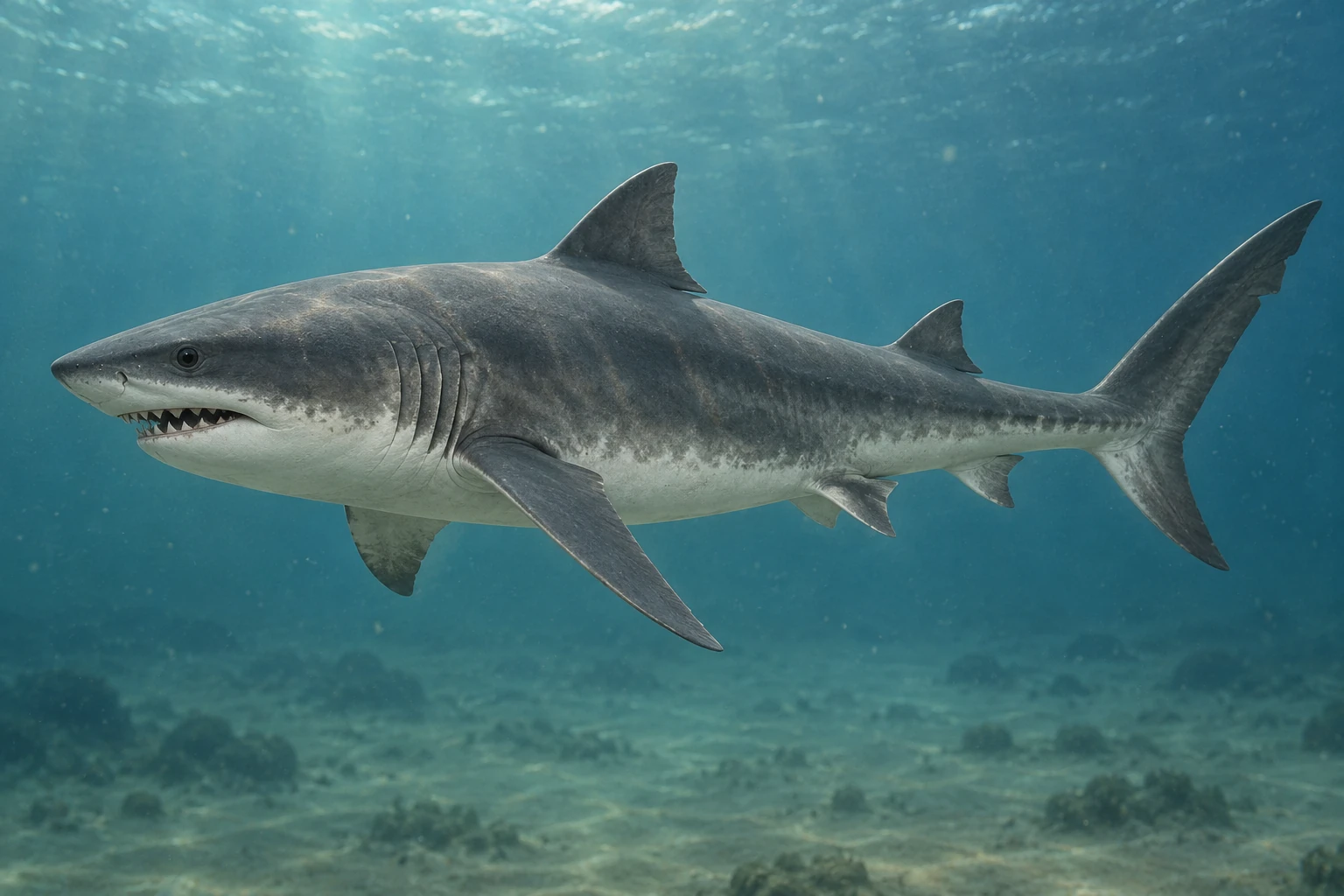
An illustrative reconstruction. Compare its anatomy with the evidence and limitations in the dossier. [1]
Source-informed reconstruction. Appearance evidence [1]. Original illustration; missing anatomy, coloration and scenery include interpretation.
Fossils constrain this life reconstruction. Missing anatomy, coloration and the environmental scene include interpretation; the dossier explains the evidence limits.
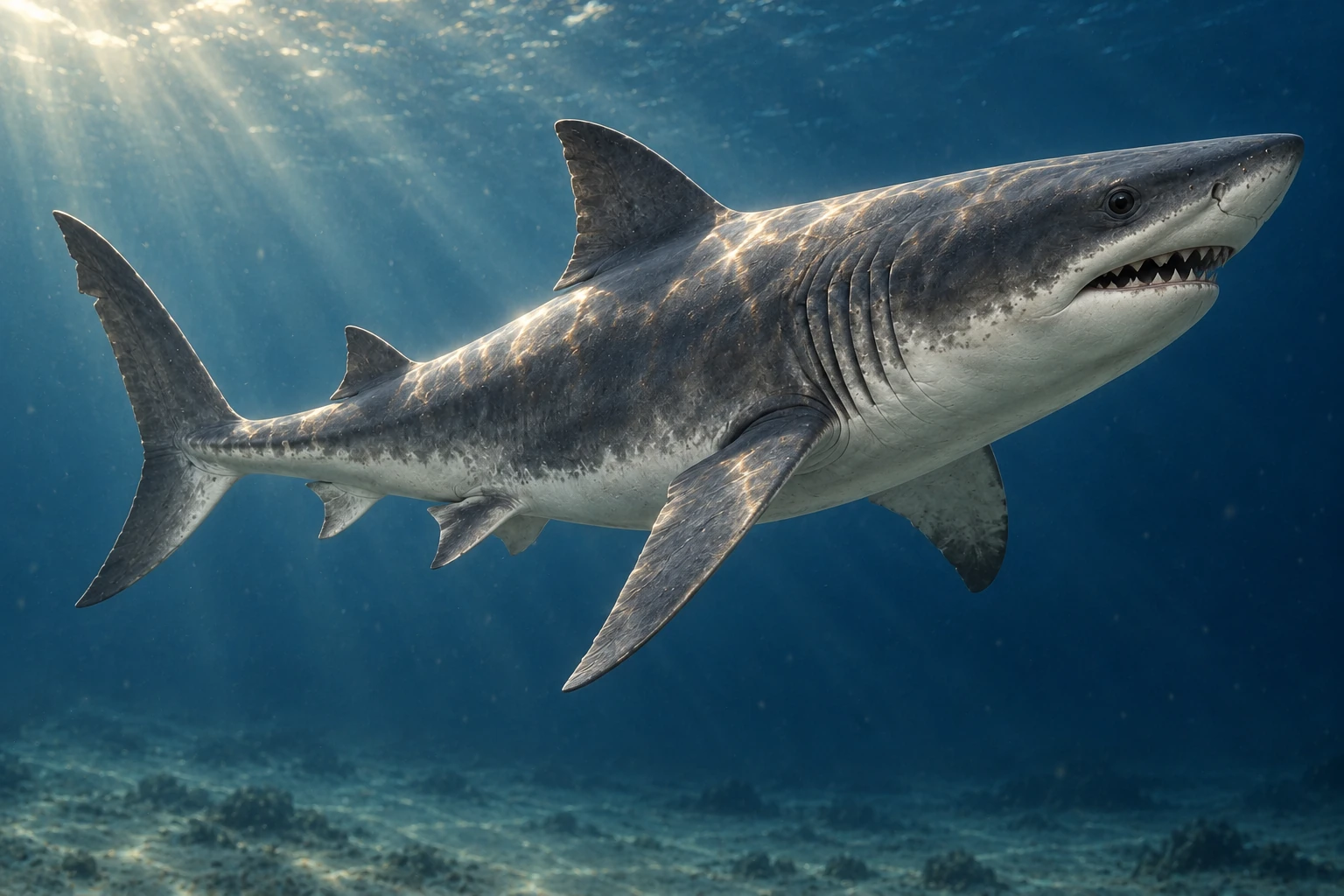
An illustrative reconstruction. Compare its anatomy with the evidence and limitations in the dossier. Lighting, coloration and scenery are artistic choices. This image does not document a fossil locality or behavior.
Original artwork · artistic interpretation.
Scientific view: source-informed reconstruction, credited paleoart or specimen-based imagery. Movie-style view: Original artistic interpretation. Reconstructions involve uncertainty.
MEET THE ANIMAL
Squalicorax was a shark that lived during the Cretaceous. Its teeth are common fossils, but some specimens preserve enough of the skeleton to test ideas that teeth alone cannot settle. The species featured here is Squalicorax falcatus; larger relatives should not supply its size automatically. [D1]
One important clue to feeding comes from teeth stuck in other animals' bones. Researchers described examples in a decayed marine-reptile bone and a dinosaur foot bone. Their condition suggests that sharks fed after those animals had died. Scavenging means eating a dead animal, and does not require killing it first. [D2]
Newer research examines zinc isotopes, different forms of the same chemical element, in fossil tooth material. The sampled New Mexico seaway assemblage helps reconstruct positions within a food web. Such chemical evidence adds another way to investigate feeding, alongside visible bite marks and associated bones. [D3]
The name also has a history. Older publications used combinations such as Corax falcatus and Anacorax falcatus for this species. Keeping those names connected avoids counting one animal twice. Neither a name list nor a tooth-bearing carcass tells us the shark’s courtship, exact colors or family life. [D4]
PREHISTORIC ANIMAL DOSSIER
The animal, the evidence, and the questions still open.
Teeth embedded in dead vertebrates show scavenging by the genus. Each feeding trace requires its own taxonomic and taphonomic interpretation. [D2]
Profile scope: One genus exhibit anchored to S. falcatus. Larger S. pristodontus measurements and genus-level feeding traces are not a falcatus adult range. [D1]
Source supported identifies a description documented by the cited source. Inferred marks a reconstruction or functional estimate. Debated marks competing interpretations. Not established means the sources reviewed for this dossier do not support a firm conclusion; it does not mean a behavior never occurred.
A size reference is an estimate, not a population range. Nesting evidence does not by itself establish courtship, mate choice, or lifelong pairing.
1.8–2.0 m (typical studied reconstructions)
The 2005 skeleton sample suggests typical 1.8–2m S. falcatus, probably below 3 m; reconstructed sample, not a measured adult population range. [D1]
Not established here
No mass reconstruction obtained; congener tooth sizes are insufficient. [D1]
Carnivore and scavenger
Genus teeth embedded in decayed vertebrate bones support postmortem feeding. Hunting every animal associated with its teeth is not established. [D2]
North American marine seaway
The isotope study samples Turonian–Coniacian Western Interior Seaway assemblages in New Mexico; this is a sampled region, not its complete range. [D3]
Active swimming inferred
Placoid-scale morphology suggests rapid swimming in the skeletal abstract; no measured speed is supplied. [D1]
Shark skeletons beyond isolated teeth
Partial and nearly complete skeletons reveal sensory and body-proportion differences among three species; tooth size alone misrepresents interspecies length. [D1]
Not established here
Focused embryo/egg searches found no attributable reproductive fossil in the inspected skeletal abstract; reproductive mode remains unresolved. [D1]
Not established here
The reviewed species database and fossil accounts do not document courtship, pair bonds or mating displays. [D4]
Not established here
Teeth gathered around carcasses may record feeding visits and tooth shedding; this does not prove schooling or cooperation. [D2]
Sources and inspection notes for the claims in this profile.
THE STORY IN THE FOSSILS
A fossil tooth can reveal feeding without identifying whether a particular encounter was an attack or a visit to a carcass. [2]
Different species require different tooth-to-body scaling ratios. [1]
The dossier identifies the scope of each reference estimate. A mount, an individual fossil and a species-wide adult range are different measurements. Comparison metrics remain unavailable where adult scope has not been established. Unknown does not mean zero.
Sources support the stated claims and scopes. Refer to the evidence notes for uncertainty.
KEEP EXPLORING
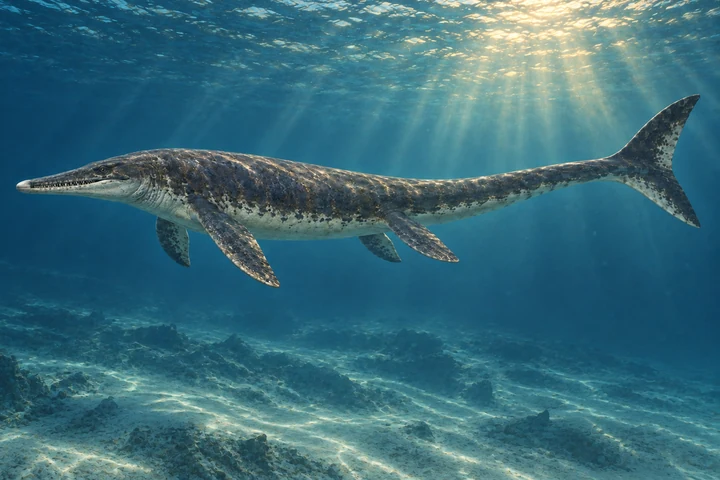
Tylosaurus proriger
Marine reptile
A marine lizard with an elongated adult snout tip, whose fossil identities are still being revised.
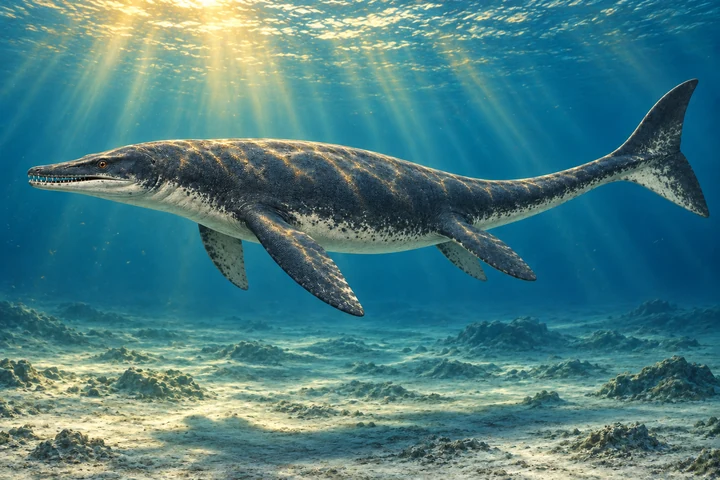
Platecarpus tympaniticus
Marine reptile
A streamlined mosasaur known from an exceptional fossil preserving skin traces and digested fish.
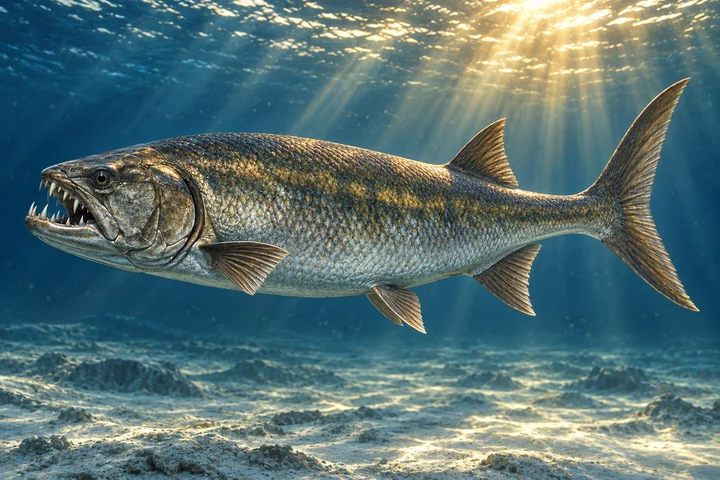
Xiphactinus audax
Prehistoric fish
A large toothed ray-finned fish, with a famous fossil preserving another fish inside it.