

Size reference
Source supported4.57–6.97 mm males; 4.66–6.75 mm females
S. daohugouensis measured specimens in supplementary Table 1, not all species or life stages. [D1]
EXHIBIT 282
Strashila
Prehistoric insect
Strashila was a Jurassic true fly with unusual male hindlegs and abdominal structures interpreted as retained gills. [1]
TWO WAYS TO PICTURE THE PAST
Compare the evidence with the familiar movie image. The illustrations are not to a shared scale.
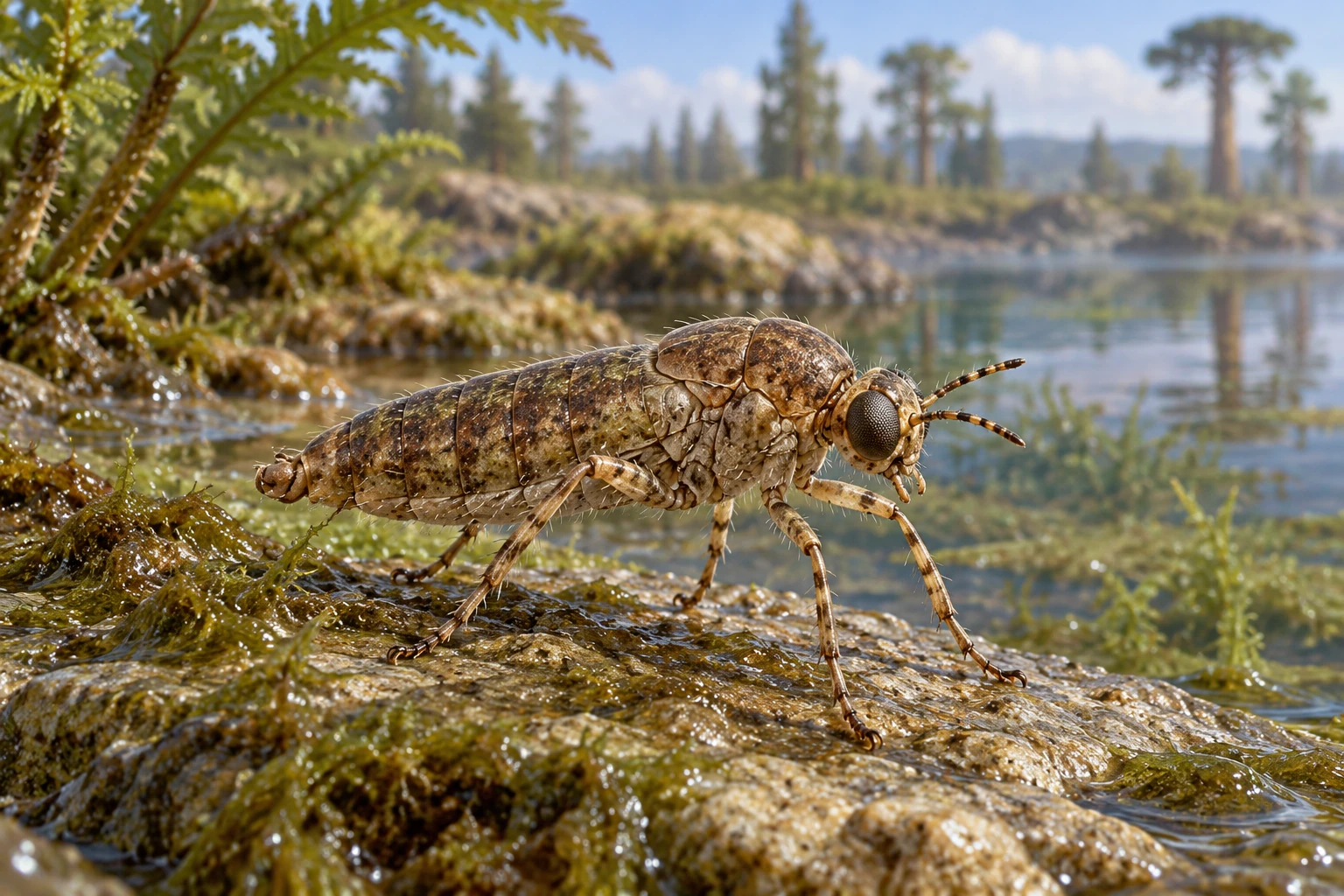
An illustrative reconstruction. Compare its anatomy with the evidence and limitations in the dossier. [3]
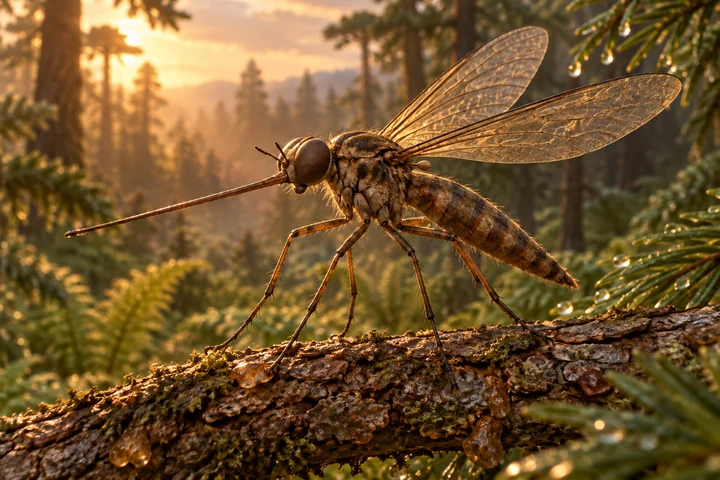
Source-informed reconstruction. Appearance evidence [3]. Original illustration; missing anatomy, coloration and scenery include interpretation.
Fossils constrain this life reconstruction. Missing anatomy, coloration and the environmental scene include interpretation; the dossier explains the evidence limits.
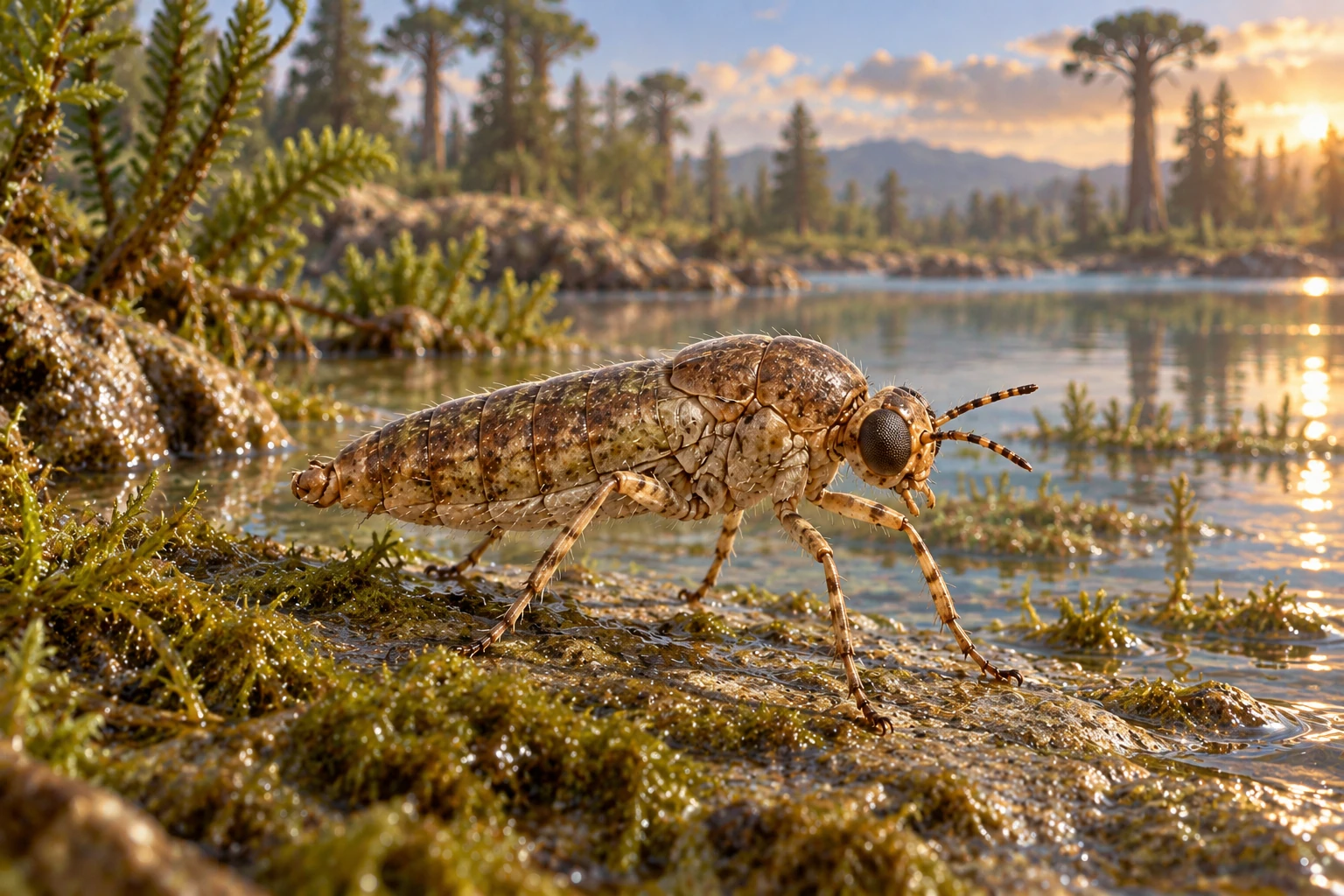
An illustrative reconstruction. Compare its anatomy with the evidence and limitations in the dossier. Lighting, coloration and scenery are artistic choices. This image does not document a fossil locality or behavior.
Original artwork · artistic interpretation.
Scientific view: source-informed reconstruction, credited paleoart or specimen-based imagery. Movie-style view: Original artistic interpretation. Reconstructions involve uncertainty.
MEET THE ANIMAL
Strashila was a true fly that lived during the Jurassic. Its fossils initially seemed so strange that researchers suggested a parasite attached to dinosaurs or flying reptiles. New Chinese specimens changed that picture. The insect had normal fly structures as well as unusual male features. The studied S. daohugouensis adults were only a few millimeters long, and some pairs were preserved together. [D1]
The Nanjing research team connected the fossils with water-associated flies alive today. A male had a broad wing, while many specimens lacked wings. Adults may have shed them after a short flying stage and returned to the water. Small, reduced mouthparts suggest that adults did not feed. Those are interpretations from anatomy and comparisons, rather than observations of a living Jurassic insect. [D2]
Males had large hindlegs with pincer-like structures and small lobes beside the abdomen. Females lacked these features. The lobes have been interpreted as gill structures retained from a younger stage, a process called paedomorphosis. The unusual legs might have helped males hold mates or compete. Fossil pairs support reproduction, but they do not show an entire courtship sequence, eggs or parenting. [D3]
PREHISTORIC ANIMAL DOSSIER
The animal, the evidence, and the questions still open.
New specimens overturned a parasite interpretation; aquatic adult life and wing shedding are inferred by comparison. [D2]
Profile scope: Genus — Strashila; S. daohugouensis NIGP 155020 and associated female NIGP 156171 anchor the reconstruction; S. incredibilis is included. [D1] [D4]
Source supported identifies a description documented by the cited source. Inferred marks a reconstruction or functional estimate. Debated marks competing interpretations. Not established means the sources reviewed for this dossier do not support a firm conclusion; it does not mean a behavior never occurred.
A size reference is an estimate, not a population range. Nesting evidence does not by itself establish courtship, mate choice, or lifelong pairing.
4.57–6.97 mm males; 4.66–6.75 mm females
S. daohugouensis measured specimens in supplementary Table 1, not all species or life stages. [D1]
Not established here
The reviewed supplementary measurements report length, not mass. [D1]
Adults probably did not feed
Vestigial mouthparts support this interpretation; larval diet is not established here. [D2]
Aquatic or amphibious adults inferred
Daohugou burial deposits and comparison with living aquatic flies support a water-associated interpretation, not a known complete range. [D2]
Winged and wingless forms
A male preserves a broad wing; shedding wings after emergence is an interpretation. [D1]
Male pincers and lateral lobes
Males have enlarged hindlegs and seven pairs of abdominal lobes; females lack these structures. [D3]
Mating pairs preserved
Associated male/female fossils support copulation; eggs and a full development sequence remain unestablished here. [D1]
Leg function proposed
Grasping mates or competing males is hypothesized; no courtship display is directly preserved. [D3]
Not established here
Pairs do not demonstrate colonies, coordinated groups or parental care. [D3]
Sources and inspection notes for the claims in this profile.
THE STORY IN THE FOSSILS
Paedomorphosis means retaining a juvenile feature as an adult. The abdominal respiratory-lobe interpretation is restricted to males, rather than copied onto every reconstruction. [3]
The dossier identifies the scope of each reference estimate. A mount, an individual fossil and a species-wide adult range are different measurements. Comparison metrics remain unavailable where adult scope has not been established. Unknown does not mean zero.
Sources support the stated claims and scopes. Refer to the evidence notes for uncertainty.
KEEP EXPLORING
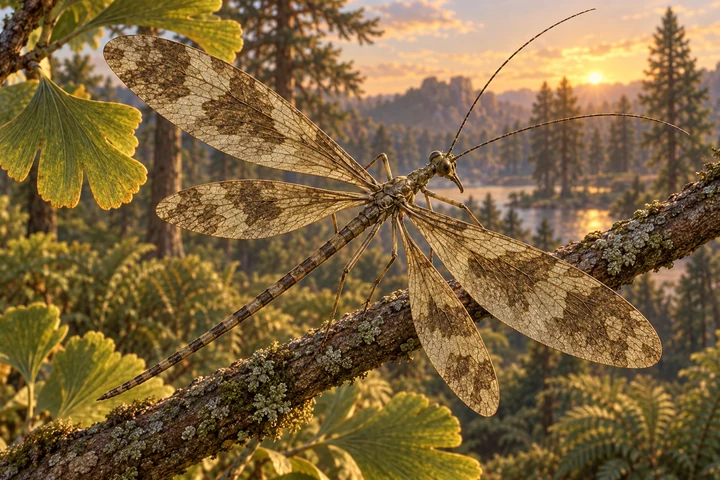
Juracimbrophlebia
Prehistoric insect
Juracimbrophlebia was a Jurassic hangingfly with wings resembling multilobed ginkgo-like leaves.
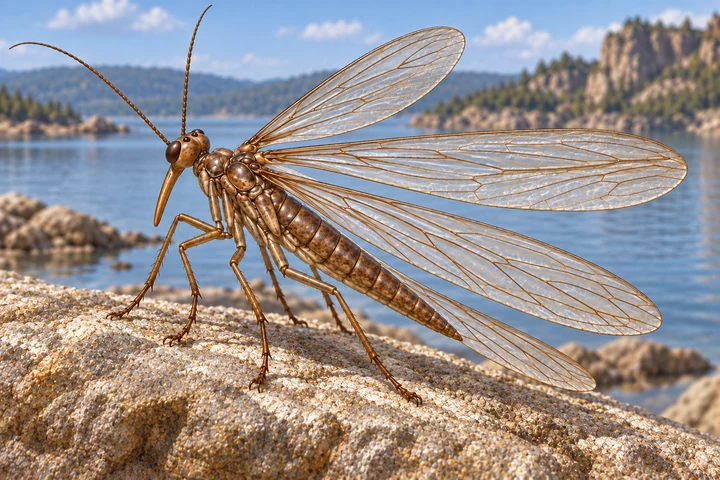
Jurassipanorpa
Prehistoric insect
Jurassipanorpa was a Jurassic scorpionfly relative identified through wing veins and unusual bristles.
Buccinatormyia
Prehistoric insect
Buccinatormyia was a Cretaceous fly with a long proboscis; a Spanish specimen carried gymnosperm pollen.