

Length
Not establishedNot established here
Reviewed2019 material predates the 2020 species split. A pooled length range would mix two adult taxa; no auditable species-specific full-body measurement adopted. [D1]
EXHIBIT 293
Tanystropheus hydroides and T. longobardicus
Aquatic reptile
An extraordinarily long-necked archosauromorph with two differently sized adult species in the same nearshore ecosystem. [4]
TWO WAYS TO PICTURE THE PAST
Compare the evidence with the familiar movie image. The illustrations are not to a shared scale.
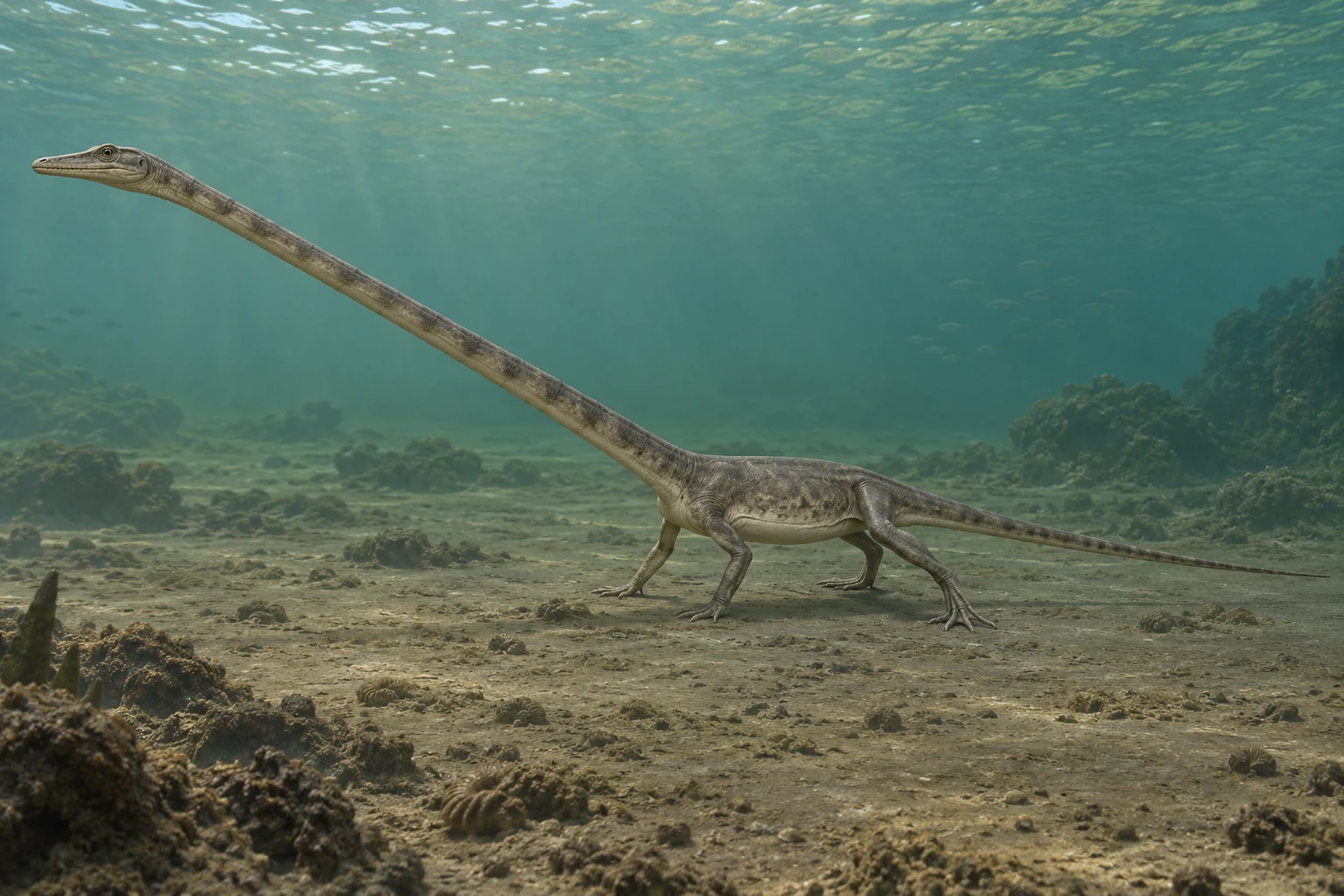
An illustrative reconstruction. Compare its anatomy with the evidence and limitations in the dossier. [3]
Source-informed reconstruction. Appearance evidence [3]. Original illustration; missing anatomy, coloration and scenery include interpretation.
Fossils constrain this life reconstruction. Missing anatomy, coloration and the environmental scene include interpretation; the dossier explains the evidence limits.
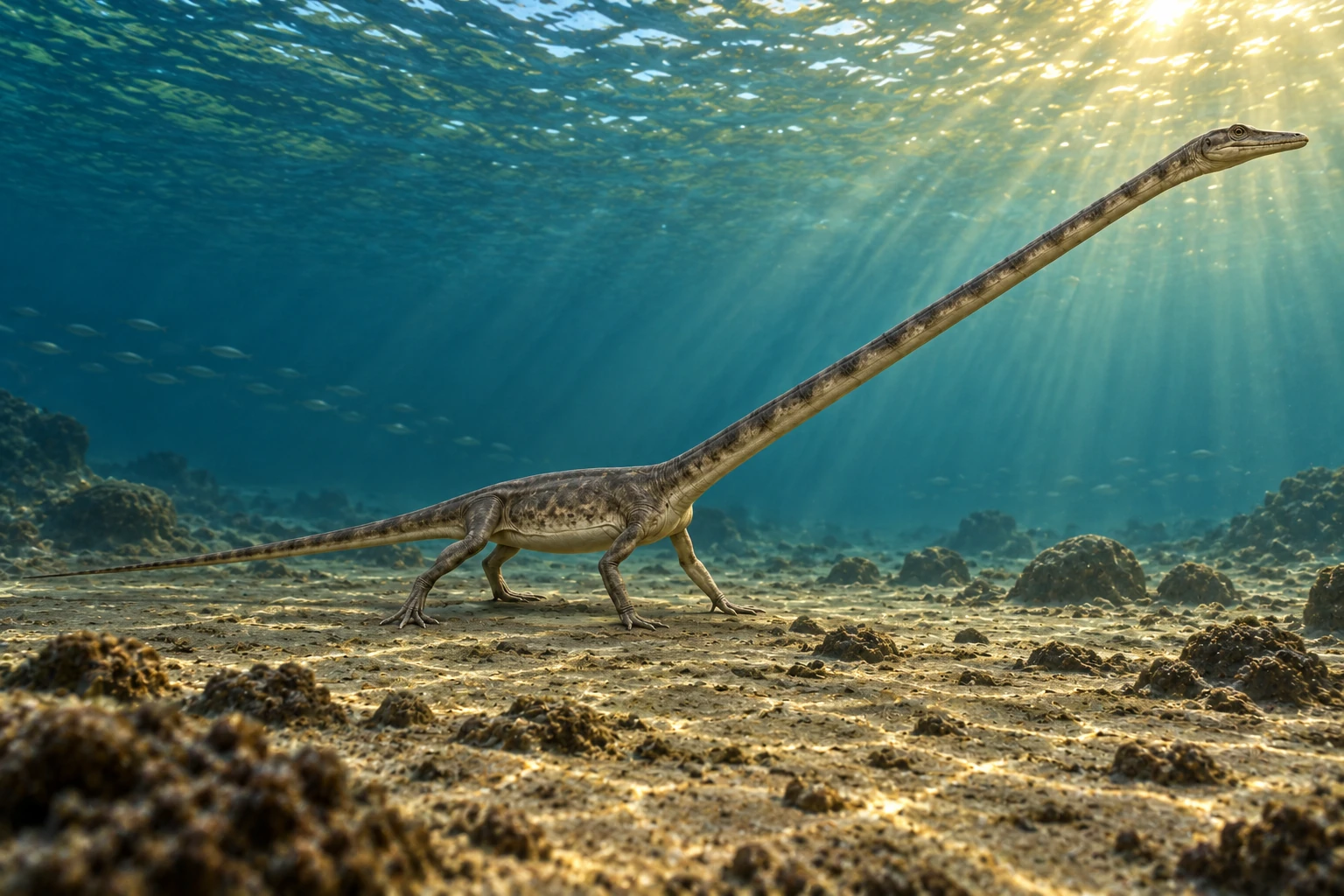
An illustrative reconstruction. Compare its anatomy with the evidence and limitations in the dossier. Lighting, coloration and scenery are artistic choices. This image does not document a fossil locality or behavior.
Original artwork · artistic interpretation.
Scientific view: source-informed reconstruction, credited paleoart or specimen-based imagery. Movie-style view: Original artistic interpretation. Reconstructions involve uncertainty.
MEET THE ANIMAL
Tanystropheus had one of the strangest necks among ancient reptiles: just thirteen backbone bones stretched into an extremely long neck. Fossils are especially well known from Monte San Giorgio on the Switzerland–Italy border. Its classification places it among archosauromorphs, relatives on the branch leading toward crocodiles and dinosaurs. [D1] [D3]
Researchers once treated the small and large fossils as young and adult versions of one species. They tested this by examining growth rings in limb bones. The smaller animals were already mature. The large form was named Tanystropheus hydroides, while the smaller form retained the name Tanystropheus longobardicus. [D4]
Powerful scans helped reconstruct a crushed large-species skull. Its nostrils faced upward, and long curved teeth could grip slippery prey. These features support hunting underwater. The rest of its body lacked the strong swimming specializations seen in some marine reptiles, so a patient ambush strategy is more plausible than fast pursuit. [D2]
The two species probably used different food resources in the same region. Their shared neck plan therefore did not force them into exactly the same lifestyle. Fossils establish the unusual anatomy and species distinction much more clearly than they establish courtship, family life or the colors chosen in a reconstruction. [D3]
PREHISTORIC ANIMAL DOSSIER
The animal, the evidence, and the questions still open.
CT reconstruction reveals an aquatic feeding skull. The larger species has recurved teeth and dorsal nostrils; movement remains debated. [D2]
Profile scope: One genus exhibit covering T. hydroides and T. longobardicus at Monte San Giorgio; historical large and small morphotypes are distinct adult species. [D4]
Source supported identifies a description documented by the cited source. Inferred marks a reconstruction or functional estimate. Debated marks competing interpretations. Not established means the sources reviewed for this dossier do not support a firm conclusion; it does not mean a behavior never occurred.
A size reference is an estimate, not a population range. Nesting evidence does not by itself establish courtship, mate choice, or lifelong pairing.
Not established here
Reviewed2019 material predates the 2020 species split. A pooled length range would mix two adult taxa; no auditable species-specific full-body measurement adopted. [D1]
Not established here
No attributable specimen mass estimate with a method was obtained in the reviewed skull study. [D2]
Fish/cephalopods; small prey in smaller species
T. hydroides curved teeth support slippery prey. T. longobardicus likely took smaller shelled prey; this is dietary interpretation, not two observed menus. [D3]
Monte San Giorgio nearshore marine ecosystem
The two species occur along the Middle Triassic western Tethys margin; fossil occurrence does not prove identical microhabitat use. [D4]
Aquatic ambush locomotion proposed
Poor hydrodynamic neck profile and limited swimming adaptations argue against efficient pursuit. Tail/leg propulsion remains an anatomical hypothesis. [D2]
Very long neck, thirteen elongate vertebrae
CT skull of T. hydroides has dorsal nostrils and fish-trap dentition; tiny specimens are mature T. longobardicus, not simply juvenile large animals. [D3]
Not established here
Focused egg/embryo searches obtained no attributable reproductive fossil. Postpelvic heterotopic bones have disputed functions, not a demonstrated egg pouch. [D2]
Not established here
The taxonomic revision does not provide direct courtship or sex-specific color evidence. [D1]
Not established here
Two species in the same fossil habitat support ecological coexistence; this does not prove social groups or parental care. [D4]
Sources and inspection notes for the claims in this profile.
THE STORY IN THE FOSSILS
Historical names need examination of their actual type material; a familiar label alone is insufficient to establish that two exhibits represent different genera. [1]
The skull is a scan-supported restoration of compressed bones; it is not an untouched three-dimensional head preserved in life posture. [2]
The dossier identifies the scope of each reference estimate. A mount, an individual fossil and a species-wide adult range are different measurements. Comparison metrics remain unavailable where adult scope has not been established. Unknown does not mean zero.
Sources support the stated claims and scopes. Refer to the evidence notes for uncertainty.
KEEP EXPLORING
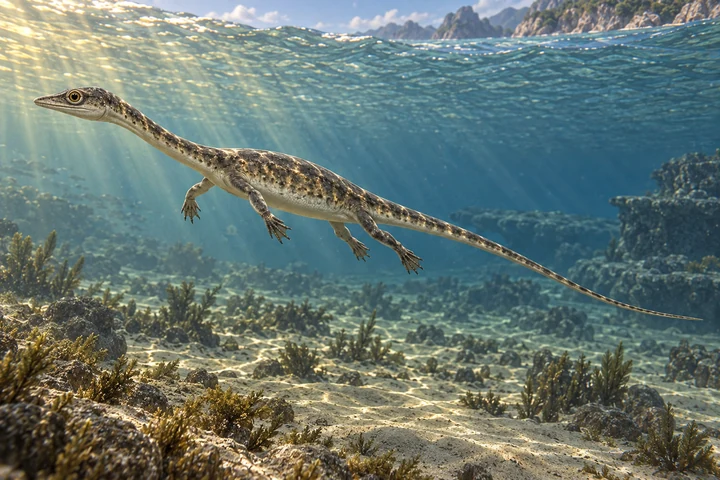
Keichousaurus hui
Aquatic reptile
A small aquatic reptile from southern China, with fish meals and pregnancies preserved in remarkable fossils.
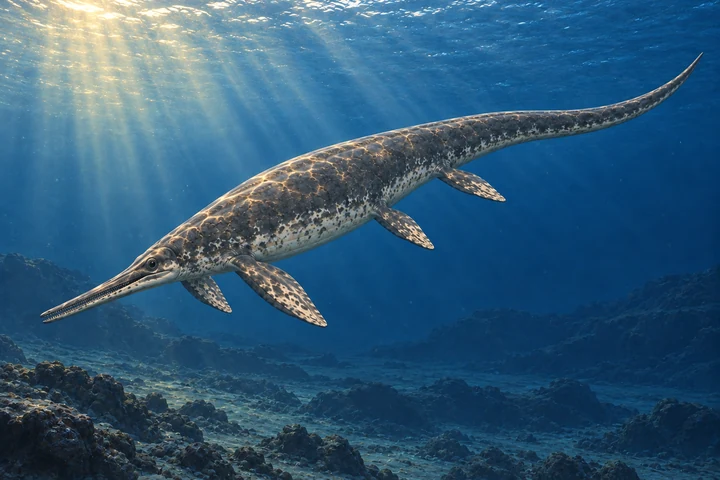
Cymbospondylus youngorum
Marine reptile
A giant ichthyosaur whose Nevada skull documents very early marine-reptile gigantism.
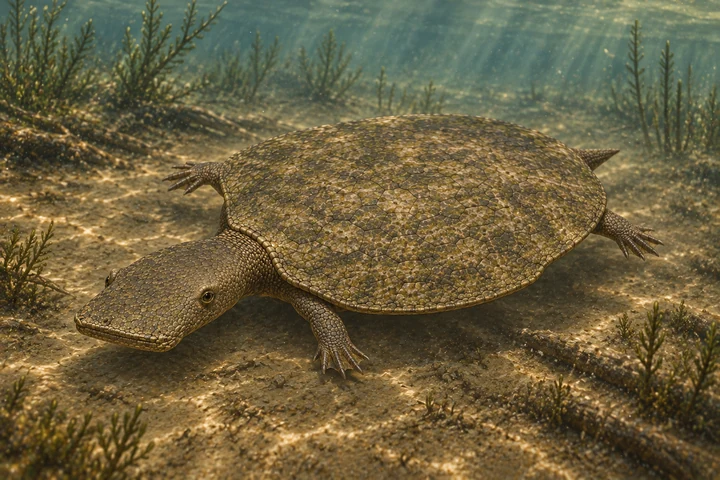
Henodus chelyops
Aquatic reptile
A turtle-like armored placodont reptile with a broad rectangular skull and reduced crushing teeth.