EXPLORE PREHISTORY 220 prehistoric animal profiles · Scientific & movie-style image galleries

EXHIBIT 108

Tazoudasaurus

Tazoudasaurus naimi

Tazoudasaurus was an early Moroccan sauropod with broad teeth and a spreading hand skeleton. Its fossils illuminate changes toward the later giant sauropod body plan. [2]

Evidence profile
PERIODEarly Jurassic[4]
DIETHerbivoreEvidence and uncertainty in the dossier
TOTAL LENGTHSee the dossierEstimate scope matters
FOSSILS FOUNDMorocco[1]
CompareRead the dossierView the sources

MEET THE ANIMAL

Meet Tazoudasaurus

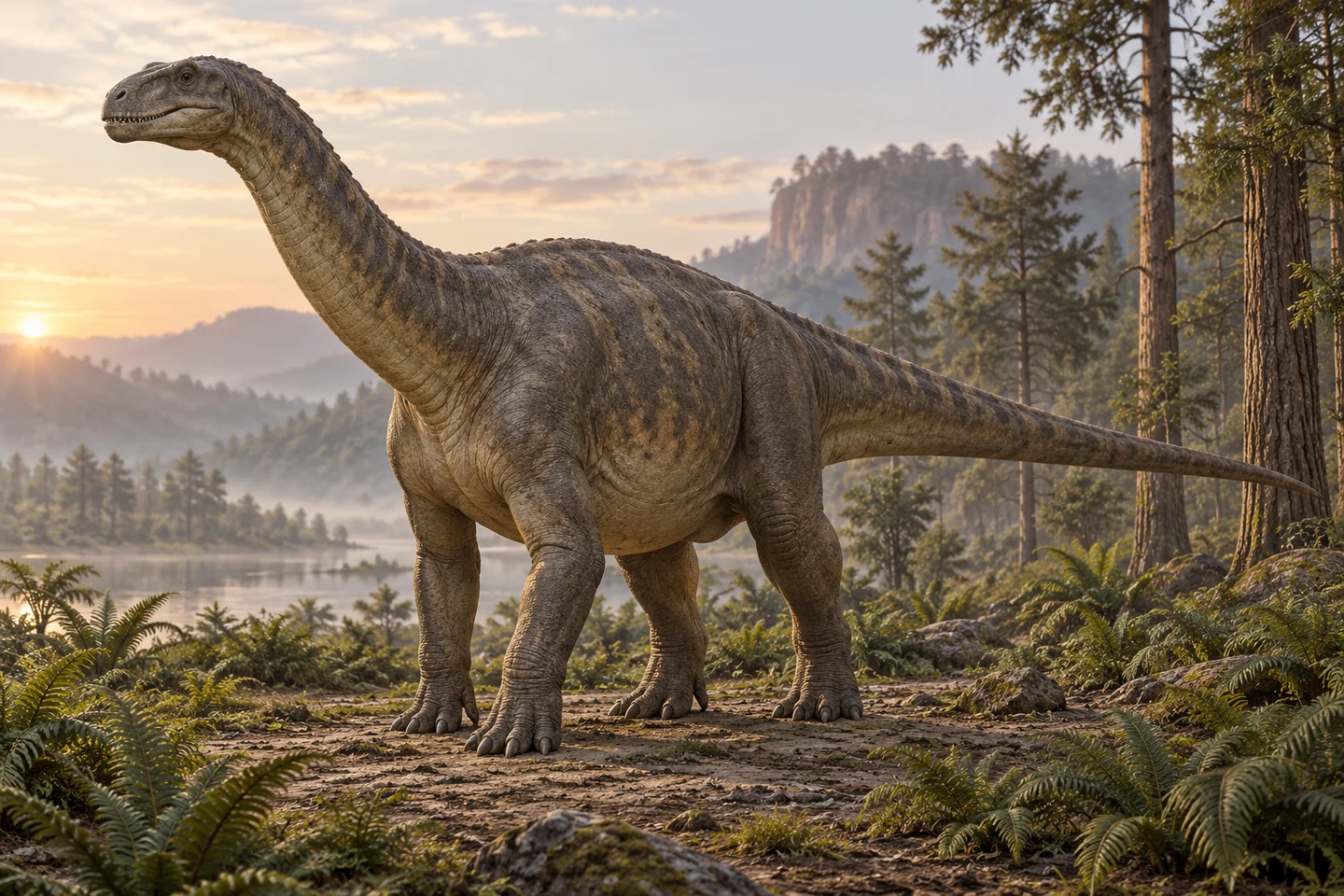
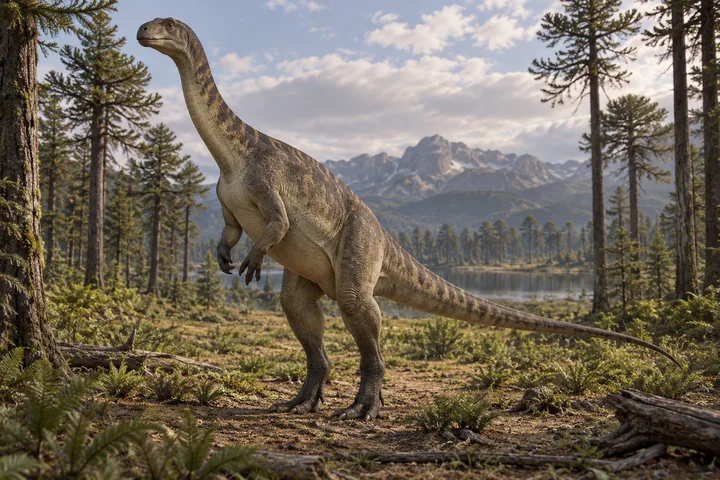
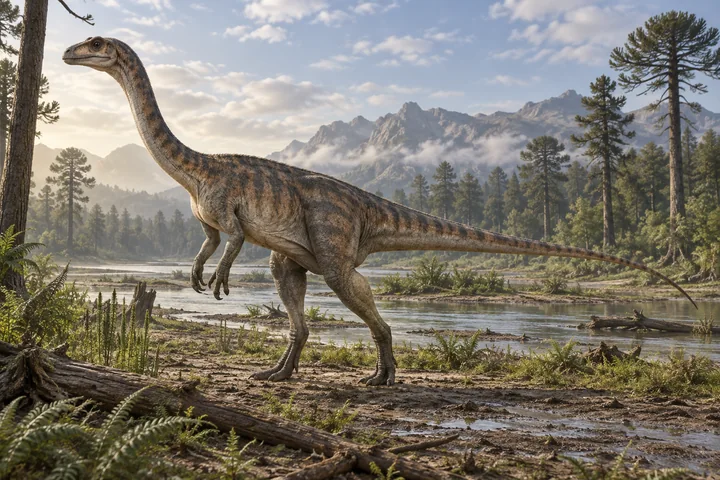
Tazoudasaurus was an Early Jurassic sauropod from Morocco. Its jaw preserves broad teeth with wear that suggests plant processing. An approximate nine-metre reconstruction introduces its size, but does not represent one complete measured animal or an adult maximum. Nearby fossil plants describe the local vegetation without proving exactly which kinds it ate. [D1]

The fossil collection includes more than 600 skeletal elements and at least ten individuals ranging from juveniles to adults. That variety helps researchers compare parts of the body and stages of growth. A large collection is not automatically one herd preserved in place, and assembling information from several animals does not produce a single complete fossil individual. [D3]

Geological work describes river and floodplain deposits with volcanic debris at Toundoute. It also cautions that the exact age within the later Early Jurassic is uncertain. The original narrower age assignment was not firmly established by fossils used to correlate rock layers. Tazoudasaurus therefore illustrates how skeletal evidence and geological evidence work together while answering different questions about the ancient animal and its setting. [D4]

PREHISTORIC ANIMAL DOSSIER

A life in profile.

The animal, the evidence, and the questions still open.

A later reconstruction drew on at least ten juvenile-to-adult individuals and more than 600 skeletal elements. Only part of this collected material had been prepared. [D3]

Profile scope: Genus profile centered on Tazoudasaurus naimi from Toundoute. Adult and juvenile remains contribute to the reconstruction; their sizes and deposits are not an adult population range. [D2]

Time
Early Jurassic
Fossil locations in this exhibit
Morocco
How to read the evidence

Source supported identifies a description documented by the cited source. Inferred marks a reconstruction or functional estimate. Debated marks competing interpretations. Not established means the sources reviewed for this dossier do not support a firm conclusion; it does not mean a behavior never occurred.

A size reference is an estimate, not a population range. Nesting evidence does not by itself establish courtship, mate choice, or lifelong pairing.

Body length

Inferred

About 9 m; original reconstructed reference

The preliminary description supplies an approximate whole-body estimate from incomplete material. It does not provide a measured complete skeleton, an adult maximum or a species population range. [D1]
Body mass

Inferred

About 3.7 tonnes; historical model reference

Paul’s CPSGM row provides no individual inventory or maturity. The skeletal-volume and long-bone-scaled estimate cannot define an adult species range. [D5]

Diet

Inferred

Plants; tooth-to-tooth processing inferred

Broad, spatulate tooth crowns and wear facets support plant processing. Plants preserved nearby describe the local flora, rather than proving which species the dinosaur ate. [D1] [D2]

Habitat & fossil setting

Debated

Toundoute rivers and floodplains; exact age uncertain

Sediments record fluvial environments and volcanic debris. Geological work supports a late Early Jurassic, Pliensbachian–Toarcian interval and notes that the initial strictly Toarcian assignment lacks demonstrated biostratigraphic support. [D4]

Movement

Inferred

Quadrupedal, with a spreading digitigrade hand

Articulated hand material has a spreading metacarpal arrangement and support through the fingers. Its hand should not be copied from the tightly bundled, column-like manus of later sauropods. [D2]

Distinctive anatomy

Source supported

Broad teeth and complex vertebral ridges

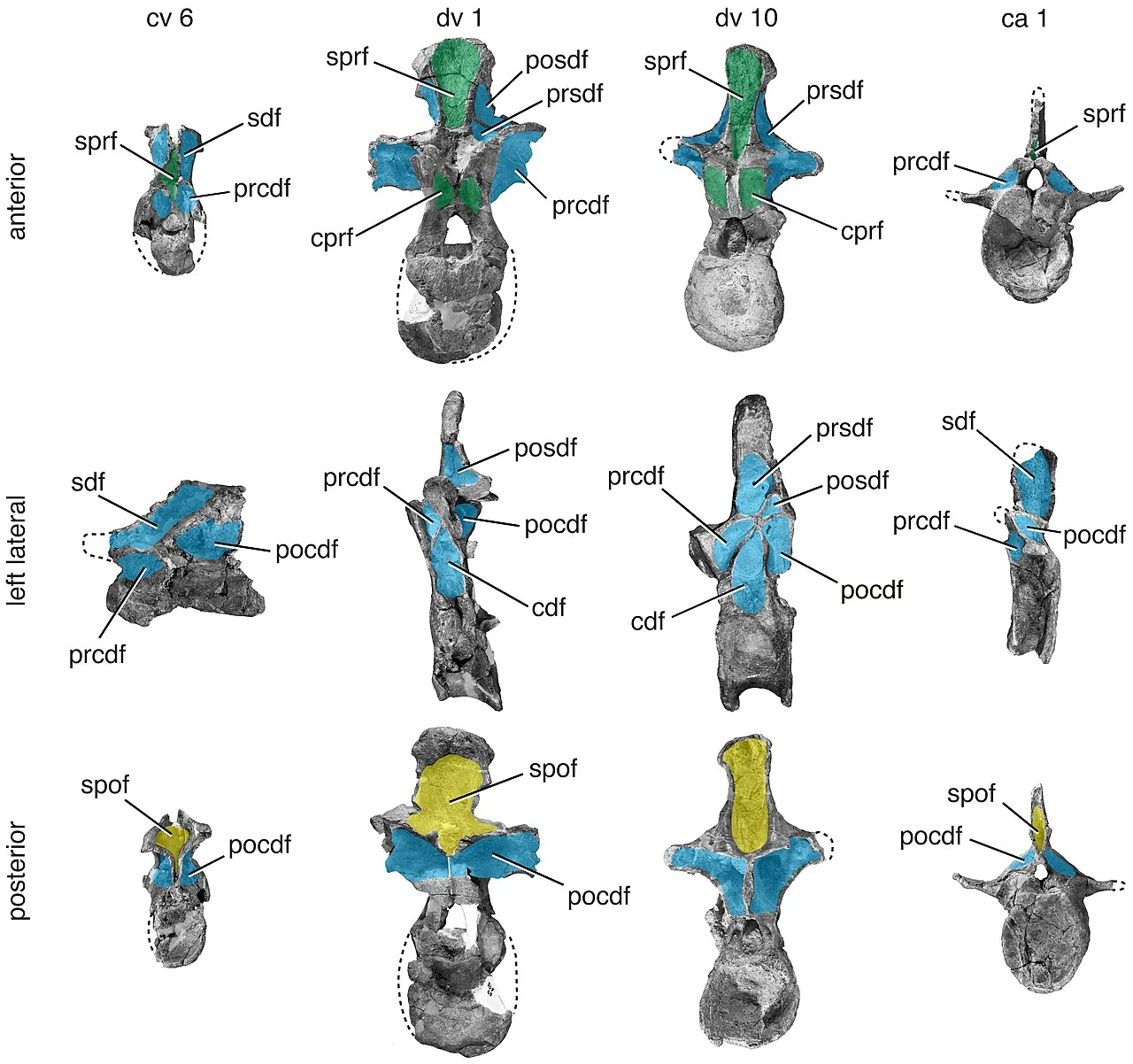
Jaw material combines ancestral traits with sauropod tooth form. Cervical and dorsal vertebrae have elaborate supporting laminae and fossae; anterior tail vertebrae show a simpler pattern. [D1] [D6]

Reproduction & life together

Reproduction & nesting

Not established

Not established here

Juvenile bones are known, but the reviewed sources do not establish assigned eggs, nesting sites, clutch size or parental care.

Courtship & mating

Not established

Not established here

Focused searches and reviewed skeletal studies do not establish displays, calls, mate choice or sex-specific anatomy.

Social behavior

Inferred

Mixed-age grouping inferred

The upper bonebed contains at least six individuals, including juveniles and adults. Limited transport and rapid mudflow burial led the authors to propose gregariousness; persistent herd structure is not demonstrated. [D2]

Dossier research & sources

Sources and inspection notes for the claims in this profile.

  1. A basal sauropod dinosaur from the Early Jurassic of MoroccoComptes Rendus Palevol; Allain and colleagues (2004), author-deposited published full text · Accessed 2026-10-02Original diagnosis, To 2000–1 type material, juvenile To 2000–2, approximate 9 m restoration, jaw/teeth and initial Toarcian assignment. · Inspected: excerpt
  2. Anatomy and phylogenetic relationships of Tazoudasaurus naimi from the late Early Jurassic of MoroccoGeodiversitas; Allain & Aquesbi (2008), MNHN-hosted published paper · Accessed 2026-10-02Full-paper excerpts: juvenile/adult anatomy, digitigrade spreading manus, quadrupedal features and upper-bonebed taphonomic interpretation of mixed-age gregariousness. · Inspected: excerpt
  3. A reconstruction of Tazoudasaurus naimi from the late Early Jurassic of MoroccoHistorical Biology; Peyer & Allain (2010) · Accessed 2026-10-02Research abstract inspected: at least ten juvenile-to-adult individuals and more than 600 elements; no numerical body length supplied by this abstract. · Inspected: abstract
  4. The Toundoute continental series and associated volcanism: Early Jurassic of the High Atlas, MoroccoSwiss Journal of Geosciences / Eclogae Geologicae Helvetiae; Montenat and colleagues (2005) · Accessed 2026-10-02Primary geological paper: fluvial deposits, volcanic influence and Pliensbachian–Toarcian age uncertainty; original strictly Toarcian assignment not biostratigraphically demonstrated. · Inspected: excerpt
  5. The Princeton Field Guide to Dinosaurs, second edition: mass-estimation appendixPrinceton University Press; Paul (2016) · Accessed 2026-10-02Methods and Tazoudasaurus CPSGM model row; no specific inventory or life stage. The 11.50 figure is a long-bone scaling input, not body length. · Inspected: excerpt
  6. A Nomenclature for Vertebral Fossae in Sauropods and Other Saurischian DinosaursPLOS ONE; Wilson, D’Emic, Ikejiri, Moacdieh & Whitlock (2011) · Accessed 2026-10-02Tazoudasaurus section and Figure 7 inspected: cervical, dorsal and anterior caudal vertebrae from several individuals, scaled and color-coded for anatomical fossae. · Inspected: excerpt

THE STORY IN THE FOSSILS

Meet Tazoudasaurus.

An articulated hand is particularly valuable here: it preserves a spreading arrangement that differs from many later sauropods. Reconstruction can therefore retain meaningful early anatomy instead of shrinking a familiar giant. [2]

The scientific plate compares different neck, back and tail vertebrae from several individuals. Its colored regions identify anatomical recesses; they do not represent a living dinosaur’s coloration. [6]

A note on scale and time

The dossier identifies the scope of each reference estimate. A mount, an individual fossil and a species-wide adult range are different measurements. Comparison metrics remain unavailable where adult scope has not been established. Unknown does not mean zero.

Sources & editorial notes

Sources support the stated claims and scopes. Refer to the evidence notes for uncertainty.

  1. A basal sauropod dinosaur from the Early Jurassic of MoroccoComptes Rendus Palevol; Allain and colleagues (2004), author-deposited published full text · Accessed 2026-10-02Original diagnosis, To 2000–1 type material, juvenile To 2000–2, approximate 9 m restoration, jaw/teeth and initial Toarcian assignment. · Inspected: excerpt
  2. Anatomy and phylogenetic relationships of Tazoudasaurus naimi from the late Early Jurassic of MoroccoGeodiversitas; Allain & Aquesbi (2008), MNHN-hosted published paper · Accessed 2026-10-02Full-paper excerpts: juvenile/adult anatomy, digitigrade spreading manus, quadrupedal features and upper-bonebed taphonomic interpretation of mixed-age gregariousness. · Inspected: excerpt
  3. A reconstruction of Tazoudasaurus naimi from the late Early Jurassic of MoroccoHistorical Biology; Peyer & Allain (2010) · Accessed 2026-10-02Research abstract inspected: at least ten juvenile-to-adult individuals and more than 600 elements; no numerical body length supplied by this abstract. · Inspected: abstract
  4. The Toundoute continental series and associated volcanism: Early Jurassic of the High Atlas, MoroccoSwiss Journal of Geosciences / Eclogae Geologicae Helvetiae; Montenat and colleagues (2005) · Accessed 2026-10-02Primary geological paper: fluvial deposits, volcanic influence and Pliensbachian–Toarcian age uncertainty; original strictly Toarcian assignment not biostratigraphically demonstrated. · Inspected: excerpt
  5. The Princeton Field Guide to Dinosaurs, second edition: mass-estimation appendixPrinceton University Press; Paul (2016) · Accessed 2026-10-02Methods and Tazoudasaurus CPSGM model row; no specific inventory or life stage. The 11.50 figure is a long-bone scaling input, not body length. · Inspected: excerpt
  6. A Nomenclature for Vertebral Fossae in Sauropods and Other Saurischian DinosaursPLOS ONE; Wilson, D’Emic, Ikejiri, Moacdieh & Whitlock (2011) · Accessed 2026-10-02Tazoudasaurus section and Figure 7 inspected: cervical, dorsal and anterior caudal vertebrae from several individuals, scaled and color-coded for anatomical fossae. · Inspected: excerpt

FOLLOW YOUR CURIOSITY

Who will you meet next?

KEEP EXPLORING

More from the collection