
Body length
Inferred3.62 m preserved (subadult type)
SC57021 lacks the tail tip. A historical 4.51 m restoration is challenged by 2021’s shorter caudal series; neither is an adult maximum. [D3] [D2]
EXHIBIT 197
Tethyshadros insularis
Tethyshadros was a plant-eating hadrosauroid with dental batteries, an unusual tail and three tightly grouped hand digits. [4]
TWO WAYS TO PICTURE THE PAST
Compare the evidence with the familiar movie image. The illustrations are not to a shared scale.
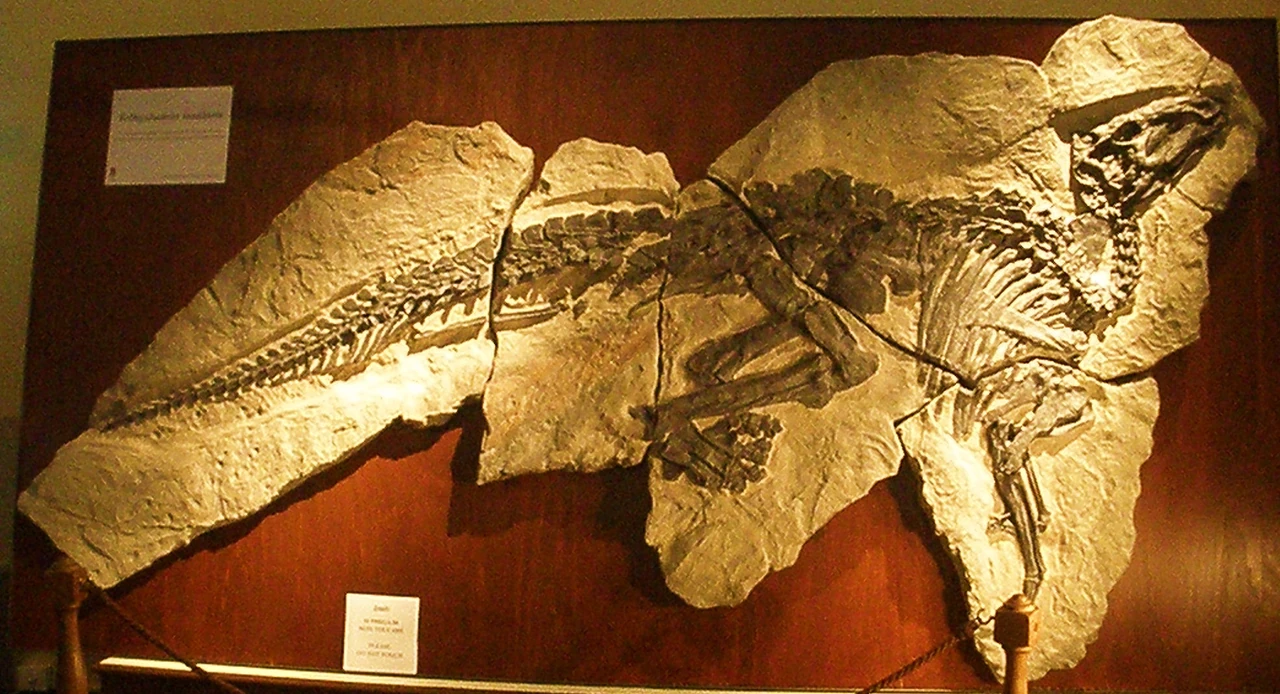
Tethyshadros insularis slab display photographed by Ghedoghedo at Museo Capellini in Bologna, retaining an existing Commons crop by FunkMonk through Cropbot. Commons categorizes the display as Antonio, the type individual SC57021, whose rib histology was reassessed as subadult in 2021. The source provides no fossil-versus-cast or element-restoration key: this display is not automatically certified as original bone. The missing tail tip, slab divisions and deformation remain visible; the photograph does not establish a complete adult outline. [4]
Tethyshadros insularis.JPG · Ghedoghedo; existing crop by FunkMonk through Cropbot. CC BY-SA 3.0. Current original Commons photograph converted to WebP and proportionally reduced for full view/thumbnail without upsampling. Existing source crop retained. No additional cropping, mirroring, anatomical edits or compositing. CC BY-SA 3.0 applies to these versions.
The photograph or figure shows the credited fossil material; displayed mounts and labels can include interpretation.
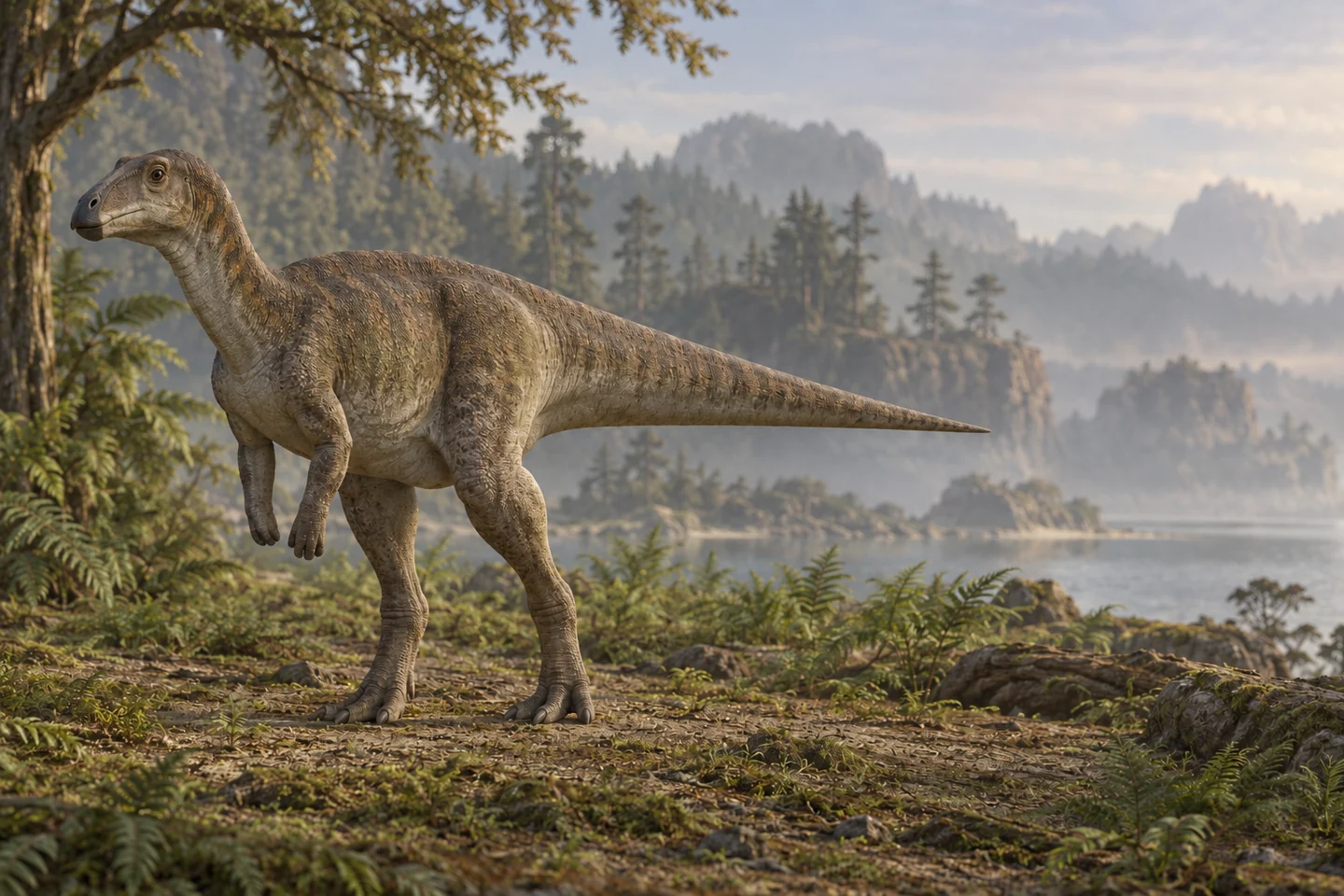
Original cinematic interpretation of Tethyshadros insularis. The older SC57247 individual guides the deeper, shorter snout; its maturity remains qualified. Three grouped hand digits form a support hand; only digits II and III have described hooflike ungual bones. The digit-IV tip and other soft tissues are restored. The gradually tapering tail uses the 2021 reconstruction alternatives. Stance, coloration and scenery are artistic choices, without demonstrated dwarfism or observed behavior. Lighting, coloration and scenery are artistic choices. This image does not document a fossil locality or behavior.
Original artwork · artistic interpretation.
Scientific view: source-informed reconstruction, credited paleoart or specimen-based imagery. Movie-style view: Original artistic interpretation. Reconstructions involve uncertainty.
MEET THE ANIMAL
Tethyshadros is known from unusually complete, articulated dinosaur material from northeastern Italy. Articulated means many bones remained arranged together, helping researchers reconstruct how the skeleton fitted. It belongs close to the familiar duck-billed dinosaurs but outside the more narrowly defined family Hadrosauridae. That distinction matters: an animal can resemble members of a family without being placed inside it by a scientific analysis. [D1]
Its jaws contained many teeth arranged in stacked rows, a dental battery suited to processing plant food. The hand had three fingers and relatively limited movement. These preserved details help explain its feeding and body structure. They do not identify a favorite plant, reveal the sex of the fossil individual or tell us how the animals behaved together. [D4]
Research on its limbs and hands supports the ability to use both two-legged and four-legged postures. It does not establish an exact running speed. Whole-body restorations also depend on how missing or incomplete parts, especially the tail, are reconstructed. A measured preserved skeleton and a model's estimated complete length answer different questions, and reconstruction estimates retain those limits. [D3]
PREHISTORIC ANIMAL DOSSIER
The animal, the evidence, and the questions still open.
Rib histology identifies “Antonio” as subadult and “Bruno” as older. Continued slow growth in Bruno remains possible. [D2]
Profile scope: Genus — Tethyshadros; T. insularis from northeastern Italy, a hadrosauroid outside Hadrosauridae. [D1]
Source supported identifies a description documented by the cited source. Inferred marks a reconstruction or functional estimate. Debated marks competing interpretations. Not established means the sources reviewed for this dossier do not support a firm conclusion; it does not mean a behavior never occurred.
A size reference is an estimate, not a population range. Nesting evidence does not by itself establish courtship, mate choice, or lifelong pairing.
3.62 m preserved (subadult type)
SC57021 lacks the tail tip. A historical 4.51 m restoration is challenged by 2021’s shorter caudal series; neither is an adult maximum. [D3] [D2]
About 514–584 kg (older-individual model)
SC57247: isometric scaling from the type’s limb model using 15–20% larger linear dimensions. Continued slow growth remains possible; this is not a species range. [D2]
Plant feeding inferred
Dental batteries held many teeth in vertical rows. This supports herbivory without identifying particular plants or an observed meal. [D4]
Campanian carbonate-platform deposits
Villaggio del Pescatore, northeastern Italy; approximately 81.5–80.5 Ma. Marginal-marine burial deposits do not establish an aquatic lifestyle. [D2]
Both two- and four-legged capability inferred
The long tibia and pillar-like hand support mixed capabilities. Digits II/III have hoof-like unguals; IV lacks one. Exclusive gait and speed remain unestablished. [D3]
Three hand digits; specialized dental batteries
Manual digits I and V are absent. II–IV form a hand with limited mobility; complete tail length remains reconstructed. [D4]
Growth and clutch hypotheses
Slower bone growth suggests sexual maturation. Tail-based longer-oviduct/larger-clutch proposals remain untested by eggs, nests or reproductive tissues. [D2] [D3]
Not established here
A posterior first chevron inspired historical sex assignments, but the museum explicitly finds these unconfirmed. No inspected display sequence or mating behavior is documented. [D4]
Not established here
Several individuals occur at the fossil site. Their occurrence does not itself establish a herd, family or cooperative behavior; focused searches found no direct social test. [D2]
Sources and inspection notes for the claims in this profile.
THE STORY IN THE FOSSILS
Earlier skeletal fusion suggested adulthood, but rib histology revised Antonio to subadult. Bruno’s older status remains distinct from certainty that growth had ceased. [2]
The unusual hand is a support structure, rather than an assumed grasping hand. Its three grouped digits help distinguish the reconstruction from thumb-spiked iguanodontians. [3]
The dossier identifies the scope of each reference estimate. A mount, an individual fossil and a species-wide adult range are different measurements. Comparison metrics remain unavailable where adult scope has not been established. Unknown does not mean zero.
Sources support the stated claims and scopes. Refer to the evidence notes for uncertainty.
KEEP EXPLORING
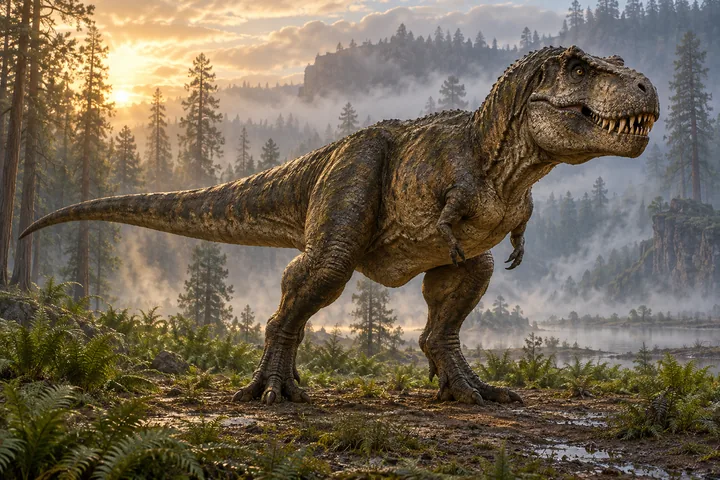
Tyrannosaurus rex
Tyrannosaurus rex was a large meat-eating dinosaur from the final part of the Cretaceous in western North America. Fossil teeth, bite marks and skeletons reveal a powerful animal whose behaviour still invites questions.
Velociraptor mongoliensis
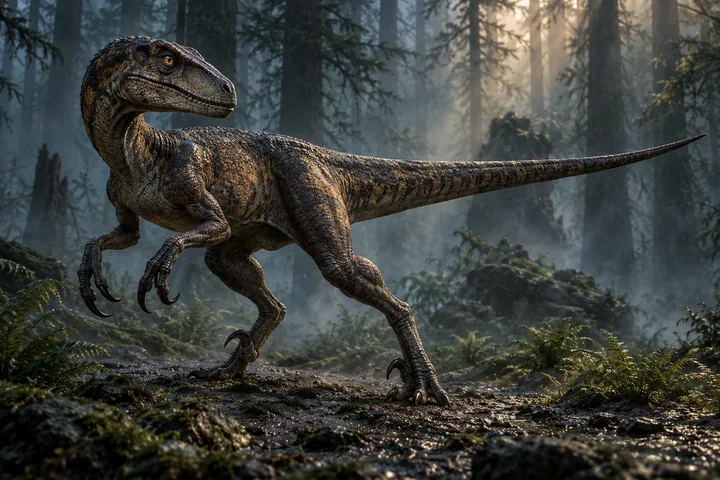
Velociraptor mongoliensis was a lightly built meat-eater from Late Cretaceous Mongolia. Its long limbs, teeth and enlarged foot claws made it distinctive, while the Fighting Dinosaurs specimen records a remarkable interaction with a horned dinosaur.
Dryptosaurus aquilunguis
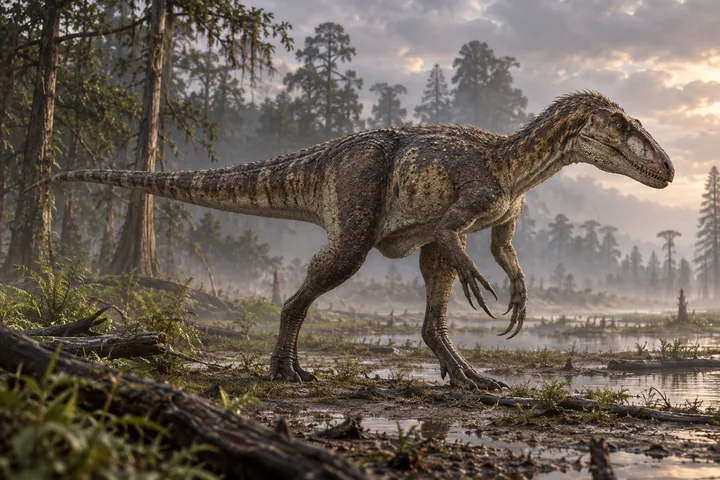
Dryptosaurus was an eastern North American tyrannosauroid with a short upper arm and unusually large hand. Its partial skeleton and changing restorations reveal how evidence and imagination interact.