
Size reference
Source supportedAbout 51 mm body length
The Wyoming T. lubei queen DMNH 9041 is the reference; this is not a worker measurement or genus-wide range. [D1]
EXHIBIT 203
Titanomyrma
Prehistoric insect
Titanomyrma was an Eocene ant genus with strikingly large winged queens and unresolved ecological details. [1]
TWO WAYS TO PICTURE THE PAST
Compare the evidence with the familiar movie image. The illustrations are not to a shared scale.
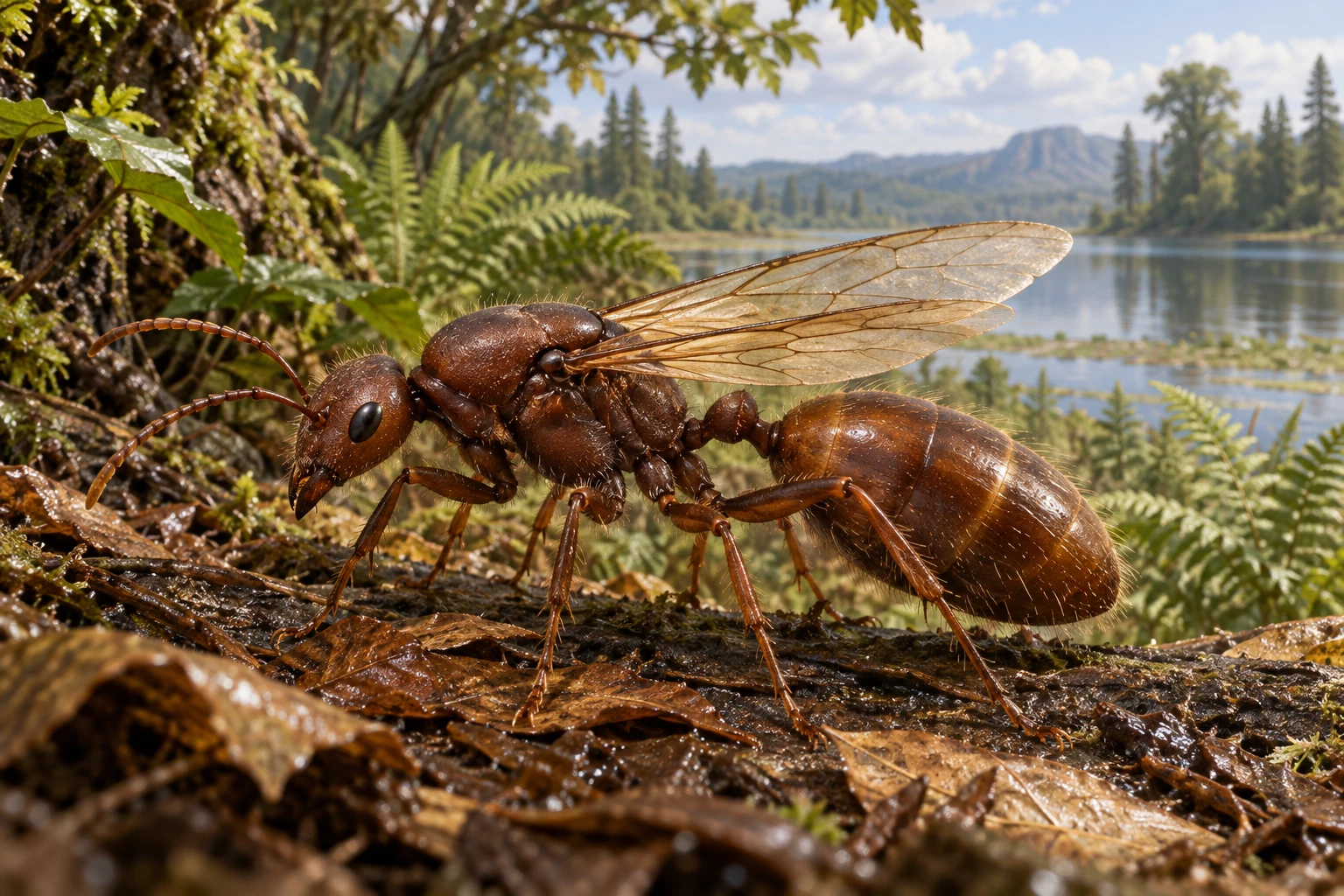
An illustrative reconstruction. Compare its anatomy with the evidence and limitations in the dossier. [1]
Source-informed reconstruction. Appearance evidence [1]. Original illustration; missing anatomy, coloration and scenery include interpretation.
Fossils constrain this life reconstruction. Missing anatomy, coloration and the environmental scene include interpretation; the dossier explains the evidence limits.
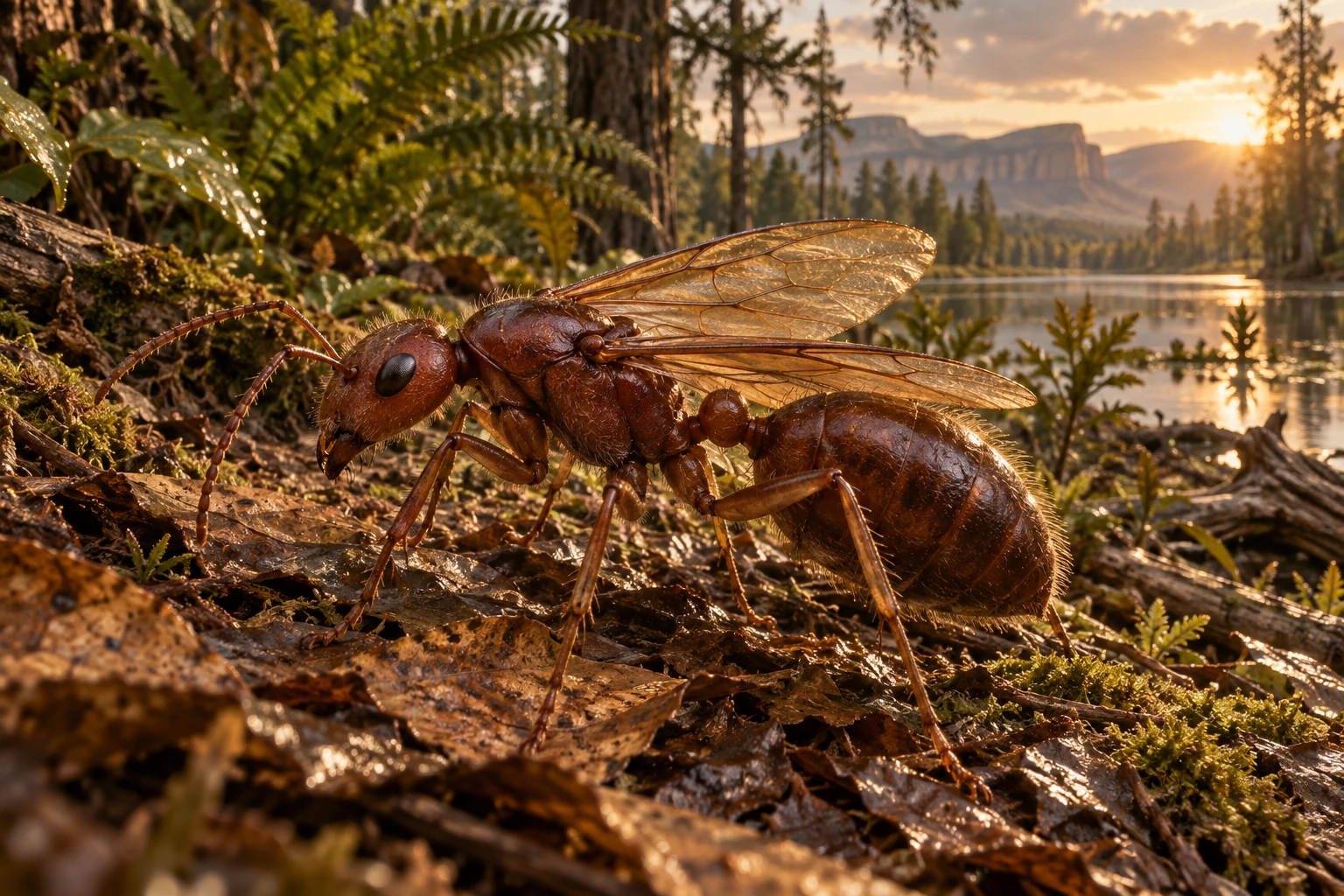
An illustrative reconstruction. Compare its anatomy with the evidence and limitations in the dossier. Lighting, coloration and scenery are artistic choices. This image does not document a fossil locality or behavior.
Original artwork · artistic interpretation.
Scientific view: source-informed reconstruction, credited paleoart or specimen-based imagery. Movie-style view: Original artistic interpretation. Reconstructions involve uncertainty.
MEET THE ANIMAL
Titanomyrma was an ant that lived during the Eocene, long after the extinction of the non-bird dinosaurs. A fossil queen from Wyoming, named Titanomyrma lubei, had a body about 51 millimeters long. That is a measurement of one queen, not a typical worker. Its narrow waist joins a strong middle body to a long rear section. Parts that are missing from the fossil need careful comparison. [D1]
Researchers have also studied related European species and an unnamed Canadian specimen. The Canadian fossil came from an ancient upland setting near Princeton in British Columbia. Pressure in the rock distorted its shape, making its true size hard to recover. That uncertainty matters: a smaller ant and a giant ant could suggest different explanations for surviving in a cooler climate. [D2]
The discovery raises a large question about movement between continents. Europe and North America were once connected across the far north, and short warm intervals might have helped these ants spread. The idea is still being tested. Finding the ant in Canada does not reveal its menu, nest or courtship, but it gives researchers a new place to investigate. [D3]
PREHISTORIC ANIMAL DOSSIER
The animal, the evidence, and the questions still open.
A distorted Canadian fossil challenges simple assumptions about the size and climate requirements of every Titanomyrma. [D3]
Profile scope: Genus — Titanomyrma; Wyoming T. lubei anchors the reconstruction, with European species and Canadian material included. [D1]
Source supported identifies a description documented by the cited source. Inferred marks a reconstruction or functional estimate. Debated marks competing interpretations. Not established means the sources reviewed for this dossier do not support a firm conclusion; it does not mean a behavior never occurred.
A size reference is an estimate, not a population range. Nesting evidence does not by itself establish courtship, mate choice, or lifelong pairing.
About 51 mm body length
The Wyoming T. lubei queen DMNH 9041 is the reference; this is not a worker measurement or genus-wide range. [D1]
Not established here
The reviewed studies provide no defensible mass for the focal queen. [D2]
Not established here
Size and ant identity alone do not establish carnivory, plant feeding or a particular foraging strategy. [D1]
Eocene terrestrial environments near fossil lakes
Warm Wyoming and European settings contrast with cooler Canadian uplands; fossil burial and living habitat are distinct. [D2]
Walking and queen flight inferred
Legs, wings and thorax support these capabilities; speed and dispersal distance of an individual are unknown. [D1]
Single petiole and elongated gaster
T. lubei preserves a rounded-triangular head and partial forewing; eyes and antennae require comparative restoration. [D1]
Winged queen fossils
Queen identity supplies reproductive context, but the reviewed material does not establish clutch size or an egg-to-adult series. [D2]
Not established here
Intercontinental distribution does not identify an observed mating flight or display. [D2]
Not established here
Ant affinity permits comparison, but worker numbers, nest architecture and cooperative behavior are not demonstrated by these specimens. [D2]
Sources and inspection notes for the claims in this profile.
THE STORY IN THE FOSSILS
A Princeton resident’s discovery added Canada to the record. Geological distortion now matters as much as apparent size when researchers test the proposed climate limits. [3]
The dossier identifies the scope of each reference estimate. A mount, an individual fossil and a species-wide adult range are different measurements. Comparison metrics remain unavailable where adult scope has not been established. Unknown does not mean zero.
Sources support the stated claims and scopes. Refer to the evidence notes for uncertainty.
KEEP EXPLORING
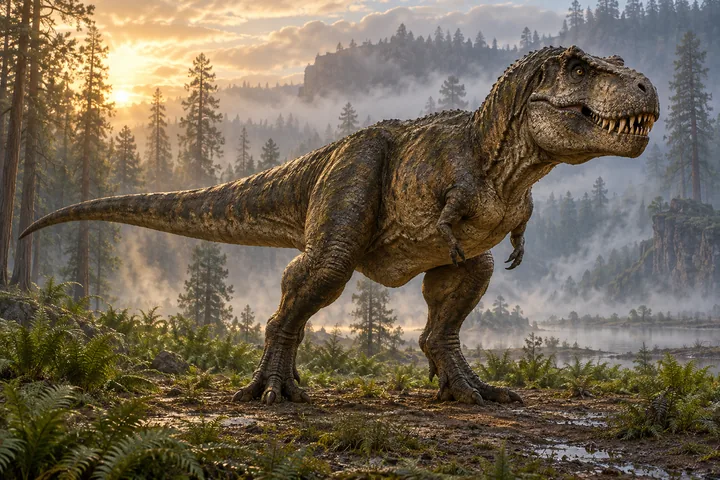
Tyrannosaurus rex
Tyrannosaurus rex was a large meat-eating dinosaur from the final part of the Cretaceous in western North America. Fossil teeth, bite marks and skeletons reveal a powerful animal whose behaviour still invites questions.
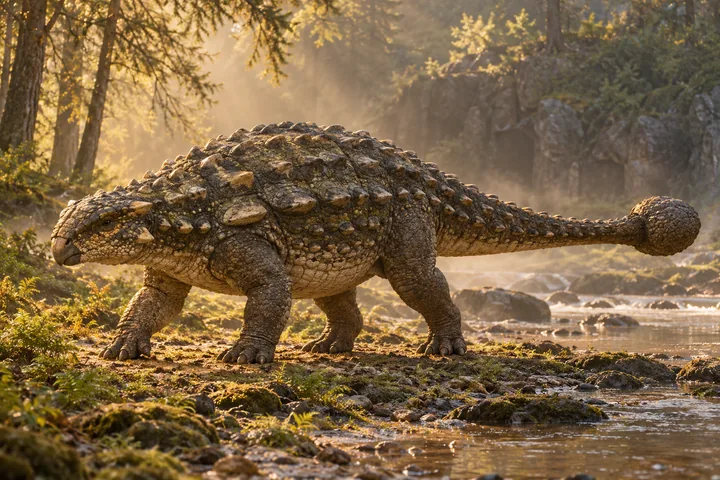
Ankylosaurus
Ankylosaurus was an armoured plant eater from the final Cretaceous of North America. Its tail club is distinctive, but no complete skeleton has yet been found.
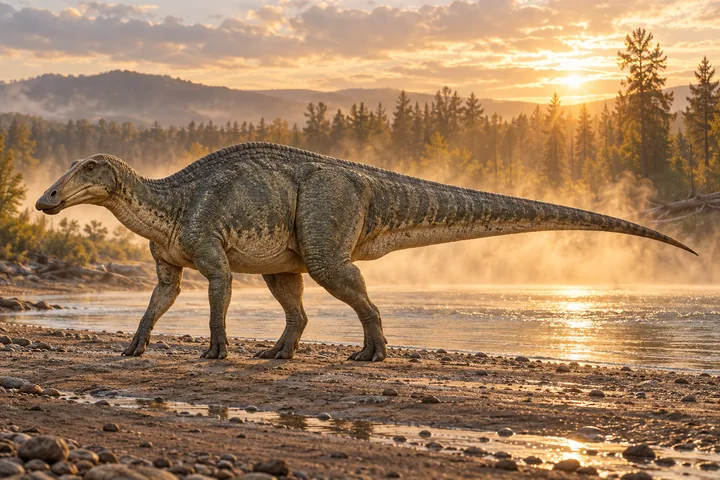
Edmontosaurus
Edmontosaurus was a large Late Cretaceous plant eater with a broad beak and grinding cheek teeth. Exceptional specimens preserve skin texture as well as bone.