
Length
InferredAbout 3.91 m; reconstructed PIN3907/11
The 2008 table labels the type adult/mature and gives reconstructed total length. Incomplete material and unverified histological maturity prevent treating this as a measured adult range. [D3]
EXHIBIT 135
Udanoceratops tschizhovi
Udanoceratops was a large beaked ceratopsian with a strikingly deep lower jaw and an incompletely known body. [1]
TWO WAYS TO PICTURE THE PAST
Compare the evidence with the familiar movie image. The illustrations are not to a shared scale.
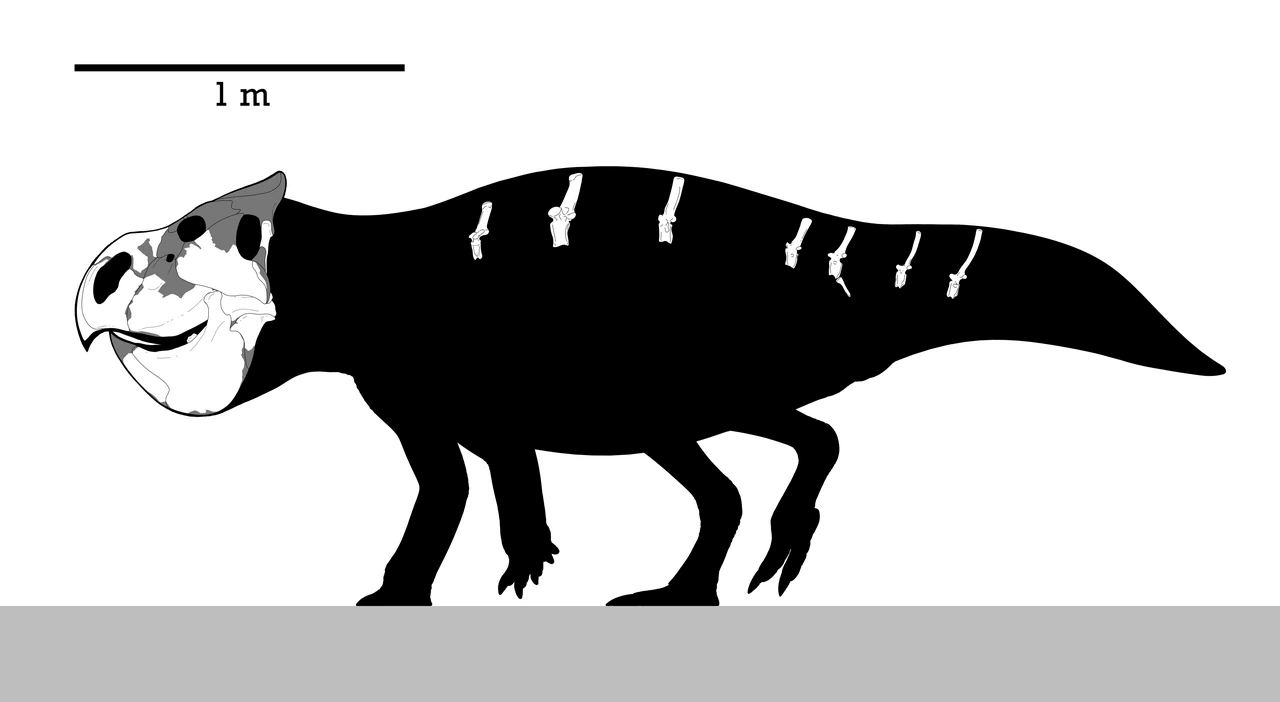
U. tschizhovi reconstruction based on PIN3907/11, distinguishing preserved skull and vertebral material from restored portions. Much of the body is comparative; this is not a measured complete individual. Living colors and soft tissues are unknown. [2]
Udanoceratops Skeleton Reconstruction.png · PaleoNeolitic. CC BY 4.0. Proportionally resized Commons preview and converted to WebP; no anatomy edits.
Skeletal mounts and drawings may restore missing parts; the caption identifies the displayed material.
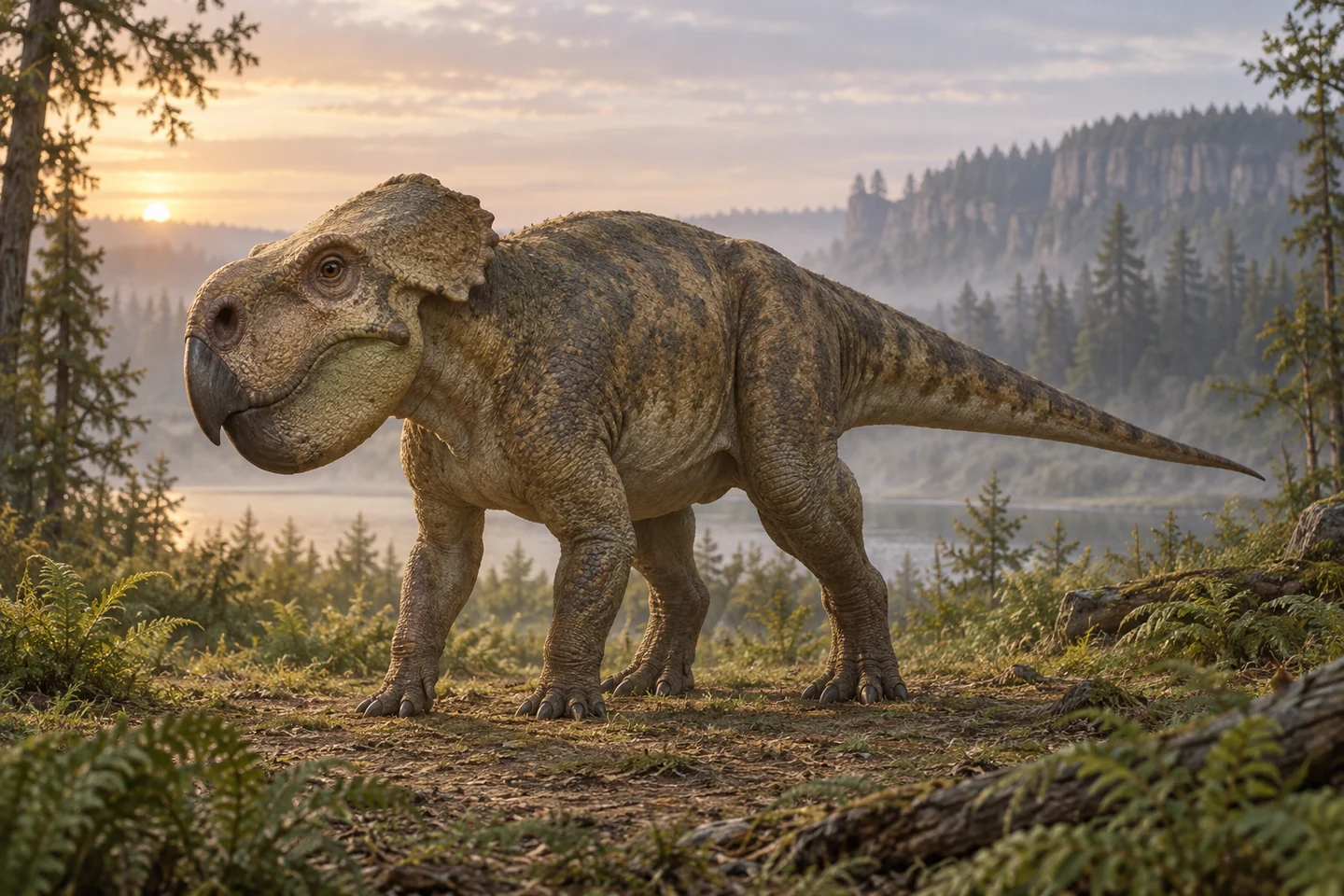
Original cinematic interpretation of Udanoceratops tschizhovi. Colors, soft tissues, scenery and missing anatomy are reconstructed artistic choices; this is not a directly observed individual or behavior. The skull anchors this view; contested or incomplete postcranial referrals do not establish an exact whole-body posture. Lighting, coloration and scenery are artistic choices. This image does not document a fossil locality or behavior.
Original artwork · artistic interpretation.
Scientific view: source-informed reconstruction, credited paleoart or specimen-based imagery. Movie-style view: Original artistic interpretation. Reconstructions involve uncertainty.
MEET THE ANIMAL
Udanoceratops was a plant-eating dinosaur from Late Cretaceous Mongolia. It belonged to the ceratopsians, the group that includes beaked dinosaurs with skull frills. Its most recognizable feature was a remarkably deep lower jaw. The surviving skull tells us more about its appearance than the incomplete bones of its body do. [D1]
That jaw curved strongly downward, beneath straight rows of teeth. The skull also had a large opening for the nostril and lacked teeth in the frontmost upper-jaw bones. These details help researchers recognize Udanoceratops. A drawing of its complete head still needs to restore missing parts, especially the outline of the frill. [D2]
Comparisons of limb bones suggest an animal that supported its weight on four legs. This four-legged stance is called quadrupedality. However, some bones assigned to Udanoceratops have an uncertain identity, so a precise walking style remains a reconstruction. Researchers must first check which bones belong to the dinosaur before using them to explain how its whole body worked. [D4]
PREHISTORIC ANIMAL DOSSIER
The animal, the evidence, and the questions still open.
Its skull is better understood than its whole skeleton. Formation correlations and referred limb material leave aspects of habitat and movement uncertain. [D5] [D6]
Profile scope: U. tschizhovi, principally holotype PIN3907/11; the disputed juvenile referral PIN4046/11 is kept separate. [D6]
Source supported identifies a description documented by the cited source. Inferred marks a reconstruction or functional estimate. Debated marks competing interpretations. Not established means the sources reviewed for this dossier do not support a firm conclusion; it does not mean a behavior never occurred.
A size reference is an estimate, not a population range. Nesting evidence does not by itself establish courtship, mate choice, or lifelong pairing.
About 3.91 m; reconstructed PIN3907/11
The 2008 table labels the type adult/mature and gives reconstructed total length. Incomplete material and unverified histological maturity prevent treating this as a measured adult range. [D3]
Not established here
Reviewed anatomical and size studies do not provide a sufficiently documented specimen-specific mass with a reproducible method. Popular rounded estimates are not adopted. [D3]
Plant eater
The museum classifies it as herbivorous. Its powerful beak-and-jaw anatomy does not identify preferred plants or a demonstrated seasonal diet. [D1]
Late Cretaceous continental Mongolia
The type comes from Üüden Sair Bed2. Competing Djadokhta/Nemegt locality correlations and disputed co-occurrences prevent a confident narrow age or particular habitat assignment. [D5]
Quadrupedal interpretation, with referral limits
Comparative forelimb anatomy favors supporting the body on four limbs. Some limb material attributed to Udanoceratops has uncertain identity, so detailed gait remains provisional. [D4] [D6]
Deep arched jaw and enlarged nostril opening
The skull has straight tooth rows, no premaxillary teeth and a very deep, curved lower jaw. Much of the complete frill and body must be restored. [D2] [D1]
Not established here
Adult and inferred-sex labels in the 2008 functional study do not establish reproductive maturity, confirmed sex, nesting or parenting. [D3]
Not established here
No reviewed evidence demonstrates sex-specific ornamentation or mating rituals. A proposed sex assignment is not a demonstrated courtship pattern. [D3]
Not established here
A purported association with other dinosaur taxa is geologically disputed and does not identify a Udanoceratops herd or family group. [D5]
Sources and inspection notes for the claims in this profile.
THE STORY IN THE FOSSILS
The deep curved lower jaw gives Udanoceratops a distinctive profile among small-frilled ceratopsians. Its enlarged nostril opening and straight tooth rows also separate its skull from that of Leptoceratops. [2]
A large reconstructed adult and a much smaller referred skeleton should not automatically become a species size range. The smaller specimen lacks a secure referral rationale, making taxonomic scope central to the life profile. [6] [3]
The dossier identifies the scope of each reference estimate. A mount, an individual fossil and a species-wide adult range are different measurements. Comparison metrics remain unavailable where adult scope has not been established. Unknown does not mean zero.
Sources support the stated claims and scopes. Refer to the evidence notes for uncertainty.
KEEP EXPLORING
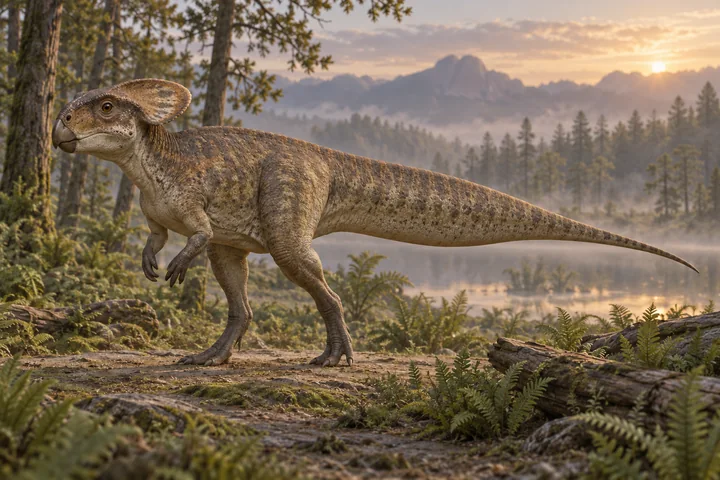
Yamaceratops dorngobiensis
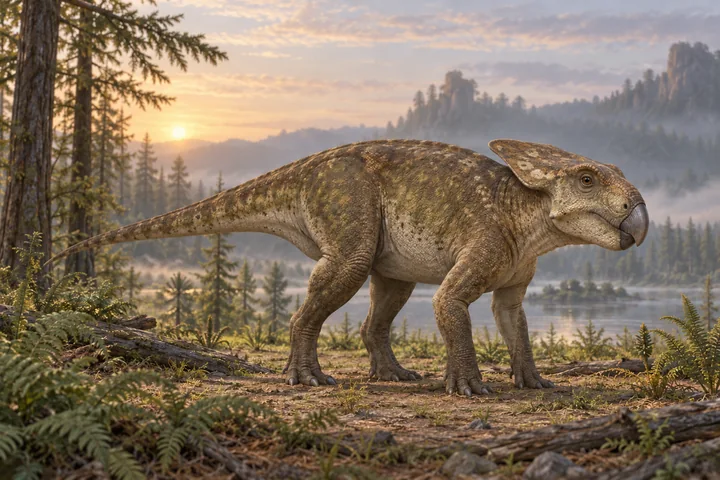
Yamaceratops was a small beaked ceratopsian whose cheek and jaw anatomy records a distinctive early neoceratopsian combination.
Leptoceratops gracilis
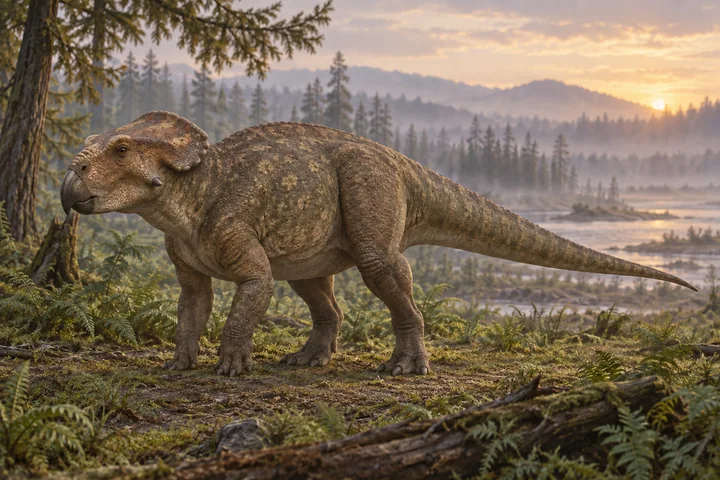
Leptoceratops was a hornless, short-frilled plant eater whose teeth preserve evidence of complex chewing.
Montanoceratops cerorhynchus
Montanoceratops was a small beaked ceratopsian; incomplete skull material has repeatedly changed how its head is reconstructed.