
Body length
InferredAbout 3–4 m (holotype restoration)
MCF PVPH 78; incomplete skeleton. Adult interpretation rests on size and vertebral fusion. [D2]
TWO WAYS TO PICTURE THE PAST
Compare the evidence with the familiar movie image. The illustrations are not to a shared scale.
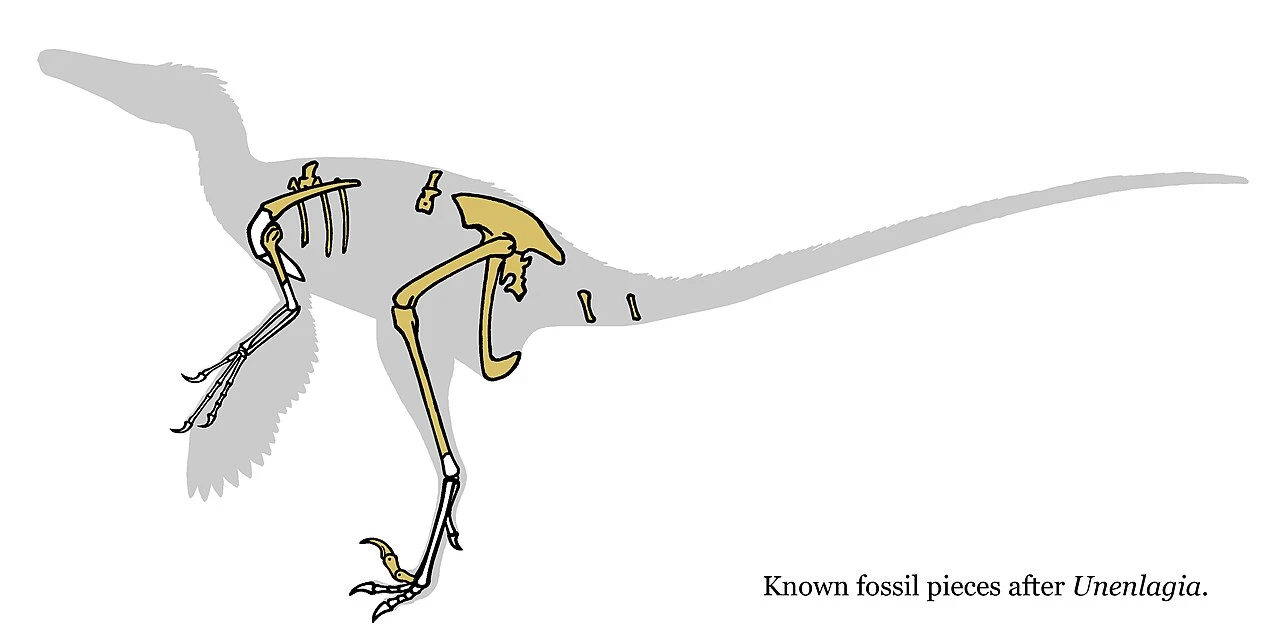
Known-material diagram of Unenlagia comahuensis by Conty. Colored pieces identify reported fossil material; the grey body, head, covering, hands and feet complete a hypothetical animal. The incomplete holotype does not preserve a skull or the entire external outline, and the silhouette is not a direct feather fossil or adult measurement. [1]
Unenlagia known material.JPG · Conty. Public domain. Current Commons 1280 px preview converted to WebP with proportional thumbnail reduction. No cropping, mirroring, anatomical edits or compositing; original diagram preserved.
Skeletal mounts and drawings may restore missing parts; the caption identifies the displayed material.
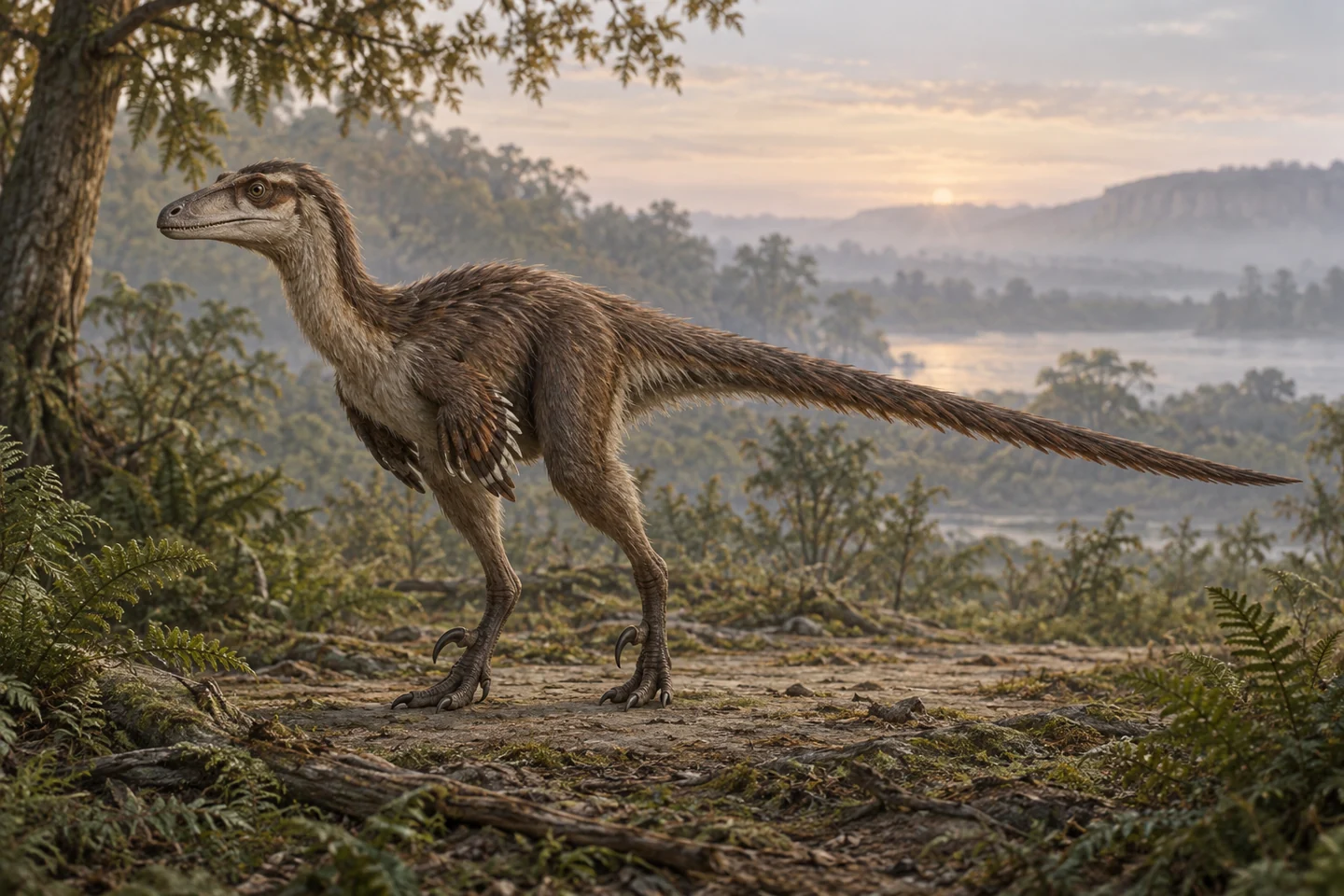
Original cinematic interpretation of Unenlagia. Colors, soft tissues, scenery and missing anatomy are reconstructed artistic choices; this is not a directly observed individual or behavior. The head and complete feather covering are comparative reconstructions, not preserved genus-specific skull or plumage. Lighting, coloration and scenery are artistic choices. This image does not document a fossil locality or behavior.
Original artwork · artistic interpretation.
Scientific view: source-informed reconstruction, credited paleoart or specimen-based imagery. Movie-style view: Original artistic interpretation. Reconstructions involve uncertainty.
MEET THE ANIMAL
Unenlagia was a carnivorous dinosaur from Late Cretaceous Argentina. This profile centers on Unenlagia comahuensis. The museum's general length reference is about 2.4 metres, but it is not tied to a particular individual or age. It should not be confused with a measured adult maximum, especially when different studies reconstruct an incomplete animal in different ways. [D5]
The original discovery drew attention to features of its shoulder and pelvis that resembled those of birds. These bones helped researchers investigate the evolutionary relationship between birds and other dinosaurs. A birdlike shoulder is a clue about anatomy, however, not a direct record of feathers or flight. Neither a flight display nor a particular courtship routine is preserved by those similarities. [D1]
Later research examined spaces inside its vertebrae, the bones that form the backbone. Internal cavities provide evidence relevant to air-filled parts of the skeleton. Such evidence concerns the animal's internal construction; it does not show the covering on its skin. Unenlagia is a useful reminder that a skeleton can reveal important evolutionary changes while leaving much of the living animal unknown. [D7]
PREHISTORIC ANIMAL DOSSIER
The animal, the evidence, and the questions still open.
An incomplete postcranial skeleton provides the body reference; its head and plumage remain reconstructions. [D2]
Profile scope: Genus — Unenlagia; U. comahuensis is the reference. U. paynemili was questioned as distinct. [D2]
Source supported identifies a description documented by the cited source. Inferred marks a reconstruction or functional estimate. Debated marks competing interpretations. Not established means the sources reviewed for this dossier do not support a firm conclusion; it does not mean a behavior never occurred.
A size reference is an estimate, not a population range. Nesting evidence does not by itself establish courtship, mate choice, or lifelong pairing.
About 3–4 m (holotype restoration)
MCF PVPH 78; incomplete skeleton. Adult interpretation rests on size and vertebral fusion. [D2]
About 63 kg (limb model)
MCF PVPH 78; measured femoral circumference. [D6]
Carnivory inferred
Institutional classification; no skull or direct prey evidence in the described type material. [D5] [D2]
Portezuelo sedimentary setting
Turonian–Coniacian mudstones at Sierra Portezuelo, Neuquén, Argentina; one partly articulated skeleton. [D2]
Flightless biped inferred
Shoulder analysis supports folding predatory forelimbs rather than powered flight; hindlimbs support two-legged movement. [D2]
Bird-like shoulder; pneumatic vertebrae
Shoulder features and CT-observed vertebral cavities document anatomy, not feathers or flight. [D1] [D7]
Not established here
The type adult assessment does not establish breeding age, eggs, nests or parental care. [D2]
Not established here
Avian-like skeletal features do not identify a mating display; reviewed sources supply no directly attributed courtship evidence. [D1]
Not established here
The type was one individual without associated vertebrates; habitual social behavior remains unknown. [D2]
Sources and inspection notes for the claims in this profile.
THE STORY IN THE FOSSILS
The shoulder helped frame debate over bird origins. [1]
CT scans reveal air-related spaces inside vertebrae. This anatomical evidence does not preserve the external covering. [7]
The dossier identifies the scope of each reference estimate. A mount, an individual fossil and a species-wide adult range are different measurements. Comparison metrics remain unavailable where adult scope has not been established. Unknown does not mean zero.
Sources support the stated claims and scopes. Refer to the evidence notes for uncertainty.
KEEP EXPLORING
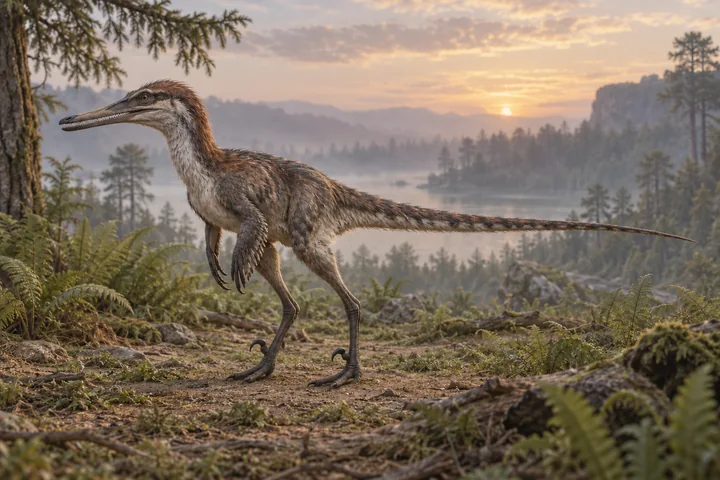
Buitreraptor gonzalezorum
Buitreraptor had a long, low snout and numerous tiny teeth.
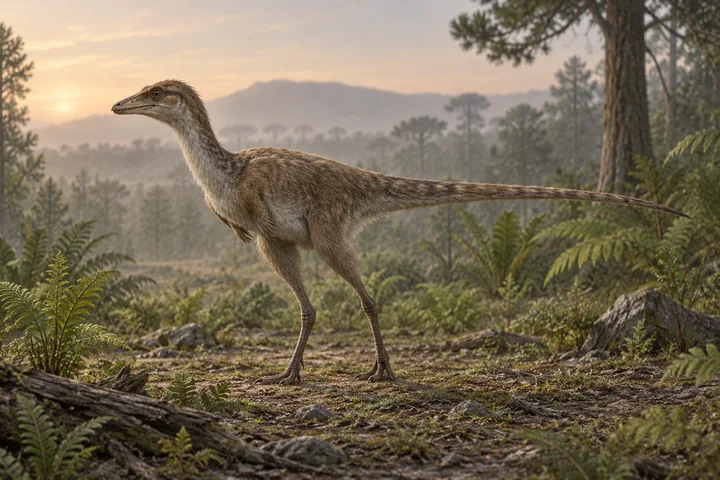
Alvarezsaurus calvoi
Alvarezsaurus is known chiefly from incomplete postcranial fossils.
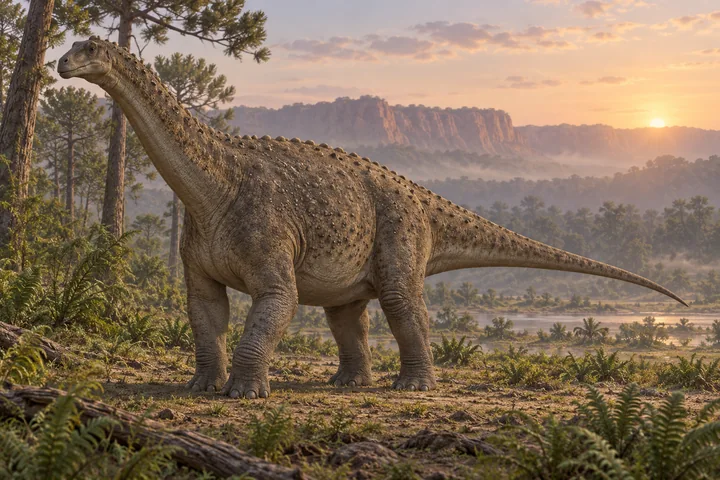
Saltasaurus loricatus
Saltasaurus was an Argentine titanosaur whose fossils preserve bony plates and tiny skin ossicles.