
Body length
InferredAbout 6.5 m; museum reference
The directory gives an unspecified whole-body reference. Missing head and neck require restoration; its method and individual maturity are not stated, and it is not an adult population range. [D4]
EXHIBIT 149
Vulcanodon karibaensis
Vulcanodon was an early sauropod from Zimbabwe with weight-bearing limbs and unusually shaped hindfoot claws. [1]
TWO WAYS TO PICTURE THE PAST
Compare the evidence with the familiar movie image. The illustrations are not to a shared scale.
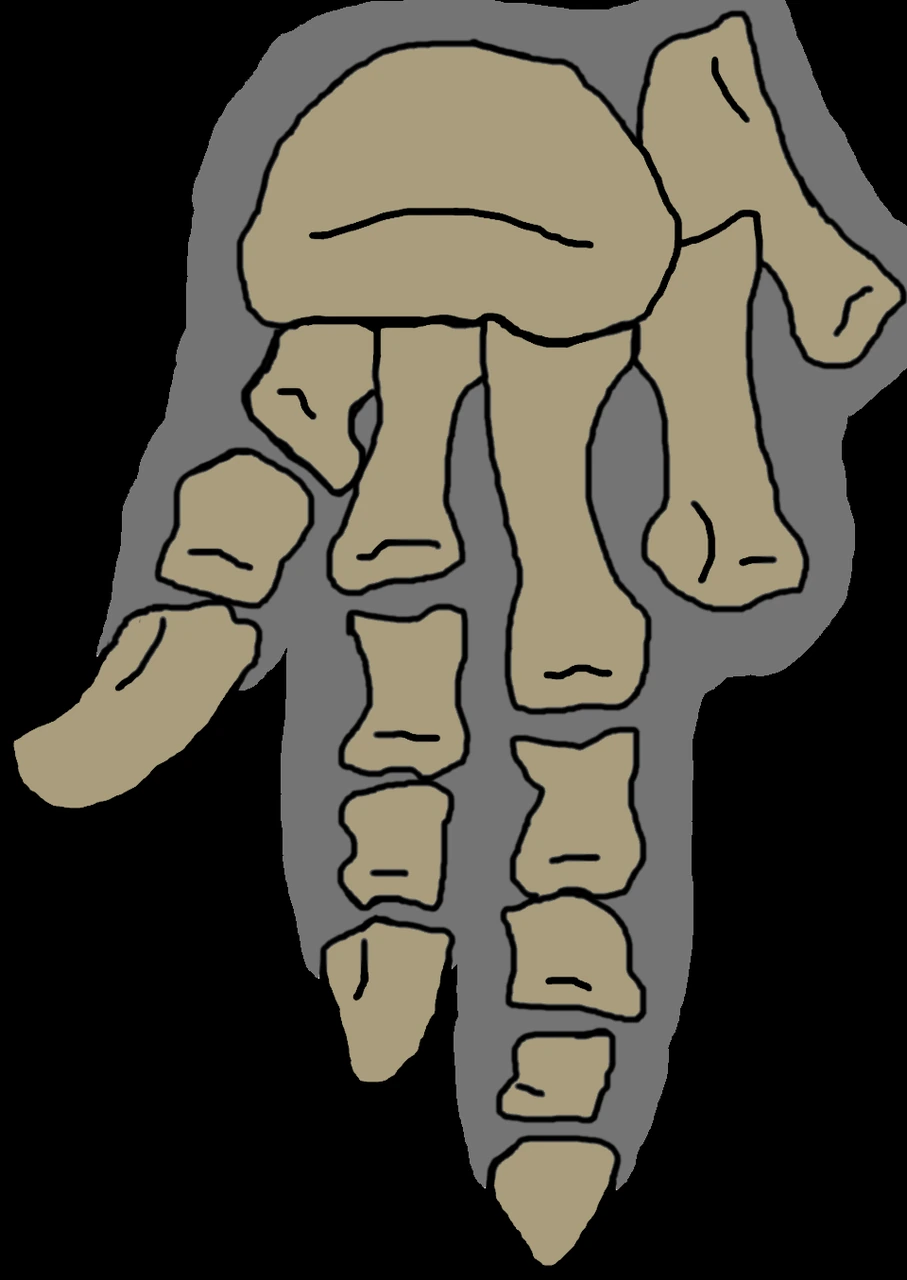
Left hindfoot reconstruction based on Raath’s published anatomy, modified by I. Reid. This is an interpreted bone drawing, not a fossil photograph or evidence of a complete hand. [1]
Vulcanodon left hindfoot reconstruction · Michael Raath; major modifications by I. Reid. CC0 1.0. Resized proportionally and converted to WebP; no anatomical edits. Same source license applies.
Skeletal mounts and drawings may restore missing parts; the caption identifies the displayed material.
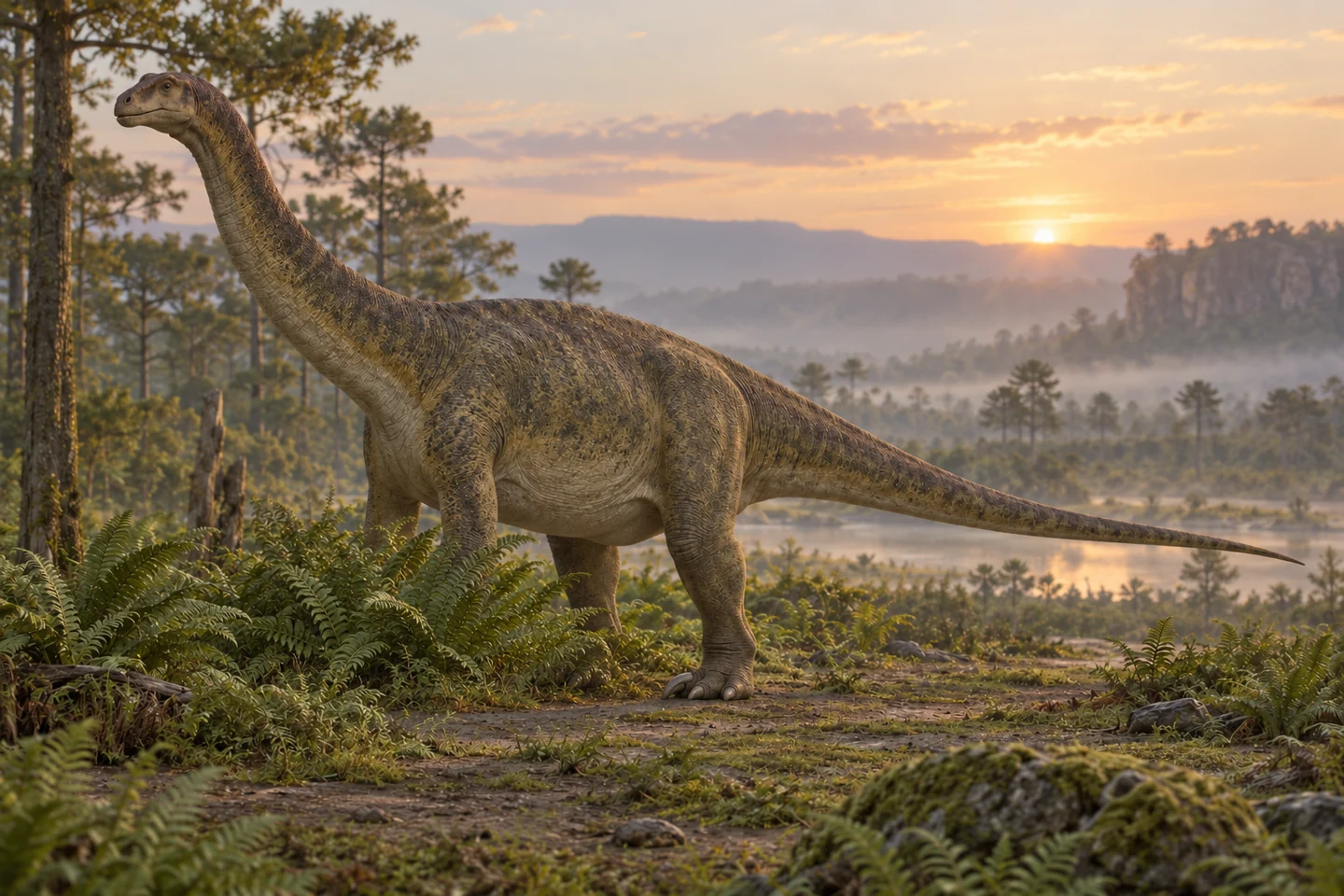
Original cinematic interpretation of a terrestrial quadruped. The head, neck and incomplete hands are restored comparatively. The humerus is about two-thirds of the femur; the displayed pose is not a calibrated full-limb ratio. Colors, soft tissues and setting are artistic. Lighting, coloration and scenery are artistic choices. This image does not document a fossil locality or behavior.
Original artwork · artistic interpretation.
Scientific view: source-informed reconstruction, credited paleoart or specimen-based imagery. Movie-style view: Original artistic interpretation. Reconstructions involve uncertainty.
MEET THE ANIMAL
Vulcanodon was an early sauropod, a member of the long-necked dinosaur group famous for its giant plant eaters. The Natural History Museum gives a general length reference of about 6.5 metres and identifies it as herbivorous. The number is a whole-body reconstruction with no growth stage or calculation method specified, so it is not a measured adult maximum. [D4]
The fossil locality lies in Zimbabwe's Lake Kariba region. A later geological reassessment placed the bones in the uppermost Forest Sandstone, changing the older interpretation of their rock setting. Comparisons with other regional deposits suggest an Early Jurassic age. This kind of matching provides a time framework, while leaving more uncertainty than a precise direct date from the fossil horizon. [D2]
Comparative research highlights a forearm arrangement that would help hold the hand in a weight-bearing position. Its limb proportions also help explain how early sauropods differed from more lightly built relatives. These are clues to supporting a large body on four legs; they do not measure the speed or exact walking rhythm of a living Vulcanodon. [S1]
PREHISTORIC ANIMAL DOSSIER
The animal, the evidence, and the questions still open.
Revisiting its locality moved the fossil horizon into the Forest Sandstone. Its early sauropod anatomy remains informative despite substantial gaps in a complete reconstruction. [D2]
Profile scope: Type-centered Vulcanodon karibaensis profile: QG 24 lacks head and neck; maturity is unresolved. [D1]
Source supported identifies a description documented by the cited source. Inferred marks a reconstruction or functional estimate. Debated marks competing interpretations. Not established means the sources reviewed for this dossier do not support a firm conclusion; it does not mean a behavior never occurred.
A size reference is an estimate, not a population range. Nesting evidence does not by itself establish courtship, mate choice, or lifelong pairing.
About 6.5 m; museum reference
The directory gives an unspecified whole-body reference. Missing head and neck require restoration; its method and individual maturity are not stated, and it is not an adult population range. [D4]
About 10.3 tonnes; limb-support model
The primary study reports this regression-based estimate for Vulcanodon. Missing anatomy and unestablished individual maturity prevent treating it as a measured adult maximum. [D3]
Plants; comparative inference
The museum identifies herbivory. Carnivorous teeth found near the skeleton were reassigned to a theropod; they are not evidence that Vulcanodon itself was a meat-eater. [D4] [D1]
Forest Sandstone, Lake Kariba region
The type horizon is now placed within Zimbabwe’s uppermost Forest Sandstone, rather than interbedded Batoka strata. A regional correlation suggests Sinemurian–Pliensbachian age; a precise absolute date remains uncertain. [D2]
Four-legged walker with weight-bearing limbs
Limb anatomy supports sauropod quadrupedality. The forelimb is reconstructed as about 78% of hindlimb length, whereas the humerus alone is about two-thirds femur length; these are different ratios. [D1]
Contrasting hindfoot claws
The large first hindfoot claw is laterally compressed; second and third claws are comparatively flattened. Known hindfoot anatomy does not establish a complete hand or a row of equivalent front-foot claws. [D1]
Not established here
Focused searches did not establish securely assigned eggs, nests, embryos, incubation practices, reproductive maturity or parental care.
Not established here
No reviewed genus-specific evidence establishes displays, calls, sex-specific ornament, mate choice or mating behavior.
Not established here
Additional bones indicate another individual. Their association does not demonstrate persistent herds or family relationships. [D1]
Sources and inspection notes for the claims in this profile.
THE STORY IN THE FOSSILS
The locality study changed the temporal setting of this early sauropod. Its proposed age is based on stratigraphic correlation and remains less precise than a direct date from the fossil horizon. [2]
The familiar long-necked body requires restoration of absent parts. The fossil limbs and hindfoot are more direct evidence than a fully rendered head or habitual neck posture. [1]
The dossier identifies the scope of each reference estimate. A mount, an individual fossil and a species-wide adult range are different measurements. Comparison metrics remain unavailable where adult scope has not been established. Unknown does not mean zero.
Sources support the stated claims and scopes. Refer to the evidence notes for uncertainty.
KEEP EXPLORING
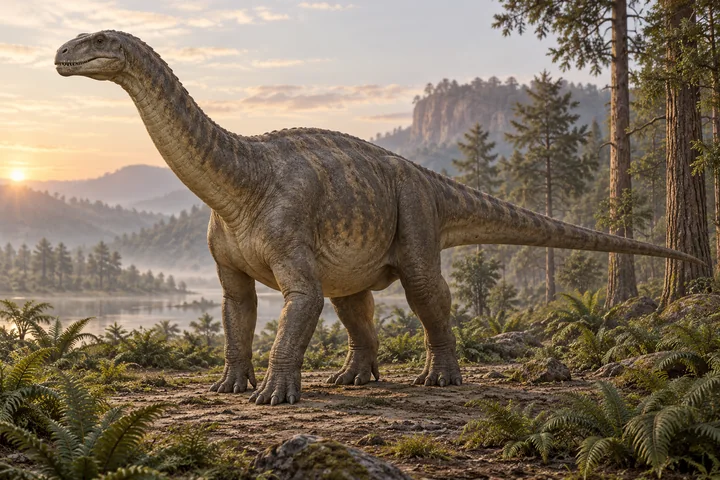
Tazoudasaurus naimi
Tazoudasaurus was an early Moroccan sauropod with broad teeth and a spreading hand skeleton. Its fossils illuminate changes toward the later giant sauropod body plan.
Brachiosaurus altithorax
Brachiosaurus altithorax was a giant sauropod from Late Jurassic North America. Its name-bearing skeleton is incomplete, and many familiar reconstructions borrow details from the separate African dinosaur Giraffatitan.
Diplodocus
Diplodocus was a long-necked plant eater from the Late Jurassic Morrison Formation. Its exceptionally long tail and distinctive double-beamed bones gave it both its silhouette and its name.