
Body length
InferredAbout 6 m; broad museum reference
ROM supplies this reconstruction without an identified individual, life stage or calculation. Disarticulated material does not establish one complete measured adult or a species-wide range. [D4]
TWO WAYS TO PICTURE THE PAST
Compare the evidence with the familiar movie image. The illustrations are not to a shared scale.
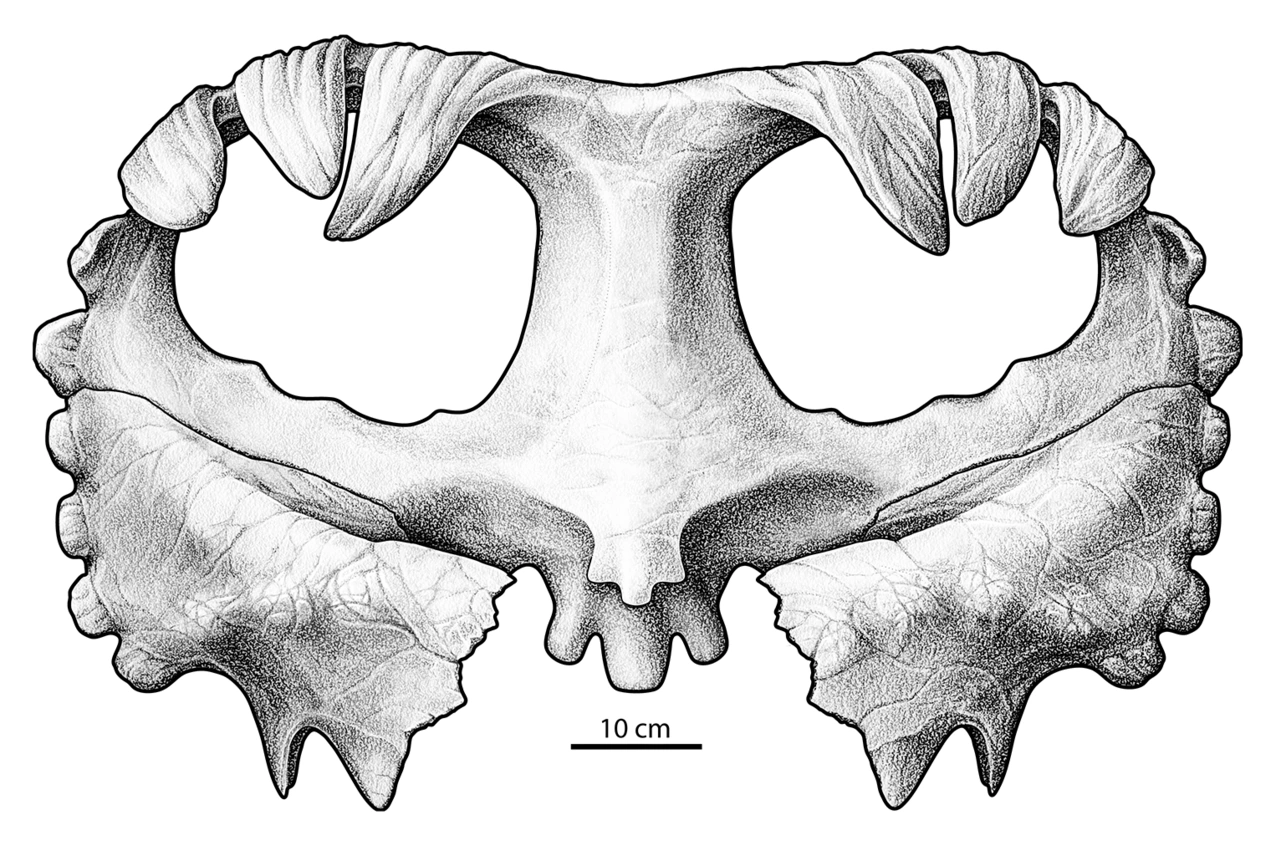
Published bony-frill reconstruction of Wendiceratops pinhornensis, combining incomplete material rather than showing one intact fossil. Curled marginal processes are anatomical interpretation; the openings are bony frill windows, not exposed holes in a living animal. Linework and shading do not reconstruct living colors. [1]
Restored Wendiceratops bony neck frill · David C. Evans and Michael J. Ryan; original paper also credits Danielle Dufault for specimen illustrations and figure assistance. CC BY 4.0. Used the current Commons extracted panel; converted to WebP and resized proportionally without upsampling or anatomical edits. Existing source linework and reconstruction retained.
Skeletal mounts and drawings may restore missing parts; the caption identifies the displayed material.
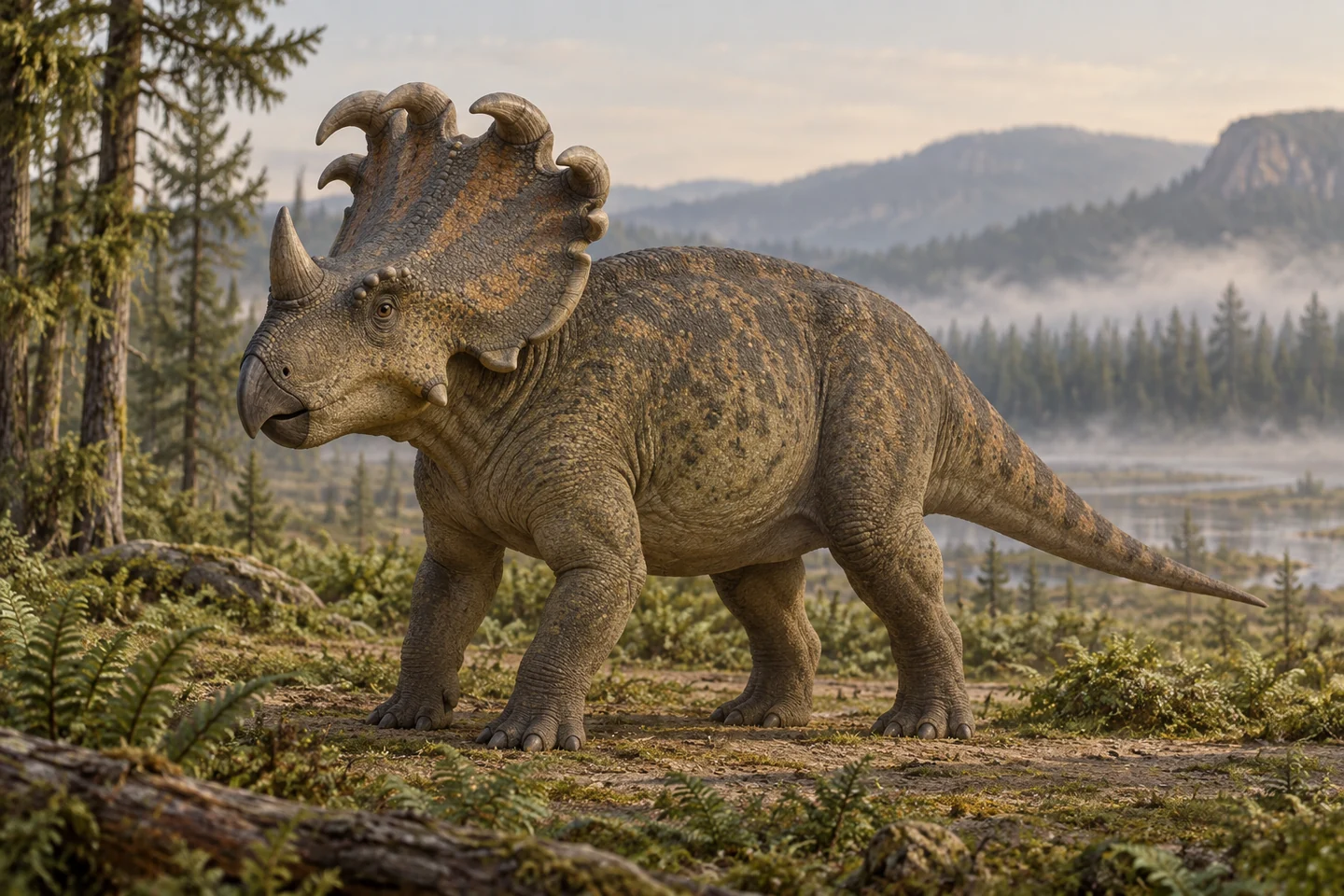
Original cinematic interpretation of Wendiceratops. Broad forward-curved frill processes guide the reconstruction. The full nasal horn profile and brow region remain hypothetical because critical skull parts are missing. The complete body combines disarticulated material and comparison; skin, pose, colors and scenery are artistic choices without a depicted herd or mating ritual. Lighting, coloration and scenery are artistic choices. This image does not document a fossil locality or behavior.
Original artwork · artistic interpretation.
Scientific view: source-informed reconstruction, credited paleoart or specimen-based imagery. Movie-style view: Original artistic interpretation. Reconstructions involve uncertainty.
MEET THE ANIMAL
Wendiceratops had a remarkable frill with ornaments curling forward around its edge. Its skull reconstruction combines bones from different individuals, rather than copying one complete head. Some regions, including the brow-horn area, remain incompletely known. That makes the preserved frill especially important for recognizing this distinctive horned dinosaur. [D1]
A beak and teeth supported plant feeding. The Royal Ontario Museum describes cropping and grinding vegetation and provides a six-metre length reference. Its article does not identify the particular individual, growth stage or calculation behind that body estimate. It gives an impression of scale rather than a securely measured maximum adult. [D4]
Comparative research places Wendiceratops among a diverse collection of horned dinosaurs in Late Cretaceous western North America. Differences between their skull ornaments help investigate relationships. Suggestions that ornaments served display or mating competition remain broader evolutionary interpretations, rather than direct observations of Wendiceratops courtship. [D3]
Its bonebed contains multiple individuals and shows disarticulation and transport. Researchers propose herding, but the deposits do not preserve a living group behaving together. [D2]
PREHISTORIC ANIMAL DOSSIER
The animal, the evidence, and the questions still open.
Detailed limb and burial studies add to the original skull description. Size references, growth classes and proposed herding each have different evidential limits. [D2] [D4]
Profile scope: W. pinhornensis, anchored by incomplete parietal TMP 2011.051.0009 and associated bonebed material. Full skull and body restorations combine evidence from different individuals. [D1]
Source supported identifies a description documented by the cited source. Inferred marks a reconstruction or functional estimate. Debated marks competing interpretations. Not established means the sources reviewed for this dossier do not support a firm conclusion; it does not mean a behavior never occurred.
A size reference is an estimate, not a population range. Nesting evidence does not by itself establish courtship, mate choice, or lifelong pairing.
About 6 m; broad museum reference
ROM supplies this reconstruction without an identified individual, life stage or calculation. Disarticulated material does not establish one complete measured adult or a species-wide range. [D4]
Over about 900 kg; broad museum reference
ROM's ton is 2,000 lb, approximately 907 kg. Its rounded reference lacks a named individual, maturity assessment and calculation; it is not an adult maximum or a measured weight. [D4]
Plant feeding inferred from beak and teeth
A maxilla preserves stacked replacement teeth. ROM describes cropping and grinding plant food; exact plants and habitual feeding height are not demonstrated by a preserved meal. [D1] [D4]
Middle Campanian Oldman Formation, Alberta
The lower Oldman bonebed lies south of the Milk River. Updated regional correlation places it roughly 78 Ma old using Montana chronology; this is not a direct date on Wendiceratops bones. [D1] [D3]
Four-legged reconstruction from limb anatomy
Recovered humerus, ulnae and radii resemble other centrosaurines. Complete stance and feet remain comparative restorations; the disarticulated bones do not establish walking speed or a particular gait. [D2]
Thick, forward-curled frill processes
Processes at positions 2 and 3 are broad and strongly curled; no median epiparietal is present. Postorbitals are missing, and the full nasal horn profile remains unknown. [D1]
Not established here
Juvenile-sized and larger material occur together, but growth classes do not identify parents and offspring. Focused searches found no securely assigned eggs, nests, incubation or care. [D2]
Display proposed at the clade level
The 2024 comparison discusses sexual selection as an explanation for centrosaurine ornament. It does not establish Wendiceratops sexes, mating rituals, mate choice or courtship seasons. [D3]
Herding proposed from the bonebed
The 2023 study interprets a mass-death aggregation, with at least four individuals. Disarticulation and hydrological reworking prevent direct reconstruction of family membership or stable herd structure. [D2]
Sources and inspection notes for the claims in this profile.
THE STORY IN THE FOSSILS
Later comparison reinterpreted the widened ischial tip as flattened and paddle-like. This refines an earlier diagnostic character rather than changing the genus's name. [3]
The bonebed preserves a death-and-burial record rather than a frozen social scene. Its mixture of growth stages and water movement supports a herding hypothesis while leaving exact group relationships unknown. [2]
The dossier identifies the scope of each reference estimate. A mount, an individual fossil and a species-wide adult range are different measurements. Comparison metrics remain unavailable where adult scope has not been established. Unknown does not mean zero.
Sources support the stated claims and scopes. Refer to the evidence notes for uncertainty.
KEEP EXPLORING
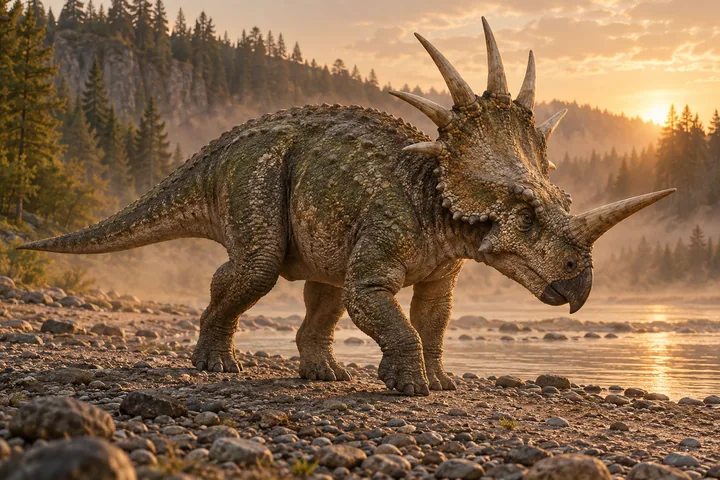
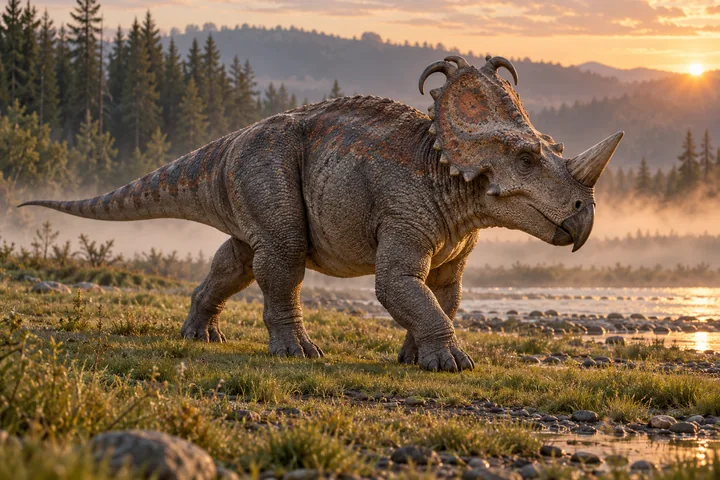
Styracosaurus
Styracosaurus was a plant-eating centrosaurine from Late Cretaceous North America. Its nasal horn and long frill spikes formed a distinctive, individually variable head display.
Centrosaurus
Centrosaurus was a horned herbivore from Late Cretaceous Canada. Its fossils reveal both distinctive skull ornamentation and evidence of disease in an individual animal.
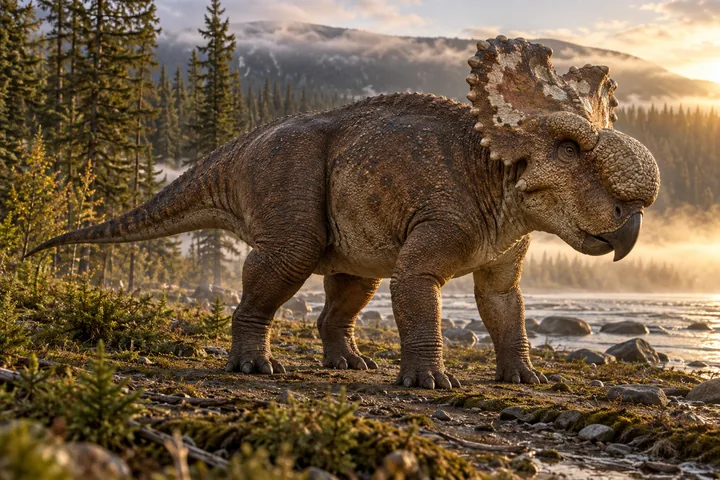
Pachyrhinosaurus
Pachyrhinosaurus was a centrosaurine herbivore from Canada and Alaska. Mature animals carried thick bosses over the nose and eyes, giving the skull an unusual profile.